 Toyota 4Runner
All generations, specs and history
Published Sources (2) Report an error
By Felix Hartmann, Automotive Technology & EV Contributor
- Built
- 1984–present
- Generations
- 6 · N60 to N500
- Top power
- 243 kW (330 PS)
Timeline
4Runner generations
Click a generation for its own page
- 4Runner N60 1984–1989 · SUV · 72–108 kW (98–147 PS)
- 4Runner N120/N130 1989–1995 · SUV · 67–110 kW (91–150 PS)
- 4Runner N180 1995–2002 · SUV · 97–136 kW (132–185 PS)
- 4Runner N210 2002–2009 · SUV · 175–200 kW (238–272 PS)
- 4Runner N280 2009–2024 · SUV · 201 kW (273 PS)
- 4Runner N500 Current 2024–now · SUV · 207–243 kW (281–330 PS)
Newest first · 6 generations since 1984
- 2024 N500 In production 2024–now · SUV · 207–243 kW (281–330 PS)
- 2009 N280 2009–2024 · SUV · 201 kW (273 PS)
- 2002 N210 2002–2009 · SUV · 175–200 kW (238–272 PS)
- 1995 N180 1995–2002 · SUV · 97–136 kW (132–185 PS)
- 1989 N120/N130 1989–1995 · SUV · 67–110 kW (91–150 PS)
- 1984 N60 1984–1989 · SUV · 72–108 kW (98–147 PS)
All generations by year: 4Runner N500 (2024–now) · 4Runner N280 (2009–2024) · 4Runner N210 (2002–2009) · 4Runner N180 (1995–2002) · 4Runner N120/N130 (1989–1995) · 4Runner N60 (1984–1989)
Which one is mine?
Pick the year of first registration to see which generation it is.
- N500 2024–present
- N280 2009–2024
- N210 2002–2009
- N180 1995–2002
- N120/N130 1989–1995
- N60 1984–1989
Which one to buy
Our verdict · Felix Hartmann
- Best all-rounder: a sixth-generation 2.4 turbo with the 8-speed automatic and optional seven seats.
- Most capable off-road: TRD Pro or Trailhunter with the i-Force Max hybrid and 630 Nm.
- Best value used: a late fifth-generation 4.0 V6, a proven engine with five-speed automatic and a simple layout.
- For towing: a fourth-generation V8, rated at up to 3,311 kg with rear-wheel drive.
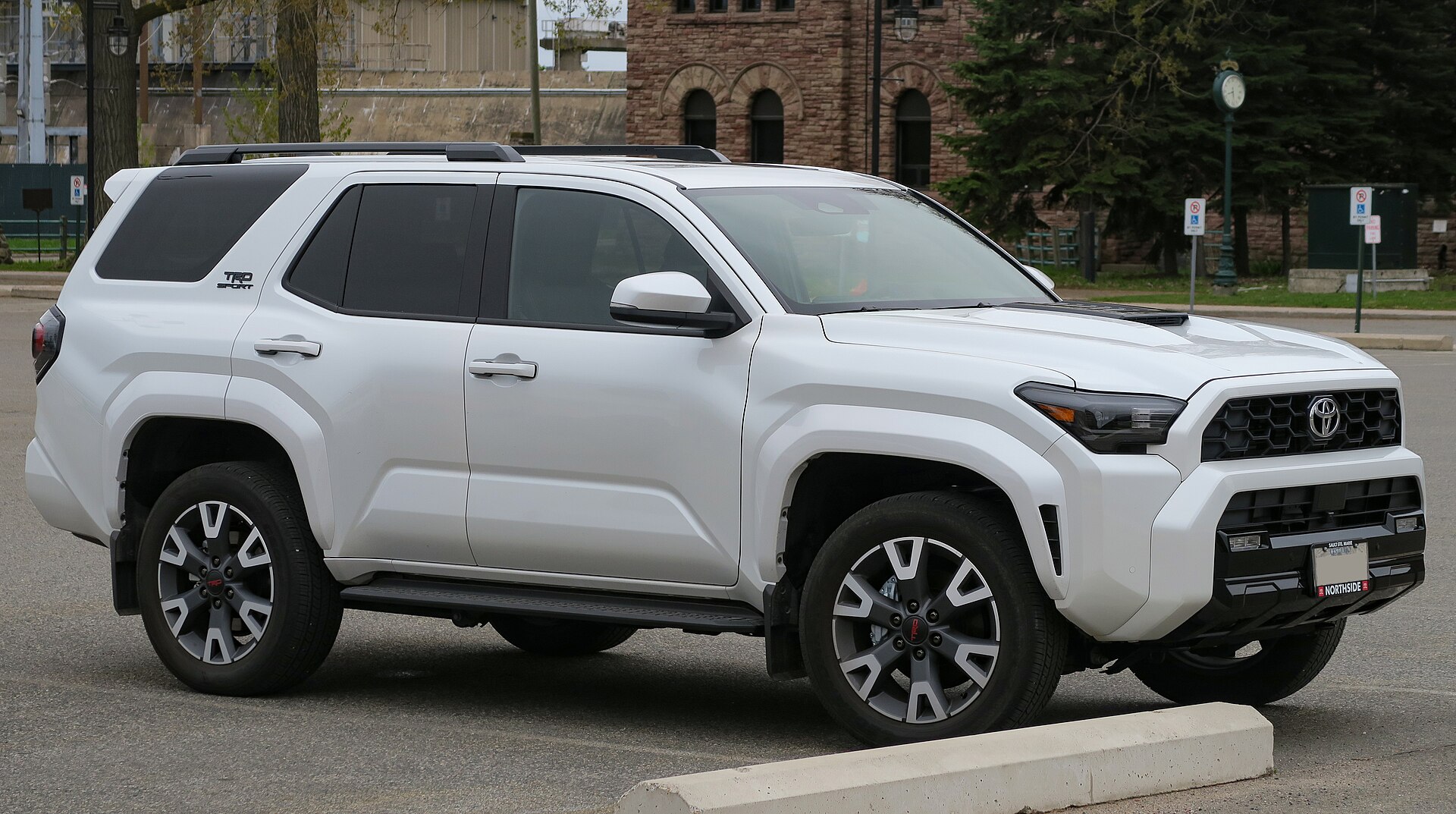
The Toyota 4Runner is a body-on-frame, mid-size SUV that Toyota has built since 1984, now in its sixth generation. It began as a Hilux pickup with a fibreglass canopy and grew into a five-door off-roader sold mainly in North America; in Japan it was the Hilux Surf, and Europe gets the Land Cruiser instead. The current model, revealed in April 2024, rides on the TNGA-F ladder frame and offers a 2.4-litre turbo petrol or the i-Force Max hybrid.
In short
- Six generations since 1984; production in Japan, most recently at Toyota's Tahara plant.
- Sixth generation (2024-): 207 kW (278 hp) 2.4 turbo or 243 kW (326 hp) i-Force Max hybrid, eight-speed automatic.
- Sold in Europe only in the first two generations; the UK dropped it in 1996 for the Land Cruiser Prado.
- US sales peaked at 144,696 cars in 2021 and were 98,805 in 2025.
Size at a glance
| Dimensions | Toyota 4Runner N500 |
|---|---|
| Length | 4,950 mm194.9 in |
| Width | 1,981 mm78.0 in |
| Height | 1,844 mm72.6 in |
| Wheelbase | 2,850 mm112.2 in |
Running cost
Fuel · 4Runner N500 2.4 i-Force
about 2,800 EUR fuel a year at 15,000 km
10.7 l/100 km · petrol at 1.75 EUR/l · change mileage, fuel price or version
Specs by version
Engines
| Version | Engine | Power | Torque | Gearbox | Drive | Production years |
|---|---|---|---|---|---|---|
| Hybrid · 1 version | ||||||
| N500 · 2.4 i-Force Max hybrid | 4 cyl · Hybrid | 243 kW 330 PS326 hp | 630 Nm465 lb-ft | 8-sp Automatic | Four-wheel drive (4×4) | 2024 |
| Petrol · 1 version | ||||||
| N500 · 2.4 i-Force | 4 cyl · Petrol | 207 kW 281 PS278 hp | 430 Nm317 lb-ft | 8-sp Automatic | Rear-wheel drive | 2024 |
Performance
Show all 1 versions
| Version | Fuel consumption |
|---|---|
| N500 · 2024–present | |
| N500 · 2.4 i-Force | 10.7 l/100 km22.0 mpg US · 26.4 mpg UK |
Dimensions and weight
Show all 1 versions
| Version | Length | Width | Height | Wheelbase | Kerb weight | Fuel tank |
|---|---|---|---|---|---|---|
| N500 · 2024–present | ||||||
| N500 · 2.4 i-Force | 4,950 mm194.9 in | 1,981 mm78.0 in | 1,844 mm72.6 in | 2,850 mm112.2 in | 2,021 kg4,456 lb | 72 l19.0 gal US |
Verified Manufacturer and type-approval data from our catalog · Sources and methodology
Toyota 4Runner at a glance
| Specification | Toyota 4Runner |
|---|---|
| Segment | Mid-size body-on-frame SUV |
| Production | 1984 to date (six generations) |
| Built in | Japan (current car: Tahara plant, left-hand drive only) |
| Platform (current) | TNGA-F (GA-F) ladder frame, shared with the Tacoma |
| Body | Five-door SUV (two- and three-door versions in early generations) |
| Japanese name | Hilux Surf (1983-2009) |
| Main markets | USA, Canada, Central and South America |
| Related models | Hilux, Land Cruiser Prado, Lexus GX, FJ Cruiser |
The name was coined by copywriter Robert Nathan at Saatchi & Saatchi as a play on "forerunner". The 4Runner sits in our Toyota catalogue next to the Land Cruiser family, which shares much of its hardware.
Generations and model history
| Generation | Code | Years | Body styles | Engines | Power (kW / hp) |
|---|---|---|---|---|---|
| 1st | N60 | 1984-1989 | 2-door with removable top | 2.4 I4 (carb, injection, turbo), 3.0 V6 | 72-108 kW (96-145 hp) |
| 2nd | N120/N130 | 1989-1995 | 3-door, 5-door | 2.0 and 2.4 petrol, 3.0 V6, 2.4/2.8/3.0 diesel | 67-110 kW (90-150 PS) |
| 3rd | N180 | 1995-2002 | 5-door | 2.7 I4, 3.4 V6, 3.0 turbodiesel (Japan) | 97-136 kW (130-183 hp) |
| 4th | N210 | 2002-2009 | 5-door | 4.0 V6, 4.7 V8 | 175-200 kW (235-268 hp) |
| 5th | N280 | 2009-2024 | 5-door | 2.7 I4 (to 2010), 4.0 V6 | up to 201 kW (270 hp) |
| 6th | N500 | 2024- | 5-door | 2.4 turbo, 2.4 turbo hybrid | 207-243 kW (278-326 hp) |
First generation (1984-1989). Production began in October 1983 and US sales in May 1984. The car was essentially a short-bed Hilux with a removable fibreglass top, a rear bench and a roll bar. The 2.4-litre 22R four gave 72 kW (96 hp); fuel injection (87 kW, 116 hp) followed in 1985 and a 101 kW (135 hp) turbo in 1986. That year also brought independent front suspension, and a 108 kW (145 hp) 3.0 V6 arrived in 1988.
Second generation (1989-1995). Launched for the 1990 model year with a full steel body on a frame and, for the first time, five doors. The two-door was dropped in the US in August 1992. Engines ranged from a 2.4 diesel to the 3.0 V6 with 110 kW (150 PS) and 240 Nm; a 1KZ-TE 3.0 turbodiesel with 96 kW (130 PS) was offered in some markets. This generation was also sold in parts of Europe.
Third generation (1995-2002). Developed from 1990, it shared its chassis with the Land Cruiser Prado and parts with the first Tacoma. The wheelbase grew by 58 mm, and the 3.4-litre 5VZ-FE V6 delivered 136 kW (183 hp) and 294 Nm. Dual airbags and ABS came in 1996, Vehicle Stability Control became standard for 2001, and the V6 could tow up to 2,270 kg.
Fourth generation (2002-2009). Based on the Land Cruiser Prado 120, it added a 4.7-litre V8 (175 kW / 235 hp, later 200 kW / 268 hp) with full-time four-wheel drive. The V6 grew to 4.0 litres and 183 kW (245 hp). Towing rose to 3,311 kg for the rear-drive V8.
Fifth generation (2009-2024). Unveiled at the State Fair of Texas in September 2009, it shared its basis with the Land Cruiser Prado J150 and the Lexus GX. The V8 was dropped and the 4.0 V6 became the core engine, rated at 201 kW (270 bhp) and 377 Nm from 2014. That year brought a facelift; the TRD Pro off-road version followed for 2015 and Toyota Safety Sense-P became standard in 2020. The fifth generation ran for 15 model years.
Sixth generation (2024-). Revealed on 9 April 2024 and built at Tahara, it moved to the TNGA-F platform of the latest Tacoma. Sales were pushed back to December 2024 by supply constraints.


Engines, transmissions and performance
| Engine (sixth generation) | Power | Torque | Gearbox | Availability |
|---|---|---|---|---|
| i-Force 2.4 turbo I4 | 207 kW (278 hp) | 430 Nm | 8-speed automatic | SR5, TRD Sport, TRD Off-Road, Limited |
| i-Force Max 2.4 turbo hybrid | 243 kW (326 hp) | 630 Nm | 8-speed automatic | Standard on Platinum, TRD Pro, Trailhunter |
The hybrid places an electric motor of 36 kW (48 hp) and 249 Nm between the engine and the gearbox. Its battery sits under the load floor, so hybrid versions lose the optional third row. The power-operated rear window, a 4Runner tradition, survives.
Earlier V6 cars used five-speed automatics; the 2.7-litre four of the fifth generation had a four-speed unit. Four-wheel drive came in part-time form on SR5 and Trail versions and as a full-time system on the Limited. To convert the American hp ratings yourself, use our power converter.

Dimensions, space and boot
| Parameter | Metric | Imperial |
|---|---|---|
| Length | 4,950 mm | 194.9 in |
| Width | 1,981 mm | 78.0 in |
| Height | 1,844 mm | 72.6 in |
| Wheelbase | 2,850 mm | 112.2 in |
| Ground clearance | 206 mm | 8.1 in |
| Kerb weight (SR5 2WD) | 2,021 kg | 4,455 lb |
| Cargo volume | 1,371 l | 48.4 cu ft |
| Cargo volume, rear seats folded | 2,554 l | 90.2 cu ft |
| Fuel tank | 72 l | 19.0 US gal |
Figures are Toyota USA data for the 2025 SR5 with rear-wheel drive; cargo volumes follow the American measuring method and are not directly comparable with European VDA litres. The 4Runner seats five, with an optional third row for seven. At almost five metres long, it is worth checking with our garage fit tool before importing one.
Fuel economy and running costs
The EPA rates the 2025 SR5 2WD with the 2.4 turbo at 20 mpg city, 26 mpg highway and 22 mpg combined (US), which equals about 11.8, 9.0 and 10.7 l/100 km. The previous 4.0 V6 of the fourth generation managed 17 mpg city and 20 mpg highway (13.8 and 11.8 l/100 km), the 4.7 V8 15 and 19 mpg.
Toyota USA listed the 2025 SR5 2WD at USD 41,270 plus USD 1,495 delivery, roughly EUR 36,500 before delivery (2025 exchange rate). European buyers pay import costs, duty and VAT on top, and the car carries no EU type approval.
Trims and equipment
The sixth generation comes in nine trims: SR5, TRD Sport, TRD Sport Premium, TRD Off-Road, TRD Off-Road Premium, Limited, Platinum, TRD Pro and Trailhunter. The last three get the hybrid as standard. TRD Pro, introduced for 2015, has had a signature colour every year, from Inferno Orange (2015) to Terra (2024). The fifth generation's 40th Anniversary Special Edition of 2023 was limited to 4,040 cars.

Safety
The 4Runner has never been tested by Euro NCAP because it is not sold in Europe. In the US, the IIHS rated the 2015 model Good for moderate-overlap frontal, side and roof-strength tests, but only Marginal in the small-overlap frontal test. The fourth generation earned Good in frontal offset and side tests (with side airbags) but Poor for rear-impact protection. Euro NCAP-tested alternatives can be found in our safety ratings section.
Reliability and known issues
Long life is a large part of the 4Runner's reputation. A 2019 iSeeCars study ranked it fifth among vehicles most likely to pass 200,000 miles (about 322,000 km), with 3.94% of cars doing so. Known weak points are few and specific: the fourth generation's 1GR-FE V6 received a head gasket modification to cure a common failure, and second-generation cars are known for rear suspension sag. Check service history and frame corrosion on any used example.
Rivals
| Model | Engines | Power (kW / hp) | Boot (l) | Price from (EUR) |
|---|---|---|---|---|
| Toyota 4Runner (2024-) | 2.4 turbo, 2.4 hybrid | 207-243 kW (278-326 hp) | 1,371 (US method) | about 36,500 (USA, 2025) |
| Toyota Land Cruiser Prado / 250 | diesel, petrol, hybrid | - | - | - |
| Ford Bronco | turbo petrol | - | - | - |
| Jeep Wrangler | turbo petrol, plug-in hybrid | - | - | - |
In Europe the closest Toyota is the Land Cruiser, which shares the 4Runner's ladder-frame engineering. Ford and Jeep offer comparable off-roaders with removable roof panels and doors.
Photo gallery


Toyota 4Runner evolution in numbers
Did you know?
- The Toyota 4Runner has been around for 42 years: 6 generations in our catalog since 1984.
- The longest-running generation is the 4Runner N280 (2009–2024): 15 years.
- The biggest jump in power came with the 4Runner N210: up to 200 kW (272 PS), 64 kW more than the 4Runner N180.
Most powerful version, kW
Figures from the 1cars catalog: power is the strongest version of each generation; generations without the figure are left out.
Toyota 4Runner: first vs latest generation
| Spec | 4Runner N60 | 4Runner N500 | Change |
|---|---|---|---|
| Years | 1984–1989 | 2024–present | 40 years apart |
| Most powerful version | 108 kW (147 PS) | 243 kW (330 PS) | +135 kW (+125%) |
Oldest and newest generation in the 1cars catalog. Power is the strongest version of each; other rows are shown only when both generations have the figure.
Toyota 4Runner in our rankings
- No. 33 of 1082 · Longest-running car nameplates (42 years · top 4%)
- No. 27 of 379 · Oldest car models still on sale (42 years · top 8%)
- No. 57 of 509 · Widest cars (1,981 mm · top 12%)
- No. 24 of 198 · Longest SUVs and crossovers (4,950 mm · top 13%)
- No. 29 of 194 · Widest SUVs and crossovers (1,981 mm · top 15%)
- No. 75 of 531 · Longest cars (4,950 mm · top 15%)
In production longer than 96% of ranked nameplates in the 1CARS catalog (No. 33 of 1082).
FAQ
Is the Toyota 4Runner sold in Europe?
Not today. Early generations were sold in some European countries, but the UK replaced it with the Land Cruiser Prado in 1996. Europe now gets the Land Cruiser instead.
How many generations of the 4Runner are there?
Six: 1984, 1989, 1995, 2002, 2009 and 2024. The Japanese version was called Hilux Surf until 2009.
Is there a hybrid 4Runner?
Yes. The sixth generation offers the i-Force Max hybrid with 243 kW (326 hp) and 630 Nm. It is standard on the Platinum, TRD Pro and Trailhunter.
What is the difference between the 4Runner and the Land Cruiser Prado?
They share ladder-frame architecture, but the 4Runner is built and tuned for North America, while the Prado (now Land Cruiser 250) serves Europe, Asia and the Middle East.
Data sources
Data checked by an editor against the sources below.
- Wikipedia - Toyota 4Runner
- Toyota - Compare