 Toyota 86
All generations, specs and history
Published Sources (3) Report an error
By Sarah Whitmore, Senior Automotive Writer
- Built
- 2012–present
- Generations
- 2 · ZN6 to ZN8
- Top power
- 173 kW (235 PS)
Timeline
86 generations
Click a generation for its own page


Newest first · 2 generations since 2012
All generations by year: 86 ZN8 (2021–now) · 86 ZN6 (2012–2021)
Which one is mine?
Pick the year of first registration to see which generation it is.
Check by VINThe Toyota GT86 is a four-seat sports car that travelled a long road from concept to production. The concept was shown at the 2009 Tokyo motor show as a spiritual successor to the famous Corolla AE86, and the production car was revealed in Japan in autumn 2011, then to European audiences at the Geneva motor show in March 2012. In Japan and North America the coupe is known simply as the Toyota 86, and Toyota itself calls it "Hachi-Roku" after the legendary original. A facelift was shown at the New York motor show in April 2016, and in 2021 the second generation, the Toyota GR86, was announced.
In short
- Developed together with Subaru: the Toyota 86 and Subaru BRZ differ only in badges and a few details.
- First generation: 2.0-litre FA20 boxer with 152 kW (207 PS) and a manual gearbox, or 149 kW (202 PS) with the automatic.
- Rear-wheel drive, a limited-slip differential, a 460 mm centre of gravity and 53/47 weight distribution.
- The GR86 (2021) has a 2.5-litre boxer with 173 kW (235 PS) and reaches 100 km/h in 6.3 seconds.
Size at a glance
| Dimensions | Toyota 86 ZN6 |
|---|---|
| Length | 4,240 mm166.9 in |
| Width | 1,775 mm69.9 in |
| Height | 1,285 mm50.6 in |
| Wheelbase | 2,570 mm101.2 in |
| Boot | 243 L8.6 cu ft |
Specs by version
Engines
| Version | Engine | Power | Torque | Drive | Production years |
|---|---|---|---|---|---|
| ZN6 · 2012–2021 | |||||
| ZN6 · GT86 2.0 (Europe) | 2.0 l · Petrol FA20 | 147 kW 200 PS197 hp | 205 Nm151 lb-ft | Rear-wheel drive | 2012 |
| ZN8 · 2021–present | |||||
| ZN8 · GR86 2.4 | 2.4 l · Petrol FA24 | 173 kW 235 PS232 hp | 250 Nm184 lb-ft | Rear-wheel drive | 2021 |
Performance
Show all 1 versions
| Version | CO₂ |
|---|---|
| ZN6 · 2012–2021 | |
| ZN6 · GT86 2.0 (Europe) | 191 g/km |
Dimensions and weight
Show all 1 versions
| Version | Length | Width | Height | Wheelbase | Kerb weight | Boot |
|---|---|---|---|---|---|---|
| ZN6 · 2012–2021 | ||||||
| ZN6 · GT86 2.0 (Europe) | 4,240 mm166.9 in | 1,775 mm69.9 in | 1,285 mm50.6 in | 2,570 mm101.2 in | 1,305 kg2,877 lb | 243 l8.6 cu ft |
Verified Manufacturer and type-approval data from our catalog · Sources and methodology
Toyota 86 at a glance
The 86 is a compact 2+2 coupe with a front-mounted flat-four engine and rear-wheel drive, designed for drifting and affordable fun. Two long-standing rivals, Toyota and Subaru, worked on it together: bought from a Toyota dealer it is the GT86, from Subaru the BRZ. More Toyota models are listed in our Toyota catalogue.
First generation: GT86 (2012–2021)
Exterior
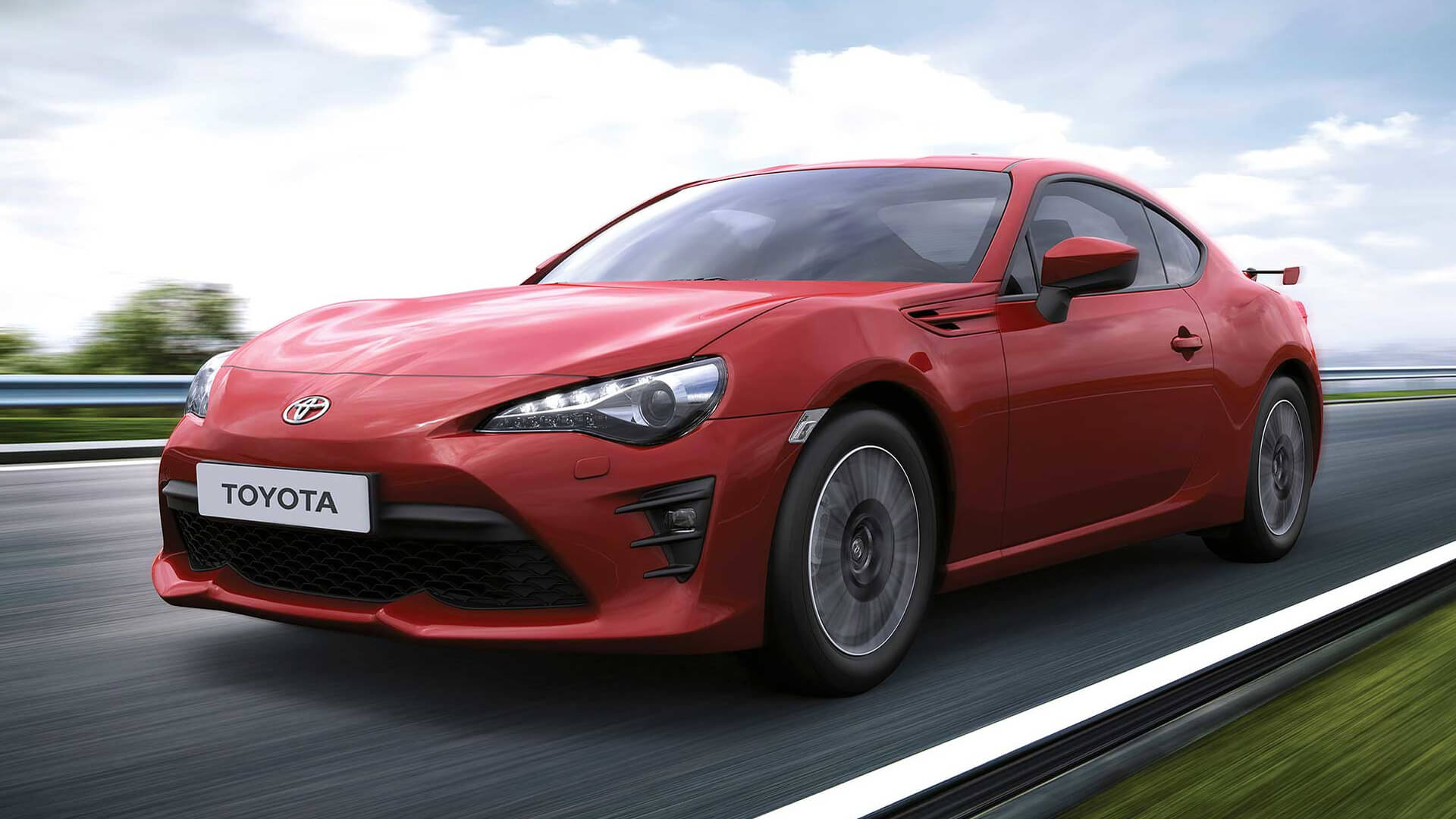
A sculpted bonnet flows into narrow xenon headlights that give the car its aggressive look, with headlight-washer covers below. The large bumper has a big grille, pleasing lines and round fog lamps. The profile is simpler, without many aerodynamic add-ons, yet it looks great. The facelifted car has 17-inch alloys, with 18-inch wheels available in Japan, and mirrors on stalks as befits a sports car. Ground clearance is 120 mm. At the rear, a sculpted boot lid with a small spoiler, attractive lights and a large bumper with a substantial diffuser and two integrated exhaust pipes add aggression.
The 2016 facelift brought small exterior changes, interior refinements and new options, along with a little more engine power, better handling and retuned suspension.
Interior
The interior remained simple and functional in a sporty way. A plain three-spoke steering wheel with audio controls and an "86" logo faces well-designed instruments where the rev counter, not the speedometer, takes centre stage, with a 4.2-inch trip-computer display and a digital speedometer. The almost vertical centre console is minimalist, with a 6.2-inch infotainment screen (which looks rather small), three round climate knobs and a row of toggle switches. Near the bottom are the start button and a USB port. The handbrake sits next to the gear lever, as if inviting the driver to drift. Materials and build quality are good enough to satisfy demanding buyers. The front seats have strong side bolstering, grippy upholstery and a wide range of adjustment.
The rear seats are suitable only for children or bags. The boot holds 237 litres (243 litres in the Subaru BRZ) and can be extended by folding the rear backrest. A full-size spare sits under the boot floor.
Engine and transmission
The 2.0-litre FA20 flat-four has combined direct and port injection (two injectors per cylinder), variable timing on intake and exhaust camshafts and 16 valves. In Europe it was rated at 147 kW (200 PS) and 205 Nm; the facelifted Japanese-market car with the manual gearbox produced 152 kW (207 PS) and 212 Nm, and with the automatic 149 kW (202 PS) and 205 Nm. Combined consumption is 7.1–7.8 l/100 km.
A six-speed manual or six-speed automatic drives the rear wheels. The GT86 is not especially quick: 0–100 km/h takes 7.6–8.2 seconds, and top speed is 210–226 km/h.
Chassis
The chassis is the GT86's strong point. The engine sits as low and as far back in the platform as possible, putting the centre of gravity at just 460 mm, and the weight distribution is 53/47 front to rear, which benefits stability and handling. The body uses high-strength lightweight steel, and the bonnet is aluminium. Suspension is independent, with MacPherson struts at the front and a four-link rear, coil springs and anti-roll bars. Rack-and-pinion steering has variable electric assistance. Even the base car has ventilated discs - 294 mm front and 290 mm rear - with ABS, EBD, BAS, TRC and VRC, plus a limited-slip rear differential.
Safety and equipment
Safety features include ABS with EBD and ESP, BAS, VRC and TRC, hill-start assist, front and side airbags, an immobiliser, the limited-slip differential, a collapsible pedal box, three-point belts and ISOFIX anchorages. Typical equipment includes climate control, cruise control, keyless entry, a light sensor and heated seats and mirrors.
Second generation: GR86 (2021)
The GR86 was again developed in close cooperation with Subaru and shares its design with the second-generation Subaru BRZ. Only the front bumper, grille and badges are unique to the Toyota. It keeps the characteristic profile and side glass. The car is 3 cm longer, the wheelbase grew by 5 mm, the width is unchanged and the height is 10 mm lower; body rigidity is 50% higher. The Toyota-specific front bumper has a large grille in the style of the GR Yaris and no fog lamps, the headlights were slightly revised, and vents behind the front wheels underline its sporting character. It sits on 18-inch wheels with 130 mm of ground clearance, and the rear lights were updated.
Inside are a 7-inch digital instrument panel, with an extra display on the left showing lateral g-forces and coolant temperature, and an 8-inch infotainment system with Android Auto, Apple CarPlay, Bluetooth and a rear camera. The layout is 2+2. Automatic versions get Subaru's EyeSight safety package with a stereo camera behind the windscreen. Sports bucket seats with strong side support have red stitching, and the round climate knobs now show their settings in their centres. With the rear seat folded there is room for a mountain bike, golf clubs or a set of track tyres and tools.
The GR86 uses a 2.5-litre naturally aspirated flat-four with combined injection, producing 173 kW (235 PS) and 250 Nm in Japanese specification. A six-speed manual or conventional automatic drives the rear wheels, and 0–100 km/h now takes 6.3 seconds. The car uses an improved version of the previous twins' platform rather than Toyota's TNGA; a new front subframe with 60% higher torsional rigidity improves handling. Suspension is MacPherson at the front and double wishbones at the rear.
Key specifications
| Parameter | GT86 (first generation) | GR86 (second generation) |
|---|---|---|
| Engine | 2.0 FA20 flat-four | 2.5 flat-four |
| Power (kW / PS) | 149–152 kW / 202–207 PS | 173 kW / 235 PS |
| Torque | 205–212 Nm | 250 Nm |
| Gearboxes | 6-speed manual or automatic | 6-speed manual or automatic |
| 0–100 km/h | 7.6–8.2 s | 6.3 s |
| Ground clearance | 120 mm | 130 mm |
| Boot | 237 l | - |
| Wheels | 17–18 in | 18 in |
Rivals
Some rivals have more powerful engines and better performance. They include the Mazda MX-5, the Subaru BRZ twin, the Hyundai Genesis Coupe, the Peugeot RCZ and the four-cylinder Ford Mustang. The Toyota 86 suits young drivers who love speed and drifting, thanks to its strong engine and rear-wheel drive, and it is popular with tuning enthusiasts.
Toyota 86: first vs latest generation
| Spec | 86 ZN6 | 86 ZN8 | Change |
|---|---|---|---|
| Years | 2012–2021 | 2021–present | 9 years apart |
| Most powerful version | 147 kW (200 PS) | 173 kW (235 PS) | +26 kW (+18%) |
Oldest and newest generation in the 1cars catalog. Power is the strongest version of each; other rows are shown only when both generations have the figure.
Image credits · Photos from Wikimedia Commons under free licences
- Toyota 86 ZN6 · Photo: M 93 / Wikimedia Commons, CC BY-SA 3.0 de
- Toyota 86 ZN8 · Photo: Elise240SX / Wikimedia Commons, CC BY-SA 4.0
Popular comparisons
Toyota 86 in our rankings
- No. 16 of 89 · Smallest coupes (4,240 mm · top 18%)
- No. 94 of 420 · Smallest cars (4,240 mm · top 23%)
- No. 19 of 79 · Lightest coupes (1,305 kg · top 25%)
- No. 272 of 912 · Longest-running car nameplates (14 years · top 30%)
- No. 95 of 304 · Lightest cars (1,305 kg · top 32%)
- No. 139 of 305 · Oldest car models still on sale (14 years · top 46%)
Shorter than 82% of ranked coupes in the 1CARS catalog (No. 16 of 89).
FAQ
What is the difference between the Toyota GT86 and Subaru BRZ?
They were developed together and are essentially the same car, differing in badges and a few details such as the front bumper.
Why is it called the Toyota 86?
It is a spiritual successor to the Corolla AE86, known in Japan as "Hachi-Roku" (eight-six).
What engine does the Toyota GT86 have?
A 2.0-litre FA20 flat-four with 152 kW (207 PS) and the manual gearbox, or 149 kW (202 PS) with the automatic.
What changed with the Toyota GR86?
A 2.5-litre flat-four with 173 kW (235 PS), 50% higher body rigidity, a new interior with digital instruments and 0–100 km/h in 6.3 seconds.
Data sources
Data checked by an editor against the sources below.
- Wikipedia - Toyota 86
- Wikipedia - Toyota GT86
- EEA CO₂ monitoring (European Environment Agency, CC BY 4.0)