 Toyota Sprinter Trueno AE86 GT Apex
Specs, engines and history
Published Sources (1) Report an error
By Sarah Whitmore, Senior Automotive Writer
- Built
- 1983–1987
- Top power
- 96 kW (131 PS)
Which AE86 to choose
Our verdict · Sarah Whitmore
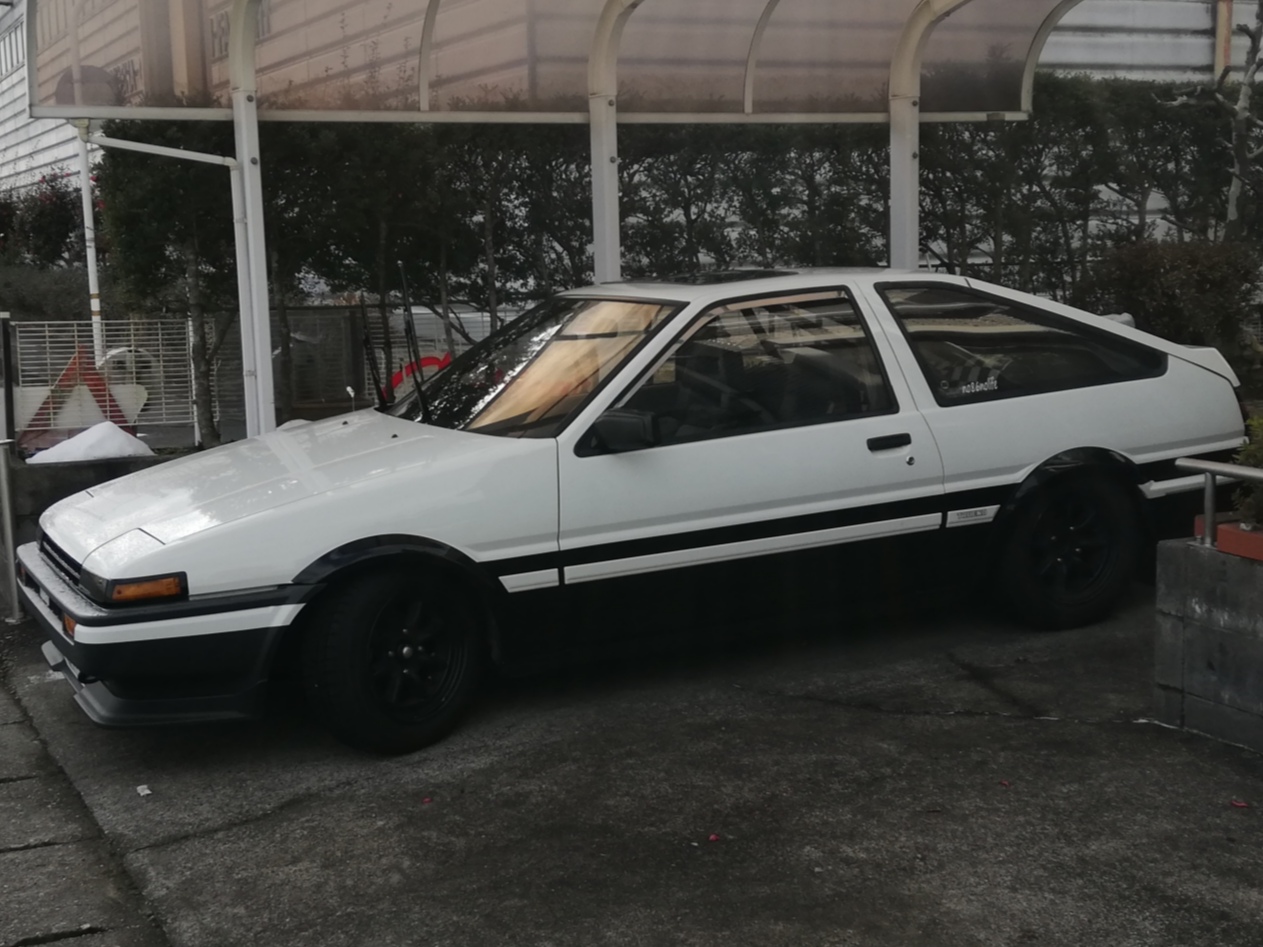
- For the classic look: a Sprinter Trueno GT APEX three-door with pop-up headlamps.
- For a lighter, cheaper start: a two-door GT, at about 900 kg the lightest version.
- For racing or drifting: a twin-cam car with the manual gearbox and the limited-slip differential, the only combination it was offered with.
- Check carefully: many cars have been modified; confirm the AE86 code, since AE85 cars with the 1.5-litre engine share the bodies.
- To compare: set the AE86 against other light sports cars in our comparison tool; other Toyotas are listed in our Toyota catalogue.
AE86 is the internal code of the rear-wheel-drive versions of the Toyota Corolla Levin and Sprinter Trueno, built from May 1983 to July 1987. While the rest of its class moved to front-wheel drive, the AE86 kept a live rear axle and paired it with the new 1.6-litre 4A-GEU twin-cam. Light, simple and easy to modify, it became a club-racing and drifting favourite, and in Japan it is known simply as the "Hachi-Roku", eight-six.
In short
- Production: May 1983 – July 1987; more than 360,000 AE86 cars are estimated to have been built.
- Corolla Levin with fixed headlamps, Sprinter Trueno with pop-up headlamps; two-door coupé or three-door liftback.
- Engine: 4A-GEU 1,587 cc DOHC 16-valve, 96 kW (130 PS, gross) and 149 Nm in Japan; five-speed T50 gearbox.
- Weight from about 900 kg; MacPherson struts at the front, four-link live axle at the rear.
Size at a glance
| Dimensions | Toyota Sprinter Trueno AE86 |
|---|---|
| Length | 4,205 mm165.6 in |
| Width | 1,625 mm64.0 in |
| Height | 1,335 mm52.6 in |
| Wheelbase | 2,400 mm94.5 in |
Specs by version
Engines
| Version | Engine | Power | Torque | Gearbox | Drive | Production years |
|---|---|---|---|---|---|---|
| GT APEX 1.6 (gross) | 1.6 l · 4 cyl · Petrol 4A-GEU | 96 kW 131 PS129 hp | 149 Nm110 lb-ft | 5-sp Manual | Rear-wheel drive | 1983–1987 |
| GT APEX 1.6 two-door (gross) | 1.6 l · 4 cyl · Petrol 4A-GEU | 96 kW 131 PS129 hp | 149 Nm110 lb-ft | 5-sp Manual | Rear-wheel drive | 1983–1987 |
Dimensions and weight
Show all 2 versions
| Version | Length | Width | Height | Wheelbase | Kerb weight |
|---|---|---|---|---|---|
| GT APEX 1.6 (gross) | 4,205 mm165.6 in | 1,625 mm64.0 in | 1,335 mm52.6 in | 2,400 mm94.5 in | 900 kg1,984 lb |
| GT APEX 1.6 two-door (gross) | - | 1,625 mm64.0 in | 1,335 mm52.6 in | 2,400 mm94.5 in | 900 kg1,984 lb |
Verified Manufacturer and type-approval data from our catalog · Sources and methodology
Toyota AE86 at a glance
| Parameter | Value |
|---|---|
| Models | Toyota Corolla Levin, Toyota Sprinter Trueno |
| Production | May 1983 – July 1987 (model years 1984–1987) |
| Designed and built by | Kanto Auto Works for Toyota |
| Bodies | two-door coupé, three-door liftback |
| Engine | 4A-GEU 1,587 cc DOHC 16-valve four-cylinder |
| Power | 96 kW (130 PS, gross) in Japan; 91 kW (124 PS) Europe; 84 kW (112 hp) North America |
| Torque | 149 Nm (Japan) |
| Gearbox | five-speed manual T50; four-speed automatic |
| Drive | rear-wheel drive, optional limited-slip differential |
| Kerb weight | 900–1,065 kg |
| Wheelbase | 2,400 mm |
| Successor | AE92 (front-wheel drive), May 1987 |
Levin or Trueno: two names, one car
The same car was sold under two names. The Corolla Levin had fixed rectangular headlamps, while the Sprinter Trueno used pop-up headlamps; under the skin they were the same. Both came as a two-door coupé and a three-door liftback, and the liftback had the better drag coefficient, 0.35 against 0.38 for the coupé. A dealer-fitted soft-top conversion of about 20 cars was sold in early 1987.
| Dimension | Corolla Levin | Sprinter Trueno |
|---|---|---|
| Length 1983–1985 | 4,185 mm | 4,205 mm |
| Length 1985–1987 | 4,200 mm | 4,215 mm |
| Width | 1,625 mm | 1,625 mm |
| Height | 1,335 mm | 1,335 mm |
| Wheelbase | 2,400 mm | 2,400 mm |
The 1985 facelift divides the cars into "zenki" (early, 1983–1985) and "kouki" (late, 1985–1987) models; on the Trueno, for example, the late cars have marker lights that wrap around the front bumper corners.

Grades and prices in Japan
In Japan the range had eight grades. Only the twin-cam cars were AE86: the two-door GT, the three-door GTV and the GT APEX in both bodies. The cheaper versions with the same bodies carried the code AE85 and a 1.5-litre engine.
| Grade | Code | Body | Engine | List price (1983 range) |
|---|---|---|---|---|
| Corolla Levin GL | AE85 | two-door | 3A-U 1.5 SOHC | ¥1,060,000 |
| Corolla Levin GT APEX | AE86 | three-door | 4A-GEU 1.6 DOHC | ¥1,548,000 |
| Sprinter Trueno (same grade) | AE85 / AE86 | as Levin | as Levin | ¥15,000–32,000 more than the Levin |
The GT APEX cost about 46 percent more than the AE85 GL, and nearly twice the ¥832,000 of a basic Corolla 1300 DX four-door of the same period.
Engines: 4A-GEU twin-cam and the AE85
The heart of the AE86 was the 4A-GEU, a 1,587 cc four-cylinder with two camshafts and 16 valves. In the version for Japan it had a compression ratio of 9.4:1 and was rated at 96 kW (130 PS, gross) at 6,600 rpm with 149 Nm. European cars had a 10.0:1 compression ratio and 91 kW (124 PS DIN) with 142 Nm, while the North American version gave 84 kW (112 hp SAE net). The cylinder heads were made by Yamaha. The AE85 used the single-cam 1,452 cc 3A-U with 61 kW (83 PS), and North American base cars had a 4A-C with 52–55 kW (70–74 hp).
| Engine | Market | Power | Torque |
|---|---|---|---|
| 4A-GEU 1.6 DOHC | Japan | 96 kW (130 PS, gross) | 149 Nm |
| 4A-GE 1.6 DOHC | Europe | 91 kW (124 PS) | 142 Nm |
| 4A-GEC 1.6 DOHC | North America | 84 kW (112 hp) | 132–136 Nm |
| 4A-C 1.6 SOHC | North America | 52–55 kW (70–74 hp) | - |
| 3A-U 1.5 SOHC (AE85) | Japan | 61 kW (83 PS) | - |
The twin-cam cars used the five-speed T50 manual gearbox; four-speed A42DL and A44DE automatics were available. Our power converter shows how gross, DIN and SAE net ratings compare.

Chassis, weight and dimensions
The drivetrain followed the classic layout: engine at the front, propeller shaft and live axle at the rear. The AE86 reused the front struts and many parts of its rear-drive predecessor, the TE71. At the front it had MacPherson struts; the rear axle was a rigid unit with four links and coil springs. Twin-cam versions had ventilated front discs; the single-cam cars made do with solid front discs and rear drums. A limited-slip differential was available only with the twin-cam engine and the manual gearbox.
Wikipedia gives a kerb weight of 900 to 1,065 kg, the lightest GT at about 900 kg; Wikipedia JA lists 935–940 kg for the three-door. With 96 kW and about 940 kg, each kilowatt had to move under 10 kg. Our power-to-weight calculator puts that ratio in context.
Export versions
| Market | Name | Notes |
|---|---|---|
| North America | Corolla Sport (DX, SR5, GT-S) | GT-S with the 4A-GEC twin-cam, 84 kW |
| Europe | Corolla GT (GTi); SR in Sweden and Switzerland | 91 kW (124 PS) twin-cam |
| Australia | Toyota Sprinter liftback | - |
Racing successes
The AE86 won the manufacturers' title of the European Touring Car Championship in 1986 with 267 points. Chris Hodgetts won the BTCC, Britain's touring-car series, in 1986 and 1987 in an AE86, and Kaoru Hoshino won Division 1 of Japan's touring-car championship in 1985. On the loose, an AE86 finished third overall at the 1989 Rallye Côte d'Ivoire, a round of the World Rally Championship.
Drifting, Initial D and the Hachi-Roku cult
Keiichi Tsuchiya, known as the "Drift King", helped make drifting popular, and the AE86 became the car most associated with the sport. Road & Track called it "a cult icon, inextricably interwoven with the earliest days of drifting". The manga and anime Initial D (1995–2013) added to the fame: its hero delivers tofu in a Sprinter Trueno GT APEX liftback. Enthusiasts call the resulting price premium the "tofu tax" or "Takumi tax".
Toyota itself still looks after the car. In November 2021 it restarted limited production of parts such as steering knuckle arms, rear brake calipers and rear half shafts, and in January 2023 Toyota Gazoo Racing and Lexus showed hydrogen and battery-electric AE86 concepts at a Tokyo show. The number returned in 2012 on the rear-drive Toyota 86, developed together with Subaru and also sold as the Subaru BRZ.

Photo gallery

Toyota Sprinter Trueno AE86 GT Apex in our rankings
- No. 4 of 79 · Lightest coupes (900 kg)
- No. 4 of 53 · Lightest hatchbacks (900 kg)
- No. 13 of 304 · Lightest cars (900 kg · top 5%)
- No. 13 of 89 · Smallest coupes (4,205 mm · top 15%)
- No. 84 of 420 · Smallest cars (4,205 mm · top 20%)
- No. 19 of 53 · Power-to-weight: hatchbacks (107 kW/t · top 36%)
Lighter than 95% of ranked cars in the 1CARS catalog (No. 13 of 304).
FAQ
What does AE86 mean?
It is Toyota's chassis code for the rear-drive 1.6-litre twin-cam Corolla Levin and Sprinter Trueno of 1983–1987. In Japan the car is called "Hachi-Roku", eight-six.
What is the difference between the Levin and the Trueno?
The Corolla Levin has fixed headlamps, the Sprinter Trueno pop-up headlamps; engines, chassis and bodies are otherwise the same.
How much power does the AE86 have?
96 kW (130 PS, gross) in Japan, 91 kW (124 PS) in Europe and 84 kW (112 hp) in North America from the 1.6-litre 4A-GE twin-cam.
Why is the AE86 famous?
It is a light rear-drive car that helped make drifting popular, it is linked with "Drift King" Keiichi Tsuchiya, and it stars in Initial D.
What replaced the AE86?
The AE92 Corolla Levin and Sprinter Trueno of May 1987, which switched to front-wheel drive.
Data sources
Data checked by an editor against the sources below.