 Lotus Esprit
Specs, engines and history
Published Sources (1) Report an error
By Felix Hartmann, Automotive Technology & EV Contributor
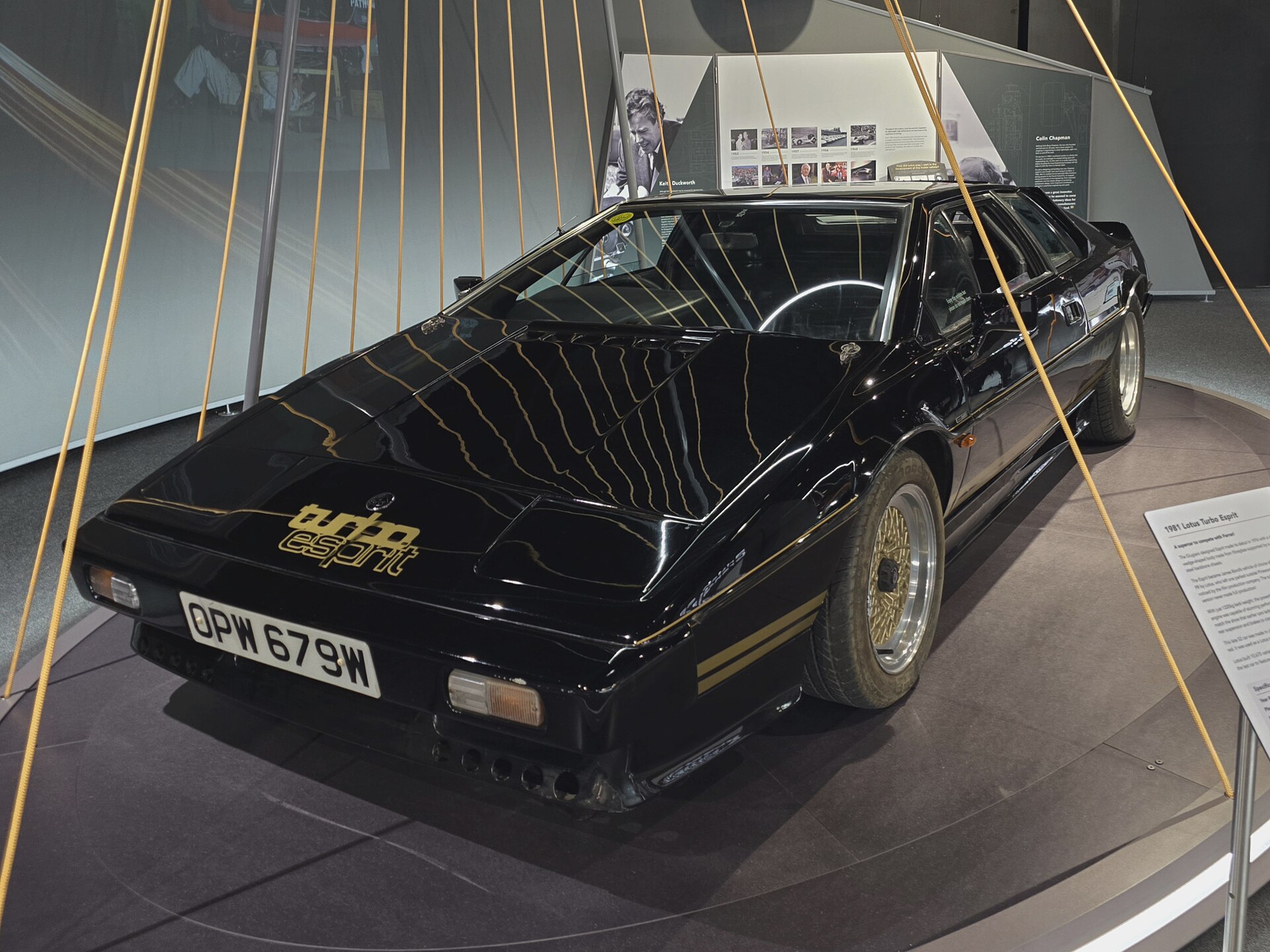
- Built
- 1976–2004
- Top power
- 261 kW (355 PS)
Which Esprit to choose
Our verdict · Felix Hartmann
- For the original design: an S1 or S2, but check the chassis carefully; galvanising arrived only in 1980.
- For the classic turbo car: a Giugiaro-bodied Turbo from the 1980s, the type seen in the Bond film.
- For the best first Esprit: a Stevens-era four-cylinder car such as the SE or S4, as Car & Classic suggests.
- For performance: a V8 or the lighter Sport 350; Car & Classic calls the V8 the most complex to run.
Car & Classic's listings data put the average Esprit at £39,031 (2026, about €45,000), with the cheapest at £13,146 (2026) and the dearest at £89,995 (2026). Colin Chapman's firm itself is covered in our history of Lotus. The four-seat Lotus of the same decade has its own Lotus Elite (Type 75) page, and every Lotus appears in the Lotus catalogue.
The Lotus Esprit was a mid-engined two-seat sports car built from 1976 to 2004. Giorgetto Giugiaro drew its wedge shape, and Peter Stevens softened it in 1987. Over the years the engine grew from a 2.0-litre four-cylinder of 119 kW to a 3.5-litre twin-turbo V8 of 261 kW. About 10,675 were built, and two of them became James Bond cars.
In short
- Shown as an Italdesign study at Turin in 1972 and launched at the Paris Motor Show in October 1975; the last car left the line on 20 February 2004.
- Three design eras: Giugiaro cars (S1 to Turbo, 1976–1987), Stevens cars (X180 to GT3, 1987–1999) and the V8 cars (1996–2004).
- Engines: Lotus 907 and 910 four-cylinders (2.0 and 2.2 litres, turbo from 1980) and the Lotus 918 3.5-litre twin-turbo V8 with 260–261 kW.
- Steel backbone chassis, fibreglass body, rear-wheel drive with Citroën and later Renault transaxles.
Specs by version
Engines
| Version | Engine | Power | Torque | Drive | Production years |
|---|---|---|---|---|---|
| S1 2.0 | 2.0 l · 4 cyl · Petrol 907 | 119 kW 162 PS160 hp | — | Rear-wheel drive | 1976–1978 |
| Turbo 2.2 | 4 cyl · Petrol 910 | 157 kW 213 PS211 hp | 271 Nm200 lb-ft | Rear-wheel drive | 1980–1981 |
| Turbo HC 2.2 | 4 cyl · Petrol | 160 kW 218 PS215 hp | 298 Nm220 lb-ft | Rear-wheel drive | 1987 |
| GT3 2.0 Turbo | 4 cyl · Petrol | 179 kW 243 PS240 hp | 294 Nm217 lb-ft | Rear-wheel drive | 1996–1999 |
| Turbo SE 2.2 | 4 cyl · Petrol 910S | 197 kW 268 PS264 hp | — | Rear-wheel drive | 1987–1993 |
| S4 2.2 Turbo | 4 cyl · Petrol | 197 kW 268 PS264 hp | 354 Nm261 lb-ft | Rear-wheel drive | 1993–1996 |
| S4s 2.2 Turbo | 4 cyl · Petrol 910 | 224 kW 305 PS300 hp | 393 Nm290 lb-ft | Rear-wheel drive | 1994–1997 |
| Sport 300 2.2 Turbo | 4 cyl · Petrol | 225 kW 306 PS302 hp | 389 Nm287 lb-ft | Rear-wheel drive | 1993 |
| V8 3.5 Twin Turbo | 3.5 l · 8 cyl · Petrol 918 | 261 kW 355 PS350 hp | — | Rear-wheel drive | 1996–2004 |
| Sport 350 3.5 V8 Twin Turbo | 3.5 l · 8 cyl · Petrol 918 | 261 kW 355 PS350 hp | — | Rear-wheel drive | 1999–2001 |
Performance
Show all 8 versions
| Version | 0–100 km/h | Top speed |
|---|---|---|
| Turbo 2.2 | — | 241 km/h150 mph |
| Turbo HC 2.2 | — | 235 km/h146 mph |
| GT3 2.0 Turbo | 4.8 s 0–62 mph | 263 km/h163 mph |
| S4 2.2 Turbo | 5.0 s 0–62 mph | 265 km/h165 mph |
| S4s 2.2 Turbo | — | 270 km/h168 mph |
| Sport 300 2.2 Turbo | 4.8 s 0–62 mph | 270 km/h168 mph |
| V8 3.5 Twin Turbo | — | 280 km/h174 mph |
| Sport 350 3.5 V8 Twin Turbo | 4.4 s 0–62 mph | — |
Dimensions and weight
Show all 6 versions
| Version | Wheelbase | Kerb weight |
|---|---|---|
| Turbo HC 2.2 | — | 1,280 kg2,822 lb |
| GT3 2.0 Turbo | — | 1,380 kg3,042 lb |
| S4 2.2 Turbo | 2,438 mm96.0 in | 1,340 kg2,954 lb |
| S4s 2.2 Turbo | 2,438 mm96.0 in | — |
| Sport 300 2.2 Turbo | 2,438 mm96.0 in | 1,305 kg2,877 lb |
| Sport 350 3.5 V8 Twin Turbo | — | 1,300 kg2,866 lb |
Verified Manufacturer and type-approval data from our catalog · Sources and methodology
Lotus Esprit at a glance
| Parameter | Value |
|---|---|
| Production | 1976 – February 2004 (Europe until 2002, USA until 2004) |
| Built | 10,675 (Wikipedia EN, Car & Classic); about 10,500 (Wikipedia DE) |
| Design | Giorgetto Giugiaro (Italdesign); new body by Peter Stevens in 1987 |
| Chassis / body | steel backbone chassis, fibreglass two-door coupé, mid-mounted engine |
| Engines | 2.0 and 2.2-litre four-cylinder (turbo from 1980); 3,506 cc twin-turbo V8 |
| Power | 104 kW (140 hp, US S1) to 261 kW (350 hp, V8) |
| Gearbox | five-speed Citroën transaxle; Renault transaxle from 1987 |
| Kerb weight | about 1,010 kg (S1) to 1,389 kg (Turbo) in Wikipedia DE |
| Successor | Lotus Evora (2009), per Wikipedia DE |
Origins: Giugiaro's wedge
Work on the car began in mid-1971 with a 1:4 scale model. Italdesign then built a full-size mock-up on a Lotus Europa base, project M70 according to Car & Classic, and showed it at the Turin show in 1972. Colin Spooner developed the production body, which had a drag coefficient of 0.36. Lotus launched the Esprit at the Paris Motor Show in October 1975 and started production in 1976.
The first car, the S1, used the Lotus 907 engine: an all-aluminium 1,973 cc four-cylinder with two overhead camshafts and 16 valves, the same unit fitted to the Jensen-Healey from 1972. It gave 119 kW (160 hp) in Europe and 104 kW (140 hp) in the US. A five-speed Citroën transaxle, also found in the Citroën SM and the Maserati Merak, sent the power to the rear wheels. Lotus claimed 222 km/h, but road tests reached about 214 km/h. The S1 weighed under 1,000 kg according to Wikipedia EN, 1,010 kg according to Wikipedia DE.

Turbo power and the Bond cars
The S2 of 1978 and the 2.2-litre S2.2 of 1980 refined the formula, and in 1980 Lotus showed the Turbo Esprit at Geneva. The first 45 cars were the Essex Turbo with a dry-sump 2.2-litre engine of 157 kW (210 hp) and a top speed of 241 km/h. According to Car & Classic, the chassis was galvanised from 1980, which makes the earliest cars the riskier buy today. The S3 and the Turbo were built side by side until 1987; Wikipedia EN's table counts 732 S3s and 2,909 Turbos. The 1987 Turbo HC raised output to 160 kW (218 PS) and 298 Nm.
Film work made the Esprit famous. In The Spy Who Loved Me (1977) an S1 turned into a submarine; the underwater car, nicknamed "Wet Nellie", was bought by Elon Musk in September 2013. Two Turbo Esprits in Essex specification followed in For Your Eyes Only (1981). Later, an X180 Esprit SE appeared in Pretty Woman and another X180 in Basic Instinct.
The Stevens cars: X180, SE, S4 and Sport 300
In 1987 Peter Stevens redesigned the body with softer lines; the car is known by its project code X180. Lotus switched to a Renault transaxle at the same time; Wikipedia DE names it as the gearbox of the Renault 25. The Esprit SE of 1989 had 197 kW (268 PS) and 354 Nm, and Wikipedia DE gives 5.0 seconds from 0 to 100 km/h and 256 km/h.
The X180R of 1990–1991 was built 20 times for the road and five times for racing; in the US it cost US$126,000 in 1990. The Sport 300 of 1993 had 225 kW (306 PS), and only 64 were made. The S4 followed in 1993, and the S4s of 1994–1997 offered 224 kW (305 PS), 393 Nm and 270 km/h. The GT3 of 1996–1999 had 179 kW (243 PS); 190 were built. Car & Classic notes that later cars gained ABS and suggests these Stevens-era four-cylinder cars as the best first Esprit.
The V8 years, 1996–2004
In 1996 Lotus fitted its own engine, the Type 918: a 3,506 cc V8 with two turbochargers and 32 valves. It produced 260 kW (354 PS) and 400 Nm at a boost of 0.75 bar, without an intercooler. Wikipedia EN notes that the engine was capable of about 373 kW (500 hp) but was rated at 261 kW (350 hp) in the Esprit. Wikipedia DE gives a 0–100 km/h time of 4.7 seconds and a Hockenheim lap of 1 minute 17.9 seconds; Wikipedia EN gives a top speed of 280 km/h.
The V8 GT of 1997–2001 was the simpler version, with 204 made. The Sport 350 of 1999–2001 weighed 1,300 kg and lapped the Nürburgring Nordschleife in 8 minutes 13 seconds. Wikipedia DE gives it 4.4 seconds to 100 km/h in its text and 4.6 seconds in its table. Wikipedia EN gives 50 cars in its text and 42 in its table. The racing GT1 of 1995, of which three were built, had 409 kW (549 hp) and weighed 900 kg.
Production for Europe ended in 2002, and the last Esprit was built on 20 February 2004. A new Esprit with a 5.0-litre Lexus V8 of up to 456 kW (620 PS) appeared at the 2010 Paris Motor Show. Lotus cancelled it on 29 September 2014. Wikipedia DE regards the Lotus Evora of 2009 as the successor.

Esprit versions and figures
| Version | Years | Engine | Power | Built |
|---|---|---|---|---|
| S1 | 1976–1978 | 1,973 cc I4 | 119 kW (160 hp); US 104 kW (140 hp) | 718 |
| S2 | 1978–1981 | 1,973 cc I4 | — | 1,061 (table) or 1,149 |
| S2.2 | 1980–1981 | 2.2 l I4 | — | 88 |
| Essex Turbo | 1980 | 2.2 l I4 turbo | 157 kW (210 hp) | 45 |
| S3 | 1981–1987 | 2.2 l I4 | — | 732 |
| Turbo / Turbo HC | 1981–1987 | 2.2 l I4 turbo | 157–160 kW (214–218 PS) | 2,909 |
| X180 / SE | 1987–1992 | 2.2 l I4 turbo | up to 197 kW (268 PS) | 1,672 |
| Sport 300 | 1993 | 2.2 l I4 turbo | 225 kW (306 PS) | 64 |
| S4 / S4s | 1993–1997 | 2.2 l I4 turbo | 197–224 kW (268–305 PS) | 625 + 367 |
| GT3 | 1996–1999 | four-cylinder | 179 kW (243 PS) | 190 |
| V8 / V8 GT / V8 SE | 1996–2004 | 3,506 cc V8 twin-turbo | 260 kW (354 PS) | 1,237 (V8), 204 (GT) |
| Sport 350 | 1999–2001 | 3,506 cc V8 twin-turbo | 261 kW (350 hp) | 50 or 42 |
Power grew by about 142 kW, or 119 percent, from the European S1 to the Sport 350. Turbocharging alone took the four-cylinder from 119 kW in the S1 to 225 kW in the Sport 300 without adding a cylinder. The power converter shows the same figures in PS or hp.
Weight, drive and ownership
Every Esprit kept the same basic layout: the engine behind the cabin, a steel backbone chassis under a fibreglass body and drive to the rear wheels. The weight-to-power ratio shows how far the car moved. Using Wikipedia DE's weights, the S1 carried about 8.5 kg per kW and the 1981 Turbo about 8.8 kg per kW, because it was much heavier. The S4 brought this down to 6.8 kg per kW, and the Sport 350 to about 5.0 kg per kW.
Car & Classic sees the Stevens cars as more mature. They gained updated suspension, stiffer bodywork and a better cabin. Its buying advice follows the three eras. Cars built before 1980 lack the galvanised chassis, parts supply differs from one era to the next, and the V8 is the most complex car to run, with costs that depend on the engine family.
Photo gallery


Lotus Esprit in our rankings
- No. 4 of 23 · Fastest cars of the 1990s (280 km/h)
- No. 5 of 17 · Quickest cars of the 1990s, 0–100 (4.4 s)
- No. 7 of 16 · Fastest cars of the 1980s (241 km/h)
- No. 8 of 17 · Quickest British cars, 0–100 (4.4 s)
- No. 10 of 19 · Fastest British cars (280 km/h)
- No. 77 of 912 · Longest-running car nameplates (28 years · top 9%)
In production longer than 91% of ranked nameplates in the 1CARS catalog (No. 77 of 912).
FAQ
How many Lotus Esprits were made?
10,675 according to Wikipedia EN and Car & Classic; Wikipedia DE gives about 10,500.
Who designed the Lotus Esprit?
Giorgetto Giugiaro of Italdesign drew the original car; Peter Stevens gave it a new body in 1987 (the X180).
Which Esprit was in the James Bond films?
A white S1 that turned into a submarine in The Spy Who Loved Me (1977) and two Turbo Esprits in For Your Eyes Only (1981).
How much power did the Esprit V8 have?
260 kW (354 PS) and 400 Nm from a 3.5-litre twin-turbo V8 built by Lotus.
When did Esprit production end?
The last car was built on 20 February 2004; European sales had ended in 2002.
Data sources
Data checked by an editor against the sources below.