 Maserati Merak
Specs, engines and history
Published Sources (1) Report an error
By Felix Hartmann, Automotive Technology & EV Contributor
- Built
- 1972–1983
- Top power
- 162 kW (220 PS)
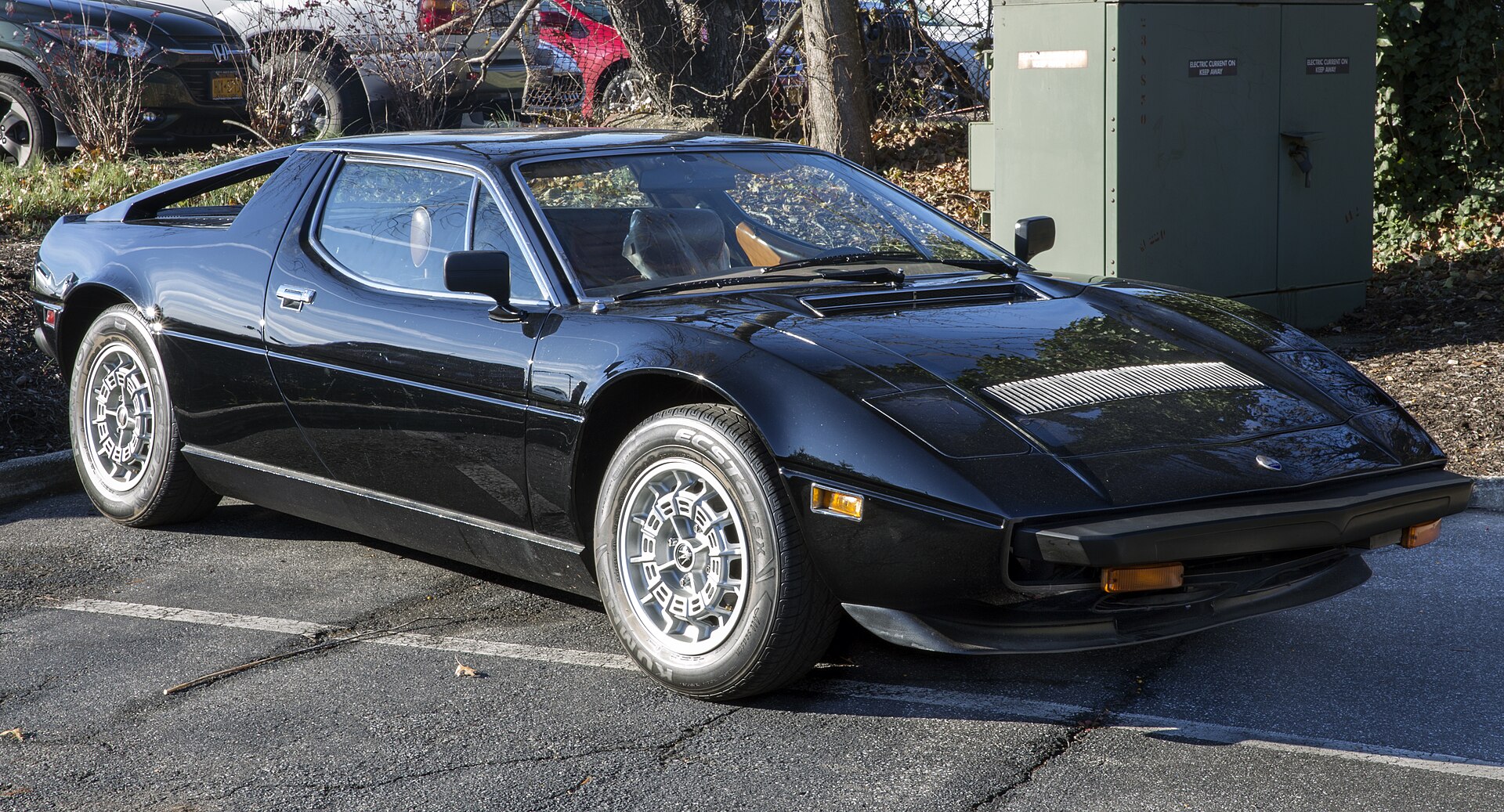
The Maserati Merak is a mid-engined 2+2 coupé that Maserati built from 1972 to 1983. It was developed from the V8 Bora as a smaller, cheaper and more practical model. Its 3.0-litre V6 came from the engine that Maserati had designed for the Citroën SM, and the car used several Citroën hydraulic systems. Over eleven years Maserati built 1,830 Meraks, including the more powerful Merak SS and the two-litre Merak 2000 GT for Italy.
In short
- Shown at the 1972 Paris motor show; built until 1983; 1,830 cars in total.
- Designed by Giorgetto Giugiaro at Italdesign on the basis of the Bora.
- 2,965 cc 90° V6 derived from the Citroën SM engine: 140 kW (190 PS) at 6,000 rpm; the Merak SS has 162 kW (220 PS).
- Five-speed Citroën transaxle; dry weight 1,400–1,430 kg; claimed top speed over 240 km/h.
Maserati Merak at a glance
| Specification | Maserati Merak (3.0) |
|---|---|
| Production | 1972–1983 |
| Cars built | 1,830 (about 1,000 Merak SS, about 200 Merak 2000 GT) |
| Designer | Giorgetto Giugiaro, Italdesign |
| Body | 2+2 coupé |
| Layout | mid-engine, rear-wheel drive |
| Engine | 2,965 cc 90° V6, DOHC, 12 valves |
| Power | 140 kW (190 PS) at 6,000 rpm |
| Torque | 255 Nm at 4,000 rpm |
| Gearbox | five-speed Citroën transaxle |
| Dry weight | 1,400–1,430 kg |
| Top speed | over 240 km/h (Maserati claim) |
The Merak sits below the V8 Bora in Maserati's range of the 1970s. All Maserati models are in the Maserati catalogue.
History: a smaller car under Citroën
Citroën owned Maserati from 1968 to 1975. In that period Maserati designed a compact V6 for the Citroën SM: the 2.7-litre Tipo C.114, created by Giulio Alfieri in 1967. A larger version of this engine later powered the Merak.
The Bora came first. It was built from 1971 with a 4.7-litre V8 that produced 228 kW (310 PS) at 6,000 rpm and 461 Nm. From 1973 a 4.9-litre V8 followed, first for the United States; from 1976 it was offered in other markets with 243 kW (330 PS) and 481 Nm. The Merak followed more than a year later, at the Paris motor show in 1972. It was intended as a more affordable alternative with a smaller engine and two extra seats.
Design: Giugiaro's 2+2 from the Bora
Giorgetto Giugiaro of Italdesign, who had designed the Bora, was asked to turn it into the Merak. The two cars share the front bodyshell up to the doors and some body panels. Behind the doors the Merak is different. It has a 2+2 cabin with a small second row of seats and a vertical rear window. Two "flying buttresses" continue the roof line to the tail, and the engine cover is open instead of the Bora's heavier glass cover.
| Dimension | Maserati Merak |
|---|---|
| Length | 4,335 mm |
| Width | 1,768 mm |
| Height | 1,134 mm |
| Wheelbase | 2,600 mm |
| Dry weight | 1,400–1,430 kg |
The Bora itself had a steel monocoque with a tubular steel rear subframe for the engine and transaxle. The subframe is fixed to the floor pan on four flexible mounts. The Bora was the first Maserati passenger car with independent suspension on all four wheels.
Engine: the Citroën SM V6
For the Merak, the SM's 90° V6 was bored out to 91.6 mm. With a stroke of 75 mm this gives 2,965 cc. The engine has chain-driven double overhead camshafts, 12 valves and three twin-choke Weber carburettors, with a compression ratio of 8.75:1. It produces 140 kW (190 PS) at 6,000 rpm and 255 Nm at 4,000 rpm.
The gearbox is a five-speed all-synchromesh transaxle from Citroën, listed as the C35. Maserati claimed a top speed of over 240 km/h.
| Version | Engine | Power | Torque | Built |
|---|---|---|---|---|
| Merak | 2,965 cc V6 | 140 kW (190 PS) at 6,000 rpm | 255 Nm at 4,000 rpm | — |
| Merak SS | 2,965 cc V6, compression 9:1 | 162 kW (220 PS) | — | about 1,000 |
| Merak 2000 GT | 1,999 cc V6 | 125 kW (170 PS) at 7,000 rpm | 186 Nm at 4,000 rpm | about 200 |
| All versions | 1,830 |
Citroën hydraulics and the SM dashboard
Many systems of the early Merak came from Citroën. The brakes were assisted and operated by high-pressure hydraulics, and the pop-up headlights were raised hydraulically. On some cars the clutch also used the hydropneumatic system. Early cars with Citroën hydraulics had inboard rear brakes.
The early left-hand-drive cars, built from 1972 to 1975, also used the dashboard of the Citroën SM. It had oval gauges and a single-spoke steering wheel. Maserati built 630 cars with this dashboard up to 1974.
Merak SS and the De Tomaso years
The Merak SS was introduced at the Geneva motor show in 1975, and production began in 1976. The Wikipedia article on the Bora gives 1981 as the debut of the improved SS, so the sources do not fully agree on its dates. Its engine had a higher compression ratio of 9:1 and larger Weber 44 DCNF carburettors. Output rose by 22 kW (30 PS) to 162 kW (220 PS), and the car was 50 kg lighter than the original Merak. The SS brought a new dashboard designed by Maserati, with round instruments and a four-spoke wheel. Later cars used the dashboard and three-spoke wheel of the Bora.
In 1975 Citroën's ownership of Maserati ended, and in 1977 Alejandro de Tomaso bought the company. After 1976 the Citroën parts were gradually replaced, and the US-specification SS returned to conventional hydraulics. The Bora was dropped after fewer than 600 cars, but the Merak stayed in production for six more years.


Merak and Bora compared
The two cars were built side by side, but they were aimed at different buyers. The Bora was a two-seat V8 car, the Merak a lighter and cheaper 2+2 with six cylinders.
| Specification | Maserati Bora | Maserati Merak |
|---|---|---|
| Years | 1971–1978 | 1972–1983 |
| Cars built | 564 | 1,830 |
| Seats | 2 | 2+2 |
| Engine | 4.7- or 4.9-litre V8 | 3.0-litre V6 (2.0 for Italy) |
| Power | 228–243 kW (310–330 PS) | 125–162 kW (170–220 PS) |
| Gearbox | five-speed ZF | five-speed Citroën |
| Weight | 1,535 kg (production) | 1,400–1,430 kg dry |
| Top speed (claimed) | 270–285 km/h | over 240 km/h |
The Bora used Citroën's LHM high-pressure hydraulics in two circuits. One worked the ventilated disc brakes. The other moved the pedal box, adjusted the height of the driver's seat and raised the headlights. The early Merak used the same kind of Citroën technology for its brakes and headlights. The Bora's body had a drag coefficient of 0.30, and its steel panels were made by Officine Padane in Modena. Its four-wheel independent suspension used coil springs, telescopic dampers and anti-roll bars; prototype MacPherson struts at the front were replaced by wishbones for production because of steering kickback.
Merak 2000 GT for Italy
In Italy, cars with engines over 2,000 cc were taxed at 38 per cent VAT instead of the usual 19 per cent. For this market Maserati presented the Merak 2000 GT at the Turin motor show in November 1977. Its V6 has 1,999 cc, with a bore of 80 mm and a stroke of 66.3 mm. It produces 125 kW (170 PS) at 7,000 rpm and 186 Nm at 4,000 rpm. About 200 were built.
Legacy and collectors
The Merak lasted much longer than the Bora on which it was based. Production ended in 1983 after 1,830 cars, about 1,000 of them SS models. It was built in far larger numbers than the Bora, of which only 564 were made.
For collectors, the main differences are the version and the period. Early cars have more Citroën hydraulics and the SM dashboard. The SS has more power, less weight and Maserati's own dashboard. The rare 2000 GT was built mainly for Italy. More about the company's history is in our history of Maserati.
Photo gallery


Maserati Merak in our rankings
- No. 324 of 912 · Longest-running car nameplates (11 years · top 39%)
- No. 562 of 859 · Most powerful cars (162 kW · top 66%)
- No. 105 of 127 · Most powerful Italian cars (162 kW · top 83%)
- No. 271 of 313 · Most powerful coupes (162 kW · top 87%)
In production longer than 61% of ranked nameplates in the 1CARS catalog (No. 324 of 912).
FAQ
What engine does the Maserati Merak have?
A 90° V6 derived from the engine Maserati designed for the Citroën SM. The 3.0-litre version produces 140 kW (190 PS), the Merak SS 162 kW (220 PS) and the Italian 2.0-litre 2000 GT 125 kW (170 PS).
How many Maserati Meraks were built?
1,830 between 1972 and 1983, including about 1,000 Merak SS and about 200 Merak 2000 GT cars.
What is the difference between the Merak and the Bora?
The Bora is a two-seater with a 4.7- or 4.9-litre V8. The Merak shares its front body but has a 3.0-litre V6, a 2+2 cabin and an open engine cover.
Who designed the Maserati Merak?
Giorgetto Giugiaro at Italdesign, who also designed the Bora.
Why was there a 2.0-litre Merak?
Italian tax rules: cars with engines over 2,000 cc paid 38 per cent VAT instead of 19 per cent, so Maserati offered the Merak 2000 GT from 1977.
Data sources
Data checked by an editor against the sources below.