 Maserati Mexico
Specs, engines and history
Published Sources (1) Report an error
By Felix Hartmann, Automotive Technology & EV Contributor
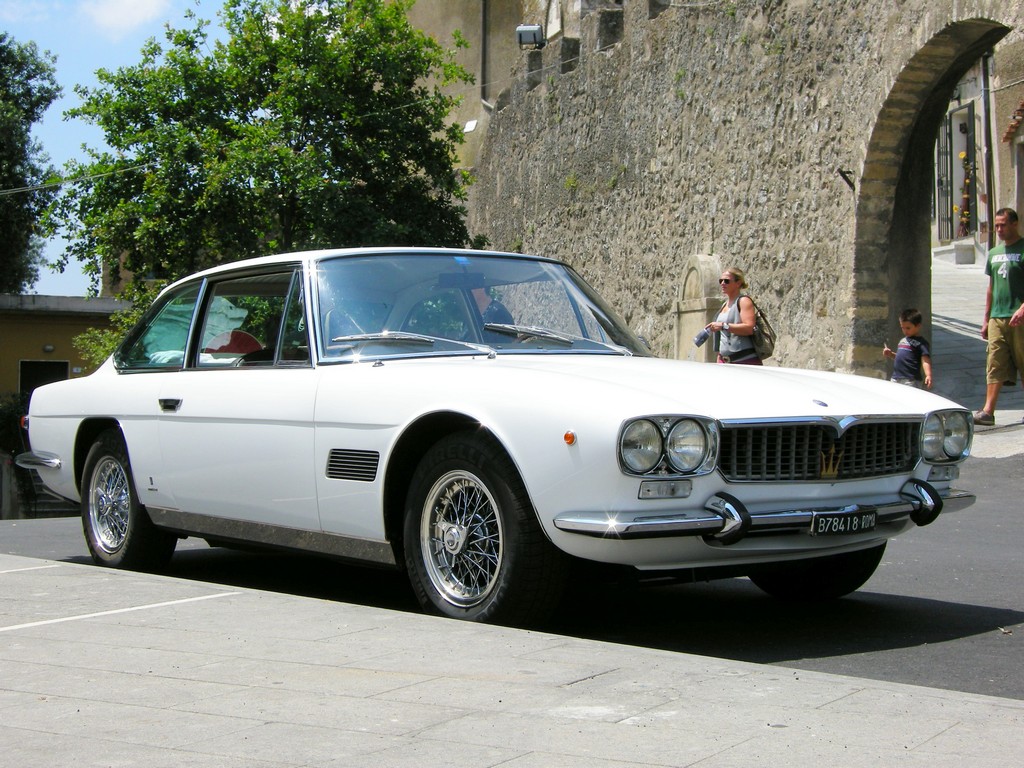
The Maserati Mexico is a four-seat grand touring coupé that Maserati built in Modena from 1966 to 1972. Designed by Virginio Vairo at Vignale and based on the mechanicals of the first Quattroporte, it combined a Maserati V8 with room for four adults and a fully equipped cabin. The name goes back to its first owner, a president of Mexico. About 485 were built, with 4.7- and 4.2-litre engines.
In short
- Turin saw the Vignale prototype in October 1965; the series car followed at the Rimini concours (August 1966) and the Paris show two months later.
- Built 1966–1972 in Modena as the Tipo AM112; 485 cars according to Wikipedia (175 with the 4.7 and 305 with the 4.2).
- 90° V8 with four Weber carburettors: 216 kW (290 hp) as the 4.7; a 4.2-litre version was added in 1969.
- Ventilated, servo-assisted discs at every wheel, a first for a series Maserati; roughly 240–250 km/h flat out.
Maserati Mexico at a glance
| Specification | Maserati Mexico (Tipo AM112) |
|---|---|
| Production | 1966–1972, Modena (Italy) |
| Cars built | 485 (Wikipedia); 175 × 4.7 and 305 × 4.2 |
| Body | two-door, four-seat coupé by Vignale |
| Designer | Virginio Vairo (Vignale) |
| Engines | Tipo 107/1 4.7-litre V8; Tipo 107 4.2-litre V8 (from 1969) |
| Power | 216 kW (290 hp) for the 4.7 |
| Gearbox | five-speed ZF manual; three-speed Borg-Warner automatic optional |
| Weight | 1,830 kg (Wikipedia, dry) |
| Dimensions | 4,760 mm long, 1,720 mm wide, 1,360 mm high, 2,640 mm wheelbase |
| Top speed | about 240–250 km/h |
| Base / successor | Quattroporte (AM107) / Kyalami |
The Mexico stood in Maserati's range next to the four-door Maserati Quattroporte, from which it took its mechanical base. Other Maserati models of every period are in the Maserati catalogue.
How the Mexico got its name
The story begins with a one-off. Vignale built a coupé prototype on the chassis of a 5000 GT, the 4.9-litre Maserati grand tourer. That chassis had suffered damage, and the new Vignale body was fitted before the car went on display in Turin in the autumn of 1965.
After the show the prototype was sold to Adolfo López Mateos, the president of Mexico. That sale gave the production car its name. Wikipedia adds a coincidence: in 1967 John Surtees won the Mexican Grand Prix in a Cooper-Maserati T81, a Formula One car with a Maserati engine.
The series car was first shown at the Rimini concours in August 1966. Two months later it was presented to an international audience in Paris.
Vignale design
The body was drawn by Virginio Vairo, who worked at Carrozzeria Vignale. Vignale's prototype of 1965 had already set the basic look of the two-door, four-seat body. At 4,760 mm the Mexico is a long car, but it is only 1,360 mm high and 1,720 mm wide.
Its wheelbase is 11 cm shorter than that of the Quattroporte saloon, which provided the platform. The prototype's look was later borrowed by Pietro Frua for a one-off, described below.

Engines and performance
The Mexico uses Maserati's 90° V8, which breathes through four twin-choke Weber 38 DCNL5 carburettors. The larger Tipo 107/1 engine displaces 4.7 litres and is rated at 216 kW (290 hp). A smaller Tipo 107 engine of 4.2 litres was added in 1969 as a second choice. With 216 kW and Wikipedia's dry weight of 1,830 kg, the 4.7 has about 8.5 kg to move per kilowatt.
| Version | Engine | Power | Gearbox | Built |
|---|---|---|---|---|
| Mexico 4.7 | Tipo 107/1 V8 | 216 kW (290 hp) | ZF S5-325 five-speed | 175 |
| Mexico 4.2 | Tipo 107 V8 (from 1969) | not stated in the source | ZF S5-20 five-speed | 305 |
Both versions could be ordered with a three-speed Borg-Warner automatic instead of the manual gearbox. Top speed is quoted at roughly 240–250 km/h. The source has no torque figures and no output for the 4.2-litre engine, so they are not given here.


Chassis, brakes and equipment
The platform is the Tipo AM107 of the first Quattroporte, with the wheelbase shortened by 11 cm to 2,640 mm. No earlier series Maserati had servo-assisted ventilated discs at all four corners; the Mexico introduced them.
The standard equipment list was long. Leather seats for four people, electric windows, a wooden dashboard, halogen headlights and air conditioning were all standard. Automatic transmission, power steering and a radio were extra-cost options. The 4.7-litre cars rolled on chromed Borrani wire wheels, while the 4.2-litre cars had steel disc wheels. Both used Pirelli Cinturato CN72 tyres in size 205VR15.

The Frua one-off
In May 1967 a second, very different Mexico appeared. The German dealer Auto Koenig commissioned it from Pietro Frua for one of its clients. Frua based the shape on the look of Vignale's prototype but used a shorter tubular chassis from the 3500 GT, with a wheelbase of 2,600 mm.
Instead of a V8, this car had the 3.7-litre six-cylinder engine of the Mistral, with Lucas fuel injection. It was painted in Oro Longchamps with a black leather interior and used the dashboard of the Quattroporte. It remained a unique car.
The Kyalami that followed
Wikipedia lists the Kyalami as the successor of the Mexico. It arrived in 1976, four years after the Mexico ended, and was again a four-seat coupé with a quad-cam V8. Pietro Frua designed its body on the basis of the De Tomaso Longchamp, and only 210 were built by 1983. The Mexico had sold more than twice as many.
Legacy
The Mexico gave Maserati a four-seat V8 coupé alongside the Quattroporte saloon, built on the same mechanical base. It also brought all-round ventilated disc brakes to Maserati's production cars. For the brand's longer story, read our history of Maserati.
Maserati Mexico in our rankings
In production longer than 31% of ranked nameplates in the 1CARS catalog (No. 553 of 912).
FAQ
Why is it called Mexico?
The Vignale prototype shown at Turin in 1965 was sold to Adolfo López Mateos, then president of Mexico, and the production car took its name from that sale.
How many Maserati Mexicos were built?
Wikipedia gives a total of 485. It also lists 175 cars with the 4.7-litre engine and 305 with the 4.2-litre engine, which adds up to 480.
What engine does the Mexico have?
A 90° quad-cam V8 with four Weber carburettors, either 4.7 litres with 216 kW (290 hp) or, from 1969, 4.2 litres.
What came after the Mexico?
The Kyalami of 1976, a four-seat V8 coupé styled by Pietro Frua on the basis of the De Tomaso Longchamp.
Data sources
Data checked by an editor against the sources below.