 Maserati Shamal
Specs, engines and history
Published Sources (1) Report an error
By Felix Hartmann, Automotive Technology & EV Contributor
- Built
- 1990–1996
- Top power
- 240 kW (326 PS)
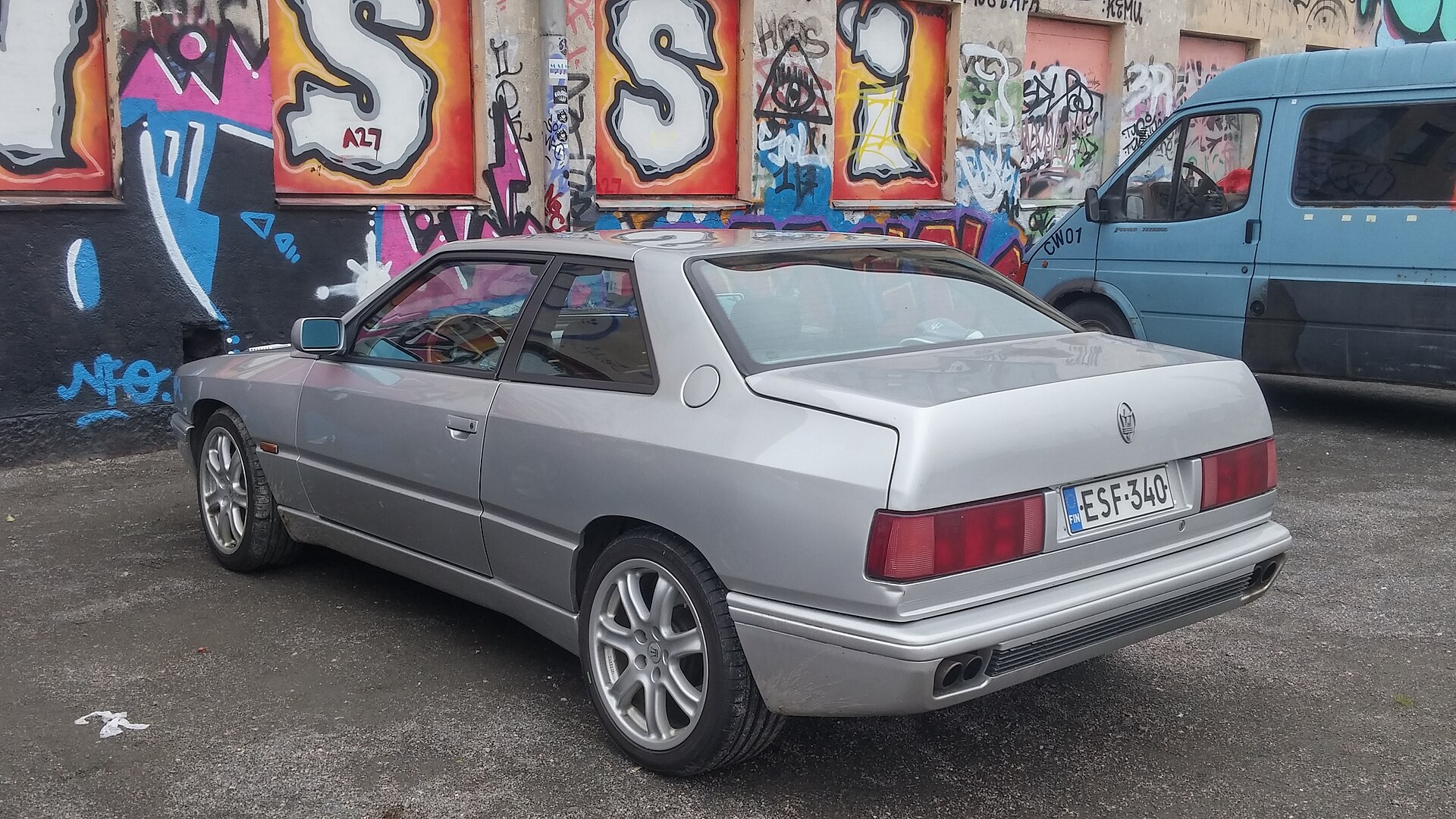
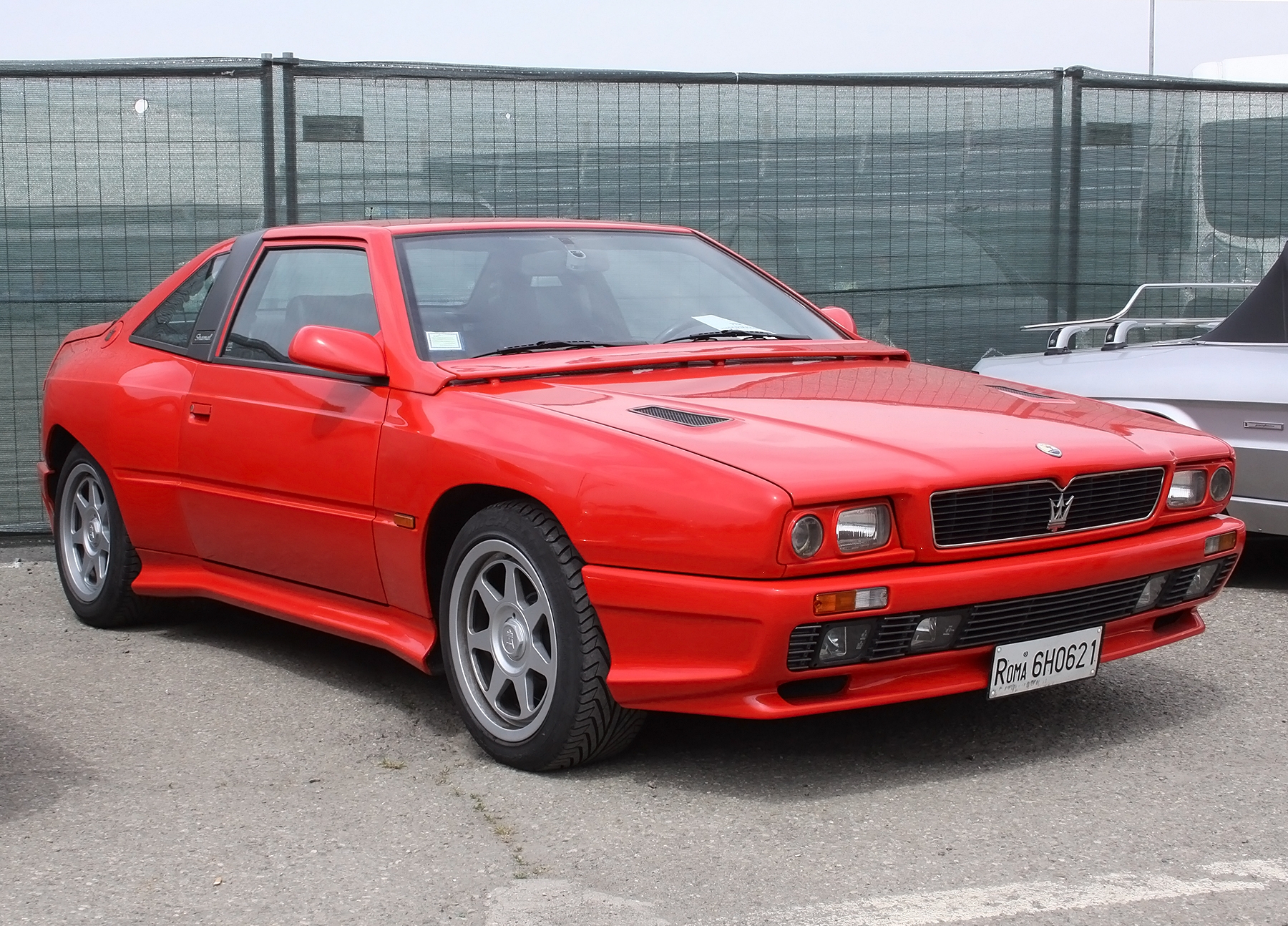
The Maserati Shamal is a short two-door coupé that Maserati built in Modena from 1990 to 1996. Styled by Marcello Gandini and based on the Biturbo, it replaced the familiar V6 with a new twin-turbo V8 and became the most extreme car of the whole Biturbo family. It was also the last model announced while Alejandro de Tomaso still owned the company. Only 369 were built.
In short
- Shown to the press in Modena on 14 December 1989; on sale from 1990 and built until 1996.
- 3,217 cc twin-turbo V8 with 32 valves: 240 kW (326 PS) at 6,000 rpm and 431 Nm at 3,000 rpm.
- Six-speed Getrag manual gearbox, Ranger limited-slip differential, Koni adaptive dampers.
- 0–100 km/h in 5.3 s and 270 km/h (claimed); dry weight 1,417 kg; 369 cars.
Maserati Shamal at a glance
| Specification | Maserati Shamal (Tipo AM339) |
|---|---|
| Production | 1990–1996, Modena (Italy) |
| Cars built | 369 |
| Body | two-door 2+2 coupé, steel unibody |
| Design | Marcello Gandini with Maserati's styling department |
| Engine | AM 479, 3,217 cc 90° V8, four camshafts, two IHI turbochargers |
| Power | 240 kW (326 PS) at 6,000 rpm |
| Torque | 431 Nm at 3,000 rpm |
| Gearbox | six-speed Getrag G560 manual, rear-wheel drive |
| Dry weight | 1,417 kg |
| Dimensions | 4,100 mm long, 1,850 mm wide, 1,300 mm high, 2,400 mm wheelbase |
| Top speed | 270 km/h (claimed) |
The Shamal sits between the Biturbo coupés and the later Ghibli in Maserati's line of compact GTs; the brand's models are collected in the Maserati catalogue. The company's ownership changes of the period are explained in our history of Maserati.
A flagship under financial pressure
Alejandro de Tomaso presented the Shamal to the press in Modena on 14 December 1989. Only a few weeks later, in January 1990, Fiat acquired half of the heavily indebted company. The Shamal was therefore the last Maserati announced under De Tomaso's sole ownership.
Money was short, so an entirely new car was out of the question. The Shamal kept the doors, the interior and the basic bodyshell of the Biturbo. What was new was the engine and much of the bodywork. At launch it was Maserati's flagship grand tourer and sat above the V6 Biturbo coupés.
The name continues Maserati's habit of naming cars after winds. According to Wikipedia, the Shamal is a hot summer wind that blows across Mesopotamia, especially over the plain between the Tigris and the Euphrates; the word means "north".
Gandini design
Marcello Gandini worked on the car together with Maserati's own styling department. The result is a compact, muscular coupé with strongly flared rear wheel arches. The central roof pillar is a functional roll bar, finished in black and carrying chrome "Shamal" badges.
A small spoiler sits at the base of the windscreen. Its job is to guide the air and to press the wipers down at speed; Gandini had used the same idea on his redesign of the De Tomaso Pantera. The headlamps sit in separate housings with Carello projector low beams, a design that Maserati later applied to the updated Biturbo range in 1991. The cars came on 16-inch alloy wheels and were at first offered only in red or black.
Inside there are extended leather seat cushions, temperature control, the Maserati oval clock and a gear lever in burled elm.

The twin-turbo V8
The AM 479 engine is essentially the Biturbo V6 with two more cylinders. The 90° V8 displaces 3,217 cc with an 80 mm bore and an equal 80 mm stroke, and it has twin camshafts on each bank and 32 valves. Two IHI turbochargers with intercoolers supply the air, and each cylinder bank has its own Marelli IAW engine control unit.
| Figure | Maserati Shamal |
|---|---|
| Displacement | 3,217 cc |
| Bore × stroke | 80 × 80 mm |
| Power | 240 kW (326 PS) at 6,000 rpm |
| Torque | 431 Nm at 3,000 rpm |
| 0–100 km/h | 5.3 s (claimed) |
| Top speed | 270 km/h (claimed) |
A six-speed Getrag G560 manual, also used by BMW in the 850CSi of the time, drives the rear wheels via Maserati's Ranger limited-slip differential. A practical detail helps servicing: the engine sits on a subframe together with the intercoolers and the radiator, and after the front bumper is removed the whole unit slides out without a lift.


Chassis and suspension
The Shamal uses the shortest of the Biturbo platforms, with the 2,400 mm wheelbase of the Biturbo Spyder and the Karif. Maserati describes the car as built on the Spyder chassis with two small rear seats added. Front suspension is by MacPherson struts and the rear uses semi-trailing arms.
Every Shamal has an adaptive damping system developed with Koni. It varies the damping according to the road surface and the comfort level chosen by the driver. With a dry weight of 1,417 kg and 240 kW, the Shamal has about 169 kW per tonne.
From Shamal to Ghibli
Maserati says that the Shamal "gave inspiration for the later Ghibli model". The Ghibli of 1992 kept the Biturbo base and the V6 engine but took over the Shamal's six-speed Getrag gearbox, according to Wikipedia. Production of the two overlapped from 1992 to 1996.
| Specification | Shamal | Ghibli II |
|---|---|---|
| Years | 1990–1996 | 1992–1998 |
| Engine | 3.2-litre twin-turbo V8 | 2.0 or 2.8-litre twin-turbo V6 |
| Power | 240 kW (326 PS) | 209–225 kW (284–306 PS) |
| Cars built | 369 | 2,337 |
Legacy
Maserati's archive calls the Shamal the most extreme evolution of the original Biturbo family and says it was intended for skilled drivers. It added a V8 to a platform that had begun with a V6 coupé in 1981. In 2020 Maserati returned to the car with Project Rekall, a restomod concept with a cyberpunk theme. With 369 cars over seven years, the Shamal remains a rare sight.
Maserati Shamal in our rankings
- No. 26 of 91 · Most powerful cars of the 1990s (240 kW · top 29%)
- No. 390 of 859 · Most powerful cars (240 kW · top 46%)
- No. 77 of 127 · Most powerful Italian cars (240 kW · top 61%)
- No. 212 of 313 · Most powerful coupes (240 kW · top 68%)
- No. 559 of 912 · Longest-running car nameplates (6 years · top 69%)
More powerful than 71% of ranked cars of the 1990s in the 1CARS catalog (No. 26 of 91).
FAQ
What does "Shamal" mean?
It is a hot summer wind that blows across Mesopotamia; the word means "north". The name continues Maserati's tradition of naming cars after winds.
What engine does the Maserati Shamal have?
A 3.2-litre twin-turbo V8 with 32 valves, producing 240 kW (326 PS) at 6,000 rpm and 431 Nm at 3,000 rpm.
How many Shamals were built?
Factory figures quoted by Wikipedia and Maserati give 369 cars, built between 1990 and 1996.
How fast is the Shamal?
The factory figures are 5.3 seconds from 0 to 100 km/h and a maximum of 270 km/h.
Data sources
Data checked by an editor against the sources below.