 Lotus Evora
Specs, engines and history
Published Sources (5) Report an error
By Felix Hartmann, Automotive Technology & EV Contributor
- Built
- 2009–2021
- Top power
- 321 kW (436 PS)
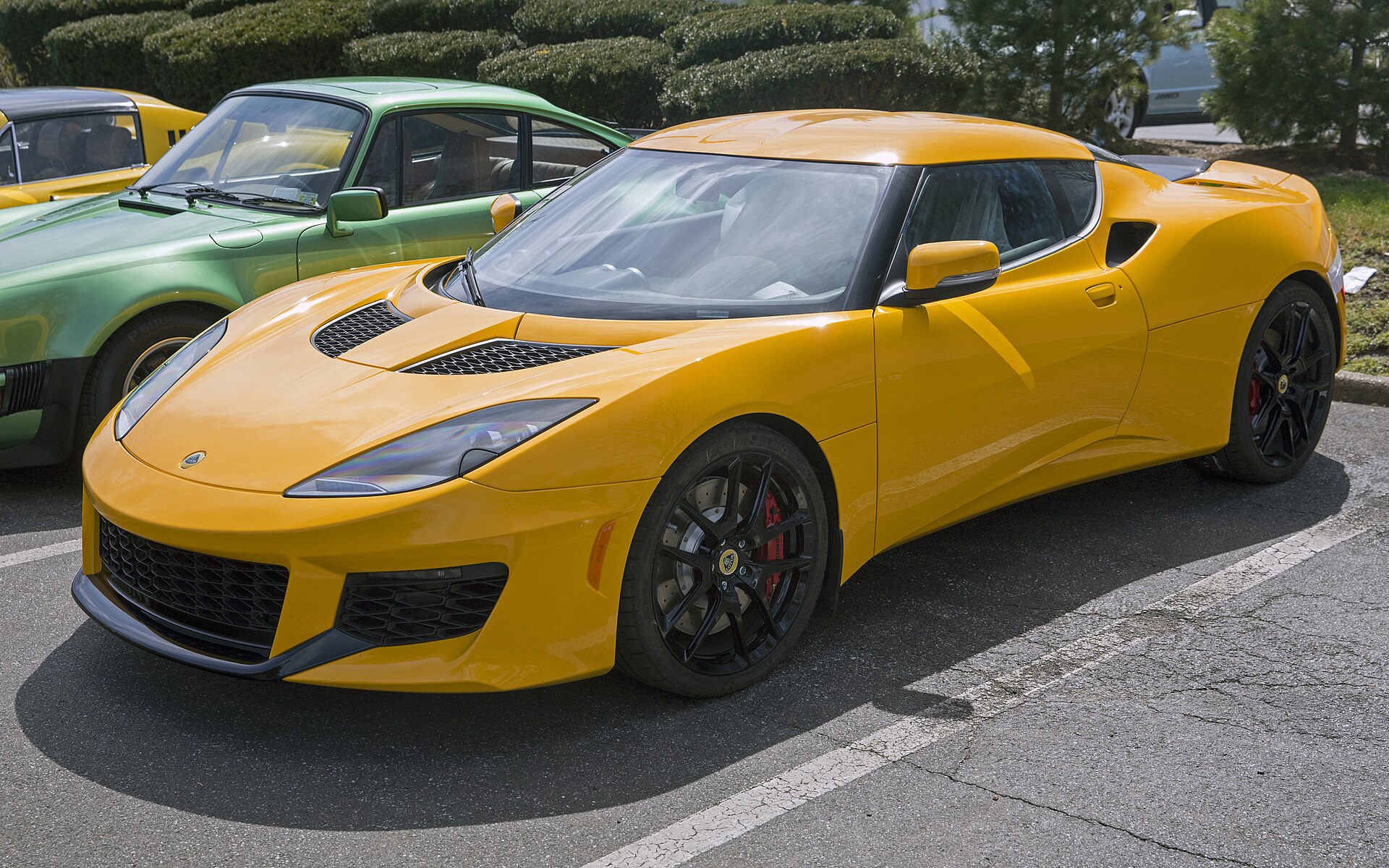
The Lotus Evora is a mid-engined sports car that Lotus built at Hethel, Norfolk, from 2009 to 2021. Revealed in July 2008 as the first all-new Lotus platform since the Elise, it was meant to take the brand beyond small track-focused cars with a more practical, everyday coupé - and it remains the only Lotus offered as a 2+2. Powered throughout by a Toyota-sourced 3.5-litre V6, naturally aspirated at first and later supercharged, the Evora grew from 206 kW (280 PS) to 321 kW (436 PS) before the Emira replaced it.
In short
- Built 2009–2021 at Hethel (United Kingdom); 6,117 cars; project name "Project Eagle", design led by Russell Carr.
- Transverse mid-mounted 3.5-litre V6 (Toyota 2GR-FE): 206 kW (280 PS) in the original, 299 kW (406 PS) in the Evora 400, 321 kW (436 PS) in the GT430.
- Six-speed manual or six-speed automatic gearbox, rear-wheel drive; bonded and riveted aluminium chassis tub.
- 2+2 seating with an optional two-seat "Plus Zero" layout; Autocar's Britain's Best Driver's Car and evo Car of the Year in 2009.
Specs by version
Engines
| Version | Engine | Gearbox | Drive | Production years |
|---|---|---|---|---|
| 3.5 L 6 cyl Automatic (S6) · 2020 (EPA) | 3.5 l · 6 cyl 3,500 cc | 6-sp Automatic | Rear-wheel drive | 2020 |
| 3.5 L 6 cyl Manual 6-spd · 2020 (EPA) | 3.5 l · 6 cyl 3,500 cc | 6-sp Manual | Rear-wheel drive | 2020 |
| 3.5 L 6 cyl Automatic (S6) · 2018 (EPA) | 3.5 l · 6 cyl 3,500 cc | 6-sp Automatic | Rear-wheel drive | 2018 |
| 3.5 L 6 cyl Manual 6-spd · 2018 (EPA) | 3.5 l · 6 cyl 3,500 cc | 6-sp Manual | Rear-wheel drive | 2018 |
| 3.5 L 6 cyl Automatic (S6) · 2017 (EPA) | 3.5 l · 6 cyl 3,500 cc | 6-sp Automatic | Rear-wheel drive | 2017 |
| 3.5 L 6 cyl Manual 6-spd · 2017 (EPA) | 3.5 l · 6 cyl 3,500 cc | 6-sp Manual | Rear-wheel drive | 2017 |
| 3.5 L 6 cyl Automatic (S6) · 2014 (EPA) | 3.5 l · 6 cyl 3,500 cc | 6-sp Automatic | Rear-wheel drive | 2014 |
| 3.5 L 6 cyl Automatic (S6) · 2014 (EPA) | 3.5 l · 6 cyl 3,500 cc | 6-sp Automatic | Rear-wheel drive | 2014 |
| 3.5 L 6 cyl Manual 6-spd · 2014 (EPA) | 3.5 l · 6 cyl 3,500 cc | 6-sp Manual | Rear-wheel drive | 2014 |
| 3.5 L 6 cyl Manual 6-spd · 2014 (EPA) | 3.5 l · 6 cyl 3,500 cc | 6-sp Manual | Rear-wheel drive | 2014 |
Performance
Show all 10 versions
| Version | Fuel consumption |
|---|---|
| 3.5 L 6 cyl Automatic (S6) · 2020 (EPA) | 11.8 l/100 km19.9 mpg US · 23.9 mpg UK |
| 3.5 L 6 cyl Manual 6-spd · 2020 (EPA) | 12.4 l/100 km19.0 mpg US · 22.8 mpg UK |
| 3.5 L 6 cyl Automatic (S6) · 2018 (EPA) | 11.8 l/100 km19.9 mpg US · 23.9 mpg UK |
| 3.5 L 6 cyl Manual 6-spd · 2018 (EPA) | 12.4 l/100 km19.0 mpg US · 22.8 mpg UK |
| 3.5 L 6 cyl Automatic (S6) · 2017 (EPA) | 11.8 l/100 km19.9 mpg US · 23.9 mpg UK |
| 3.5 L 6 cyl Manual 6-spd · 2017 (EPA) | 12.4 l/100 km19.0 mpg US · 22.8 mpg UK |
| 3.5 L 6 cyl Automatic (S6) · 2014 (EPA) | 10.7 l/100 km22.0 mpg US · 26.4 mpg UK |
| 3.5 L 6 cyl Automatic (S6) · 2014 (EPA) | 10.7 l/100 km22.0 mpg US · 26.4 mpg UK |
| 3.5 L 6 cyl Manual 6-spd · 2014 (EPA) | 11.2 l/100 km21.0 mpg US · 25.2 mpg UK |
| 3.5 L 6 cyl Manual 6-spd · 2014 (EPA) | 11.8 l/100 km19.9 mpg US · 23.9 mpg UK |
Verified Manufacturer and type-approval data from our catalog · Sources and methodology
Lotus Evora at a glance
| Specification | Lotus Evora |
|---|---|
| Production | 2009–2021, Hethel, Norfolk (United Kingdom) |
| Cars built | 6,117 |
| Body | two-door 2+2 coupé (two-seat option); transverse mid-engine, rear-wheel drive |
| Engine | 3.5-litre 24-valve V6 (Toyota 2GR-FE), naturally aspirated or supercharged |
| Power | 206 kW (280 PS) to 321 kW (436 PS), by version |
| Torque | 350 Nm (Evora) to 450 Nm (GT430 and GT with automatic) |
| Gearbox | six-speed manual or six-speed automatic (Aisin) |
| Kerb weight | 1,248–1,442 kg, by version and equipment |
| Dimensions | 4,395 × 1,848 × 1,229 mm, wheelbase 2,575 mm |
| Predecessor / successor | Europa S / Emira |
The Evora sat above the Lotus Elise and its derivatives in the Lotus range. All models are listed in the Lotus catalogue, and the background of the company is in our history of Lotus.
History and development
The Evora was the first product of a five-year plan that Lotus started in 2006 to widen its range beyond small, track-oriented cars. The aim was a practical road car for a larger market, and Lotus set a sales target of 2,000 cars a year. Developed under the name Project Eagle, the car was launched on 22 July 2008 at the 2008 British International Motor Show. It was planned as the first of three models on the same platform; US sales started at the beginning of 2010.
The name follows the Lotus tradition of model names starting with E and was built from the words "evolution", "vogue" and "aura". Lotus also considered Eagle and Ethos, which proved hard to register as trademarks, and Exira.
The car evolved in several steps. The supercharged Evora S came in 2010 and the heavily revised Evora 400 at the Geneva motor show in 2015. The lighter Sport 410 followed in 2016, the GT430 in 2017 and the North American Evora GT in 2019. Production ended in December 2021, and the Emira took its place in spring 2022.

Design and chassis
The Evora was the first entirely new Lotus platform since the Elise of 1995 - the Exige and the 2006 Europa S were both derived from the Elise. It is larger than those cars, and its cabin was sized for tall occupants; according to Wikipedia, former Lotus chief executive Mike Kimberley and two people of 195 cm were among the benchmarks. The rear seats make it the only Lotus with a 2+2 layout, but buyers could also order a two-seat "Plus Zero" version. Wikipedia notes that the Evora and the BMW i8 were the only mid-engined 2+2 coupés on sale. The boot behind the engine is large enough for a set of golf clubs, although designer Russell Carr has said this was not intentional.
The chassis is a lightweight aluminium tub made of 6000-series alloy extrusions that are bonded with epoxy adhesive and riveted together for stiffness. An aluminium crash structure sits at the front, and a steel rear subframe carries the engine and gearbox. The suspension uses forged aluminium double wishbones all round with Bilstein gas dampers and Eibach coil springs, and the steering is hydraulically assisted. The drag coefficient is 0.337.
Later versions added aerodynamic parts: the Evora 400 body kit produced about 23 kg of downforce, the North American Evora GT about 64 kg at maximum speed and the GT430 about 250 kg.

Engine and performance
Every road-going Evora uses a version of the 3.5-litre, 24-valve 2GR-FE V6 supplied by Toyota and mounted transversely behind the cabin. In the original car it is naturally aspirated. The Evora S added a Harrop supercharger without an intercooler; from the Evora 400 onwards, Lotus used an Edelbrock supercharger with an intercooler. Customers could choose a six-speed manual gearbox or a six-speed automatic called IPS (Intelligent Precision Shift) and made by Aisin. Manual cars from the GT range have a Torsen limited-slip differential.
| Version | Years | Power | Torque | Top speed (manual) | Weight |
|---|---|---|---|---|---|
| Evora | from 2009 | 206 kW (280 PS) at 6,400 rpm | 350 Nm at 4,600 rpm | 262 km/h | 1,383 kg |
| Evora S | 2010–2014 | 257 kW (350 PS) at 7,000 rpm | 400 Nm at 4,500 rpm | 286 km/h | - |
| Evora 400 | from 2015 | 299 kW (406 PS) at 7,000 rpm | 410 Nm at 3,500 rpm | 299 km/h | 1,395 kg |
| Evora Sport 410 | from 2016 | 306 kW (416 PS) at 7,000 rpm | 420 Nm at 3,500 rpm | 306 km/h | 1,325 kg |
| Evora GT430 | from 2017 | 321 kW (436 PS) at 7,000 rpm | 440 Nm (manual) | 306 km/h | 1,258 kg |
| Evora GT410 Sport | from 2018 | 306 kW (416 PS) at 7,000 rpm | 440 Nm (manual) | 306 km/h | 1,297 kg |
| Evora GT (North America) | 2019–2021 | 310 kW (422 PS) at 7,000 rpm | 430 Nm (manual) | 303 km/h | 1,408–1,451 kg |
Cars with the automatic gearbox are slightly slower at the top end: 256 km/h for the original Evora and 280 km/h for the supercharged versions from the 400 on. The road-legal Evora GTE, a run of 25 cars using the engine of the racing car, had 327 kW (444 PS) and weighed 1,277 kg.

Main versions
Evora S (2010–2014). The "S" stands for supercharged. With 257 kW (350 PS) and 400 Nm, it was the first major step up in performance.
Evora 400 (2015). Shown at Geneva in 2015, it was more than a facelift: new bodywork with a split rear wing, an intercooled supercharger, 299 kW (406 PS), a sports exhaust that the driver can open and optional forged wheels.
Evora Sport 410 (2016). A lighter version with a carbon-fibre roof, tailgate and front access panel, a lithium-ion battery and one-piece carbon seats; the rear seats were removed. It weighed 1,325 kg.
Evora GT430 (2017). The most extreme Evora, with 321 kW (436 PS), an Edelbrock supercharger, a titanium exhaust and a large rear wing. At its launch it was the fastest road-legal Lotus. Only 60 were planned. A GT430 Sport without the wing reached 315 km/h with the manual gearbox.
Evora GT410 Sport (2018). Made for Lotus's 70th anniversary, with 306 kW (416 PS) and a weight of 1,297 kg, 28 kg less than the Sport 410. It was available as a two-seater or a 2+2.
Evora GT (2019–2021). Built for North America from June 2019, with 310 kW (422 PS). A carbon pack saved 22 kg and a titanium exhaust another 10 kg.


Racing
The Evora raced in several categories. In the 2010 GT4 European Cup, Ollie Hancock won the Nürburgring round; in 2011 Stefano D'Aste won at Zandvoort and finished third in the GT4 European series. Jetalliance Racing entered two Evoras at the 2011 24 Hours of Le Mans; one finished 22nd after 295 laps. In Japan, a GT300 Evora run by Cars Tokai - built to the Mother Chassis rules with a Nissan V8 - raced in Super GT from 2015 to 2021 and won at Fuji in 2020 and at Motegi in 2021.
Reception and legacy
The Evora was well received by the UK press. Autocar named it Britain's Best Driver's Car in 2009, and evo made it its Car of the Year the same year. Jeremy Clarkson, testing it for Top Gear in 2009, praised the performance, handling and ride, but criticised the tight rear seats, parts of the interior and the satellite navigation.
The Evora also served as a technical base for other projects, such as the 414E range-extender hybrid prototype of 2012 and the Infiniti Emerg-e concept. When production ended in December 2021, 6,117 cars had been built. Its successor, the Emira, continued the formula of a compact mid-engined Lotus sports car. For the electric direction of the brand, see the Lotus Evija.
Photo gallery

Lotus Evora in our rankings
- No. 11 of 51 · Most economical coupes (10.7 l/100 km · top 26%)
- No. 249 of 859 · Most powerful cars (321 kW · top 30%)
- No. 309 of 912 · Longest-running car nameplates (12 years · top 35%)
- No. 240 of 557 · Biggest engines: cars (3,500 cc · top 44%)
- No. 139 of 313 · Most powerful coupes (321 kW · top 45%)
- No. 55 of 109 · Most powerful British cars (321 kW · top 52%)
More economical than 74% of ranked coupes in the 1CARS catalog (No. 11 of 51).
FAQ
How many Lotus Evoras were built?
6,117 cars were built at Hethel between 2009 and 2021.
What engine does the Lotus Evora use?
A 3.5-litre V6 supplied by Toyota (2GR-FE), mounted transversely behind the cabin. It is naturally aspirated in the original Evora and supercharged in the Evora S, 400, 410, GT430 and GT.
Is the Lotus Evora a four-seater?
It is a 2+2 with two small rear seats - the only Lotus with this layout. A two-seat "Plus Zero" version was also offered.
What is the most powerful Evora?
The Evora GT430 of 2017, with 321 kW (436 PS) and 440–450 Nm.
What replaced the Lotus Evora?
The Lotus Emira, which went on sale in spring 2022.
Data sources
Data checked by an editor against the sources below.
- Wikipedia - Lotus Evora
- US EPA fueleconomy.gov - 41904.shtml
- US EPA fueleconomy.gov - 41903.shtml
- US EPA fueleconomy.gov - 41258.shtml
- US EPA fueleconomy.gov - 41257.shtml