 Lotus Evija
Specs, engines and history
Updated Published Sources (2) Report an error
By Felix Hartmann, Automotive Technology & EV Contributor Reviewed by Oleksandr Hnatiuk

- Built
- 2023–present
- Top power
- 1,500 kW (2,039 PS)
- New price
- from about €1,936,726 (2019)
Verdict: who the Evija suits
Our verdict · Felix Hartmann
The Evija is for collectors who want the most powerful Lotus ever made and a piece of the brand's change to electric power. It is not a practical car: there is almost no luggage space, the range on a track is short, and every car is built to order. Buyers who want a usable mid-engined Lotus should look at the Emira; those who want a light, simple Lotus can choose a used Lotus Elise.
The Lotus Evija is a two-seat electric hypercar with four motors and 1,500 kW (2,039 PS), revealed in London on 16 July 2019 and built by hand at Hethel in Norfolk. Lotus planned 130 cars. The first went to Jenson Button in August 2023, and customer deliveries were under way by December 2024, about four years later than first promised.
In short
- Four motors, one per wheel, with 375 kW each: 1,500 kW (2,039 PS) and 1,704 Nm in total.
- 93 kWh battery behind the seats (70 kWh was planned in 2019), about 346 km of range.
- Lotus figures: 0–100 km/h in under 3 s, 0–300 km/h in 9.1 s, limited to 349 km/h.
- The first all-new Lotus under Geely ownership and the brand's first electric car.

Lotus Evija at a glance
The Evija, code-named Type 130, was the first new Lotus since the Evora of 2008 and the first developed after Geely bought a majority of Lotus in 2017. The name derives from Eve and is linked to the Hebrew word for "living". The company presents the car as the first of its electric era, ahead of the Eletre SUV and the Emeya saloon, which are built in Wuhan, China.

| Fact | Value |
|---|---|
| Reveal | 16 July 2019, London; Guangzhou Auto Show 21 November 2019 |
| Production | from July 2023, Hethel, Norfolk (UK) |
| Planned run | 130 cars, including 8 Fittipaldi editions |
| Body | two-seat coupé, carbon-fibre monocoque |
| Drive | four motors, all-wheel drive with torque vectoring |
| Designers | Anthony Bushell and Barney Hatt, under Russell Carr |
The story of the brand, from Colin Chapman's first cars to the present, is in the history of Lotus.
Motors, battery and performance
Each wheel has its own motor with a planetary reduction gear and inverter, packaged as a single electric drive unit by Integral Powertrain. Each unit makes 375 kW (510 PS), giving 1,500 kW (2,039 PS) and 1,704 Nm (1,257 lb-ft). Software splits the torque between all four wheels, so the car can steer itself through corners by speeding up the outer wheels. Five drive modes run from an economy setting for range to Track.

| Parameter | 2019 plan | Production car |
|---|---|---|
| Power | 1,470 kW (2,000 PS) | 1,500 kW (2,039 PS) |
| Torque | 1,700 Nm | 1,704 Nm (1,257 lb-ft) |
| Battery | 70 kWh, Williams Advanced Engineering | 93 kWh, Hyperbat (Unipart/Williams) |
| Kerb weight | 1,680 kg target | 1,887 kg (4,160 lb) |
| Range | about 400 km target | about 346 km (215 mi) |
| 0–300 km/h | 9.0 s | 9.1 s |
| Top speed | over 320 km/h | 349 km/h (217 mph), limited |
The battery sits upright behind the cabin, where a mid-engined car carries its engine. That keeps the centre of gravity low and the weight spread evenly. It can be charged from 0 to 80% in about 18 minutes on a 350 kW DC charger. In 2019 Lotus talked about future 800 kW chargers; such chargers are not in public use.
Simple arithmetic shows how extreme the car is: 1,887 kg divided by 1,500 kW is about 1.26 kg per kW, against about 1.8 kg per kW for a Bugatti Chiron (1,995 kg, 1,103 kW). The power-to-weight calculator gives the same figure for any car, and the most powerful cars ranking shows where the Evija sits.
Aerodynamics and the Venturi tunnels
The design is built around air. Two large Venturi tunnels run through the rear of the body from the side intakes to the tail, so the air passes through the car instead of over it. Lotus first used ground-effect ideas in Formula 1 in the late 1970s. A rear wing rises from the bodywork when needed, and a large diffuser finishes the tail.

There are no door mirrors. Cameras replace them, with their images shown on screens inside the cabin. The headlamps are thin, almost vertical strips; Lotus said the laser main-beam units were supplied by Osram. The magnesium wheels measure 20 inches at the front and 21 at the rear, with Pirelli Trofeo R tyres, and the ground clearance at rest is 105 mm.
| Parameter | Metric | Imperial |
|---|---|---|
| Length | 4,459 mm | 175.6 in |
| Width | 2,000 mm | 78.7 in |
| Height | 1,122 mm | 44.2 in |
| Ground clearance | 105 mm | 4.1 in |
| Kerb weight | 1,887 kg | 4,160 lb |
| Wheels | 20 in front / 21 in rear | – |
Carbon chassis, suspension and brakes
The one-piece carbon-fibre monocoque, made by CPC in Modena, weighed 129 kg according to Lotus's 2019 figures. It sits on Lotus's bespoke Extreme platform. The suspension uses Multimatic adaptive dampers with spool valves, with three dampers per axle mounted inboard: two control roll and pitch, the third deals with vertical movement. AP Racing supplies carbon-ceramic brakes.
Cabin and equipment
The cabin is a two-seater with carbon-fibre, Alcantara and leather trim, and a narrow centre console with a vertical row of switches. A digital screen behind the steering wheel shows speed, charge and mode; the camera feeds replace the mirrors. Lotus listed climate control, Apple CarPlay and Android Auto, over-the-air updates and a smartphone app. Buyers could choose paint, trim materials and personal badges. Every car is assembled by hand at Hethel.
Price, production and delays
Customer cars were first planned for 2020. The pandemic, the switch to a larger battery and supplier changes pushed the timeline back. In 2022 the company said eight cars were in build; Jenson Button received the first car in August 2023, and in December 2024 Lotus's European chief confirmed that deliveries to customers were under way and would continue for about two years. Whether all 130 cars will be built has not been confirmed. A deposit was required when orders opened in 2019; a dated euro price was never published, so none is given here.
Rivals: electric hypercars compared
| Model | Motors | Power | Battery | Built |
|---|---|---|---|---|
| Lotus Evija | 4 | 1,500 kW (2,039 PS) | 93 kWh | 130 planned |
| Rimac Nevera | 4 | about 1,400 kW (1,914 PS) | 120 kWh | 150 planned |
| Pininfarina Battista | 4 | about 1,400 kW (1,900 PS) | 120 kWh | 150 planned |
| Bugatti Chiron (petrol, for scale) | W16 | 1,103 kW (1,500 PS) | – | 500 |
The Evija is the most powerful of the three electric cars on paper, with the smallest battery. The Rimac grew out of the Rimac Concept Two, and the Bugatti Chiron is the petrol benchmark. You can set any two of them side by side in the 1cars comparison tool.
Lotus Evija in our rankings
- No. 1 of 109 · Most powerful British cars (1,500 kW)
- No. 1 of 97 · Most powerful electric cars (1,500 kW)
- No. 2 of 313 · Most powerful coupes (1,500 kW)
- No. 3 of 239 · Most powerful cars of the 2020s (1,500 kW)
- No. 3 of 859 · Most powerful cars (1,500 kW)
- No. 804 of 912 · Longest-running car nameplates (3 years · top 89%)
More powerful than 99% of ranked British cars in the 1CARS catalog (No. 1 of 109).
Lotus Evija videos 3
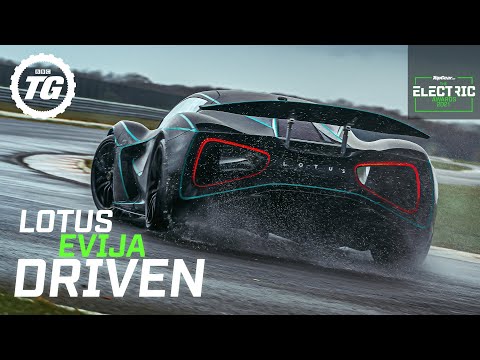
Lotus Evija video 1
Lotus Evija video 2

Lotus Evija video 3
FAQ
How much power does the Lotus Evija have?
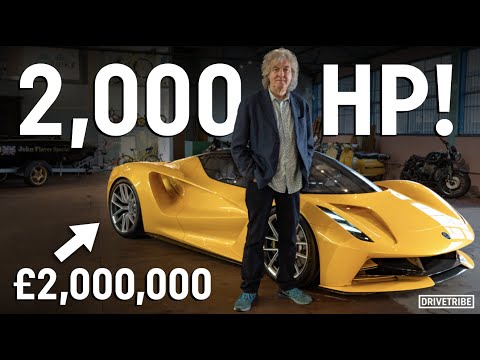
The production Evija has four 375 kW motors with a combined 1,500 kW (2,039 PS, about 2,011 hp) and 1,704 Nm of torque. In 2019 Lotus announced 2,000 PS and 1,700 Nm.
How many Lotus Evija are made?
Lotus planned 130 cars, including eight Fittipaldi editions, built by hand at Hethel. The first car was delivered in August 2023; in late 2024 Lotus did not confirm whether the full run of 130 would be completed.
How fast is the Lotus Evija?
Lotus claims 0–100 km/h in under 3 seconds, 0–300 km/h in 9.1 seconds and a top speed limited to 349 km/h (217 mph). Independent figures for a complete 0–300 km/h run have not been published.
What is the range of the Lotus Evija?
About 346 km (215 miles) from the 93 kWh battery, according to Lotus data, with charging from 0 to 80% in about 18 minutes on a 350 kW DC charger. Range falls sharply in Track mode.
Who owns Lotus, the maker of the Evija?
Lotus is controlled by the Chinese Geely group, which bought a majority stake in 2017. The Evija was the first all-new Lotus developed under Geely and is built in England, while the Eletre and Emeya are built in China.
Data sources
Data checked by an editor against the sources below.
- The text of this article (1cars archive)
- Wikipedia - Lotus Evija