
 Pagani Huayra Imola
Specs, engines and history
Updated Published Sources (3) Report an error
By Felix Hartmann, Automotive Technology & EV Contributor Reviewed by Oleksandr Hnatiuk
- Built
- 2019–2021
- Top power
- 616 kW (838 PS)
- New price
- from about €5,000,000 (2020)
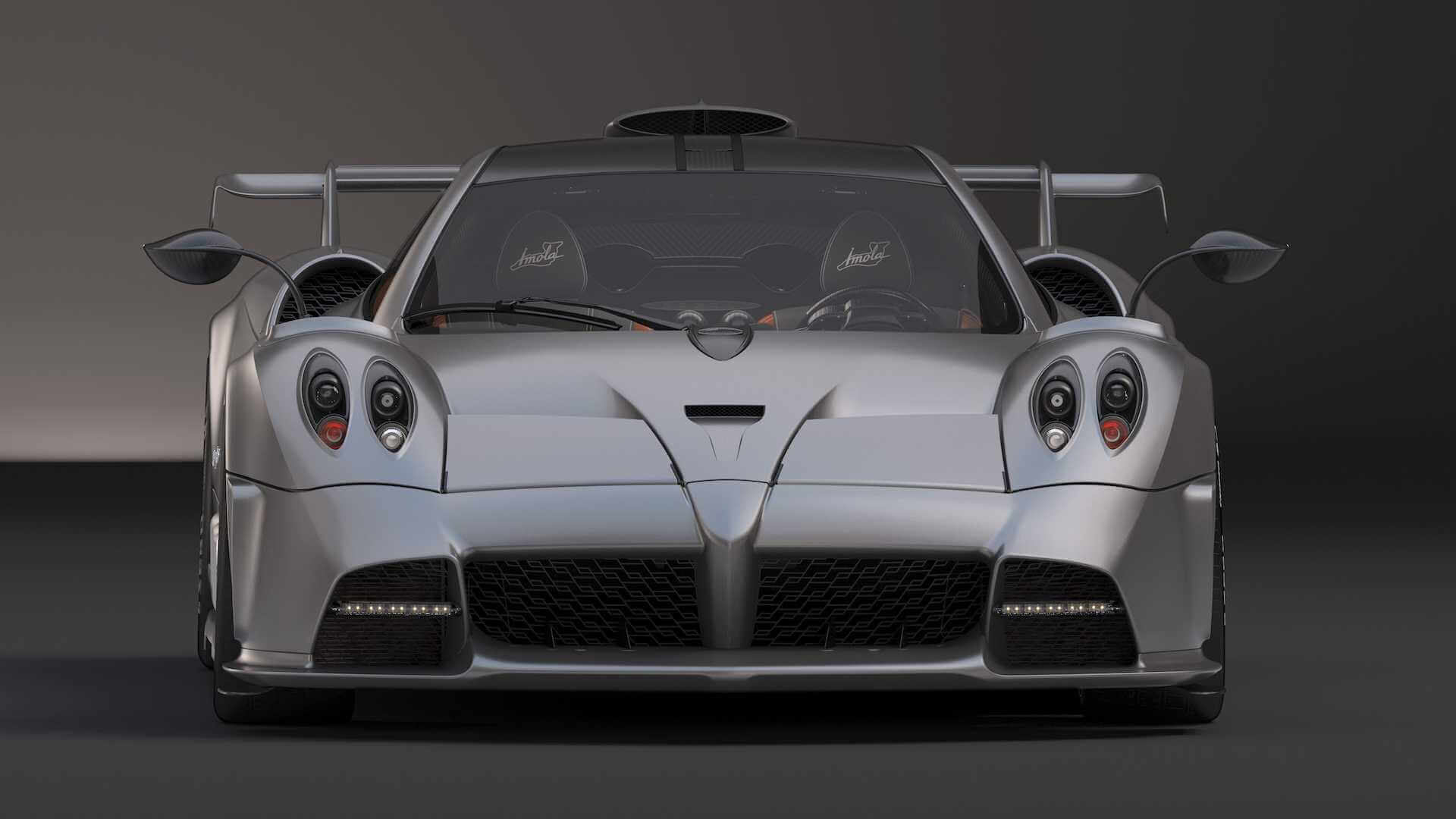
The Pagani Huayra Imola is a road-legal, track-tuned version of the Huayra that Pagani presented in February 2020 and built in only five customer cars. Its 6.0-litre twin-turbo V12 from Mercedes-AMG gives 616 kW (838 PS) and 1,100 Nm. The dry weight is 1,246 kg, and the prototypes covered about 16,000 km on the Imola circuit. Each car cost about €5 million.
In short
- Engine: 5,980 cc AMG V12 with two turbochargers, 616 kW (827 hp) and 1,100 Nm, rear-wheel drive.
- Purpose: a rolling laboratory for technology later used in the Roadster BC and newer Pagani models.
- Production: five customer cars plus one prototype; an Imola Roadster in eight cars followed in 2023.
- Key details: active aerodynamics with four moving flaps, 398 mm carbon-ceramic front discs and Acquarello Light paint that saves 5 kg.

Specs by version
Verified Manufacturer and type-approval data from our catalog · Sources and methodology
Pagani Huayra Imola at a glance

| Parameter | Metric | Imperial |
|---|---|---|
| Engine | 5,980 cc 60-degree V12, twin-turbo (Mercedes-AMG) | 365 cu in |
| Power | 616 kW (838 PS) | 827 hp |
| Torque | 1,100 Nm | 811 lb-ft |
| Gearbox | Xtrac 7-speed automated manual, transverse | same |
| Drive | rear-wheel, electro-mechanical differential | same |
| Dry weight | 1,246 kg | 2,747 lb |
| Tyres | 265/30 R20 front, 355/25 R21 rear | - |
| Brake discs | 398 × 36 mm front, 380 × 34 mm rear | 15.7 / 15.0 in |
| Built | 5 customer cars (2020) | - |
| Price | about €5 million (reported, 2020) | - |
Why it carries the name of a race track
Pagani named the car after the Autodromo Enzo e Dino Ferrari at Imola, where the development team spent much of its testing time. The test cars covered more than 16,000 km at racing speed there. Pagani compares that with about three times the distance of a 24-hour race at Le Mans and calls it the most severe track validation it had ever applied to a car.

The company described the Imola as a "vehicle-laboratory". Pagani's experimental work goes back to the Zonda R of 2008, which led to the carbon-titanium materials used in the Huayra. In the same way, solutions tested on the Imola went into the Roadster BC and later cars. The first information appeared in September 2019, and Pagani presented the finished car in February 2020, ahead of a planned debut at the Geneva Motor Show that was then cancelled.
Chassis, weight and paint
The monocoque combines two composites, Carbo-Titanium HP62 G2 and Carbo-Triax HP62, the same materials as in the Roadster BC. Tubular chrome-molybdenum steel subframes are bolted to the front and rear. More than 770 parts are forged or machined from solid metal, and the aluminium pieces got a new textured finish.

Paint was part of the weight work. A new process called Acquarello Light uses about 5 kg less paint while keeping the depth and shine of a normal finish. The old version of this page gave 4 kg, but Pagani's own figure is 5 kg. The result is a dry weight of 1,246 kg: heavier than the Huayra BC, but lighter than the first Huayra by more than 100 kg.
| Huayra version | Power | Torque | Dry weight | kg per kW (our calculation) |
|---|---|---|---|---|
| Huayra coupé (2011) | 544 kW | 1,000 Nm | 1,350 kg | 2.48 |
| Huayra BC (2016) | 562 kW | 1,000 Nm | 1,218 kg | 2.17 |
| Huayra Imola (2020) | 616 kW | 1,100 Nm | 1,246 kg | 2.02 |
| Imola Roadster (2023) | 625 kW | 1,100 Nm | 1,260 kg | 2.02 |
The full family, from the first coupé to the track-only R, is covered on our Pagani Huayra page.
AMG V12 and the Xtrac gearbox
Mercedes-AMG supplies the 60-degree V12 of 5,980 cc with two turbochargers. For the Imola it was tuned to 616 kW and 1,100 Nm, which is 72 kW and 100 Nm more than the first Huayra. By our calculation that is about 103 kW per litre of displacement.

A seven-speed Xtrac automated manual gearbox is mounted transversely behind the engine. It works with an electro-mechanical differential and Pagani's SMART GAS function, which the company developed to cut shift times. Our power converter shows how the 616 kW translate into PS and hp.
Active aerodynamics and suspension
Pagani chose efficiency over elegance for the bodywork. The car keeps the Huayra's active system with four moving flaps that change angle with speed, cornering and braking, and they also act as an airbrake. Fixed fins, winglets and deflectors are added on top, together with a roof scoop that feeds air to the engine. The team deliberately left the ground clearance higher than the ideal for maximum downforce, because uneven public roads can cause sudden losses of grip if a car runs too low.

The suspension uses double wishbones and coil springs with electronically controlled dampers at each wheel, linked to one another. The front ride height changes automatically. One central control unit coordinates the aerodynamics, engine, differential and gearbox, so that the flaps, the shift and the torque split respond to the same driving situation.
Brakes, wheels and tyres
Brembo supplied four ventilated carbon-ceramic discs: 398 × 36 mm at the front with six-piston monobloc calipers, and 380 × 34 mm at the rear with four-piston calipers. Pagani shaped the cooling ducts with aerodynamic studies so that the brakes stay in their working range during long track sessions.
The forged wheels measure 20 inches at the front and 21 inches at the rear. Pirelli developed P Zero Trofeo R tyres in 265/30 R20 and 355/25 R21 for the car, using its Next MIRS system. The rear tyre is 90 mm wider than the front, a gap our tyre size calculator can put into context.
Price, production and rivals
Pagani built five Imolas for customers, plus one prototype. Reports at the launch in February and March 2020 gave a price of about €5 million per car; the old text of this page quoted €5.4 million, which no source confirms. All cars were sold before the public presentation. In 2023 Pagani added the Imola Roadster in eight cars with 625 kW.
The Imola appeared when the hypercar field was growing quickly. Petrol-only rivals of the time included the De Tomaso P72, the Gordon Murray T.50, the Hennessey Venom F5 and the SSC Tuatara, while hybrid and electric hypercars were raising the performance benchmark. None of them offered the same mix of a twin-turbo V12, a manual-style automated gearbox and hand-built carbon-titanium construction.
Who the Imola suits
The Imola suits a Pagani collector who wants the most track-ready closed Huayra that can still be registered for the road. It is heavier than the BC but stronger and better developed for circuits, and its five-car run makes it rarer than almost any other Huayra derivative. Owners who want an open car have the Imola Roadster, and those who want the newest Pagani should look at the Pagani Utopia, the Huayra's successor. The company's story is told on the Horacio Pagani profile.

Rivals
Compare with…
Compare Pagani Huayra Imola with
- Bugatti La Voiture Noire quick spec comparison
-
Ended 2021
- Years
- 2019–2021
- Body
- Coupe
- Fuel
- Petrol
- Power
- 1,103 kW (1,500 PS)

Pagani Huayra Imola in our rankings
- No. 2 of 28 · Most powerful V12 cars (616 kW)
- No. 10 of 360 · Most powerful cars of the 2010s (616 kW)
- No. 10 of 127 · Most torque: coupes (1,100 Nm)
- No. 13 of 497 · Most torque: cars (1,100 Nm · top 3%)
- No. 42 of 1025 · Most powerful cars (616 kW · top 5%)
- No. 11 of 146 · Most powerful Italian cars (616 kW · top 8%)
More powerful than 97% of ranked cars of the 2010s in the 1CARS catalog (No. 10 of 360).
Pagani Huayra Imola photos 6
FAQ
How many Pagani Huayra Imola were built?
Pagani built five customer cars and one prototype. All five were sold before the car was presented in February 2020. An open Imola Roadster followed in 2023 in eight examples.
How much horsepower does the Pagani Imola have?
Its 6.0-litre twin-turbo V12 from Mercedes-AMG produces 616 kW, which equals 838 PS or 827 hp, with 1,100 Nm of torque. Power goes to the rear wheels through a seven-speed Xtrac gearbox.
How much did the Pagani Huayra Imola cost?
About €5 million per car, according to reports at the launch in 2020. Pagani did not publish a list price, and the figure may exclude taxes and options.
Why is it called Imola?
The name comes from the Imola circuit in Italy. Pagani's test cars lapped it for more than 16,000 km, about three times the distance of the Le Mans 24 Hours.
How much does the Huayra Imola weigh?
Pagani quotes a dry weight of 1,246 kg. That is 28 kg more than the Huayra BC and 104 kg less than the original Huayra coupé of 2011.
Data sources
Data checked by an editor against the sources below.
- The text of this article (1cars archive)
- Wikipedia - Pagani Huayra
- Pagani - Imola


