 Lotus 2-Eleven
Specs, engines and history
Published Sources (1) Report an error
By Felix Hartmann, Automotive Technology & EV Contributor
- Built
- 2007–2011
- Top power
- 188 kW (256 PS)
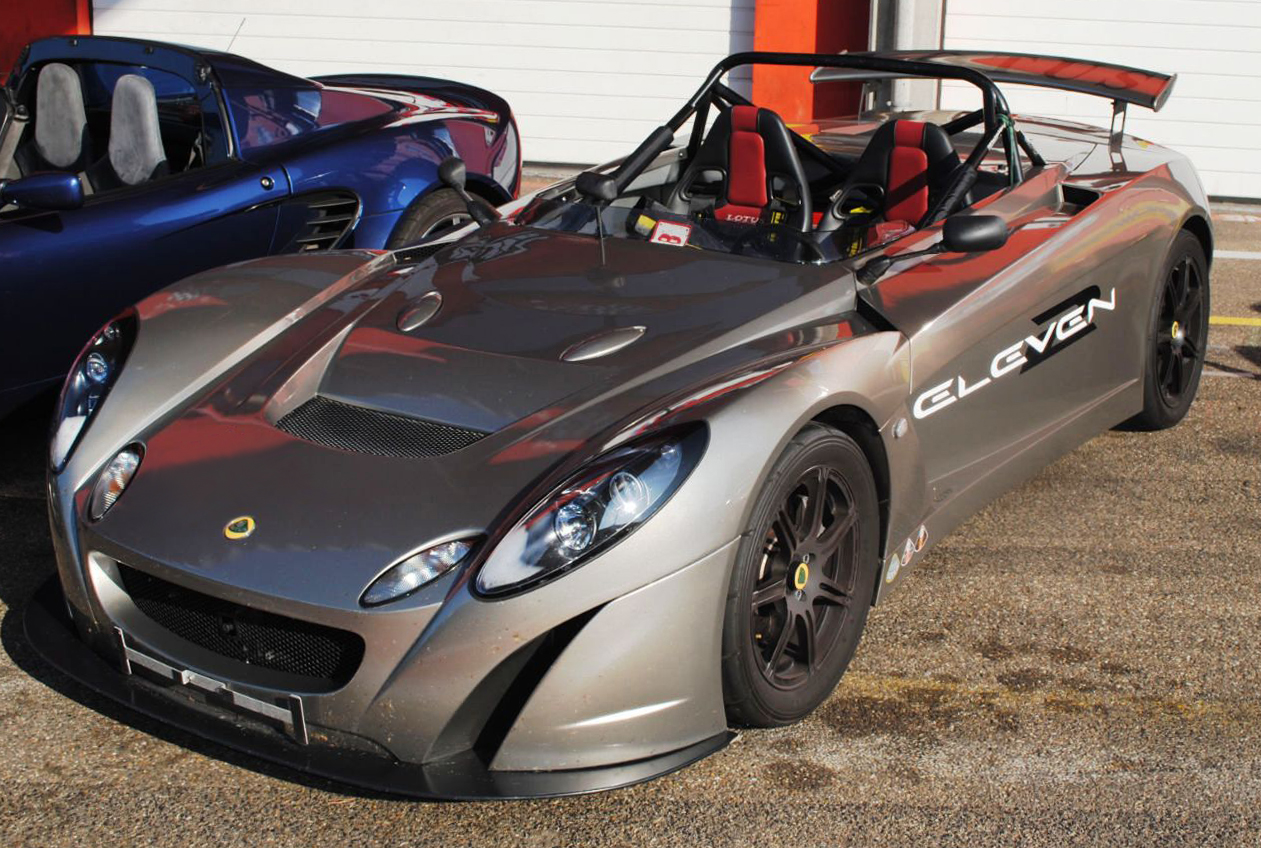
Built at Hethel in Norfolk between 2007 and 2011, the Lotus 2-Eleven is a roofless two-seater designed first of all for circuit use. Developed by Lotus Sport, the company's racing department, it was based on the Exige S but had no roof, no doors and no full windscreen. A supercharged 1.8-litre Toyota engine gave it 188 kW (255 PS) for a weight of only 670 kg. It was mainly a track-day car, but a road-registered version was also available.
In short
- Revealed on 28 February 2007 at the Geneva motor show; production at Hethel from April 2007 until 2011.
- Supercharged and intercooled 1,796 cc Toyota 2ZZ-GE four-cylinder: 188 kW (255 PS) at 8,000 rpm and 242 Nm at 7,000 rpm.
- Six-speed manual gearbox, 670 kg as a road car and 666 kg as a track car.
- 0–60 mph in 3.8 s; top speed 241 km/h (Wikipedia) or about 249 km/h (Lotus launch data).
Lotus 2-Eleven at a glance
| Specification | Lotus 2-Eleven |
|---|---|
| Production | 2007–2011, Hethel (England) |
| Body | open two-seater without roof or doors, composite panels |
| Base | Lotus Exige S |
| Chassis | bonded aluminium extrusions, steel rear subframe |
| Engine | 1,796 cc Toyota 2ZZ-GE, Eaton M62 supercharger, intercooler |
| Power | 188 kW (255 PS) at 8,000 rpm |
| Torque | 242 Nm at 7,000 rpm |
| Gearbox | six-speed manual, rear-wheel drive |
| Weight | 670 kg (road), 666 kg (track) |
| Dimensions | 3,822 mm long (track car 3,872 mm), 1,735 mm wide, 1,112 mm high, 2,300 mm wheelbase |
| Predecessor / successor | Lotus 340R / Lotus 3-Eleven |
The 2-Eleven belongs to the family of lightweight Lotus cars that started with the Lotus Elise. Other models of the brand are in the Lotus catalogue.
Launch at Geneva
Lotus Sport presented the 2-Eleven at the 77th Geneva motor show on 28 February 2007. According to the launch specification, production was due to start in April 2007 at the company's base in Hethel, Norfolk. Each car carried a Lotus Sport build plate.
Lotus presented the car as a modern expression of Colin Chapman's principle of "performance through lightweight". Wikipedia lists the 340R as the predecessor of the 2-Eleven and the 3-Eleven as its successor.
From Exige S to 2-Eleven
The 2-Eleven used the mechanical base of the Exige S, the supercharged coupé of the time. Lotus removed the roof and the doors and fitted a new composite body. The gearbox kept the same ratios as in the Exige S.
The result was a much lighter and more extreme car. Without the coupé's roof structure and glazing, the 2-Eleven weighs 670 kg in road form. The power-to-weight ratio is about 281 kW per tonne, or 376 bhp per tonne in Lotus's own figures.

Engine and performance
The engine is Toyota's 1.8-litre 2ZZ-GE four-cylinder with variable valve timing and lift (VVTL-i). Bore and stroke are 82 mm and 85 mm. Lotus added an Eaton M62 Roots-type supercharger driven from the crankshaft, an intercooler, four high-capacity injectors and an uprated fuel pump. For track use there are an Accusump oil accumulator and two oil coolers.
| Figure | Lotus 2-Eleven |
|---|---|
| Displacement | 1,796 cc |
| Power | 188 kW (255 PS) at 8,000 rpm |
| Torque | 242 Nm at 7,000 rpm |
| 0–60 mph | 3.8 s |
| 0–100 mph | about 9.1 s (Lotus launch data) |
| Top speed | 241 km/h (Wikipedia); about 249 km/h (Lotus launch data) |
A C64 six-speed manual with an aluminium casing drives the rear wheels. An open differential was standard. The switchable Lotus Traction Control System works through the engine and is active above 8 km/h.

Chassis, body and safety
The chassis is a high-sided version of the Elise structure, made of aluminium extrusions bonded with epoxy. A glass-fibre crash structure protects the front, and a high sill gives side protection. At the rear a galvanised steel subframe includes a crushable section.
A six-point roll-over structure that meets FIA rules is built in, with integral mounting points for the safety belts. The composite body weighs only 40 kg. Its panels are bolted on from the outside, so they can be removed and repaired easily.
The suspension uses unequal-length wishbones at all four corners, Öhlins dampers adjustable in two ways, coil-over springs and an adjustable Lotus Sport front anti-roll bar. A double-shear brace at the rear protects the track control arm from kerb strikes. Special steering arms and front upper wishbones allow a very low ride height.

Brakes, wheels and tyres
The 288 mm cross-drilled and ventilated cast-iron discs are gripped by two-piston AP Racing aluminium calipers at the front and Brembo sliding calipers at the rear. Pagid RS14 pads, silicone brake fluid and braided hoses are fitted, together with four-channel ABS.
Forged black five-spoke wheels measure 7J × 16 at the front and 8J × 17 at the rear. They carry Yokohama A048 R LTS tyres, 195/50 R16 at the front and 225/45 R17 at the rear.
Road car and track car
At launch Lotus offered the 2-Eleven only as a Launch Edition with a three-colour Lotus Sport paint scheme and decals. Two forms were available. The road-going version, approved in the United Kingdom through Single Vehicle Approval, had front and rear lights, a catalytic converter and a single-plane rear wing.
The track-only version was even more focused. It had a high-downforce carbon rear wing and a front splitter, brake lights and rear indicators, and an FIA-approved driver's race seat. Wikipedia calls the 2-Eleven a "track day car", with road legality as an extra-cost option in the UK.

Legacy
The 2-Eleven sits between the 340R and the 3-Eleven in a line of open, very light Lotus cars. Like them, it put the brand's lightweight principle into its most direct form: no roof, no doors and a weight of well under 700 kg.
Lotus 2-Eleven in our rankings
- No. 43 of 79 · Most powerful convertibles and roadsters (188 kW · top 55%)
- No. 509 of 859 · Most powerful cars (188 kW · top 60%)
- No. 82 of 109 · Most powerful British cars (188 kW · top 76%)
- No. 722 of 912 · Longest-running car nameplates (4 years · top 83%)
More powerful than 45% of ranked convertibles and roadsters in the 1CARS catalog (No. 43 of 79).
FAQ
How powerful is the Lotus 2-Eleven?
Its supercharged 1.8-litre Toyota engine produces 188 kW (255 PS) at 8,000 rpm and 242 Nm at 7,000 rpm.
How much does the 2-Eleven weigh?
670 kg as a road car and 666 kg as a track car, according to Wikipedia.
Is the Lotus 2-Eleven road legal?
It was designed as a track-day car, but a road-going version with lights, a catalytic converter and UK approval was available at extra cost.
What car is the 2-Eleven based on?
The Lotus Exige S: it uses its supercharged Toyota engine and gearbox ratios with a new open composite body.
Data sources
Data checked by an editor against the sources below.