 Lotus Elan M100
Specs, engines and history
Published Sources (1) Report an error
By Felix Hartmann, Automotive Technology & EV Contributor
- Built
- 1989–1995
- Top power
- 121 kW (165 PS)
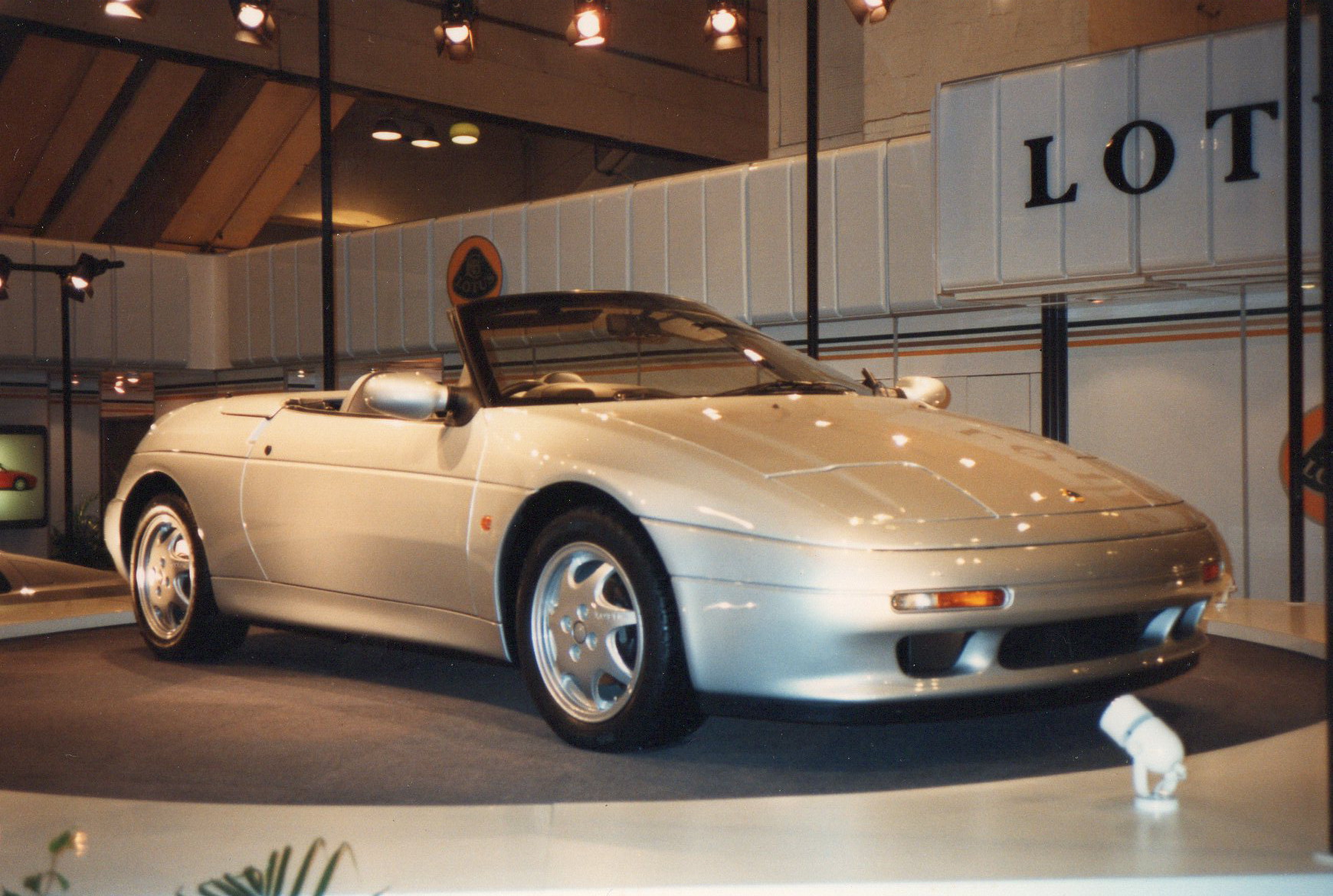
The Lotus Elan M100 is a two-seat roadster that Lotus built at Hethel from 1989 to 1995. Launched in August 1989, it revived the Elan name after 14 years and is the only Lotus with front-wheel drive. Developed with money from General Motors, which had bought Lotus in 1986, it used a 1.6-litre Isuzu engine, available with or without a turbocharger. After 3,855 cars and a final run of 800 S2 models, the rights went to Kia, which built the car in South Korea until 1999.
In short
- Launched in August 1989; built at Hethel from November 1989 to July 1992 (3,855 cars) and as the S2 from June 1994 to September 1995 (800 cars, UK only).
- 1,588 cc DOHC 16-valve four-cylinder from Isuzu: 97 kW (130 bhp) naturally aspirated, 121 kW (162 bhp) as the Turbo SE.
- Front-wheel drive with a manual gearbox from Isuzu; weight 1,075–1,110 kg; top speed 220 km/h.
- Designed by Peter Stevens; later built by Kia as the Kia Elan (1,056 cars, 1996–1999).
Lotus Elan M100 at a glance
| Specification | Lotus Elan M100 |
|---|---|
| Production | 1989–1992 and 1994–1995 (S2), Hethel (United Kingdom) |
| Cars built | 3,855 + 800 S2 |
| Body | two-seat roadster; front engine, front-wheel drive |
| Engine | 1,588 cc DOHC 16-valve inline-four (Isuzu), turbocharged or naturally aspirated |
| Power | 97 kW (130 bhp); Turbo SE 121 kW (162 bhp); S2 116 kW (155 bhp) |
| Gearbox | manual (Isuzu) |
| Weight | 1,075–1,110 kg |
| Top speed | 220 km/h |
| Designer | Peter Stevens |
The Elan M100 carried a famous Lotus name; the company's story is in our history of the Lotus car company, and later Lotus roadsters include the Lotus Elise. All models are in the Lotus catalogue.
The Elan name before 1989
The M100 revived one of Lotus's best-known names. The original Elan was built from 1962 to 1975 with a steel backbone chassis, a fibreglass body and the 1,558 cc Lotus-Ford Twin Cam engine, a twin-cam conversion of Ford's Kent four-cylinder. It weighed only about 640 kg in Series 1 form and evolved through Series 2, 3 and 4 and the Sprint of 1970; the longer Elan +2 with two small rear seats followed in 1967. Estimates of two-seater production range from about 8,700 to more than 12,000 cars.
The old Elan was famous for its handling. McLaren F1 designer Gordon Murray reportedly called the Series 3 probably the best-handling sports car ever made, and the original Elan is usually credited as the inspiration for the Mazda MX-5 - Mazda evaluated two Elans while developing it. Ironically, the MX-5 appeared in 1989, the same year as the new front-wheel-drive Elan.
Development under General Motors
General Motors bought Lotus in 1986, and its money made a new small Lotus possible. Peter Stevens's design for the car, known internally as Type M100, was approved at the end of 1986. Development was thorough: Lotus used 19 crash-test cars and 42 development vehicles and covered nearly one million test miles over two years. Every production car was test-driven for about 30 miles at Hethel before delivery. Some suspension parts, including the rear arms and hub carriers, were supplied by Portland Engineering.
The new Elan was launched in August 1989, fourteen years after the last car with the name, and production started in November.

Engine and chassis
The engine came from the Isuzu Gemini and was modified by Lotus: a 1,588 cc inline-four with double overhead camshafts and 16 valves. The naturally aspirated Elan 1.6 produced 97 kW (130 bhp); the Turbo SE, which most buyers chose, produced 121 kW (162 bhp). The gearbox was also supplied by Isuzu.
The decision to drive the front wheels made the Elan unique among Lotus cars. Autocar and Motor measured 0–60 mph in 6.5 seconds, and the top speed is 220 km/h. Autocar called the car "the quickest point to point car available". Some reviewers, however, found the handling too secure and predictable compared with rear-wheel-drive sports cars.
| Version | Years | Power | Built |
|---|---|---|---|
| Elan 1.6 (non-turbo) | 1989–1992 | 97 kW (130 bhp) | 129 |
| Elan Turbo SE | 1989–1992 | 121 kW (162 bhp) | about 3,726 |
| Elan S2 (UK only) | 1994–1995 | 116 kW (155 bhp) | 800 |
| Kia Elan | 1996–1999 | 111 kW (151 PS), 1.8-litre | 1,056 |

Versions: 1.6, Turbo SE, S2 and US cars
Elan 1.6 and Turbo SE (1989–1992). Of the 3,855 cars built in the first run, only 129 had the naturally aspirated engine. 559 cars were sold in the United States; they had a different boot spoiler, a longer nose and 16-inch wheels.
Elan S2 (1994–1995). After production had stopped in 1992, Lotus built a final series of 800 cars for the UK between June 1994 and September 1995. A catalytic converter reduced the output to 116 kW (155 bhp), and 0–60 mph took 7.5 seconds.


The Kia Elan
After the last S2 cars, Lotus sold the production rights to Kia Motors. Kia's engineering company Kia Motech built the car in Ansan, South Korea, from 1996 to 1999, with its own 1.8-litre T8D engine of Mazda origin producing 111 kW (151 PS). The Kia Elan can be recognised by Kia-designed tail lights, which replaced the units shared with the Renault Alpine GTA. 1,056 were made, and in Japan the car was sold as the Vigato.

Reception and legacy
The Elan M100 was praised for its pace and grip, and Lotus said the dashboard alone cost more to produce than the entire production line of the earlier Excel. Sales were nevertheless disappointing, which is commonly linked to the debut of the Mazda MX-5 at the same time. Today the M100 remains the only front-wheel-drive Lotus, an unusual chapter between the Esprit and the Elise.
Photo gallery

Lotus Elan M100 in our rankings
- No. 558 of 912 · Longest-running car nameplates (6 years · top 69%)
- No. 59 of 79 · Most powerful convertibles and roadsters (121 kW · top 75%)
- No. 643 of 859 · Most powerful cars (121 kW · top 75%)
- No. 96 of 109 · Most powerful British cars (121 kW · top 89%)
In production longer than 31% of ranked nameplates in the 1CARS catalog (No. 558 of 912).
FAQ
Is the Lotus Elan M100 front-wheel drive?
Yes. It is the only front-wheel-drive Lotus model.
What engine does the Elan M100 have?
A 1,588 cc 16-valve four-cylinder from Isuzu, modified by Lotus: 97 kW (130 bhp) without and 121 kW (162 bhp) with a turbocharger.
How many Elan M100s were built?
3,855 between 1989 and 1992 and 800 S2 cars in 1994–1995 at Hethel, plus 1,056 Kia Elans in South Korea.
Who designed the Elan M100?
Peter Stevens; his design was approved in late 1986.
Data sources
Data checked by an editor against the sources below.