 Lotus Elan
Specs, engines and history
Published Sources (1) Report an error
By Felix Hartmann, Automotive Technology & EV Contributor
- Built
- 1962–1973
- Top power
- 94 kW (128 PS)
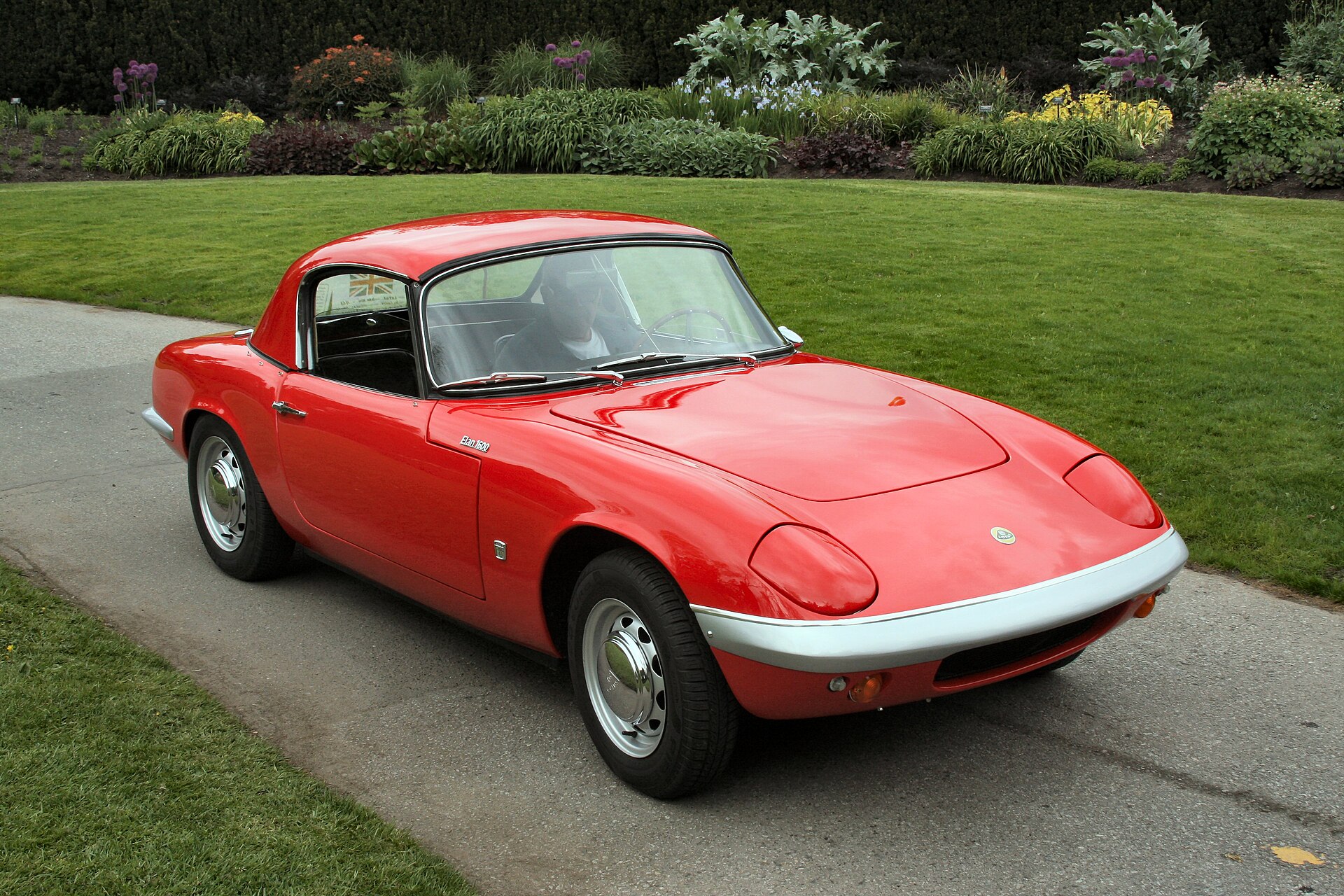
The Lotus Elan is the small two-seat sports car that Lotus built from 1962 to 1973, with an Elan +2 four-seater following in 1967. It combined a steel backbone chassis, a fibreglass body and a twin-cam engine developed from a Ford four-cylinder, and it weighed little more than 600–700 kg. The Elan was Lotus's first real commercial success, funded the company's racing programme for about a decade, and is usually credited as the inspiration for the Mazda MX-5.
In short
- Built 1962–1973 (Elan +2 until 1975) by Lotus in Cheshunt and, from 1966, Hethel; total production estimates for the two-seater range from about 8,700 to 12,224.
- 1,558 cc Lotus-Ford Twin Cam: 67–78 kW (90–105 bhp) in standard form, up to 94 kW (126 bhp) in the Sprint.
- Steel backbone chassis with a fibreglass body bolted on; designed by Ron Hickman under Colin Chapman.
- Magazine tests recorded top speeds from 174 km/h (Series 2) to 198 km/h (Sprint).
Lotus Elan at a glance
| Specification | Lotus Elan (1962–1973) |
|---|---|
| Production | 1962–1973; Elan +2 1967–1975 |
| Versions | 1500, 1600 (S1), S2, S3, S4, Sprint; Elan +2; 26R racing car |
| Body | two-seat convertible (DHC) and, from 1965, fixed-head coupé (FHC) |
| Chassis | steel backbone ("tuning fork") with bolted-on fibreglass body |
| Engine | Lotus-Ford Twin Cam, 1,558 cc four-cylinder, front-mounted |
| Power | 67–78 kW (90–105 bhp); Sprint 94 kW (126 bhp) |
| Torque | 146 Nm; Sprint 153 Nm |
| Gearbox | four-speed manual (Ford); five-speed on the late +2S 130/5 |
| Weight | about 640–700 kg depending on series (Workshop Manual) |
| Successor | none directly; the name returned in 1989 on the front-drive Elan |
The Elan sits between the fibreglass Elite of the late 1950s and the mid-engined Europa and Lotus Esprit in the history of Lotus road cars. All models are listed in the Lotus catalogue, and the story of the company is told in our history of Lotus.
History and development
By the early 1960s Lotus needed a replacement for the Elite, a beautiful but expensive car with a fibreglass monocoque that had strained the company's finances. Colin Chapman's answer was simpler and cheaper to build: a separate steel chassis and a fibreglass body. The original Elan was designed by Ron Hickman, who also designed the first Lotus Europa and, later, the Black & Decker Workmate.
The Elan was announced in October 1962 as the Elan 1500. After a short run of 22 cars it was given a bigger engine and renamed Elan 1600 - these early cars are now usually called the Series 1. The S2 replaced it in 1964, followed by the S3, the S4 in 1968 and the Sprint in 1970. Production of the two-seater ended in 1973. "SE" (Special Equipment) versions of the S2, S3 and S4 had slightly more power and more equipment.
The car was built at Cheshunt and, from 1966, at the new factory in Hethel, Norfolk. In the United Kingdom many Elans were sold in kit form: a car bought as a kit avoided purchase tax, and Lotus advertised that the final assembly took about a weekend. The customer had to fit the engine, gearbox, exhaust, suspension parts, wheels and radiator; the chassis, body, electrics and trim came assembled.
Chassis and body
The heart of the Elan is its steel backbone chassis. Seen from above it looks like a double-ended tuning fork: the engine and gearbox sit between the front arms, and the differential between the rear arms. The backbone is the main load-bearing part of the car, and the fibreglass body sits over it like a saddle, bolted on at 16 points. This construction became a Lotus signature for nearly three decades. The chassis is light - about 40 kg according to the Workshop Manual - and most surviving cars have received a new chassis at some point.
Front suspension uses double wishbones with coil-over dampers and Triumph uprights and steering parts. At the rear is a Chapman strut layout with a wide wishbone on each side. Steering is by unassisted rack and pinion with only 2.7 turns from lock to lock. Girling disc brakes are fitted all round. Drive to the rear wheels goes through rubber Rotoflex couplings, which many owners have since replaced with constant-velocity joints.
Chapman's design target for weight was about 680 kg. According to the Workshop Manual figures quoted by Wikipedia, the S1 weighed about 640 kg and later series around 690–700 kg, as electric windows, carpets and bigger wheels were added.
The Lotus-Ford Twin Cam engine
The engine is based on the 1,498 cc Ford Kent four-cylinder with a new aluminium twin-cam cylinder head designed by Harry Mundy. Enlarged to 1,558 cc, it became known as the Lotus-Ford Twin Cam. Lotus also used Ford gearboxes and a modified Ford differential.
| Version | Power | Torque | Source |
|---|---|---|---|
| Standard (early figure) | 78 kW (105 bhp) at 5,500 rpm | 146 Nm at 4,000 rpm | Workshop Manual, earlier edition |
| SE (early figure) | 81 kW (108 bhp) at 6,000 rpm | 146 Nm at 4,000 rpm | Workshop Manual, earlier edition |
| Standard (revised, net) | 67 kW (90 bhp) at 5,500 rpm | 146 Nm | final Workshop Manual |
| SE (revised, net) | 69 kW (93 bhp) at 6,000 rpm | 146 Nm | final Workshop Manual |
| Sprint "Big Valve" | 94 kW (126 bhp) at 6,500 rpm | 153 Nm at 5,500 rpm | final Workshop Manual |
The two sets of figures are an interesting detail. Wikipedia notes that when the Sprint was launched, Lotus lowered the published outputs of the existing models, which made the Sprint's gain look larger. The Sprint's extra power came mainly from slightly larger inlet valves.
Performance and road tests
The Elan's performance came from low weight rather than high power. Wikipedia quotes several contemporary road tests:
| Model | Top speed | Magazine and date |
|---|---|---|
| Elan 1600 | 181 km/h | Motor, September 1964 |
| Series 2 | 174 km/h | Motor Sport, February 1965 |
| Series 3 DHC SE | 192 km/h | Road & Track, November 1967 |
| Series 4 DHC SE | 193 km/h | Motor, April 1970 |
| Sprint DHC | 198 km/h | Car, June 1971 |
Reviewers praised the steering, the handling and the roadholding above all. Gordon Murray, later the designer of the McLaren F1, singled out the steering and handling of the Series 3, and Sports Car International ranked the Elan sixth among the top sports cars of the 1960s.

Elan +2 and the 26R
The Elan +2 (Type 50) of 1967 had a longer wheelbase, a wider track and two small rear seats. It was aimed at families who wanted a Lotus and was larger and better equipped than the two-seater. Versions included the +2S of 1968, the +2S 130 of 1971 with the Big Valve engine and the +2S 130/5 with a five-speed gearbox. Production continued until 1975; estimates range from about 3,300 to about 5,200 cars.
Lotus originally described the Elan as a touring car, but customers raced it anyway, so the company developed the Type 26R from 1964. It had lightweight competition wishbones, sliding-spline driveshafts instead of rubber couplings, bigger anti-roll bars, dual-circuit brakes and a lighter body with flared wheel arches. The Cosworth-tuned engine produced about 104 kW (140 bhp) at first, and more was offered later.


Production numbers
Lotus's records from the period are incomplete, and sources disagree:
| Source | S1–S3 | S4 | Sprint | Total two-seaters |
|---|---|---|---|---|
| Bolster (1980) | 7,895 | 2,976 | 1,353 | 12,224 |
| Robinshaw and Ross | 900 + 1,250 + 2,650 | 2,976–3,000 | 900–1,353 | 8,676–9,153 |
In April 2018 an owners' registry knew of about 1,100 surviving cars, including about 330 Elan +2s, in more than 30 countries.
Legacy
The Elan established the formula of light weight, a backbone chassis and a fibreglass body that Lotus used for nearly three decades, and its handling became a benchmark for small sports cars. Mazda studied two Elans while developing the MX-5 of 1989, and the chassis of the Toyota 2000GT closely resembles the Elan's. Diana Rigg drove an Elan as Emma Peel in the television series The Avengers.
Lotus revived the Elan name in 1989 for a front-wheel-drive roadster with an Isuzu engine, which shares nothing with the original. The spirit of the first Elan is closer to the later Lotus Elise.

Lotus Elan in our rankings
- No. 321 of 912 · Longest-running car nameplates (11 years · top 39%)
- No. 65 of 79 · Most powerful convertibles and roadsters (94 kW · top 83%)
- No. 729 of 859 · Most powerful cars (94 kW · top 86%)
- No. 99 of 109 · Most powerful British cars (94 kW · top 92%)
In production longer than 61% of ranked nameplates in the 1CARS catalog (No. 321 of 912).
FAQ
What engine does the Lotus Elan have?
The 1,558 cc Lotus-Ford Twin Cam, a Ford Kent block with a Lotus twin-cam head; outputs range from 67 kW (90 bhp) to 94 kW (126 bhp) in the Sprint.
How many Lotus Elans were built?
Estimates for the two-seater range from about 8,700 to 12,224; the Elan +2 adds roughly 3,300 to 5,200 more.
Did the Lotus Elan inspire the Mazda MX-5?
The original Elan is usually credited as the design inspiration, and Mazda evaluated two Elans during the MX-5's development.
What is the Elan Sprint?
The final version of 1970–1973 with the "Big Valve" engine, 94 kW (126 bhp) and a top speed of 198 km/h in Car's 1971 test.
Data sources
Data checked by an editor against the sources below.