 Ferrari F80
Specs, engines and history
Published Sources (2) Report an error
By Felix Hartmann, Automotive Technology & EV Contributor
- Built
- 2025–present
- Top power
- 883 kW (1,201 PS)
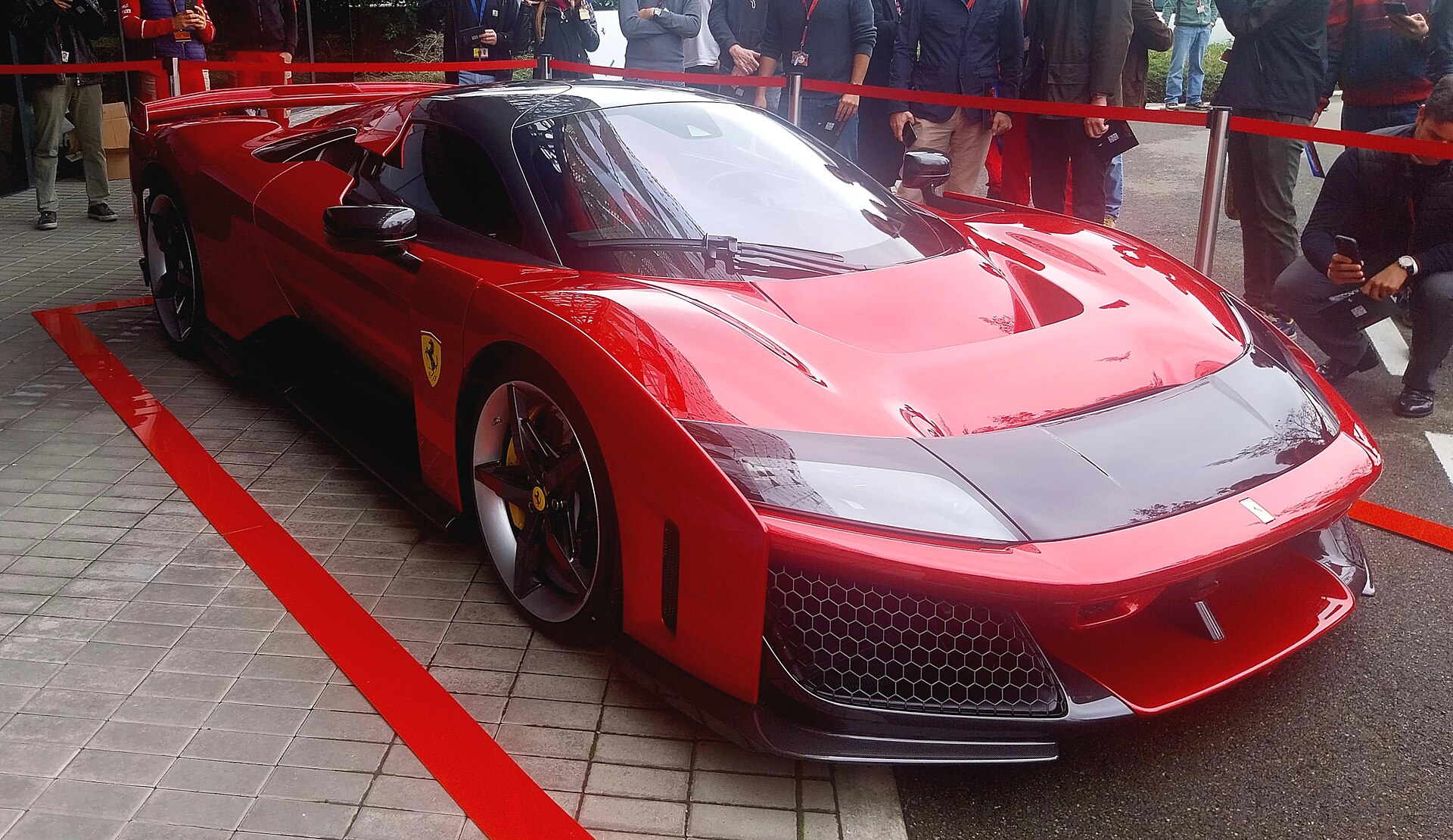
The Ferrari F80 is the hybrid hypercar that Ferrari unveiled on 17 October 2024 as the successor to the LaFerrari. Built in Maranello from 2025 in a series of 799 cars, it uses a 3.0-litre twin-turbo V6 derived from the engine of the Ferrari 499P racing car, combined with three electric motors for a total of 883 kW (1,200 PS). With a lap time of 1:15.30 at Fiorano it is the fastest road-legal Ferrari around the company's test track.
In short
- Unveiled on 17 October 2024; production in Maranello from 2025, limited to 799 cars; successor to the LaFerrari.
- 2,992 cc 120° twin-turbo V6 (F163 CF) with 662 kW (900 PS), plus three electric motors with 221 kW (300 PS); 883 kW (1,200 PS) combined.
- All-wheel drive, eight-speed dual-clutch gearbox, 2.28 kWh 800-volt battery.
- 0–100 km/h in 2.15 seconds, 0–200 km/h in 5.75 seconds, top speed 350 km/h; up to 1,050 kg of downforce.
Running cost
Fuel · F80 F250 2.9 L 6 cyl Automatic (AM8) · 2026 (EPA)
about 3,600 EUR fuel a year at 15,000 km
13.8 l/100 km · petrol at 1.75 EUR/l · change mileage, fuel price or version
Specs by version
Engines
| Version | Engine | Gearbox | Drive | Production years |
|---|---|---|---|---|
| 2.9 L 6 cyl Automatic (AM8) · 2026 (EPA) | 2.9 l · 6 cyl · Hybrid 2,900 cc | 8-sp Dual-clutch | All-wheel drive | 2026 |
Performance
Show all 1 versions
| Version | Fuel consumption |
|---|---|
| 2.9 L 6 cyl Automatic (AM8) · 2026 (EPA) | 13.8 l/100 km17.0 mpg US · 20.5 mpg UK |
Verified Manufacturer and type-approval data from our catalog · Sources and methodology
Ferrari F80 at a glance
| Specification | Ferrari F80 |
|---|---|
| Production | from 2025, Maranello (Italy); 799 cars planned |
| Design | Ferrari Styling Centre under Flavio Manzoni |
| Body | two-door coupé with butterfly doors |
| Layout | rear mid-engine, all-wheel drive (electric front axle) |
| Engine | F163 CF 2,992 cc 120° V6, two turbochargers |
| Engine power | 662 kW (900 PS) |
| Electric motors | three, 221 kW (300 PS) in total |
| System power | 883 kW (1,200 PS) |
| Gearbox | eight-speed dual-clutch (Magna 8DCL900) |
| Dry weight | 1,525 kg |
| Predecessor | LaFerrari |
The F80 continues Ferrari's line of limited-edition flagship cars, which includes the Ferrari Enzo and the LaFerrari. All current and past models are listed in the Ferrari catalogue.
Development and launch
Ferrari presented the F80 on 17 October 2024 as the successor to the LaFerrari. Prototypes had been seen around Maranello before the launch under the working name "F250". Production began in 2025 and, according to Wikipedia, was expected to continue until 2027, with 799 cars planned in total.
The engineering link to racing is direct. Ferrari says the architecture and many components of the F80's V6 come from the 499P, the car that won the Le Mans 24 Hours in 2023 and 2024. The electric motors are the first that Ferrari developed, tested and built itself in Maranello, and their design — a tooth-coil stator, a Halbach-array rotor and carbon fibre magnet retention — comes from Formula One. Ferrari calls the F80 its most powerful road car so far. For an earlier step in Ferrari's hybrid road cars, see the Ferrari SF90 Stradale.

Design
The F80 was designed by the Ferrari Styling Centre under Flavio Manzoni. It is a two-door coupé with butterfly doors, 4,840 mm long, 2,065 mm wide and only 1,138 mm high, on a 2,665 mm wheelbase.
Wikipedia points to several historic Ferraris as design influences. The name and the role of the car recall the F40, built for Ferrari's 40th anniversary. Ferrari says the vertical panel behind the front wheel arch pays homage to the F40, and the body has a dihedral cross-section anchored at the wheels. The black band across the bonnet comes from the 1960s 365 GTB/4 Daytona, and Wikipedia also lists the Daytona SP3 as an influence and notes the similarity to the 12Cilindri. Aerodynamics play a major role: Ferrari claims more than a tonne of downforce, and Wikipedia gives 1,050 kg at speed.
| Dimension | Ferrari F80 |
|---|---|
| Length | 4,840 mm |
| Width | 2,065 mm |
| Height | 1,138 mm |
| Wheelbase | 2,665 mm |
| Dry weight | 1,525 kg |

Engine and hybrid system
The combustion engine, type F163 CF, is a 2,992 cc twin-turbo V6 with a wide 120° angle between the cylinder banks, derived from the 499P race engine. It runs at a boost pressure of up to 3.7 bar and produces 662 kW (900 PS) on its own — about 221 kW per litre. Motor Trend described both the output and the specific output as the highest of any production car at the time.
The engine works with three electric motors developed by Ferrari. Two radial-flux motors form an electric front axle, which Ferrari calls e-4WD. A third motor at the rear, the MGU-K, works as starter and hybrid motor. Together the electric motors add 221 kW (300 PS). Energy comes from a 2.28 kWh lithium-ion battery that operates at 800 volts.
The combined output is 883 kW (1,200 PS). Power goes to the rear wheels through an eight-speed dual-clutch transmission, type 8DCL900, supplied by Magna.
| Figure | Ferrari F80 |
|---|---|
| V6 engine | 662 kW (900 PS), boost up to 3.7 bar |
| Electric motors | 221 kW (300 PS) |
| Combined | 883 kW (1,200 PS) |
| 0–100 km/h | 2.15 s |
| 0–200 km/h | 5.75 s |
| Top speed | 350 km/h |
| Fiorano lap | 1:15.30 |
Chassis, suspension and brakes
The F80 is built around a carbon fibre cell and roof. Aluminium subframes at the front and rear are bolted to the tub with titanium screws, and the battery sits on an additional aluminium subframe at the rear. Ferrari describes this as a multi-material approach: each area uses the material best suited to its job.
The suspension is active. It was developed from the system of the Ferrari Purosangue and retuned for a sports car. The stability electronics include version 9.0 of Ferrari's Side Slip Control, which uses a "digital twin" estimator called FIVE to model the car's behaviour from sensor data in real time.
The brakes were developed with Brembo and use a carbon-ceramic material called CCM-R Plus. Its longer carbon fibres give, according to Ferrari, twice the mechanical strength and four times the thermal conductivity of the previous material, and the braking surfaces have a silicon-carbide coating that reduces wear and shortens bedding-in.
Aerodynamics and the 1+ cockpit
Ferrari quotes 1,050 kg of downforce. At the front, an S-duct in the bonnet joins the two wings, with two internal flaps that make a three-element arrangement. An active "reverse Gurney" flap works with the active rear wing, which moves continuously between a high-downforce setting for braking and corners and a low-drag setting for straights, based on acceleration, speed and steering angle. Under the car, three pairs of bargeboards guide the air to the rear, where the diffuser is 180 cm long. To make room for it, the engine and gearbox are rotated by 1.3 degrees.
The cabin is laid out as a "1+": the driver sits at the centre of attention, as in a single-seat racing car, while the passenger seat is placed further back and integrated into the trim. This offset allowed a narrower cabin. The steering wheel is new — smaller, flattened at the top and bottom and with physical buttons on both spokes.
Performance on the road and track
Ferrari quotes 2.15 seconds from 0 to 100 km/h and 5.75 seconds from 0 to 200 km/h, with a top speed of 350 km/h. At Ferrari's Fiorano test track the F80 lapped in 1:15.30, the fastest time recorded there by a road-legal Ferrari.
These figures combine the outputs of the V6 and the electric motors with all-wheel drive and the downforce of the body, which Wikipedia gives as 1,050 kg at speed.
Production and customer cars
The F80 is limited to 799 cars, built in Maranello. Wikipedia mentions a tailor-made car seen in Monaco in April 2026 in a red Rosso Supercar livery without the standard black bonnet band and black roof.
Place in Ferrari history
The F80 is the latest in Ferrari's line of limited flagship cars, after the F40, the F50, the Enzo and the LaFerrari. Its name and black bonnet band look back to earlier Ferraris, while its engine comes from the Le Mans-winning 499P and its electric motors from Ferrari's Formula One know-how. The company's wider story is told in our history of Ferrari.

Photo gallery

Ferrari F80 in our rankings
- No. 1 of 127 · Most powerful Italian cars (883 kW)
- No. 19 of 859 · Most powerful cars (883 kW · top 3%)
- No. 16 of 313 · Most powerful coupes (883 kW · top 6%)
- No. 15 of 239 · Most powerful cars of the 2020s (883 kW · top 7%)
- No. 292 of 557 · Biggest engines: cars (2,900 cc · top 53%)
- No. 27 of 51 · Most economical coupes (13.8 l/100 km · top 55%)
More powerful than 99% of ranked Italian cars in the 1CARS catalog (No. 1 of 127).
FAQ
How much power does the Ferrari F80 have?
The 3.0-litre twin-turbo V6 produces 662 kW (900 PS), and three electric motors add 221 kW (300 PS), for a combined 883 kW (1,200 PS).
How many Ferrari F80s will be built?
Ferrari planned 799 cars, built in Maranello from 2025.
Is the F80 engine from a racing car?
Yes. Ferrari says the architecture and many parts of the 120° twin-turbo V6 come from the 499P, which won Le Mans in 2023 and 2024.
How fast is the Ferrari F80?
Ferrari quotes 0–100 km/h in 2.15 seconds, 0–200 km/h in 5.75 seconds and a top speed of 350 km/h.
Data sources
Data checked by an editor against the sources below.
- Wikipedia — Ferrari F80
- US EPA fueleconomy.gov — 50044.shtml