 Ferrari Purosangue
Specs, engines and history
Published Sources (4) Report an error
By Felix Hartmann, Automotive Technology & EV Contributor
- Built
- 2022–present
- Top power
- 533 kW (725 PS)
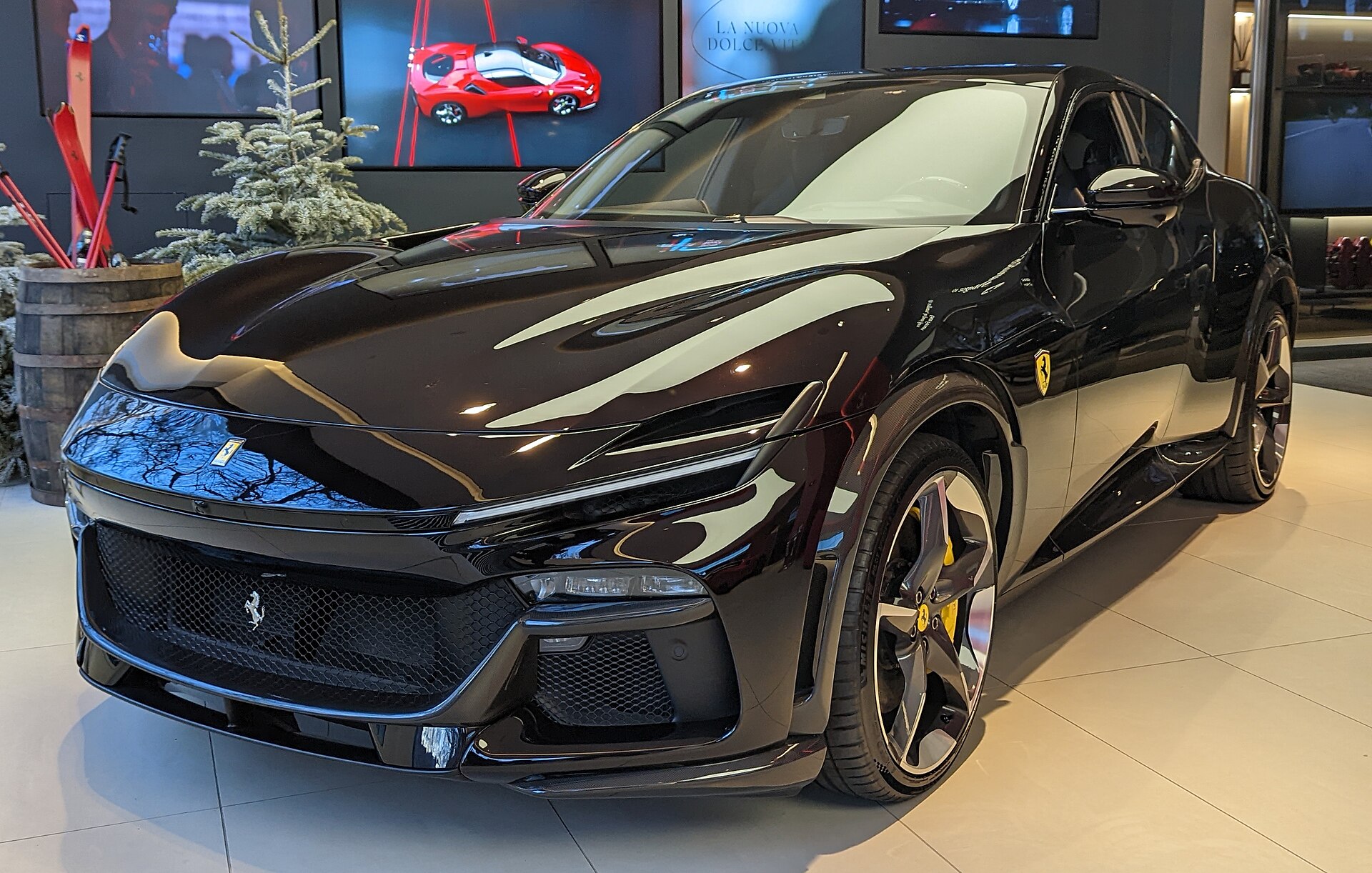
The Ferrari Purosangue is the first four-door, four-seat car in Ferrari's history. Revealed on 13 September 2022 and built in Maranello since 2023, it combines a naturally aspirated V12 with all-wheel drive, a raised body and rear-hinged rear doors. Ferrari avoids calling it an SUV; in the catalogue it stands next to the brand's grand tourers as a car for four adults that still behaves like a Ferrari on the road.
In short
- Revealed 13 September 2022 at the Teatro del Silenzio in Lajatico (Pisa); production in Maranello since 2023; €390,000 in Italy at launch (AGI, 2022).
- Front-mid-mounted 6,496 cc V12 (F140IA): 533 kW (725 PS) at 7,750 rpm and 716 Nm at 6,250 rpm; eight-speed dual-clutch gearbox.
- Active suspension with Multimatic's True Active Spool Valve technology, four-wheel steering and all-wheel drive via a front power transfer unit.
- Ferrari figures: 0–100 km/h in 3.3 s, 0–200 km/h in 10.6 s, top speed over 310 km/h.
Specs by version
Engines
| Version | Engine | Gearbox | Drive | Production years |
|---|---|---|---|---|
| 6.5 L 12 cyl Automatic (AM8) · 2026 (EPA) | 6.5 l · 12 cyl 6,500 cc | 8-sp Dual-clutch | All-wheel drive | 2026 |
| 6.5 L 12 cyl Automatic (AM8) · 2025 (EPA) | 6.5 l · 12 cyl 6,500 cc | 8-sp Dual-clutch | All-wheel drive | 2025 |
| 6.5 L 12 cyl Automatic (AM8) · 2024 (EPA) | 6.5 l · 12 cyl 6,500 cc | 8-sp Dual-clutch | All-wheel drive | 2024 |
Performance
Show all 3 versions
| Version | Fuel consumption |
|---|---|
| 6.5 L 12 cyl Automatic (AM8) · 2026 (EPA) | 19.6 l/100 km12.0 mpg US · 14.4 mpg UK |
| 6.5 L 12 cyl Automatic (AM8) · 2025 (EPA) | 19.6 l/100 km12.0 mpg US · 14.4 mpg UK |
| 6.5 L 12 cyl Automatic (AM8) · 2024 (EPA) | 19.6 l/100 km12.0 mpg US · 14.4 mpg UK |
Verified Manufacturer and type-approval data from our catalog · Sources and methodology
Ferrari Purosangue at a glance
| Specification | Ferrari Purosangue |
|---|---|
| Production | from 2023, Maranello (Italy); project code F175 |
| Body | five-door, four-seat; rear-hinged rear doors |
| Engine | F140IA 6,496 cc 65° V12, naturally aspirated, front-mid-mounted |
| Power | 533 kW (725 PS) at 7,750 rpm |
| Torque | 716 Nm at 6,250 rpm |
| Gearbox | eight-speed dual-clutch, rear transaxle |
| Drive | all-wheel drive (power transfer unit at the front, E-Diff at the rear) |
| Weight | 2,033 kg dry with lightweight options (Ferrari); 2,170 kg kerb (Wikipedia) |
| Dimensions | 4,973 mm long, 2,028 mm wide, 1,589 mm high, 3,018 mm wheelbase |
| Price at launch | €390,000 in Italy (2022) |
The Purosangue shares its V12 with the Ferrari 812 family and continues the idea of the four-seat V12 Ferraris such as the FF and the GTC4Lusso. Its rivals are cars such as the Lamborghini Urus and the Aston Martin DBX. All Ferrari models are listed in the Ferrari catalogue.
Development and launch
Development of the project, coded F175, began in 2017. The car had been hinted at by the then chief executive Sergio Marchionne and was officially confirmed in September 2018. A test mule based on the GTC4Lusso was seen in October 2018, and Ferrari released a partial official image in early 2022, about a month after leaked images had appeared.
The name means "thoroughbred" in Italian. Ferrari's attempt to register it as a trademark was opposed by the Purosangue Foundation, and the dispute went to court in March 2021.
The car was revealed on 13 September 2022 at the Teatro del Silenzio in Lajatico, near Pisa. Ferrari called it "the first ever four-door, four-seater car" in its 75-year history. According to the Italian news agency AGI, the price in Italy was €390,000 and first deliveries in Europe were planned for the second half of 2023. Demand was strong from the start: L'argus reported that Ferrari had stopped taking new orders for a time, with waiting lists of around two years. Ferrari limited the model to about a fifth of its business — AGI described the limit as 20 per cent of the average value of production, L'argus as no more than 20 per cent of annual deliveries.

Design and body
The Purosangue was designed by the Ferrari Styling Centre under Flavio Manzoni. It shares its platform with the Ferrari Roma, and the engine sits behind the front axle line with the gearbox at the rear — the classic front-mid-engine transaxle layout of Ferrari's grand tourers. Ferrari calls the car an "FUV", Ferrari Utility Vehicle.
The most unusual feature is the door arrangement. The front doors open conventionally to 63 degrees; the rear "welcome doors" are hinged at the back, open electrically to 79 degrees and make it easier to get into the rear seats. Each of the four seats is a separate, electrically adjustable and heated seat — another first for Ferrari. The boot holds 473 litres, the largest of any Ferrari according to the company.
The front has no conventional grille. Ferrari used a suspended "dihedral" element and air bridges on the bonnet, a suspended rear spoiler, a small lip on the tailgate, air curtains in the front wheel arches and a rear diffuser. A carbon fibre roof is standard and is about 20 per cent lighter than an aluminium roof with sound insulation; an electrochromic glass roof is an option. In 2024 the design received the Compasso d'Oro industrial design award.

V12 engine and gearbox
The F140IA is a 65-degree V12 with a displacement of 6,496 cc, dry-sump lubrication and high-pressure direct injection. Bore and stroke are 94 mm and 78 mm, and the compression ratio is 13.6:1. Ferrari says 80 per cent of the peak torque is available from 2,100 rpm, and the engine revs to 8,250 rpm.
| Figure | Ferrari Purosangue |
|---|---|
| Power | 533 kW (725 PS) at 7,750 rpm |
| Torque | 716 Nm at 6,250 rpm |
| 0–100 km/h | 3.3 s |
| 0–200 km/h | 10.6 s |
| Top speed | over 310 km/h |
| Braking 100–0 km/h | 32.8 m |
| Braking 200–0 km/h | 129 m |
The eight-speed dual-clutch gearbox uses the same ratios as in the SF90 Stradale and the 296 GTB. Ferrari says gear changes are about 18 per cent faster than with its earlier seven-speed unit. Fuel tank capacity is 100 litres.

All-wheel drive and active suspension
Like the FF and the GTC4Lusso, the Purosangue drives its front wheels through a power transfer unit (PTU) mounted at the front of the engine, while the rear wheels are driven through the transaxle and an electronic differential. The 4RM-S control system manages the split, with torque vectoring at the front.
The suspension is the main technical highlight. Ferrari uses Multimatic's True Active Spool Valve (TASV) system, in which 48-volt electric motors act directly on each damper. This allows the car to control body roll and pitch actively, and Ferrari describes the system as a world first. The roll centre can be lowered by up to 10 mm. Four-wheel steering, brake-by-wire and large brakes (398 mm discs at the front, 380 mm at the rear) complete the chassis. The tyres are 255/35 R22 at the front and 315/30 R23 at the rear.
Ferrari gives a weight distribution of 49 per cent front and 51 per cent rear, and says the structure has 30 per cent more torsional stiffness than its earlier designs.
Handling Speciale package
In spring 2026 Ferrari added an optional Handling Speciale package. According to CAR magazine, the active suspension is recalibrated to reduce body roll by 10 per cent, gear changes in Race and ESC Off modes are faster and happen at higher revs, and the V12 sounds louder on start-up and in the cabin. Visual changes are small: badges, carbon fibre shields on the front wings, new diamond-cut wheels and darker exhaust tips. Ferrari's performance figures stay the same, and the package has to be chosen when the car is ordered.
Interior and equipment
The cabin follows the layout of Ferrari's recent models, with a digital instrument display for the driver and a separate 10.2-inch display for the front passenger. A Burmester 3D sound system is standard, as are Android Auto and Apple CarPlay. Massaging front seats and an air-quality system with PM2.5 filtration are options. Ferrari also pointed to sustainable materials: Alcantara made with recycled polyester and carpets made from polyamide recovered from fishing nets.
Photo gallery


Ferrari Purosangue in our rankings
- No. 4 of 125 · Biggest engines: SUVs and crossovers (6,500 cc)
- No. 5 of 197 · Most powerful SUVs and crossovers (533 kW)
- No. 82 of 859 · Most powerful cars (533 kW · top 10%)
- No. 58 of 557 · Biggest engines: cars (6,500 cc · top 11%)
- No. 49 of 239 · Most powerful cars of the 2020s (533 kW · top 21%)
- No. 26 of 127 · Most powerful Italian cars (533 kW · top 21%)
More powerful than 97% of ranked SUVs and crossovers in the 1CARS catalog (No. 5 of 197).
FAQ
Is the Ferrari Purosangue an SUV?
It has a raised body, four doors and all-wheel drive, but Ferrari does not call it an SUV; it calls it a four-door, four-seat car or "FUV".
How much power does the Purosangue have?
The naturally aspirated 6.5-litre V12 produces 533 kW (725 PS) and 716 Nm.
How much did the Ferrari Purosangue cost?
At launch in 2022 the price in Italy was €390,000, according to AGI.
How fast is the Purosangue?
Ferrari quotes 0–100 km/h in 3.3 seconds and a top speed of over 310 km/h.
Data sources
Data checked by an editor against the sources below.
- Wikipedia — Ferrari Purosangue
- US EPA fueleconomy.gov — 49801.shtml
- US EPA fueleconomy.gov — 48634.shtml
- US EPA fueleconomy.gov — 47264.shtml