 Ferrari 456
All generations, specs and history
Published Sources (1) Report an error
By Felix Hartmann, Automotive Technology & EV Contributor
- Built
- 1992–2003
- Generations
- 2
- Top power
- 325 kW (442 PS)
Timeline
456 generations
Click a generation for its own page


- 456 GT / GTA 1992–1998 · Coupe · 325 kW (442 PS)
- 456M GT / GTA 1998–2003 · Coupe · 325 kW (442 PS)
Newest first · 2 generations since 1992
-
1998
-
1992
All generations by year: 456M GT / GTA (1998–2003) · 456 GT / GTA (1992–1998)
Which one is mine?
Pick the year of first registration to see which generation it is.
- 456M GT / GTA 1998–2003
- 456 GT / GTA 1992–1998
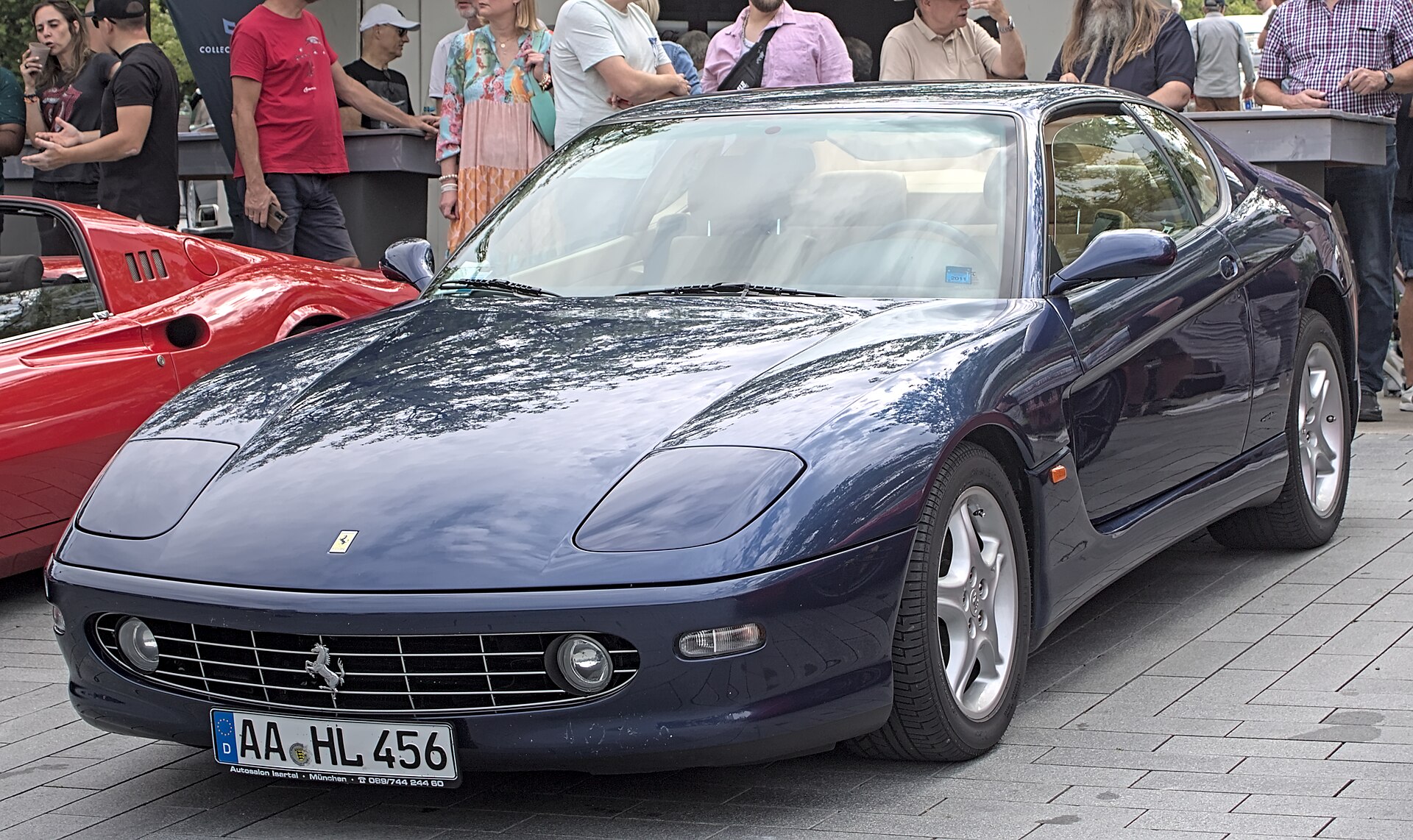
The Ferrari 456 is a front-engined V12 grand tourer with four seats, built in Maranello from 1992 to 2003. It replaced the 412 and, unlike its automatic-only predecessors, was offered with a six-speed manual transaxle; an automatic GTA followed in 1996, and the updated 456M arrived in 1998. With 325 kW (442 PS) it was, according to Wikipedia, the second-fastest production four-seater in the world at its launch. Ferrari built 3,289 cars before the 612 Scaglietti took over.
In short
- Announced in September 1992, shown at the Paris motor show in October 1992; 456 built 1992–1997, 456M 1998–2003; 3,289 cars.
- 5,474 cc 65° V12 with four valves per cylinder: 325 kW (442 PS) at 6,200 rpm.
- Six-speed all-synchromesh manual transaxle (GT) or four-speed automatic (GTA, from 1996).
- 0–100 km/h in 5.2 seconds (GT) and a claimed top speed of 309 km/h.
Ferrari 456 at a glance
| Specification | Ferrari 456 GT / GTA / 456M |
|---|---|
| Production | 1992–2003, Maranello (Italy) |
| Cars built | 3,289 (456: 1,951; 456M: 1,338) |
| Body | 2+2 coupé; front engine, rear-wheel drive |
| Engine | F116 5,474 cc V12, 65°, dry sump |
| Power | 325 kW (442 PS) at 6,200 rpm |
| Gearbox | six-speed manual transaxle (GT) or four-speed automatic (GTA) |
| Weight | 1,690–1,770 kg |
| Dimensions | 4,730 mm long (456M 4,763 mm), 1,920 mm wide, 1,300 mm high, wheelbase 2,600 mm |
| Predecessor / successor | 412 / 612 Scaglietti |
The 456 belongs to the line of front-engined V12 Ferraris; later examples on 1CARS include the Ferrari 599 and the Ferrari 812. All models are listed in the Ferrari catalogue.
History: launch in Brussels and Paris, 1992
Ferrari announced the 456 in September 1992, at an event marking the 40th anniversary of its Belgian importer Garage Francorchamps, with a launch gala at the Palais du Cinquantenaire in Brussels. The public debut followed at the Paris motor show in October 1992. The name follows Ferrari tradition: 456 refers to the swept volume of one cylinder, about 456 cc.
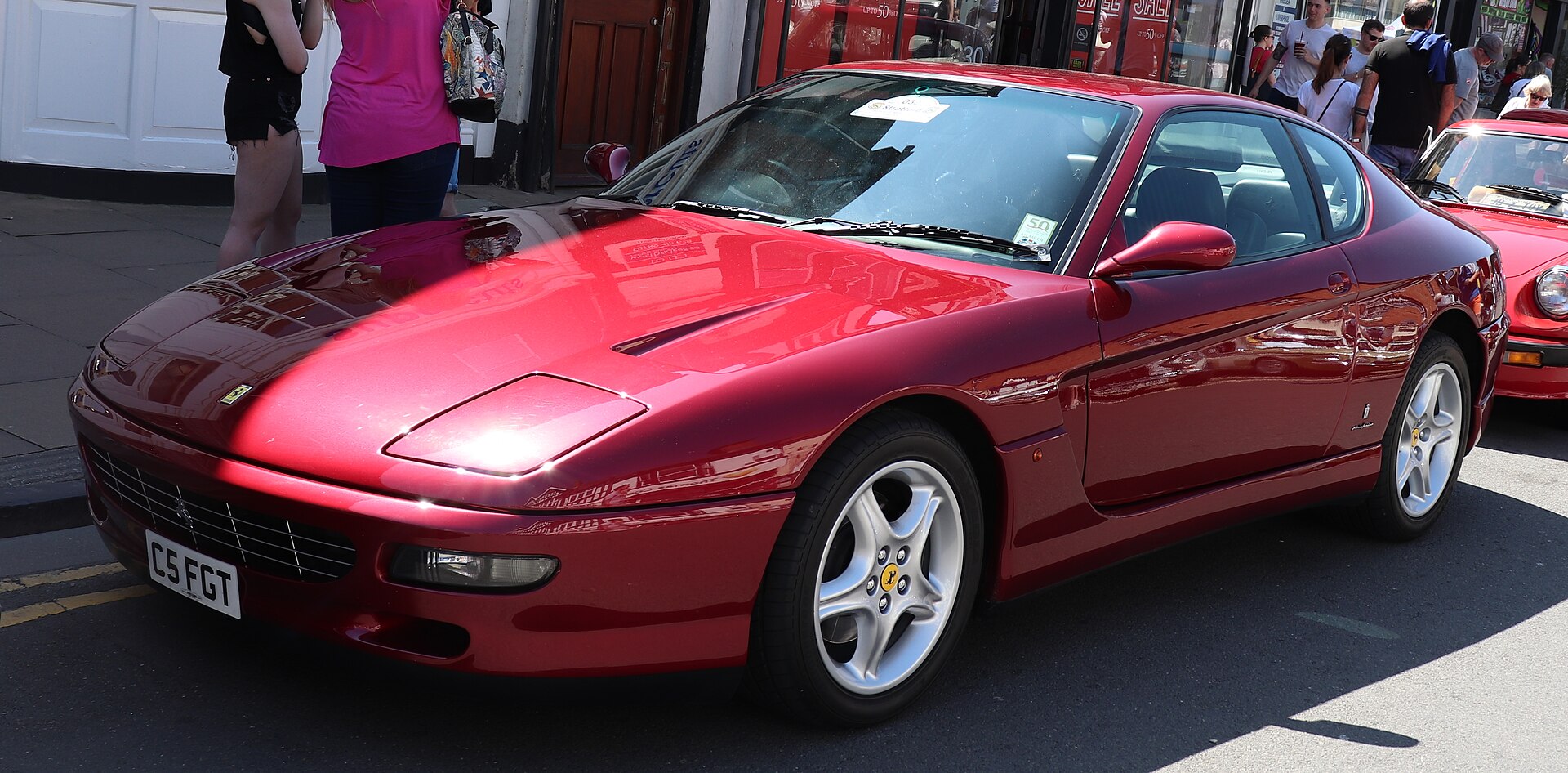
The 456 replaced the 412 and was the company's most powerful regular production road car when it was developed. The automatic GTA joined the GT in 1996. In 1998 the revised 456M (for "modificata") was shown at the Geneva motor show, and it stayed in production until 2003. The 612 Scaglietti replaced it in 2004.
Engine and gearboxes
The engine is a 65° V12 of 5,474 cc (bore 88 mm, stroke 75 mm) with twin overhead camshafts per bank, four valves per cylinder and dry-sump lubrication. The block, heads and sump are made of light alloy, with Nikasil-coated cylinder liners. Ferrari describes it as its first new twelve-cylinder engine since the flat-12 of the Berlinetta Boxer. Engine management was by Bosch Motronic 2.7, replaced by Motronic 5.2 in 1996 (engine code F116 C). It produces 325 kW (442 PS) at 6,200 rpm, and it won its class in the International Engine of the Year awards in 2000 and 2001.
The six-speed manual gearbox is mounted at the rear as a transaxle — Ferrari says it was the first all-synchromesh six-speed transaxle on one of its road cars. Earlier Ferrari 2+2 models had been sold with automatic gearboxes; the 456 at first was manual only. The four-speed automatic of the GTA, introduced in 1996, was developed with FF Developments.
| Version | Years | Gearbox | 0–100 km/h (Ferrari) | Built |
|---|---|---|---|---|
| 456 GT | 1992–1997 | six-speed manual | 5.2 s | 1,548 |
| 456 GTA | 1996–1997 | four-speed automatic | 5.5 s | 403 |
| 456M GT | 1998–2003 | six-speed manual | — | 688 |
| 456M GTA | 1998–2003 | four-speed automatic | — | 650 |

Design, chassis and cabin
Pietro Camardella designed the body at Pininfarina, with an interior by Maurizio Corbi under Lorenzo Ramaciotti. The shape has retractable headlights and recalls the 365 GTB/4 "Daytona". The body uses aluminium panels welded to a steel tube frame with a sandwich material called Feran, plus composite front and rear sections. An electrically operated rear spoiler adjusted its angle with speed to add downforce. Pininfarina built the bodies until 1996, 1,435 in total.
The wheelbase is 2,600 mm, 100 mm shorter than the 412's. The independent suspension has electronically adjustable dampers that the driver can select, self-levelling at the rear and anti-roll bars at both ends; the power steering reduces its assistance as speed rises. All four brakes are ventilated discs with anti-lock.
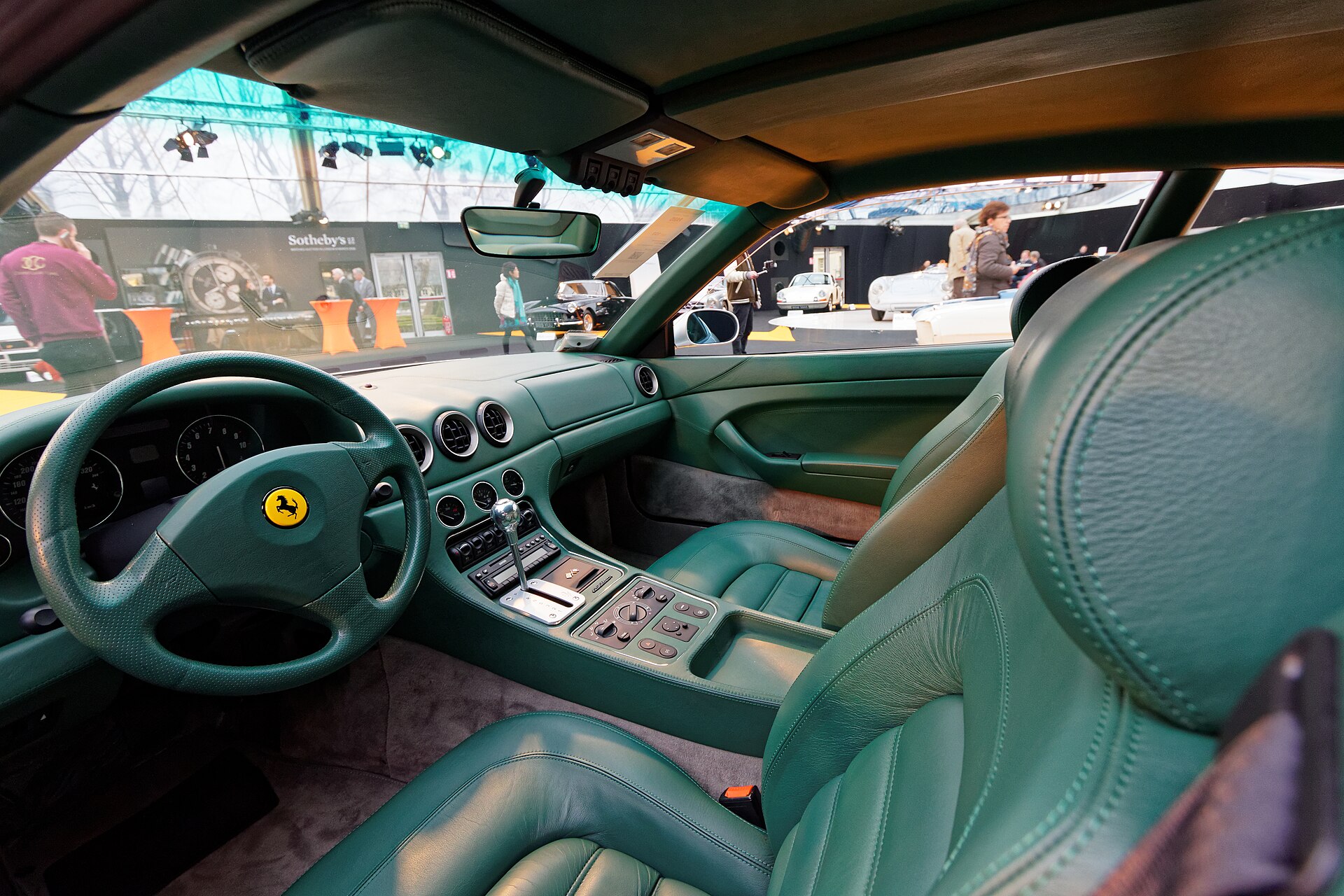
Inside, the 456 has four leather seats, fitted leather luggage, electric front seats that slide forward for access to the rear, air-conditioning and an eight-speaker CD stereo. Twin airbags became standard in mid-1996.

The 456M (1998–2003)
The 456M kept the 325 kW (442 PS) output but was refined in many details. Ken Okuyama at Pininfarina reworked the design; the car became 33 mm longer, the motorised rear spoiler was replaced by a fixed one, and the dashboard was simplified from five gauges to three. The front brakes received 330 mm discs from the 550 Maranello. A Schumacher Edition of 30 cars (10 with manual gearbox) was built in the Scaglietti programme.

Special versions
The 456 was popular with the royal family of Brunei, which ordered several unique cars from Pininfarina: at least three four-door saloons, two spyder convertibles and seven five-door estates called "Venice", commissioned by Prince Jefri Bolkiah. The American firm R. Straman built three cabriolet conversions for private customers.

Legacy
The 456 brought back the idea of a fast, practical four-seat Ferrari with a manual gearbox and a big V12, and it led to the 612 Scaglietti and later four-seat V12 Ferraris. For the company's background see our history of Ferrari.
Photo gallery

Ferrari 456: first vs latest generation
| Spec | 456 GT / GTA | 456M GT / GTA | Change |
|---|---|---|---|
| Years | 1992–1998 | 1998–2003 | 6 years apart |
| Most powerful version | 325 kW (442 PS) | 325 kW (442 PS) | same (0%) |
Oldest and newest generation in the 1cars catalog. Power is the strongest version of each; other rows are shown only when both generations have the figure.
Image credits · Photos from Wikimedia Commons under free licences
- Ferrari 456 GT / GTA · Photo: Vauxford / Wikimedia Commons, CC BY-SA 4.0
Ferrari 456 in our rankings
- No. 8 of 91 · Most powerful cars of the 1990s (325 kW)
- No. 243 of 859 · Most powerful cars (325 kW · top 29%)
- No. 330 of 912 · Longest-running car nameplates (11 years · top 39%)
- No. 54 of 127 · Most powerful Italian cars (325 kW · top 43%)
- No. 135 of 313 · Most powerful coupes (325 kW · top 44%)
- No. 253 of 345 · Cars with the most generations (2 generations)
More powerful than 91% of ranked cars of the 1990s in the 1CARS catalog (No. 8 of 91).
FAQ
What does 456 mean?
It refers to the swept volume of one cylinder, about 456 cc, of the 5.5-litre V12.
How powerful is the Ferrari 456?
Its 5,474 cc V12 produces 325 kW (442 PS) at 6,200 rpm in both the 456 and the 456M.
How many Ferrari 456s were built?
3,289: 1,951 of the original 456 (1,548 GT and 403 GTA) and 1,338 of the 456M (688 GT and 650 GTA).
What is the difference between the 456 GT and GTA?
The GT has a six-speed manual transaxle; the GTA, from 1996, has a four-speed automatic and is slightly slower to 100 km/h.
Data sources
Data checked by an editor against the sources below.