 Ferrari Daytona SP3
Specs, engines and history
Published Sources (4) Report an error
By Felix Hartmann, Automotive Technology & EV Contributor
- Built
- 2021–2025
- Top power
- 618 kW (840 PS)
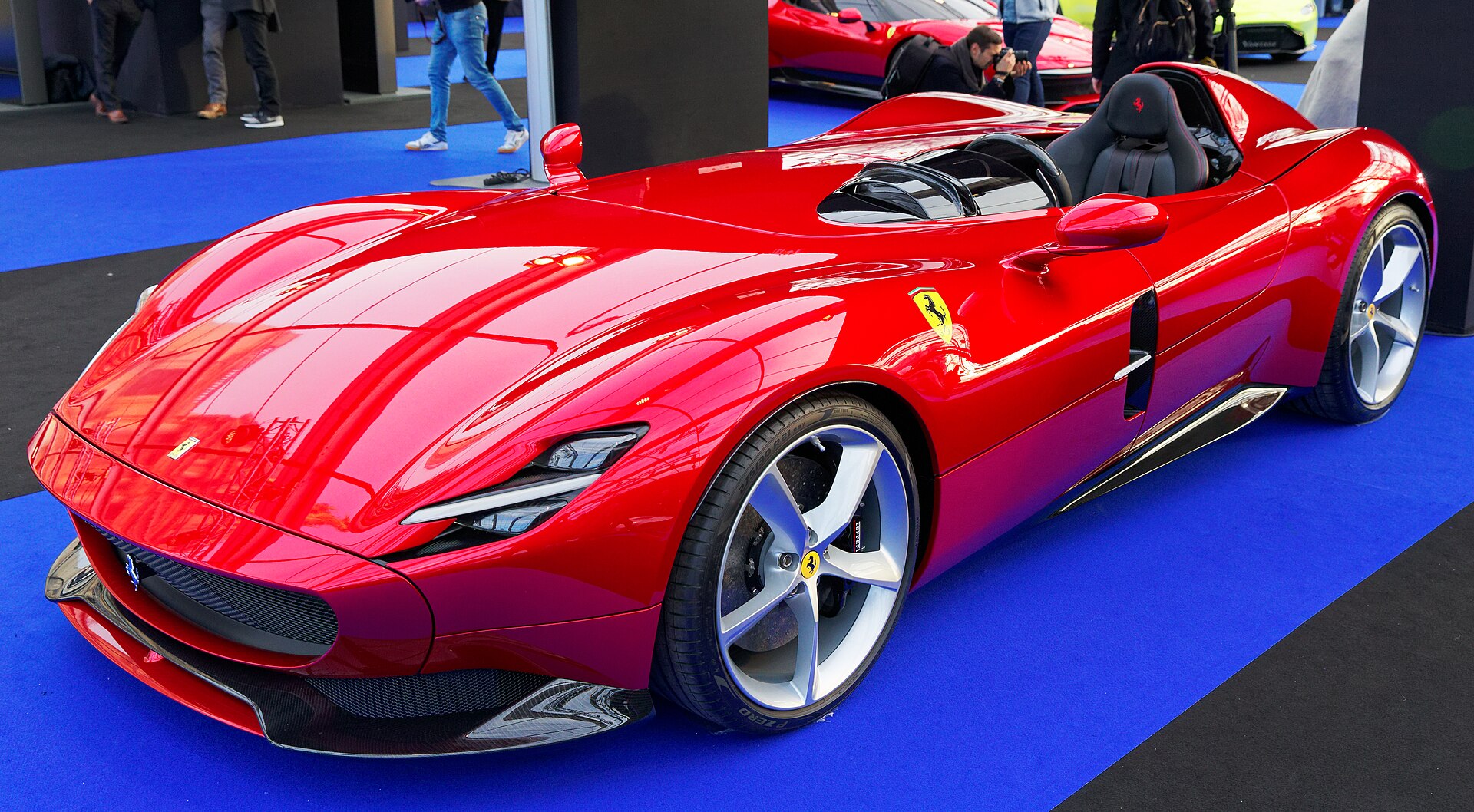
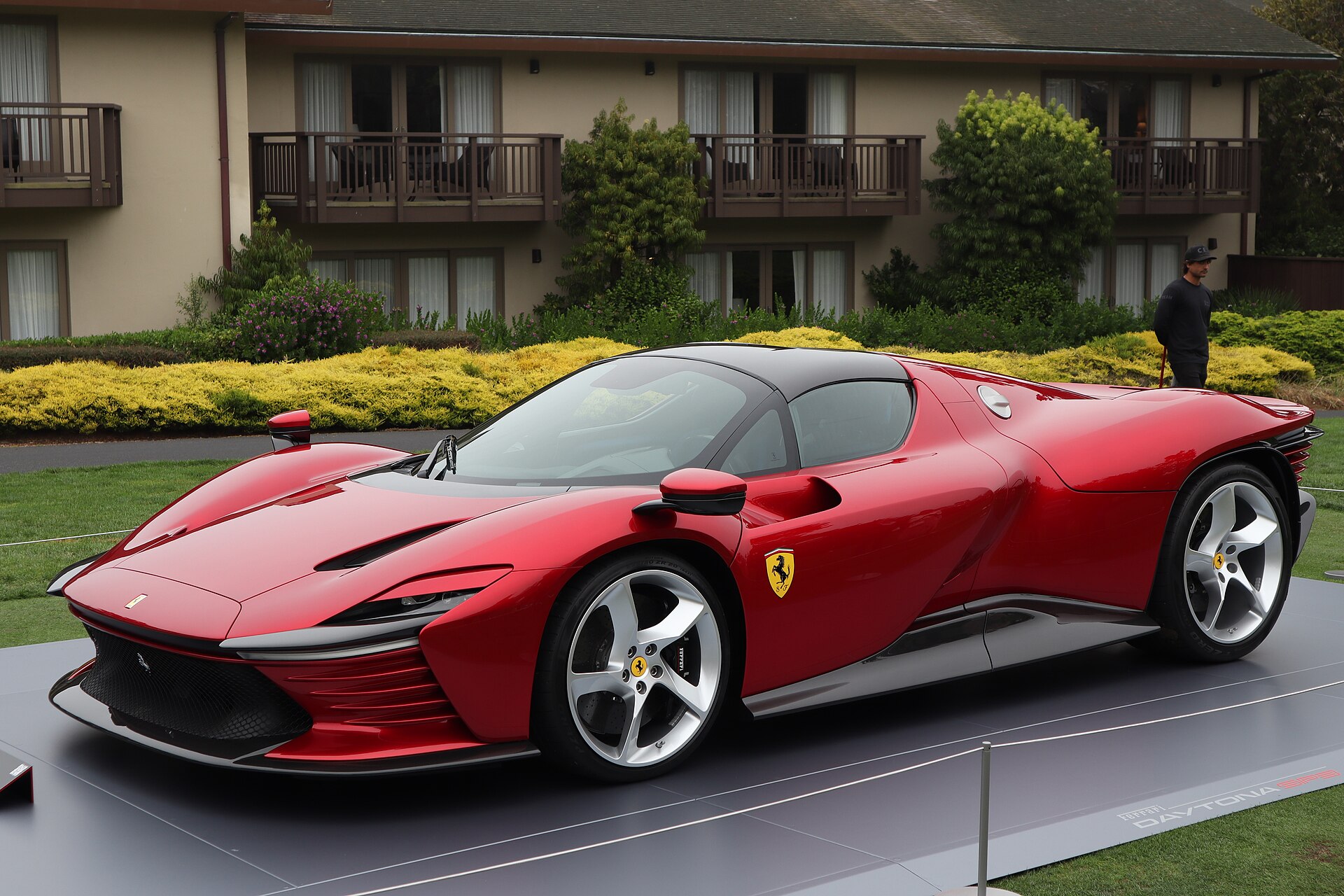
The Ferrari Daytona SP3 is a limited-edition, mid-engined V12 sports car with a removable targa roof, built in Maranello from 2022 to 2025. Unveiled in November 2021, it is the second model of Ferrari's Icona series, after the Monza SP1 and SP2. Its design pays tribute to the sports prototypes that took the first three places at the 1967 24 Hours of Daytona. Ferrari built 599 cars for selected customers, plus one more for charity.
In short
- Icona series car, 599 built from 2022 (a 600th was sold for The Ferrari Foundation in 2025), all sold by invitation.
- 6,496 cc naturally aspirated 65° V12 behind the cabin: 618 kW (840 PS) at 9,250 rpm, 697 Nm at 7,250 rpm, 9,500 rpm limit.
- Seven-speed dual-clutch gearbox, rear-wheel drive, carbon-fibre chassis derived from the LaFerrari Aperta, 1,485 kg dry.
- 0–100 km/h in 2.85 seconds, 0–200 km/h in 7.4 seconds, top speed over 340 km/h.
Specs by version
Engines
| Version | Engine | Gearbox | Drive | Production years |
|---|---|---|---|---|
| 6.5 L 12 cyl Automatic (AM7) · 2025 (EPA) | 6.5 l · 12 cyl 6,500 cc | 7-sp Dual-clutch | Rear-wheel drive | 2025 |
| 6.5 L 12 cyl Automatic (AM7) · 2024 (EPA) | 6.5 l · 12 cyl 6,500 cc | 7-sp Dual-clutch | Rear-wheel drive | 2024 |
| 6.5 L 12 cyl Automatic (AM7) · 2023 (EPA) | 6.5 l · 12 cyl 6,500 cc | 7-sp Dual-clutch | Rear-wheel drive | 2023 |
Performance
Show all 3 versions
| Version | Fuel consumption |
|---|---|
| 6.5 L 12 cyl Automatic (AM7) · 2025 (EPA) | 18.1 l/100 km13.0 mpg US · 15.6 mpg UK |
| 6.5 L 12 cyl Automatic (AM7) · 2024 (EPA) | 18.1 l/100 km13.0 mpg US · 15.6 mpg UK |
| 6.5 L 12 cyl Automatic (AM7) · 2023 (EPA) | 18.1 l/100 km13.0 mpg US · 15.6 mpg UK |
Verified Manufacturer and type-approval data from our catalog · Sources and methodology
Ferrari Daytona SP3 at a glance
| Specification | Ferrari Daytona SP3 |
|---|---|
| Production | 2022–2025, Maranello (Italy) |
| Cars built | 599 (plus one charity car in 2025) |
| Body | two-seat targa with removable roof, butterfly doors; mid-engine, rear-wheel drive |
| Engine | F140 HC 6,496 cc V12, 65°, naturally aspirated |
| Power | 618 kW (840 PS) at 9,250 rpm |
| Torque | 697 Nm at 7,250 rpm |
| Gearbox | seven-speed dual-clutch |
| Weight | 1,485 kg dry; weight distribution 44:56 |
| Series | Icona (after Monza SP1/SP2) |
The Daytona SP3 shares its V12 with the front-engined Ferrari 812 and its carbon chassis concept with the open LaFerrari. Other limited Ferraris are listed in the Ferrari catalogue.
History and the Icona series
Ferrari started the Icona series in 2018 with the Monza SP1 and SP2: small runs of modern cars whose design recalls famous Ferraris of the past. The second model was unveiled on 20 November 2021 and shown in full two days later at the Finali Mondiali at Mugello. To mark the occasion, the new car crossed the line in a photo finish with two 330 P4s and a 412 P. It was a reminder of Ferrari's one-two-three at the 1967 24 Hours of Daytona, the first round of that year's World Sports Car Championship.
Ferrari planned 599 cars from 2022 and sold them by invitation to existing Ferrari customers. According to Wikipedia, all 499 owners of a Monza SP1 or SP2 bought one, and the remaining 100 went to collectors of earlier limited-edition Ferraris. In 2025 a 600th example was built and sold at the Monterey Car Week, with all proceeds going to The Ferrari Foundation.
Why Daytona: the 1967 race
Ferrari calls the 1960s the golden age of closed-wheel sports prototype racing. The 24 Hours of Daytona on 4–5 February 1967 was the first round of that year's World Sports Car Championship. There Ferrari answered Ford's victory at Le Mans the year before with a one-two-three finish: a 330 P3/4, a 330 P4 and a 412 P crossed the line side by side. The image of the three cars arriving together became one of the best-known in Ferrari's racing history, and the 330 P4 that won the race is the direct model for the SP3's shape. The name Daytona had already been attached unofficially, by the media, to the 365 GTB/4 of 1968; with the SP3 Ferrari used it officially for a road car.
Design inspired by the 330 P4
The Ferrari Styling Centre under Flavio Manzoni took the 330 P4 of 1967 as the main reference and added details from other racing Ferraris of the period:
- The low, wraparound windscreen and the mirrors placed on top of the front wings come from the 330 P3 and P4.
- The "double-crested" front wings refer to the 512 S, 712 Can-Am and 312 P.
- The horizontal fins at the rear are inspired by the 250 P5 concept that Pininfarina designed in 1968.
- The headlamps are partly hidden under a cover that slides back when the lights are switched on.
The body has a removable targa roof that is stored separately when off, and the butterfly doors open upwards, as on the Enzo and LaFerrari. The car is 4,686 mm long, 2,050 mm wide and only 1,142 mm high, on a 2,651 mm wheelbase.
There is no active aerodynamics. Ferrari designed the body to work purely passively; according to technical director Michael Leiters, it produces about 230 kg of downforce at 201 km/h. The radiator air ducts run inside the door trims.


Engine and performance
The engine is the F140 HC naturally aspirated V12 of 6,496 cc, with a 65° angle between the banks. It is shared with the front-engined 812 family and here produces 618 kW (840 PS) at 9,250 rpm and 697 Nm at 7,250 rpm, with a rev limit of 9,500 rpm. Placed behind the cabin, it made the SP3 the first mid-engined V12 Ferrari road car without hybrid support since the Enzo of 2002. Wikipedia describes it as the last mid-engined V12 for Ferrari road cars, as the company moves to hybrid V8 and V6 engines.
A seven-speed dual-clutch gearbox (a faster-shifting version of the 812 Competizione unit) drives the rear wheels; gear changes take less than 200 milliseconds. The electronic systems include the e-Diff, F1-Trac and the Side Slip Control 6.1 with Ferrari Dynamic Enhancer.
| Figure | Daytona SP3 |
|---|---|
| Power | 618 kW (840 PS) at 9,250 rpm |
| Torque | 697 Nm at 7,250 rpm |
| 0–100 km/h | 2.85 s |
| 0–200 km/h | 7.4 s |
| Top speed | over 340 km/h |
| Dry weight / power-to-weight | 1,485 kg / 416 kW (566 PS) per tonne |

Chassis and cabin
The chassis is derived from that of the LaFerrari Aperta and uses carbon fibre for the tub and several body panels. The weight distribution is 44% front and 56% rear. The car runs on Pirelli P Zero Corsa tyres, 265/30 ZR20 at the front and 345/30 ZR21 at the rear, with Brembo brakes of 398 mm at the front and 380 mm at the rear.
The cabin follows the racing-car theme.
The seats are fixed to the structure and cannot be adjusted; instead, the pedal box moves forwards and backwards. The dashboard is carbon fibre with an Alcantara-covered top, the driver faces a 16-inch curved digital display, and the centre console recalls the open-gate gear lever of classic Ferraris.
The carbon steering wheel, an evolution of the one in the Ferrari Roma, uses touch controls and keeps the traditional Manettino switch. According to Ferrari, about 80% of the functions can be operated without taking the hands off the wheel, and a light strip at the top of the rim shows when to change gear. The seats are two-piece shells with a separate headrest, and the steering column adjusts for height. In the US test cycle the SP3 is rated at 18.1 l/100 km combined.
Production and legacy
All 599 planned cars were built between 2022 and 2025. The extra 600th car, built to a special "Tailor Made" specification in black and yellow, was auctioned by RM Sotheby's in 2025 for The Ferrari Foundation.
The Daytona SP3 closes a long line of mid-engined twelve-cylinder Ferraris that began with the racing cars of the 1960s and continued on the road with the Berlinetta Boxer, the Ferrari Enzo and the LaFerrari. It is above all a tribute to the brand's racing past, built for collectors. For the wider story see our history of Ferrari.
Photo gallery


Ferrari Daytona SP3 in our rankings
- No. 3 of 79 · Most powerful convertibles and roadsters (618 kW)
- No. 7 of 49 · Biggest engines: convertibles and roadsters (6,500 cc)
- No. 10 of 127 · Most powerful Italian cars (618 kW)
- No. 40 of 859 · Most powerful cars (618 kW · top 5%)
- No. 25 of 239 · Most powerful cars of the 2020s (618 kW · top 11%)
- No. 57 of 557 · Biggest engines: cars (6,500 cc · top 11%)
More powerful than 96% of ranked convertibles and roadsters in the 1CARS catalog (No. 3 of 79).
FAQ
How many Ferrari Daytona SP3s were built?
Ferrari built 599 cars from 2022 to 2025. A 600th car was added in 2025 and sold for The Ferrari Foundation.
What engine does the Daytona SP3 use?
A naturally aspirated 6.5-litre (6,496 cc) V12 mounted behind the cabin, with 618 kW (840 PS) at 9,250 rpm and 697 Nm.
How fast is the Daytona SP3?
Ferrari quotes 0–100 km/h in 2.85 seconds, 0–200 km/h in 7.4 seconds and a top speed of more than 340 km/h.
Why is it called Daytona?
The name recalls Ferrari's one-two-three finish at the 1967 24 Hours of Daytona with the 330 P3/4, 330 P4 and 412 P, the cars that inspired its design.
Is the Daytona SP3 a hybrid?
No. It was the first mid-engined V12 Ferrari road car without hybrid support since the Enzo of 2002.
Data sources
Data checked by an editor against the sources below.
- Wikipedia — Ferrari Daytona SP3
- US EPA fueleconomy.gov — 48580.shtml
- US EPA fueleconomy.gov — 47010.shtml
- US EPA fueleconomy.gov — 45965.shtml