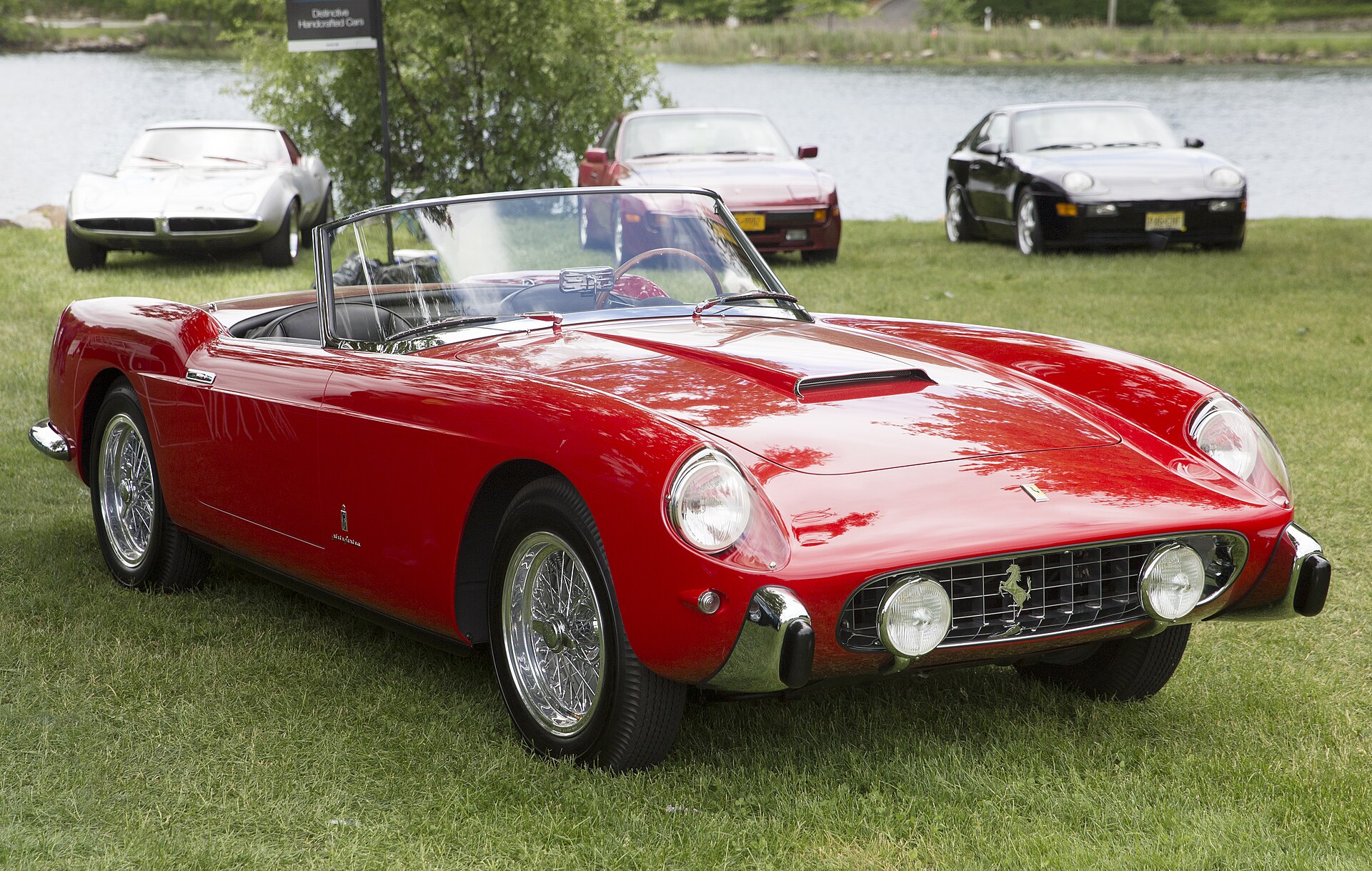
 Ferrari 250 GT Cabriolet
All generations, specs and history
Published Sources (1) Report an error
By Felix Hartmann, Automotive Technology & EV Contributor
- Built
- 1957–1962
- Generations
- 2
Timeline
250 GT Cabriolet generations
Click a generation for its own page
- 250 GT Cabriolet Series I 1957–1959 · Convertible
- 250 GT Cabriolet Series II 1959–1962 · Convertible
Newest first · 2 generations since 1957


All generations by year: 250 GT Cabriolet Series II (1959–1962) · 250 GT Cabriolet Series I (1957–1959)
Which one is mine?
Pick the year of first registration to see which generation it is.
- 250 GT Cabriolet Series II 1959–1962
- 250 GT Cabriolet Series I 1957–1959
The Ferrari 250 GT Cabriolet Pinin Farina is the open, comfortable member of Ferrari's 250 GT family of the late 1950s. Built from 1957 to 1962, it was designed and bodied by Pinin Farina rather than by Scaglietti, and it was offered in two series. The first series was made in only about 30 cars; the second, shown at the Paris motor show in 1959, reached around 200. Its engine is the 3.0-litre Colombo V12 with 177 kW (240 PS).
In short
- Built from July 1957 to the end of 1962; Series I about 30 cars, Series II about 200 (the Ferrari 250 article gives about 36 and about 212).
- Designed and built by Pinin Farina; production in the new Pinin Farina plant at Grugliasco near Turin.
- 2,953 cc 60° Colombo V12 with three Weber carburettors: 177 kW (240 PS) at 7,000 rpm and 245 Nm.
- Four-speed manual gearbox with overdrive; 1,050 kg; top speed 240 km/h; removable hard top from 1961.
Ferrari 250 GT Cabriolet at a glance
| Specification | Ferrari 250 GT Cabriolet Pinin Farina |
|---|---|
| Production | July 1957 – 1962 |
| Cars built | Series I about 30; Series II about 200 |
| Design and body | Pinin Farina |
| Body | two-seat cabriolet; hard top optional from 1961 |
| Chassis | tubular steel frame, 2,600 mm wheelbase |
| Engine | 2,953 cc 60° Colombo V12, one camshaft per bank |
| Power | 177 kW (240 PS) at 7,000 rpm |
| Torque | 245 Nm |
| Gearbox | four-speed manual with overdrive |
| Weight | 1,050 kg |
| Top speed | 240 km/h |
| Predecessor / successor | 212 Inter / 275 GTS |
The cabriolet belongs to the large Ferrari 250 family, which also includes the Ferrari 250 GT Tour de France. All Ferrari models are in the Ferrari catalogue.
History and prototypes
Open 250s started with a series of prototypes. In 1953 Pinin Farina built a cabriolet called "Ariowitch" on a 250 Europa chassis with a Lampredi engine. In 1956 a second cabriolet, based on the Europa GT and designed by Mario Boano, was shown at Geneva. The final prototype, built by Pinin Farina on a 250 GT chassis, appeared at the Geneva show in 1957.
Pinin Farina's 1956 Geneva show car was lent to the racing driver Peter Collins. He raced it in England with four Dunlop disc brakes.
Enzo Ferrari's aim was higher output and higher sales. Production of the cabriolet began in July 1957.
Design and production by Pinin Farina
Unusually for Ferrari at the time, the same company designed the car and built its body. Most bodies of the period were made by Scaglietti, but the cabriolet came from Pinin Farina's new, larger plant at Grugliasco near Turin. Ferrari also installed a new raised assembly line at its own factory.
The Series I, which Wikipedia describes as a kind of pre-production, was built until July 1959. It can be recognised by two vertical bumpers on each side of the grille and two long-range lamps in front of it; in 1958 the lamps moved behind the grille. The Series I was based on the 250 GT Boano/Ellena.
The Series II was unveiled at the Paris motor show in October 1959. Like the California Spyder, it was based on the 250 GT Berlinetta "Tour de France". It has a higher, more upright windscreen, larger side windows, more room behind the seats and a larger boot. A change in Italian law replaced the special low-beam headlamps with conventional units, and some cars have chrome vents behind the front wheel arches. From 1961 a removable hard top was available. The Series II was the most expensive 250 GT of its time.
| Dimension | 250 GT Cabriolet |
|---|---|
| Length | 4,430 mm |
| Width | 1,980 mm |
| Height | 1,130 mm |
| Wheelbase | 2,600 mm |
| Weight | 1,050 kg |

Engine and chassis
The engine is the 60° Colombo V12 of 2,953 cc, with a bore of 73 mm and a stroke of 58.8 mm and one overhead camshaft per bank. Series I cars used three Weber 36 DCL 3 carburettors, Series II cars Weber 40 DCL. The compression ratio was between 8.5:1 and 9.5:1. Wikipedia gives 177 kW (240 PS) at 7,000 rpm and 245 Nm. In 1960 the spark plugs were moved to the outside of the cylinder heads, and the engine received twelve separate intake ducts.
Power goes through a four-speed manual gearbox with overdrive. The tubular steel frame carries independent front suspension with double wishbones and coil springs, and a rigid rear axle with semi-elliptic leaf springs and parallel trailing arms. Telescopic hydraulic dampers are fitted all round. Drum brakes were later replaced by discs, which Ferrari first adopted on the 250 Testa Rossa racing car.
Wikipedia quotes a top speed of 240 km/h and 0–100 km/h in about 7.1 seconds. Inside there is a wooden Nardi steering wheel with three aluminium spokes and seven round instruments.

Cabriolet or California Spyder?
The 250 GT California Spyder, built from the following year mainly for the American market, looks similar but had a sportier character. The Pinin Farina Cabriolet put more weight on comfort, refinement and a luxurious interior. Wikipedia notes that the California Spyder is better remembered today.

Legacy
The 250 GT Cabriolet sits between the 212 Inter and the 275 GTS in Ferrari's line of open grand tourers. With about 230 cars in two series, it was built in much larger numbers than the earlier prototypes, and Pinin Farina was responsible for both its design and its body. More about the company is in our history of Ferrari.
Photo gallery

Image credits · Photos from Wikimedia Commons under free licences
- Ferrari 250 GT Cabriolet Series I · Photo: Mr.choppers / Wikimedia Commons, CC BY-SA 4.0
- Ferrari 250 GT Cabriolet Series II · Photo: Glen Bowman / Flickr, CC BY 2.0
Ferrari 250 GT Cabriolet in our rankings
- No. 628 of 912 · Longest-running car nameplates (5 years · top 77%)
- No. 238 of 345 · Cars with the most generations (2 generations)
In production longer than 23% of ranked nameplates in the 1CARS catalog (No. 628 of 912).
FAQ
How many Ferrari 250 GT Cabriolets were built?
About 30 of the Series I (1957–1959) and about 200 of the Series II (1959–1962), according to Wikipedia's cabriolet article; its Ferrari 250 article gives about 36 and about 212.
What is the difference between Series I and Series II?
The Series II, from October 1959, has a higher windscreen, larger side windows, more room behind the seats, a larger boot and was based on the 250 GT "Tour de France" chassis.
How powerful is the 250 GT Cabriolet?
Its 3.0-litre Colombo V12 produces 177 kW (240 PS) at 7,000 rpm and 245 Nm.
What is the difference from the California Spyder?
The California Spyder was sportier and aimed at the American market, while the Pinin Farina Cabriolet focused on comfort and a luxurious interior.
Data sources
Data checked by an editor against the sources below.