 Ferrari 250 GT SWB
Specs, engines and history
Published Sources (1) Report an error
By Felix Hartmann, Automotive Technology & EV Contributor
- Built
- 1959–1962
- Top power
- 206 kW (280 PS)
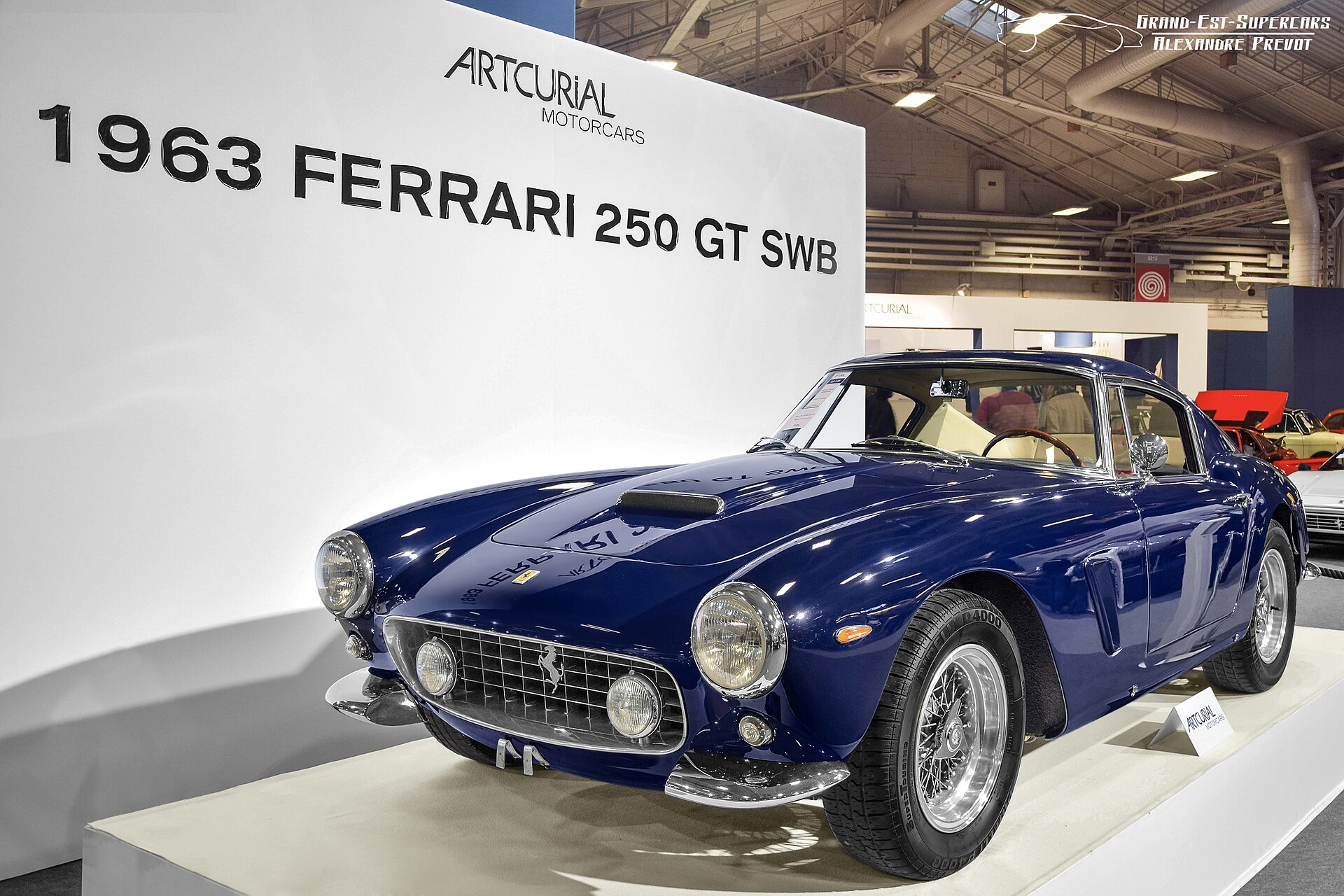
The Ferrari 250 GT SWB Berlinetta is the short-wheelbase version of Ferrari's 250 GT, built from 1959 to 1962 as a car that could be driven to a race, win it and be driven home. Designed by Pininfarina and bodied by Scaglietti in Modena, it combined a 3.0-litre Colombo V12 with a 2,400 mm wheelbase and disc brakes, and it was sold both as a road-oriented "Lusso" and as an aluminium-bodied "Competizione". It won the GT class at Le Mans, the Tour de France Automobile three years in a row and the Tourist Trophy at Goodwood, and it is one of the most sought-after Ferraris of its era.
In short
- Shown at the Paris Motor Show in October 1959; built until 1962. Wikipedia gives 176 cars, RM Sotheby's 165.
- 2,953 cc 60° V12 (bore × stroke 73 × 58.8 mm), three Weber carburettors, 177–206 kW (240–280 PS) depending on specification.
- Tubular steel chassis with a 2,400 mm wheelbase, four-speed gearbox, live rear axle; Ferrari's first GT with disc brakes as standard.
- Racing record: GT class wins at Le Mans in 1960 and 1961, the Tour de France Automobile in 1960, 1961 and 1962, the Goodwood Tourist Trophy in 1960 and 1961.
Ferrari 250 GT SWB at a glance
| Specification | Ferrari 250 GT SWB Berlinetta |
|---|---|
| Production | 1959–1962 (Paris show October 1959; production 1960–1962 per Ferrari) |
| Cars built | 176 (Wikipedia) or 165 (RM Sotheby's) |
| Factory type | 539, later 539/61 |
| Body | two-seat berlinetta; design Pininfarina, built by Scaglietti |
| Engine | 2,953 cc 60° V12, single overhead camshaft per bank, front-mounted |
| Power | 177–206 kW (240–280 PS); 206 kW (280 hp) at 7,000 rpm for the most powerful version |
| Gearbox | four-speed manual, all-synchromesh |
| Dry weight | 960 kg |
| Top speed | 268 km/h (Ferrari) |
| Predecessor / successor | 250 GT Berlinetta "Tour de France" / 250 GTO (racing), 250 GT Lusso (road) |
The SWB belongs to the large Ferrari 250 family, built from 1952 to 1964 around the 3.0-litre V12 designed by Gioacchino Colombo. Its direct predecessor is the Ferrari 250 GT Tour de France, and its racing cousin of the same years is the Ferrari 250 Testa Rossa. All Ferrari models are listed in the Ferrari catalogue.
History and development
At the end of the 1950s Ferrari's GT racing car was the long-wheelbase 250 GT Berlinetta, known as the "Tour de France" after its victories in that long road-and-track event in 1956, 1957 and 1958. In 1959 Ferrari built seven "interim" berlinettas: they still had the 2,600 mm chassis, but already carried an aluminium body in the new Pininfarina style. One of them won the 1959 Tour de France.
The new car shortened the wheelbase to 2,400 mm. The aim was a lighter, more agile car with a more aerodynamic shape. Its development is credited to three engineers who would become famous in their own right: Giotto Bizzarrini, Carlo Chiti and Mauro Forghieri. The car was unveiled at the Paris Motor Show in October 1959. On 17 June 1960 the FIA homologated it as a GT car under homologation number 22, in time for the Le Mans 24 Hours on 25 June 1960.
The design followed Ferrari's practice of offering one model for both road and track. A customer could order a car biased towards road use, or a car in "Competizione" trim, with an aluminium body, a lighter interior and a more highly tuned engine. Production continued, with many small changes, until 1962 - the year in which Ferrari introduced the 250 GTO for GT racing and the 250 GT Lusso as its road-going berlinetta.
Design and body
The shape is the work of Pininfarina, and the bodies were built by Scaglietti in Modena. Compared with the Tour de France, the SWB is shorter and more aerodynamic, with a lighter chassis underneath. The front track is 1,354 mm and the rear 1,349 mm.
Ferrari distinguishes two main versions:
- Lusso (road car): a steel body with aluminium opening panels - bonnet, doors and boot lid. From 1961 it was available with left- or right-hand drive.
- Competizione (racing car): an all-aluminium body, light interior trim and a more powerful engine. Early cars of both types had full aluminium bodies; later, aluminium was reserved for the racing versions.
During the production run the details changed: the shape of the wings, the exhaust slots, the position of the fuel filler and the door windows. Ferrari notes that the arrival of the Jaguar E-Type in 1961 was one of the reasons for lighter bodies and more tuned engines on the competition cars.

Engine and gearbox
The engine is a front-mounted, longitudinal 60° V12 developed from Gioacchino Colombo's original design. It has a displacement of 2,953 cc (bore 73 mm, stroke 58.8 mm), about 246 cc per cylinder - the origin of the "250" name. Each bank has a single overhead camshaft and two valves per cylinder; the compression ratio is 9.2:1, and there is one spark plug per cylinder with two coils and a distributor at the rear. Lubrication is wet sump.
Fuel is supplied by three Weber 40 DCL/6 carburettors. Other carburettors were homologated, among them Weber 38 DCN, Solex C40 PAAI and, for the 1961 competition engines, Weber 46 DCF/3. RM Sotheby's notes that the Competizione cars used a "B" version of the Tipo 168 engine with more aggressive camshaft profiles.
| Version | Power | Notes |
|---|---|---|
| Lusso (road) | about 177 kW (240 PS) | standard road specification |
| Competizione | up to 206 kW (280 PS) at 7,000 rpm | aluminium body, higher state of tune |
Power goes through a single-plate clutch and a four-speed, all-synchromesh gearbox to a rigid rear axle. Racing cars had ribbed alloy gearbox casings, road cars plain cast-iron ones.
Chassis and brakes
The chassis is a tubular steel frame with two large oval-section longitudinal members, cross bracing and a rectangular front cross member. The front suspension uses unequal-length wishbones and coil springs; at the rear there is a live axle located by radius arms and semi-elliptic leaf springs. Steering is by worm and roller. The tyres were 6.00 × 16 or 175 × 400, and the fuel tank holds 120 litres.
The most important technical step was the brakes. The SWB was the first Ferrari GT car to have disc brakes as standard, a clear advantage in long races against cars that still used drums. Ferrari lists a dry weight of 960 kg and a top speed of 268 km/h.
| Specification | 250 GT SWB |
|---|---|
| Wheelbase | 2,400 mm |
| Track front / rear | 1,354 / 1,349 mm |
| Dry weight | 960 kg |
| Fuel tank | 120 l |
| Top speed | 268 km/h |
Racing record
The SWB made its name in GT racing. At Le Mans in 1960, SWBs took the first four places in the 3.0-litre GT class, and the model won the GT class again in 1961. It won the Tour de France Automobile in 1960, 1961 and 1962 Ferrari also lists the Nürburgring 1000 km of 1961 and 1962 among its successes. In 1961 it helped Ferrari win the GT class of the Constructors' Championship.
The most famous results came at Goodwood. In 1960 Stirling Moss won the Tourist Trophy in an SWB entered by the private Rob Walker team - according to RM Sotheby's, so comfortably that he listened to the circuit commentary on the car's radio. The SWB won the Tourist Trophy again in 1961. Moss raced SWBs eight times and won seven of those races.


Variants and special bodies
The same short chassis was used for several other cars:
- 250 GT California Spyder SWB: shown at the 1960 Geneva Motor Show, with disc brakes and a 206 kW (280 PS) version of the V12; about 55 were built. It can be told apart from the earlier long-wheelbase California by its lower bonnet scoop and different bumper vents.
- One-off and special bodies: Pininfarina built coupés and a cabriolet in the style of the 400 Superamerica; Bertone bodied chassis 1739GT in 1960 and chassis 3269GT in 1961 with the "Chiti" shark nose; Zagato built a Spider Speciale.
- "Breadvan": an SWB modified by Giotto Bizzarrini and Piero Drogo for Giovanni Volpi.
A lightweight chassis with a 400 Superamerica-style body, 2643GT, was raced at Le Mans, Daytona and Sebring by drivers including Stirling Moss and Giancarlo Baghetti.

Legacy and collectors
The 250 GT SWB is remembered as a dual-purpose car: the same model, ordered in Lusso or Competizione form, could serve as a fast road car or win major GT races. It introduced disc brakes to Ferrari's GT cars, and its short 2,400 mm chassis was followed in 1962 by the 250 GTO. The engineers credited with its development - Bizzarrini, Chiti and Forghieri - all went on to play major roles in Italian motor sport.
In 2004 Sports Car International placed the SWB seventh among the sports cars of the 1960s, and Motor Trend Classic ranked it fifth in its list of the greatest Ferraris. Because so few were built and many have a racing history, cars with known competition records are among the most valuable Ferraris of the period. Buyers look closely at chassis history, the body type (steel Lusso or aluminium Competizione) and originality. More on the company's history is in our history of Ferrari.
Photo gallery

Ferrari 250 GT SWB in our rankings
- No. 463 of 859 · Most powerful cars (206 kW · top 56%)
- No. 85 of 127 · Most powerful Italian cars (206 kW · top 69%)
- No. 237 of 313 · Most powerful coupes (206 kW · top 78%)
- No. 762 of 912 · Longest-running car nameplates (3 years · top 89%)
More powerful than 44% of ranked cars in the 1CARS catalog (No. 463 of 859).
FAQ
What does SWB mean on the Ferrari 250 GT?
SWB stands for "short wheelbase". The 250 GT SWB has a 2,400 mm wheelbase, 200 mm shorter than the earlier 250 GT Berlinetta "Tour de France".
How many Ferrari 250 GT SWBs were built?
Sources differ: Wikipedia gives 176 cars, RM Sotheby's 165, built between 1959 and 1962 in steel-bodied road (Lusso) and aluminium-bodied racing (Competizione) versions.
How powerful is the 250 GT SWB?
The 2,953 cc Colombo V12 produced between 177 kW (240 PS) and 206 kW (280 PS), depending on the version.
What races did the 250 GT SWB win?
GT class wins at Le Mans in 1960 and 1961, the Tour de France Automobile from 1960 to 1962 and the Goodwood Tourist Trophy in 1960 and 1961.
Data sources
Data checked by an editor against the sources below.