 Ferrari 250 GT California Spyder
All generations, specs and history
Published Sources (1) Report an error
By Felix Hartmann, Automotive Technology & EV Contributor
- Built
- 1957–1963
- Generations
- 2
Timeline
250 GT California Spyder generations
Click a generation for its own page
Newest first · 2 generations since 1957


All generations by year: SWB (1960–1963) · LWB (1957–1960)
Which one is mine?
Pick the year of first registration to see which generation it is.
- SWB 1960–1963
- LWB 1957–1960
The Ferrari 250 GT California Spyder is the open-top version of Ferrari's 250 GT berlinetta, built by Scaglietti in Modena from 1957 to 1963. It was created at the request of Ferrari's American importers, who wanted a fast, sporting convertible for customers on the US West Coast - hence the name. Ferrari built 106 cars in two series, on a long and then a short wheelbase, and today the California Spyder is one of the most valuable Ferraris of all.
In short
- 106 cars built: the long-wheelbase (LWB) series from 1958 to 1960 after a 1957 prototype, the short-wheelbase (SWB) series from 1960 until early 1963.
- 2,953 cc Colombo V12 at the front, three Weber carburettors, four-speed manual gearbox, rear-wheel drive.
- Body by Scaglietti, mostly steel with aluminium opening panels; only nine cars were fully aluminium.
- Class wins and top results in endurance racing, including fifth overall at Le Mans in 1959.
Ferrari 250 GT California Spyder at a glance
| Specification | Ferrari 250 GT California Spyder |
|---|---|
| Production | 1957 (prototype) – early 1963, Scaglietti, Modena (Italy) |
| Cars built | 106 (LWB and SWB in roughly equal numbers) |
| Body | two-seat convertible (cabriolet with folding hood), optional hard-top |
| Engine | Colombo V12, 60°, 2,953 cc, bore × stroke 73 × 58.8 mm |
| Power | LWB about 179–194 kW (240–260 hp); SWB about 209 kW (280 hp), by source |
| Gearbox | four-speed manual (overdrive added in 1960) |
| Wheelbase | 2,600 mm (LWB), 2,400 mm (SWB) |
| Weight | about 1,100 kg dry |
| Related model / successor | 250 GT Berlinetta / 275 GTS |
The California Spyder is part of the large 250 family that defined Ferrari in the 1950s and early 1960s; the closed racing relatives include the 250 GT Tour de France and the 250 Testa Rossa. All Ferrari models are in the Ferrari catalogue.
How the California Spyder was born
In the 1950s American interest in European sports cars and racing grew quickly, and European makers began to think of models tailored for the US market. Ferrari already sold an open car, the luxurious 250 GT Cabriolet by Pinin Farina, but it was not what the sporting customers in California were asking for.
The initiative came from the United States. John von Neumann, Ferrari's representative on the West Coast, proposed an open version of the competition berlinetta, and the importer Luigi Chinetti backed the idea. Chinetti later said that the factory found it hard to see a convertible as a serious sports car, and Enzo Ferrari was hesitant because the Cabriolet already existed. According to Wikipedia, if Ferrari had refused, the two dealers would probably have had a berlinetta converted into a spider by Scaglietti themselves.
Ferrari agreed. A prototype was built in late 1957, and series production started in 1958. Ferrari itself notes that the name "Spyder" is not strictly accurate: the car is technically a cabriolet with a full folding hood, unlike the bare racing spiders of the time.
Design and body by Scaglietti
Pinin Farina was too busy to build the car, so the work went to Carrozzeria Scaglietti in Modena, which built Ferrari's competition bodies. Sergio Scaglietti adapted the lines of the 250 GT by Pinin Farina. The result looks close to the 250 GT Cabriolet Series I of the same year, but slimmer and more aggressive. It has a "shark mouth" grille, the berlinetta's recess in front of the rear wheels and a more steeply raked windscreen.
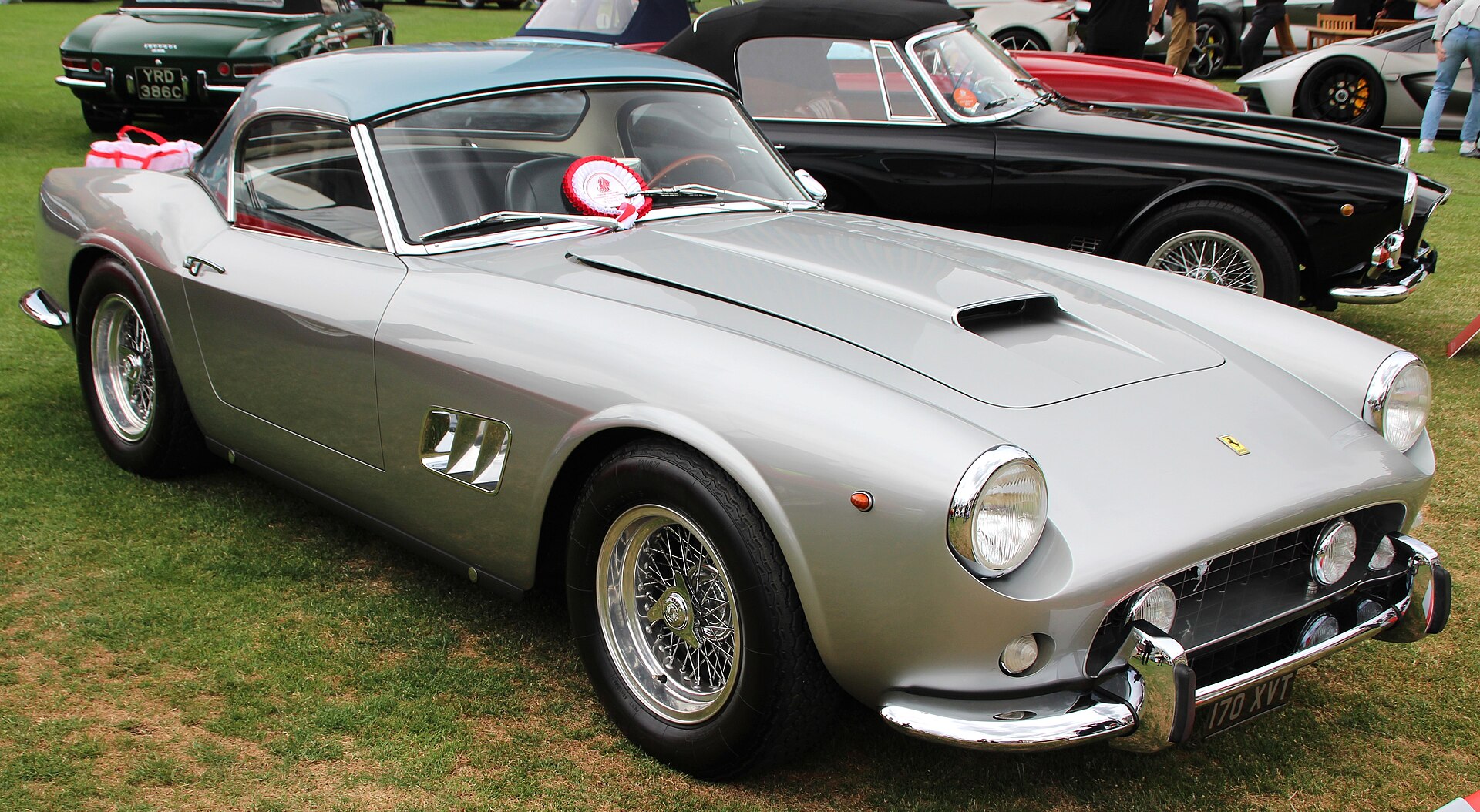
Early cars share the berlinetta's body from the waist down. The headlights could be faired in under plexiglass covers or left open, at the customer's choice - except on cars sold in Italy in 1959, which had to have open lights. Behind the front wheels, vents with polished strips help to cool the engine bay: three strips on the LWB cars, two on the SWB.
The bodies are mainly steel, with aluminium doors, bonnet and boot lid. Nine cars were built entirely in aluminium. A removable hard-top was available for both series. All cars but one SWB were built with left-hand drive.

Engine and chassis
The engine is the 3.0-litre V12 designed by Gioacchino Colombo and used across the 250 series since 1952: an aluminium-alloy 60° V12 with a single overhead camshaft per bank, two valves per cylinder and a capacity of 2,953 cc (bore 73 mm, stroke 58.8 mm). It breathes through three Weber twin-choke carburettors, 36 mm at first and 42 mm from 1960. Over the years Ferrari used several engine types (128C, 128D, 128DF, 128F and, on the later SWB cars, 168 and 168/61). On later cars the spark plugs moved outside the vee, as on the 250 Testa Rossa racing car, which made servicing easier.
Power figures depend on the source. Wikipedia gives 179 kW (240 hp) at 7,000 rpm for the LWB and 209 kW (280 hp) for the SWB, which received new cylinder heads and larger valves. Ferrari's heritage department gives 194 kW (260 bhp) for the LWB engine with twin ignition. Some cars were delivered with the more powerful engines of the competition berlinettas.
| Series | Years | Wheelbase | Power (by source) | Brakes |
|---|---|---|---|---|
| LWB | 1958–1960 (prototype 1957) | 2,600 mm | 179 kW (240 hp) Wikipedia; 194 kW (260 bhp) Ferrari | drums, discs from late 1959 |
| SWB | 1960–early 1963 | 2,400 mm | 209 kW (280 hp) Wikipedia | Dunlop discs all round |
The chassis and drivetrain come from the 250 GT Tour de France berlinetta: a tubular steel frame, independent front suspension with double wishbones and coil springs, and a rigid rear axle on leaf springs. The four-speed manual gearbox was praised for its easy shift and reliability; an overdrive was added in 1960. Drum brakes were replaced by Dunlop disc brakes from late 1959, and in 1960 telescopic dampers replaced the earlier Houdaille units at the front. The car weighs about 1,100 kg dry, roughly 100 kg more than the berlinetta.
LWB and SWB: the two series
The first series used the 2,600 mm long-wheelbase chassis of the Tour de France. In 1960 Ferrari moved the California to the new 2,400 mm short-wheelbase chassis of the 250 GT SWB berlinetta; the change was presented at the Geneva motor show in 1960. The shorter chassis brought wider tracks, a 30 mm lower overall height and sharper handling. Production was split almost evenly between the two series.
The two are easy to tell apart. Early LWB cars have berlinetta-style rear lights and flush door handles, and the air intake on the bonnet stands proud of the surface. On the SWB, the intake sits in a recess and the front wing vents have two strips instead of three.

Inside the cabin
The interior is similar in finish to the Pinin Farina Cabriolet, but simpler and more functional. The dashboard carries seven round dials. On the LWB cars they sit behind a three-spoke Nardi steering wheel in wood and aluminium; on the SWB they are arranged in a line across the dashboard. There was no dedicated place for the number plate, so owners had to find their own solutions.

Racing record
The California was not designed for racing, but many cars were raced in endurance events. At the 1959 24 Hours of Le Mans, a North American Racing Team car (LWB chassis 1451 GT) driven by Bob Grossman and Fernand Tavano finished fifth overall. At the 12 Hours of Sebring, California Spyders won their class with Richie Ginther and Howard Hively in 1959, and with Giorgio Scarlatti, Fabrizio Serena and Carlo Abate in 1960.

Collectors and auction records
Its small production, its looks and its racing history have made the California Spyder one of the most sought-after classic cars. On 18 May 2008, at Sotheby's "Ferrari Legends and Passions" sale, broadcaster Chris Evans bought a car formerly owned by the actor James Coburn for €7,040,000, a record at the time. On 6 February 2015, at the Artcurial sale at Rétromobile in Paris, an SWB car from the Baillon collection sold for €14,200,000 before fees. It had been hidden away for almost 30 years and had once belonged to Alain Delon.
The model became widely known outside the classic car world after the 1986 film Ferris Bueller's Day Off. Ferrari later revived the name: the Ferrari California of 2008 echoes the design of the 250 GT California Spyder.
Photo gallery

Image credits · Photos from Wikimedia Commons under free licences
- Ferrari LWB · Photo: Brett Weinstein / Wikimedia Commons, CC BY-SA 3.0
- Ferrari SWB · Photo: richebets / Wikimedia Commons, CC BY 2.0
Ferrari 250 GT California Spyder in our rankings
- No. 550 of 912 · Longest-running car nameplates (6 years · top 69%)
- No. 239 of 345 · Cars with the most generations (2 generations)
In production longer than 31% of ranked nameplates in the 1CARS catalog (No. 550 of 912).
FAQ
How many Ferrari 250 GT California Spyders were built?
Ferrari gives 106 cars, split almost evenly between the long-wheelbase series (1958–1960, plus a 1957 prototype) and the short-wheelbase series (1960–1963).
What engine does the California Spyder have?
A front-mounted 2,953 cc Colombo V12 with three Weber carburettors. Power was about 179–194 kW (240–260 hp) in the LWB and about 209 kW (280 hp) in the SWB, depending on the source.
What is the difference between LWB and SWB?
The LWB cars use a 2,600 mm wheelbase, the SWB cars 2,400 mm. The SWB is lower, has wider tracks, disc brakes, more power and a recessed bonnet air intake.
Who built the body?
Carrozzeria Scaglietti in Modena, to a design adapted by Sergio Scaglietti from the 250 GT by Pinin Farina.
Data sources
Data checked by an editor against the sources below.