 Aston Martin Valhalla
Specs, engines and history
Published Sources (2) Report an error
By Felix Hartmann, Automotive Technology & EV Contributor
- Built
- 2025–present
- Top power
- 793 kW (1,078 PS)
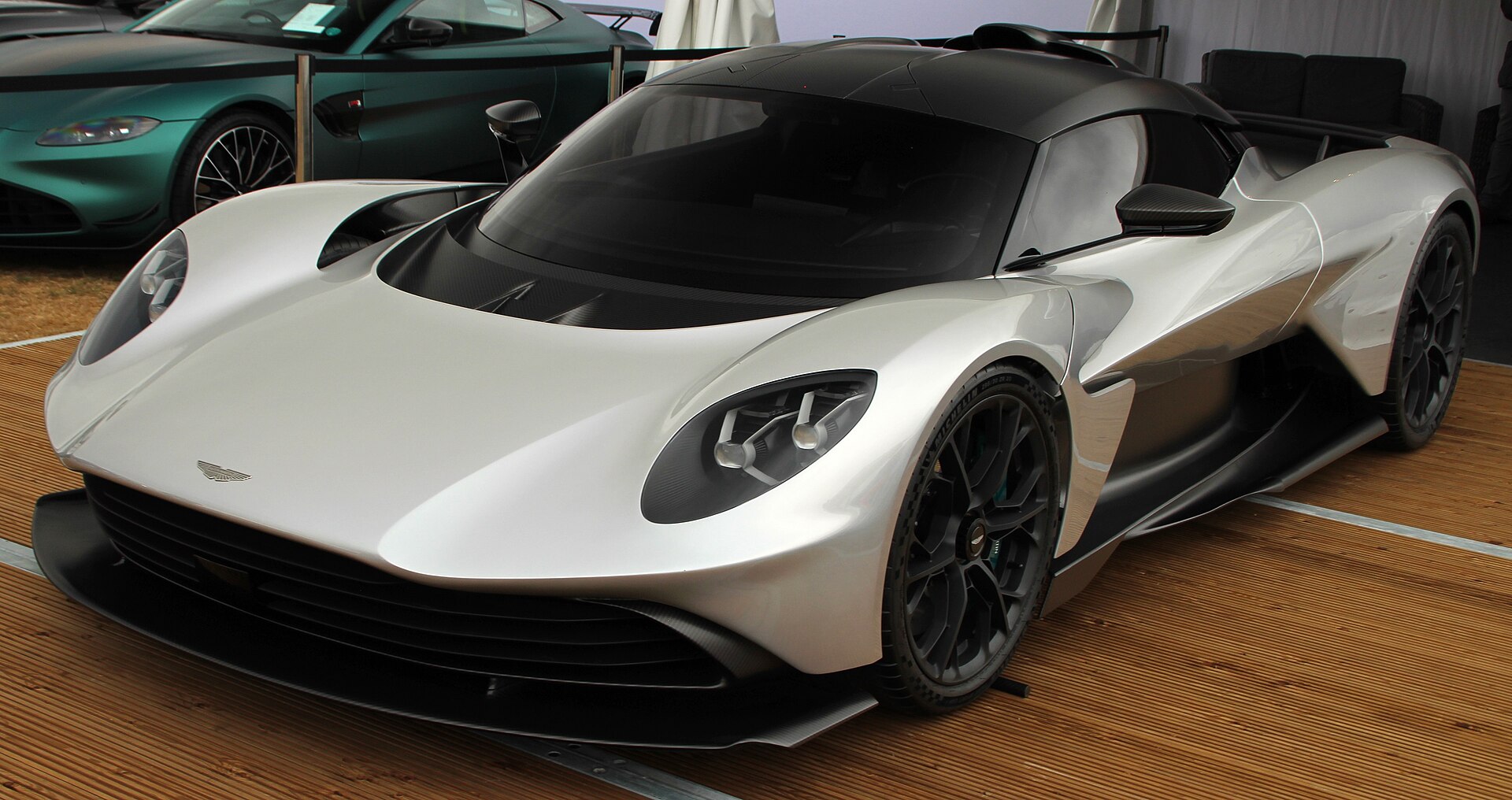
The Aston Martin Valhalla is a mid-engined plug-in hybrid supercar built at Gaydon, Warwickshire, from 2025. It is the first series-production mid-engined Aston Martin and the brand's first plug-in hybrid. Conceived with Red Bull Racing as a more usable sibling of the Valkyrie hypercar, it reached production with a 4.0-litre twin-turbo V8 and three electric motors producing a combined 794 kW (1,079 PS). Production is limited to 999 cars.
In short
- Shown as the AM-RB 003 concept in 2019, production form in 2021, final specification in December 2024; first customer car delivered in the United Kingdom in December 2025.
- 4.0-litre twin-turbo flat-plane-crank V8 with 609 kW (828 PS) plus three electric motors with 185 kW (251 PS); 794 kW (1,079 PS) and 1,100 Nm combined.
- Eight-speed dual-clutch gearbox, all-wheel drive through two front electric motors, 14 km electric range.
- Carbon-fibre monocoque, 1,655 kg dry, more than 600 kg of downforce from 240 km/h; 0–100 km/h in 2.5 seconds (target) and 350 km/h top speed.
Running cost
Fuel · Valhalla 4 L 8 cyl Automatic 8-spd · 2026 (EPA)
about 3,850 EUR fuel a year at 15,000 km
14.7 l/100 km · petrol at 1.75 EUR/l · change mileage, fuel price or version
Specs by version
Engines
| Version | Engine | Gearbox | Drive | Production years |
|---|---|---|---|---|
| 4 L 8 cyl Automatic 8-spd · 2026 (EPA) | 4.0 l · 8 cyl · Plug-in hybrid 4,000 cc | 8-sp Automatic | All-wheel drive | 2026 |
Performance
Show all 1 versions
| Version | Fuel consumption |
|---|---|
| 4 L 8 cyl Automatic 8-spd · 2026 (EPA) | 14.7 l/100 km16.0 mpg US · 19.2 mpg UK |
Verified Manufacturer and type-approval data from our catalog · Sources and methodology
Aston Martin Valhalla at a glance
| Specification | Aston Martin Valhalla |
|---|---|
| Production | from 2025, Gaydon (United Kingdom); first delivery December 2025 |
| Cars planned | 999 |
| Body | two-door coupé with dihedral doors; mid-engine, all-wheel drive |
| Engine | 4.0-litre twin-turbo V8, flat-plane crank, dry sump: 609 kW (828 PS) |
| Electric motors | three (two on the front axle, one in the gearbox): 185 kW (251 PS) |
| System power | 794 kW (1,079 PS) |
| System torque | 1,100 Nm |
| Gearbox | eight-speed dual-clutch, no reverse gear (reverse by the front motors) |
| Weight | 1,655 kg (dry) |
| Related model | Aston Martin Valkyrie |
The Valhalla sits below the Valkyrie and above the front-engined sports cars in the current Aston Martin catalogue. For the background of the company and its racing past, see our history of Aston Martin.
From AM-RB 003 to Valhalla
The car began as a joint project of Aston Martin and Red Bull Racing, positioned below the Valkyrie. It was shown as the AM-RB 003 concept at the Geneva motor show in March 2019, and at its public introduction the project was nicknamed "Son of Valkyrie". The final name, Valhalla, continues Aston Martin's tradition of model names starting with V and, like Valkyrie, comes from Norse mythology.
The concept was planned with a 3.0-litre twin-turbo V6, combined with an energy-recovery system shared with the Valkyrie and an estimated output of about 735 kW (1,000 PS). The plan also included top-exit exhausts and a quick oil-change system from Castrol first used on the track-only Vulcan. The concept had a FlexFoil rear wing, designed to change downforce without changing its angle.
The project then changed course. When the production-intent car was shown in July 2021 it had been heavily redesigned and used a Mercedes-AMG-based twin-turbo V8 instead of the V6, with a quoted output of 699 kW (950 PS) at that time. At the same stage the planned run grew from 500 cars to 999.
Development continued for three more years. Aston Martin published the final specification in December 2024, when the car entered its industrialisation phase, and gave its first public dynamic debut in Monaco in May 2025, ahead of the Grand Prix. Production started in 2025, and the first customer car was handed over in the United Kingdom in December 2025.

Design: carbon body and dihedral doors
The body is almost entirely carbon fibre. The forward-hinged dihedral doors work with A-pillars moved forward, lower sills and cut-outs in the roof. Together they make getting in and out easier - important for a car meant to be driven often, not only on track days. Air for the engine enters through an F1-style roof scoop, and two of the four exhaust tailpipes exit on the top of the rear deck. At the rear, three-dimensional light blades shine through a mesh panel.
Customers can order the carbon body painted or with exposed carbon, in gloss or satin finish and with optional red, blue or green tint, plus six livery themes inspired by Aston Martin's racing history. Design was led by Marek Reichman, the company's chief creative officer.

Powertrain
The engine is a 4.0-litre twin-turbo V8 developed specifically for the Valhalla. It uses a flat-plane crankshaft (crankpins at 180 degrees), dry-sump lubrication, new camshafts, pistons and exhaust manifolds, and twin-scroll turbochargers on roller bearings. With 609 kW (828 PS), or 152 kW (207 PS) per litre, it has the highest specific output of any Aston Martin engine.
Three electric motors add 185 kW (251 PS). Two of them sit in a front drive unit, one for each front wheel, which allows torque vectoring across the front axle. The third is built into the new eight-speed dual-clutch gearbox: it starts the engine, charges the battery and fills the torque gap during gear changes. There is no reverse gear; the front motors drive the car backwards. Front and rear axles have no mechanical connection - the control system coordinates them. An electronic differential manages the rear wheels.
| Element | Output |
|---|---|
| V8 engine | 609 kW (828 PS) |
| Three electric motors | 185 kW (251 PS) |
| Combined | 794 kW (1,079 PS), 1,100 Nm |
| Battery | 560 cells, dielectric cooling, 150 kW peak |
| Electric-only range | 14 km, front motors only, up to 140 km/h |
Aston Martin quotes 0–100 km/h in 2.5 seconds as a target and an electronically limited top speed of 350 km/h. The drive modes are Pure EV, Sport (the default), Sport+ and Race.
Chassis, cabin and equipment
The car is built around a carbon-fibre tub; its lower section weighs just 74.2 kg. Front and rear subframes are aluminium. The front suspension is a pushrod design with inboard springs and dampers, as on a racing car, and the rear has a five-link layout. Bilstein DTX adaptive dampers are fitted at both ends. Aston Martin Performance Technologies, the consulting arm of the Aston Martin Formula 1 team, worked on the chassis, aerodynamics and the carbon tub.
The brakes are Brembo carbon-ceramics with 410 mm front and 390 mm rear discs, six-piston front and four-piston rear calipers, and a brake-by-wire system - the largest brake package fitted to an Aston Martin sports car. Standard wheels are forged aluminium with Michelin Pilot Sport S 5 tyres (285/30 ZR20 front, 335/35 ZR21 rear); optional magnesium wheels save 12 kg of unsprung weight and come with Pilot Sport Cup 2 tyres.
With a dry weight of 1,655 kg, the Valhalla has 480 kW (652 PS) per tonne. Inside, raised footwells give a low, racing-style seating position. There are one-piece carbon seats, a carbon steering wheel, a display mounted on the steering column and a central touchscreen that shows the flow of energy in the hybrid system.

Aerodynamics
Active aerodynamics produce more than 600 kg of downforce from 240 km/h up to the top speed. At the front, a hidden active wing has a drag-reduction function. At the rear, a dual-element "T" wing rises by 255 mm in Race mode and can change its angle in less than half a second to act as an air brake. Underneath, a concave floor and two venturi tunnels generate downforce, an approach taken from the Valkyrie.
Cooling is complex. Three radiators at the front serve the V8, separate radiators serve the high-voltage system, and side radiators cool the engine and gearbox oil. Turning vanes in the doors improve the oil coolers' efficiency by 50%.

Production and legacy
Aston Martin builds the Valhalla at Gaydon in a limited run of 999 cars. The chassis is produced by Aston Martin; at the start of the project the aerodynamic body panels were to come from Red Bull Racing. The car moves the brand into a class it had only touched with limited specials: series-production, mid-engined, hybrid supercars. It shares this class with cars such as the McLaren P1 and the Ferrari SF90 Stradale.
Before production, the AM-RB 003 had already become known to a wider public: it appeared briefly in the James Bond film No Time to Die and in the Forza video games.
Photo gallery


Aston Martin Valhalla in our rankings
- No. 4 of 109 · Most powerful British cars (793 kW)
- No. 23 of 859 · Most powerful cars (793 kW · top 3%)
- No. 20 of 313 · Most powerful coupes (793 kW · top 7%)
- No. 17 of 239 · Most powerful cars of the 2020s (793 kW · top 8%)
- No. 183 of 557 · Biggest engines: cars (4,000 cc · top 35%)
- No. 105 of 173 · Biggest engines: coupes (4,000 cc · top 62%)
More powerful than 97% of ranked cars in the 1CARS catalog (No. 23 of 859).
FAQ
How powerful is the Aston Martin Valhalla?
Its 4.0-litre twin-turbo V8 produces 609 kW (828 PS), and three electric motors add 185 kW (251 PS). The combined output is 794 kW (1,079 PS) and 1,100 Nm.
How many Valhallas will be built?
Production is limited to 999 cars. The first plan, announced with the concept, was 500 cars.
How fast is the Valhalla?
Aston Martin gives a target of 2.5 seconds from 0 to 100 km/h and an electronically limited top speed of 350 km/h. In electric mode the car can reach 140 km/h.
Is the Valhalla a plug-in hybrid?
Yes. It is Aston Martin's first plug-in hybrid and can drive about 14 km on electric power alone, using only the front motors.
When were the first Valhallas delivered?
Production started in 2025, and the first customer car was delivered in the United Kingdom in December 2025.
Data sources
Data checked by an editor against the sources below.
- Wikipedia - Aston Martin Valhalla
- US EPA fueleconomy.gov - 50309.shtml