 Aston Martin DB Mark III
Specs, engines and history
Published Sources (1) Report an error
By Felix Hartmann, Automotive Technology & EV Contributor
- Built
- 1957–1959
- Top power
- 145 kW (197 PS)
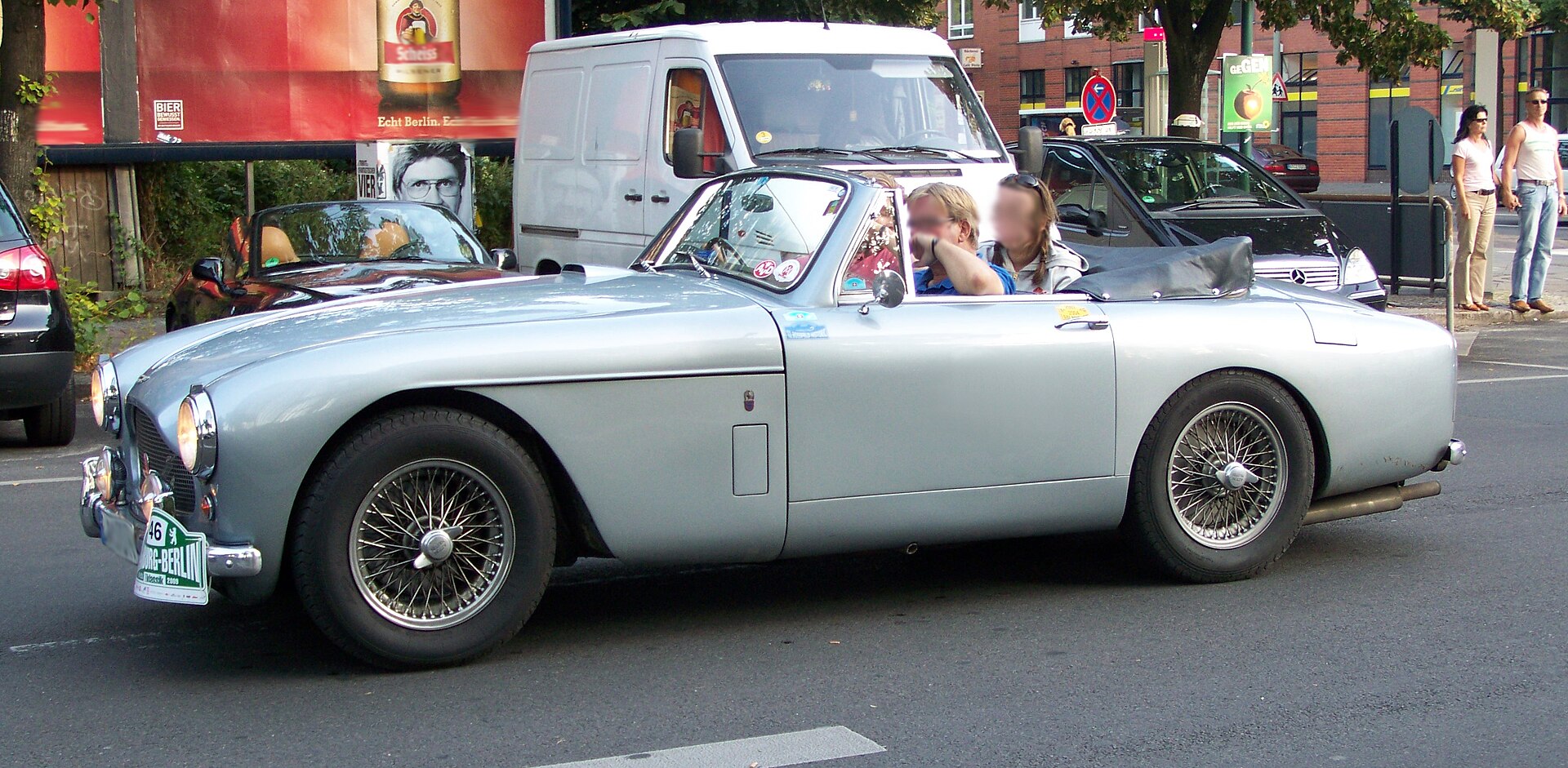
The Aston Martin DB Mark III, also called the DB2/4 Mark III, is a grand tourer that Aston Martin built at Newport Pagnell from 1957 to 1959. It was the final development of the DB2 family, with a new front end inspired by the DB3S racing car, a more powerful 2.9-litre six-cylinder engine and front disc brakes. 551 were made before the all-new DB4 took over. It is also the car that James Bond drives in Ian Fleming's novel Goldfinger.
In short
- Built 1957–1959 at Newport Pagnell: 551 cars — 462 hatchbacks, 84 drophead coupés and 5 fixed-head coupés.
- 2,922 cc Lagonda straight-six redesigned by Tadek Marek: 121 kW (162 bhp) in standard form, up to 145 kW (195 bhp) with Weber carburettors.
- Girling front disc brakes became standard after the first 100 cars; four-speed gearbox with optional overdrive.
- Top speed of about 193 km/h; Bond's car in the Goldfinger novel, replaced by the DB5 in the film.
Aston Martin DB Mark III at a glance
| Specification | Aston Martin DB Mark III |
|---|---|
| Production | 1957–1959, Newport Pagnell (England) |
| Cars built | 551 (462 hatchbacks, 84 dropheads, 5 fixed-head coupés) |
| Body | two-door 2+2 hatchback, drophead coupé or fixed-head coupé |
| Engine | 2,922 cc straight-six, front-mounted |
| Power | 121 kW (162 bhp) to 145 kW (195 bhp) |
| Gearbox | four-speed manual, optional overdrive; automatic on five cars |
| Kerb weight | about 1,361 kg |
| Dimensions | 4,369 mm long, 1,651 mm wide, 1,359 mm high, 2,515 mm wheelbase |
| Predecessor / successor | DB2/4 Mark II / DB4 |
The DB Mark III closes the DB2 chapter of Aston Martin's history, which also includes the Aston Martin DB2/4 Touring Spyder. The background of the company is told in our Aston Martin history, and all models are listed in the Aston Martin catalogue.
Development and design
The DB Mark III was an evolution of the DB2/4 Mark II rather than a new car. Its new look came from an unexpected source: according to Wikipedia, the design is credited to John Turner, who was only 17 at the time and suggested fitting the front of the DB3S racing car to the body of the DB2/4. The result was the grille shape designed by Bert Thickpenny for the DB3S, which became the signature of Aston Martin's road cars for decades.
Inside there was a new instrument panel whose shape echoed the grille. At the rear the tail fins grew and carried larger Lucas lamps, also used on the Humber Hawk and the Alvis TD21. More than five out of six cars were built as hatchbacks with folding rear seats — a practical feature that Aston Martin had introduced on the DB2/4 in 1953. Only 83 cars were built with left-hand drive.
Engine and chassis
The engine is the 2,922 cc six-cylinder developed for Lagonda and redesigned for the Mark III by Tadek Marek. Several versions were offered:
| Engine | Induction | Power | Cars (Wikipedia) |
|---|---|---|---|
| DBA | standard | 121 kW (162 bhp); 133 kW (178 bhp) with dual exhaust | 68 |
| DBD | three SU carburettors, dual exhaust | 134 kW (180 bhp) | 14 in the table, 47 in the text |
| DBB | three twin-choke Weber carburettors | 145 kW (195 bhp) | 2 in the table, 10 ordered according to the text |
| DBC | one car | reputedly 160 kW (214 bhp) | 1 |
A four-speed gearbox was standard, with a Laycock-de Normanville overdrive as an option; the clutch was now operated hydraulically. An automatic gearbox was offered, but only five cars were built with it. Girling disc brakes at the front became standard after the first 100 cars, and many earlier cars were later converted. The worm-and-sector steering and the live rear axle were carried over from the earlier cars.
With the dual exhaust, the DBA engine took the car from 0 to 60 mph in 9.3 seconds, and the Mark III could reach about 193 km/h. Road & Track tested it in 1959 and called it "a car for connoisseurs", although it criticised the heavy steering, the high door sills and the firm ride.


Body styles
| Body | Cars built | Notes |
|---|---|---|
| Hatchback (2+2) | 462 | rear hatch and folding rear seats |
| Drophead coupé | 84 | open version |
| Fixed-head coupé | 5 | without the rear hatch |
The hatchback, which made the DB2 family unusually practical for a sports car of the 1950s, was by far the most popular choice. The drophead coupé accounted for 84 cars, and the fixed-head coupé without a hatch was built only five times. Wikipedia counts 83 left-hand-drive cars in total; all the others had right-hand drive. The car measures 4,369 mm in length, 1,651 mm in width and 1,359 mm in height, on a 2,515 mm wheelbase, and weighs about 1,361 kg.
The James Bond connection
In Ian Fleming's novel Goldfinger, James Bond drives a "DB III" — the DB Mark III. In the chapter "Thoughts in a DB III" Bond follows Goldfinger on his way to the famous golf match. It is the only Bond car in Fleming's novels fitted with gadgets. When the novel was filmed in 1964, the car was updated to the then-new DB5, which became the most famous Bond car of all.

Legacy
The DB Mark III was the last of the DB2-based cars. Its successor, the DB4, introduced in 1958, was an all-new car that started the line leading to the DB5 and DB6. The Mark III's grille, however, lived on: its shape became a permanent part of Aston Martin's design language.

Aston Martin DB Mark III in our rankings
- No. 591 of 859 · Most powerful cars (145 kW · top 70%)
- No. 89 of 109 · Most powerful British cars (145 kW · top 82%)
- No. 276 of 313 · Most powerful coupes (145 kW · top 89%)
- No. 818 of 912 · Longest-running car nameplates (2 years · top 96%)
More powerful than 30% of ranked cars in the 1CARS catalog (No. 591 of 859).
FAQ
How many Aston Martin DB Mark IIIs were built?
551: 462 hatchbacks, 84 drophead coupés and 5 fixed-head coupés.
What engine does the DB Mark III have?
A 2.9-litre straight-six redesigned by Tadek Marek, with 121–145 kW (162–195 bhp) depending on the version.
Is the DB Mark III a Bond car?
Yes — in Ian Fleming's novel Goldfinger Bond drives a "DB III". The film replaced it with the DB5.
What replaced the DB Mark III?
The Aston Martin DB4, introduced in 1958.
Does the DB Mark III have disc brakes?
Yes. Girling disc brakes on the front wheels became standard after the first 100 cars, and many earlier cars were converted later.
Data sources
Data checked by an editor against the sources below.