 Aston Martin 2-Litre Sports (DB1)
Specs, engines and history
Published Sources (1) Report an error
By Felix Hartmann, Automotive Technology & EV Contributor
- Built
- 1948–1950
- Top power
- 67 kW (91 PS)
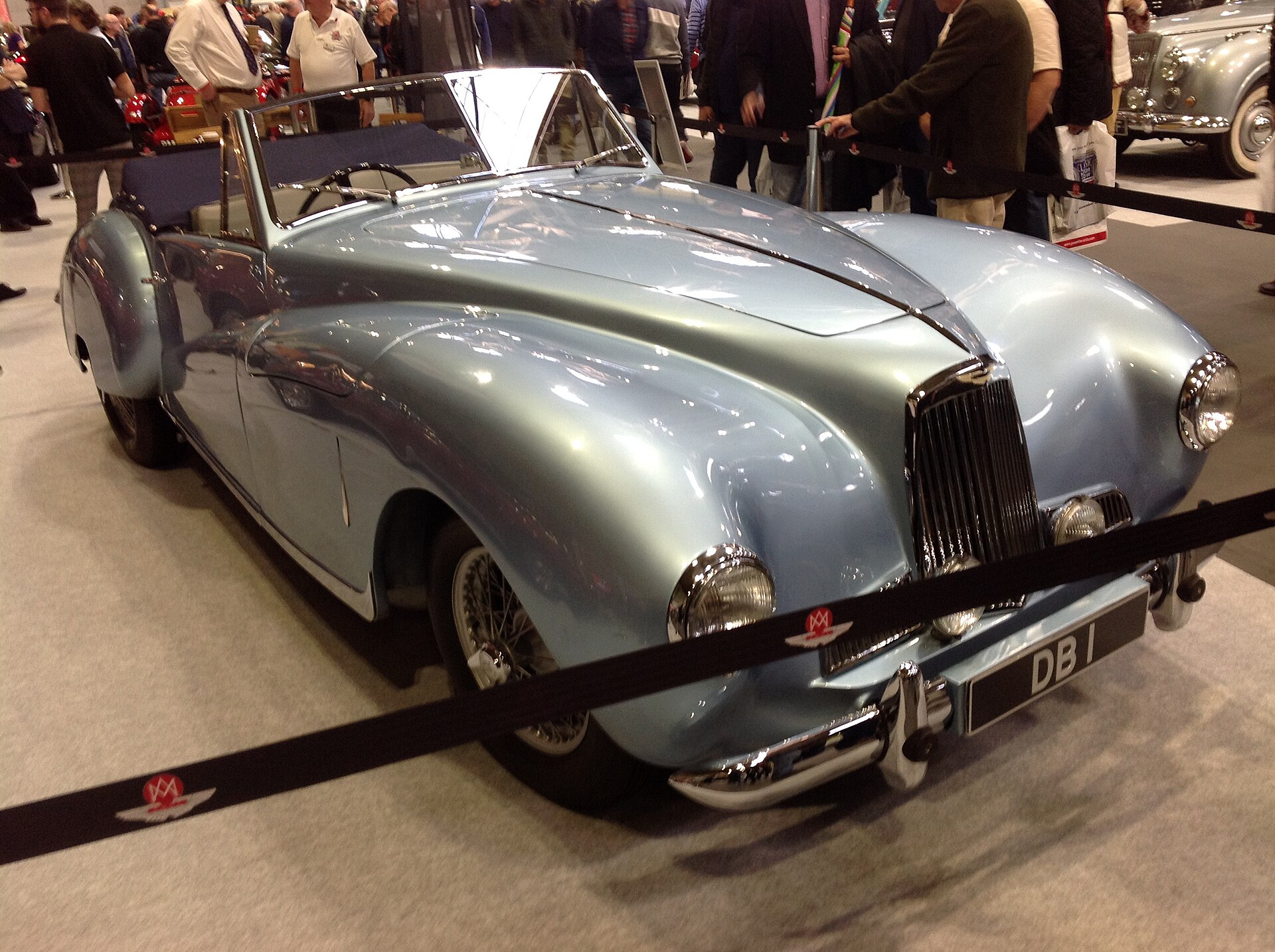
The Aston Martin 2-Litre Sports is the first car that Aston Martin built under the ownership of David Brown. Shown at the London Motor Show in 1948 and built until 1950, it was a two-seat roadster with a tubular chassis and a 2.0-litre four-cylinder engine developed by Claude Hill. Only 15 were made. After the DB2 arrived in 1950, the earlier car became known as the DB1 - the first of the "DB" models named after David Brown.
In short
- Built 1948–1950; 15 cars, 13 of them with the factory roadster body, according to Wikipedia.
- 2.0-litre four-cylinder pushrod engine with 67 kW (90 hp); top speed about 150 km/h.
- Tubular steel chassis with coil-spring suspension at both ends, designed by Claude Hill; body credited to Frank Feeley.
- A prototype won the 24 Hours of Spa outright in 1948.
Aston Martin 2-Litre Sports at a glance
| Specification | Aston Martin 2-Litre Sports (DB1) |
|---|---|
| Production | 1948–1950 |
| Cars built | 15 |
| Body | two-seat roadster |
| Engine | 1,970 cc four-cylinder, pushrod valve gear, front-mounted |
| Power | 67 kW (90 hp) |
| Gearbox | David Brown synchromesh manual |
| Weight | 1,143 kg (kerb) |
| Dimensions | 4,470 mm long, 1,715 mm wide |
| Top speed | about 150 km/h |
| Successor | DB2 |
The 2-Litre Sports opens the "DB" line that continued with the DB2, the Aston Martin DB2/4 Touring Spyder and, much later, the DB5 and the Aston Martin DB7. The story of the company is told in our Aston Martin history.
From the Atom to the 2-Litre Sports
The car's roots go back to the Second World War. Claude Hill developed the Aston Martin Atom prototype with a new tubular chassis and a new 2.0-litre four-cylinder engine. When the industrialist David Brown bought Aston Martin, work started on an updated version, and the 2-Litre Sports became the first product of the company under his ownership.
In an interview with Motor Sport magazine in April 1949, Hill explained his aims: simple construction suited to small-scale production, first-class steering and roadholding, and a genuine 90 mph (about 145 km/h) with a comfortable ride from soft springs.

Engineering
The chassis was a frame of rectangular and square mild-steel tubes, replacing the channel-section chassis of earlier Aston Martins. According to Hill, two men could build a frame in ten days. The Spa car had a wheelbase of about 2,740 mm, while closed cars were planned with about 2,640 mm.
The front suspension was independent, with trailing links running on needle-roller and ball bearings, coil springs and Armstrong hydraulic dampers, plus an anti-roll bar through the front cross-member. At the rear, a hypoid axle on trailing members was also sprung by coil springs. Front brakes were 305 mm (12-inch) Girling hydraulic units.
The four-cylinder engine has a bore of 82.5 mm and a stroke of 92 mm, giving about 1,970 cc. Hill replaced the overhead camshaft of the pre-war Bertelli engines with simpler pushrod valve gear and dropped dry-sump lubrication. The normal compression ratio was 7.3:1. A David Brown synchromesh gearbox replaced the Cotal gearbox of the Atom.
The Spa 24 Hours victory
To test its durability, the updated prototype was entered for the 24 Hours of Spa in 1948. Driven by St. John Horsfall and Leslie Johnson, it won outright. Motor Sport reported an average speed of about 116 km/h over roughly 2,780 km, on a single set of Dunlop racing tyres. The race car had two oversize SU carburettors, a compression ratio of 8.5:1 for the local fuel and a 136-litre fuel tank in the tail.
The car averaged about 14 litres per 100 km over the race and carried Lucas headlamps and two spot lamps for the night. In the same interview Hill described the plans for Le Mans in 1949: two 2-litre cars, one experimental 2-litre engine and closed bodywork on the shorter wheelbase.
After the race, Aston Martin showed a rebuilt Spa car at the London Motor Show as the "Spa Replica", offered for public sale, but there were no buyers. The original Spa car spent many years in a Dutch museum before returning to the United Kingdom in 2006, where it was fully restored.

Production
The production 2-Litre Sports, presented at the London Motor Show in 1948, had a more conventional body than the cycle-winged Spa car. Thirteen cars received the open roadster body with a three-part grille and a spare-wheel compartment in one front wing, and one more was delivered as a bare chassis for custom coachwork. By the time the DB2 arrived only 12 had been built; chassis 13, 14 and 15 were completed to special order as soft-tops for customers who still wanted the earlier car.
The car weighed 1,143 kg and could reach about 150 km/h. One car, registered UMD 123, has a remarkable later history: sold to New Zealand in 1991 and to Japan in 1994, it was stolen from a wharf, recovered in 2007 and then sold to a buyer in Australia.
Legacy
The 2-Litre Sports was built in tiny numbers, but its Spa victory and its new chassis gave Aston Martin a fresh start under David Brown. Its successor, the DB2 of 1950, was a closed car with a Lagonda straight-six designed by W. O. Bentley, and David Brown's initials went on to name a long line of Aston Martins, from the DB2 to the DB12.

Photo gallery

Aston Martin 2-Litre Sports (DB1) in our rankings
- No. 69 of 79 · Most powerful convertibles and roadsters (67 kW · top 88%)
- No. 801 of 859 · Most powerful cars (67 kW · top 94%)
- No. 104 of 109 · Most powerful British cars (67 kW · top 96%)
- No. 813 of 912 · Longest-running car nameplates (2 years · top 96%)
More powerful than 12% of ranked convertibles and roadsters in the 1CARS catalog (No. 69 of 79).
FAQ
Why is the Aston Martin 2-Litre Sports called DB1?
The name came later: after the DB2 was introduced in 1950, the earlier car became widely known as the DB1, after David Brown.
How many Aston Martin DB1s were built?
15 cars between 1948 and 1950.
What engine does the DB1 have?
A 2.0-litre four-cylinder with pushrod valve gear, designed by Claude Hill, producing 67 kW (90 hp).
Did the DB1 win races?
The prototype won the 24 Hours of Spa outright in 1948, driven by St. John Horsfall and Leslie Johnson.
Who designed the Aston Martin DB1?
Claude Hill developed the chassis and the engine; Wikipedia credits the body design to Frank Feeley.
Data sources
Data checked by an editor against the sources below.