 Aston Martin One-77
Specs, engines and history
Published Sources (1) Report an error
By Felix Hartmann, Automotive Technology & EV Contributor
- Built
- 2009–2012
- Top power
- 559 kW (760 PS)
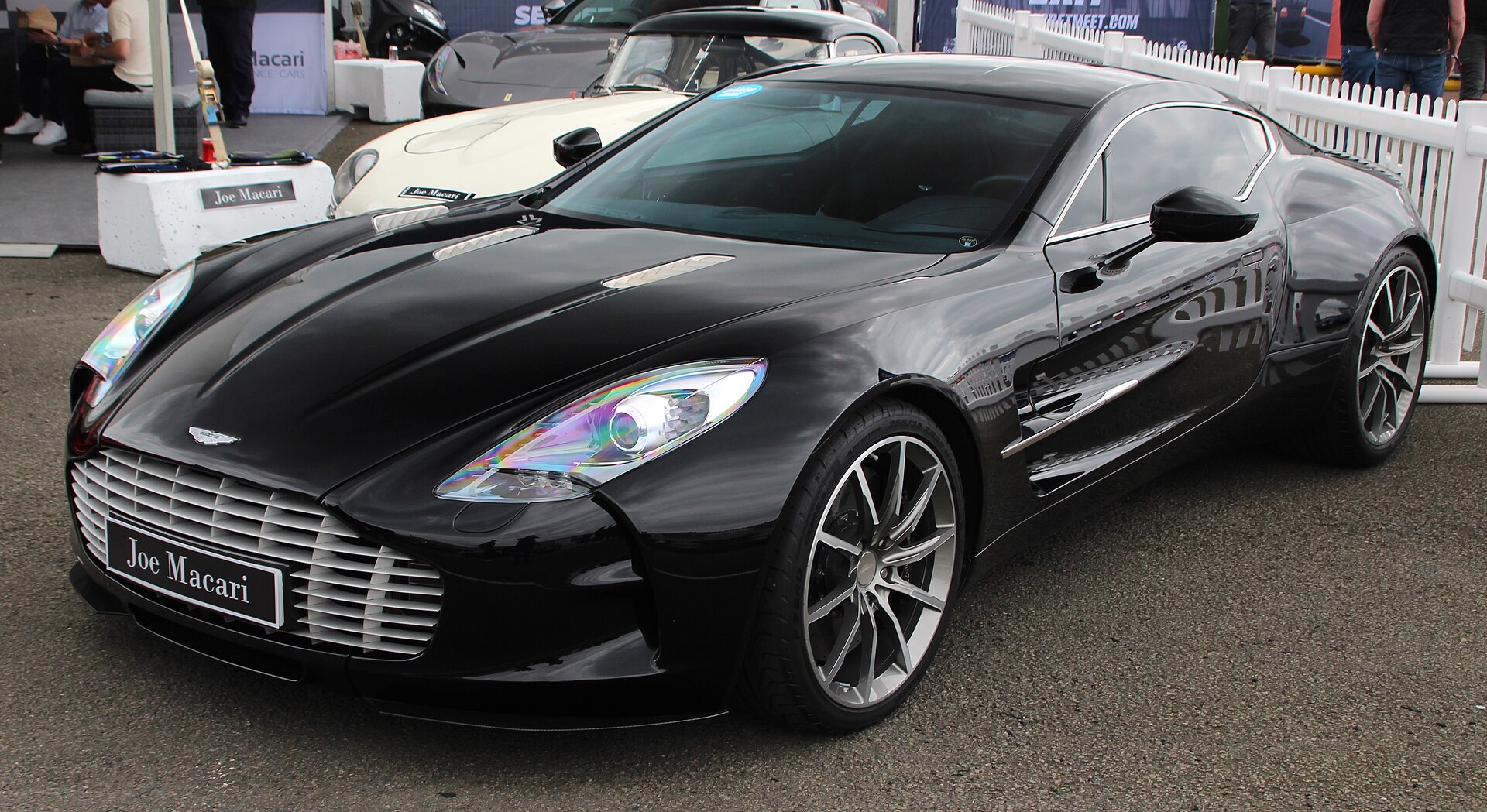
The Aston Martin One-77 is a limited-edition, front-mid-engined two-seater that Aston Martin built from 2009 to 2012 as its flagship. As the name says, only 77 cars were made. Each combined a carbon-fibre monocoque with a hand-formed aluminium body and a 7.3-litre V12 of 559 kW (760 PS) - at the time, according to Aston Martin, the most powerful naturally aspirated production engine in the world.
In short
- Previewed under a cover at the 2008 Paris motor show, fully revealed at Geneva in March 2009; deliveries from 2011; 77 customer cars.
- 7,312 cc V12 with four valves per cylinder: 559 kW (760 PS) at 7,500 rpm and 750 Nm at 5,000 rpm.
- Six-speed automated manual gearbox by Graziano, rear-wheel drive, carbon-ceramic brakes, adjustable pushrod suspension.
- 1,630 kg; top speed measured at 354 km/h in December 2009.
Aston Martin One-77 at a glance
| Specification | Aston Martin One-77 |
|---|---|
| Production | 2009–2012 |
| Cars built | 77 (plus development cars) |
| Body | two-door, two-seat coupé with swan doors; front mid-engine, rear-wheel drive |
| Chassis | carbon-fibre monocoque (Multimatic) |
| Engine | 7,312 cc V12, DOHC, four valves per cylinder, variable valve timing |
| Power | 559 kW (760 PS) at 7,500 rpm |
| Torque | 750 Nm at 5,000 rpm |
| Gearbox | six-speed automated manual (Graziano) |
| Weight | 1,630 kg |
| Dimensions | 4,601 × 2,204 (with mirrors) × 1,222 mm, wheelbase 2,791 mm |
The One-77 sat above the Vanquish and the V12 Vantage in Aston Martin's range of the time. All models are listed in the Aston Martin catalogue.
History of the One-77
Aston Martin first showed the One-77 at the Paris motor show in 2008 in an unusual way: the car stood on the stand mostly hidden under a tailored fabric "skirt" made in the Savile Row style. Some details leaked in the following months, but the full specification and the uncovered car were presented at the Geneva motor show in March 2009.
The name sums up the concept: one model, 77 cars. Production ran from 2009 to 2012 and deliveries to customers began in 2011. Besides the 77 customer cars, Aston Martin built several development cars. One of them, a development car later refurbished by the factory, is registered in the United States for "show or display" use, so that 78 cars can be said to exist.
In May 2012 a One-77 was badly damaged in an accident in Hong Kong and was first declared a write-off; it has since been fully rebuilt.
Carbon chassis and aluminium body
The One-77 was designed by Marek Reichman, Aston Martin's head of design. Its structure is a full carbon-fibre monocoque; the engineering and production of the carbon chassis and the suspension were contracted to Multimatic in Canada. On top of this sits a body of aluminium panels formed by hand, with swan doors that rise slightly as they open.
The suspension is a pushrod design, and the ride height can be adjusted. A dynamic stability control system is standard. The car runs on Pirelli P Zero Corsa tyres - 255/35 ZR20 at the front and 335/30 ZR20 at the rear - and has carbon-ceramic brakes.
The early target weight was 1,500 kg; production cars weigh 1,630 kg. The car is 4,601 mm long, 2,204 mm wide including mirrors and 1,222 mm high, on a 2,791 mm wheelbase.
The design won several awards, including a Concorso d'Eleganza design award for concept cars and prototypes, a GOOD DESIGN award from the Chicago Athenaeum and the "Best Design" award from Auto Express.

Engine and performance
The engine, listed as the AM77 V12 and associated with Cosworth, has a capacity of 7,312 cc, double overhead camshafts, four valves per cylinder and variable valve timing. It produces 559 kW (760 PS) at 7,500 rpm and 750 Nm at 5,000 rpm. When the first car was delivered, Aston Martin described it as the most powerful naturally aspirated production engine in the world.
Power goes to the rear wheels through a six-speed automated manual gearbox supplied by Graziano Trasmissioni. The engine sits behind the front axle, which places most of its mass within the wheelbase.
| Figure | One-77 |
|---|---|
| Power | 559 kW (760 PS) at 7,500 rpm |
| Torque | 750 Nm at 5,000 rpm |
| Top speed | 349 km/h (estimate); 354.067 km/h measured in December 2009 |
| Weight | 1,630 kg |
| Power-to-weight | about 343 kW (466 PS) per tonne |
Aston Martin first estimated the top speed at 349 km/h. In December 2009 a car was measured at 354.067 km/h.


Timeline
| Year | Event |
|---|---|
| 2008 | One-77 shown under a fabric cover at the Paris motor show |
| 2009 | Full reveal at the Geneva motor show; production starts |
| 2009 | 354.067 km/h measured in December |
| 2011 | First deliveries to customers |
| 2012 | End of production after 77 cars; Q-Series of seven cars |
| 2020 | One-off Aston Martin Victor based on the One-77 |
Q-Series and the Victor
Q-Series. Near the end of production, Aston Martin's personalisation department "Q by Aston Martin" built seven One-77 Q-Series cars. Mechanically they are the same as the standard car, but they have special colour schemes. Wikipedia lists four of them:
- metallic grey with black ten-spoke wheels, a red and black interior and a red stripe on the front;
- solid white with silver ten-spoke wheels, a black interior, a red front stripe and black mirrors;
- solid white with silver twelve-spoke wheels, a red and black interior and a red double stripe along the body;
- black with black ten-spoke wheels, a red and black interior, a red front stripe and dark red mirrors.
Aston Martin Victor. In 2020 Aston Martin built the Victor, a coachbuilt one-off based on the One-77. Designed by Kaize "Ken" Zheng and shown at the 2020 Hampton Court Concours, it has round headlights recalling the 1977 V8 Vantage and side exhausts taken from the track-only Vulcan. Its V12, revised by Cosworth, produces 623 kW (836 bhp) and 822 Nm. Unlike the One-77, it has a six-speed manual gearbox, and at the time it was the most powerful Aston Martin with a manual transmission.

Legacy
The One-77 showed what Aston Martin could do with a carbon structure and a 7.3-litre naturally aspirated V12 in a small series. Later limited models such as the Vulcan, the Valkyrie and the Valhalla followed the same idea of a halo car built in small numbers. The background of the brand is told in our history of Aston Martin.
Photo gallery


Aston Martin One-77 in our rankings
- No. 72 of 859 · Most powerful cars (559 kW · top 9%)
- No. 12 of 109 · Most powerful British cars (559 kW · top 12%)
- No. 53 of 313 · Most powerful coupes (559 kW · top 18%)
- No. 779 of 912 · Longest-running car nameplates (3 years · top 89%)
More powerful than 91% of ranked cars in the 1CARS catalog (No. 72 of 859).
FAQ
How many Aston Martin One-77s were built?
77 customer cars were built between 2009 and 2012, plus several development cars.
What engine does the One-77 have?
A 7.3-litre (7,312 cc) naturally aspirated V12 producing 559 kW (760 PS) at 7,500 rpm and 750 Nm at 5,000 rpm.
How fast is the One-77?
Aston Martin estimated 349 km/h; in December 2009 a car was measured at 354.067 km/h.
What is the One-77 made of?
A carbon-fibre monocoque chassis, built with Multimatic, covered by a hand-formed aluminium body.
What is the Aston Martin Victor?
A one-off built in 2020 on the basis of the One-77, with a Cosworth-revised V12 of 623 kW (836 bhp) and a six-speed manual gearbox.
Data sources
Data checked by an editor against the sources below.