 Aston Martin V8
All generations, specs and history
Published Sources (2) Report an error
By Felix Hartmann, Automotive Technology & EV Contributor
- Built
- 1969–1989
- Generations
- 2
- Top power
- 239 kW (325 PS)
Timeline
V8 generations
Click a generation for its own page
- DBS V8 1969–1972 · Coupe · 239 kW (325 PS)
- AM V8 Series 3–5 1972–1989 · Coupe · 183–231 kW (249–314 PS)
Newest first · 2 generations since 1969
-
1972
-
1969
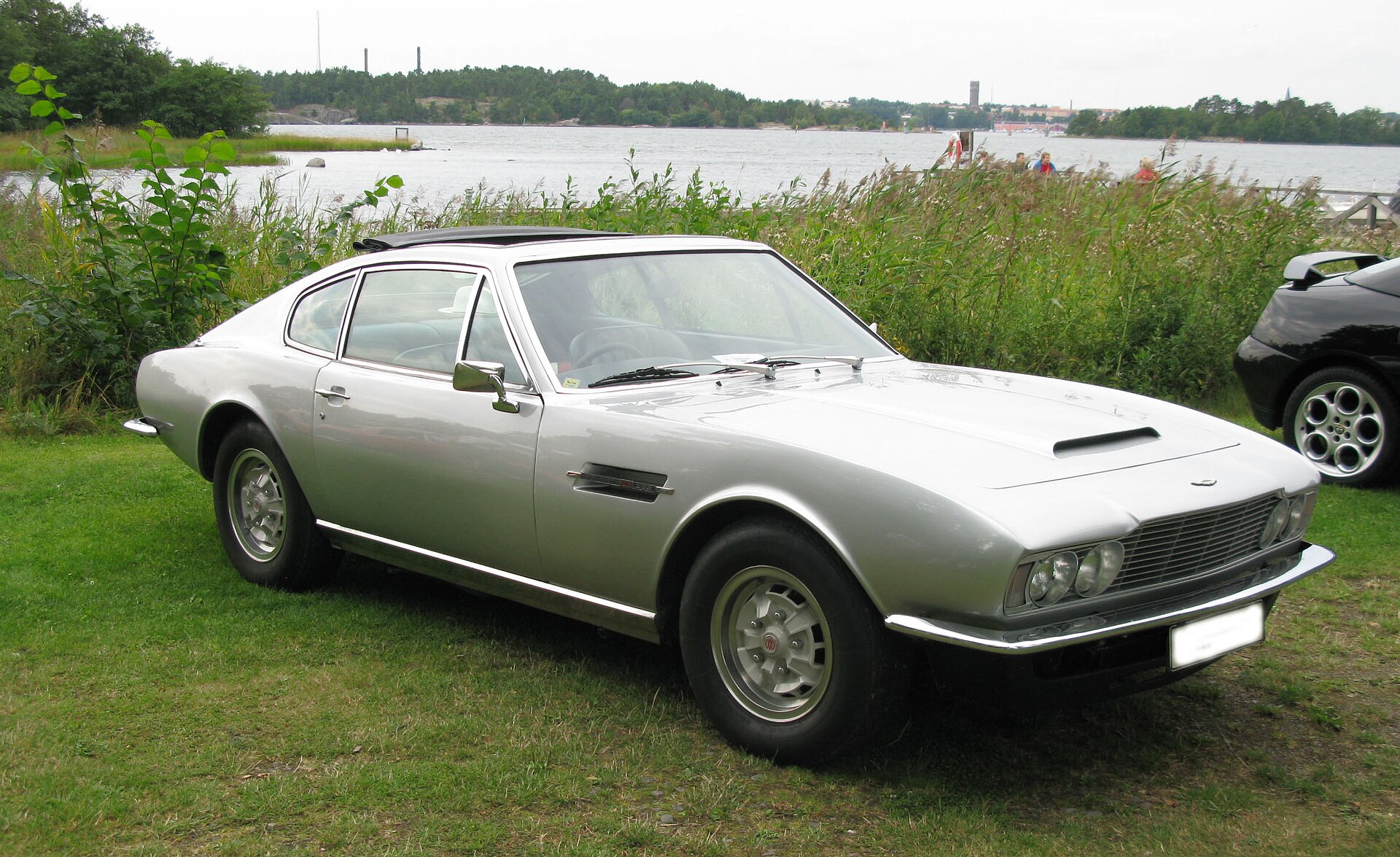


All generations by year: AM V8 Series 3–5 (1972–1989) · DBS V8 (1969–1972)
Which one is mine?
Pick the year of first registration to see which generation it is.
- AM V8 Series 3–5 1972–1989
- DBS V8 1969–1972
The Aston Martin V8 is the grand tourer that Aston Martin built from 1969 to 1989, first as the DBS V8 and from 1972 simply as the V8. Its body was designed by William Towns, and its engine was the 5.3-litre V8 developed by Tadek Marek. Over twenty years the car was built in five series of saloons, as the Volante convertible and as the high-performance Vantage. In total, 4,021 cars were made, including the Vantage and Volante models. The Virage replaced it in 1989.
In short
- Built from 1969 to 1989: DBS V8 (1969–1972), then V8 Series 2 to Series 5; 4,021 cars including Vantage and Volante.
- Designed by William Towns; 5,340 cc V8 by Tadek Marek, with Bosch fuel injection, later Weber carburettors and finally Weber/Marelli injection.
- ZF five-speed manual or Chrysler TorqueFlite three-speed automatic; kerb weight about 1,820 kg.
- Volante convertible from 1978; Vantage, Vantage Volante and Zagato versions; successor: the Virage.
Aston Martin V8 at a glance
| Specification | Aston Martin V8 |
|---|---|
| Production | 1969–1989 |
| Cars built | 4,021 (all versions) |
| Designer | William Towns |
| Body | two-door saloon (coupé); Volante convertible from 1978 |
| Layout | front engine, rear-wheel drive |
| Engine | 5,340 cc V8, designed by Tadek Marek |
| Power | about 235 kW (315 hp) estimated for the DBS V8 |
| Gearbox | ZF five-speed manual or Chrysler TorqueFlite three-speed automatic |
| Kerb weight | about 1,820 kg |
| Dimensions | 4,585 × 1,830 × 1,330 mm, wheelbase 2,610 mm |
| Successor | Virage |
All Aston Martin models are in the Aston Martin catalogue.
History: from the DBS to the V8
The story begins with the DBS of 1967. Its body by William Towns was designed for a V8, but the engine was not ready, so the first DBS used the six-cylinder engine of the DB6 Vantage. The V8 arrived in 1969 in the DBS V8, and 402 of these cars were built.
William Towns was brought in at short notice. Carrozzeria Touring of Milan had built two prototypes for a DB6 replacement before it closed, and the DB6 itself could not take the planned V8. Towns gave the new car a fastback rear and a square grille, while keeping Aston Martin details such as the bonnet scoop, the side vents and knock-off wire wheels on the early cars. The DBS was built at Newport Pagnell and was the last Aston Martin developed under David Brown's control. Its dimensions — a 2,610 mm wheelbase and a width of 1,830 mm — carried over to the V8.
Its 5.3-litre engine had Bosch fuel injection. The V8 article on Wikipedia says the output was never officially published and estimates it at around 235 kW (315 hp). Wikipedia's DBS article gives 239 kW (324 PS) at 5,000 rpm and 450 Nm. The DBS V8 had alloy wheels, Pirelli Cinturato 225/70 VR15 tyres and ventilated brake discs, and it was promoted as the fastest four-seat production car in the world at the time. The DBS article gives its weight as 1,727 kg. Wikipedia gives 0–100 km/h in 7.1 seconds and a top speed of 242 km/h. The V8 car was about 113 kg heavier than the six-cylinder DBS, although the engine itself weighed only about 14 kg more. Heavier ventilated brake discs, air conditioning, wider tyres, a stronger ZF gearbox and extra bodywork under the front bumper added the rest.
From May 1972 the car was called simply the Aston Martin V8. David Brown had left the company before the Series 2 appeared.
Five series of the V8 saloon
| Series | Years | Built | Main changes |
|---|---|---|---|
| DBS V8 | 1969–1972 | 402 | Bosch fuel injection |
| Series 2 | May 1972 – July 1973 | 288 | twin quartz-halogen headlights, mesh grille; first 34 still badged DBS V8 |
| Series 3 | 1973 – October 1978 | 967 | four twin-choke Weber carburettors, taller bonnet scoop; no production in 1975 |
| Series 4 "Oscar India" | October 1978 – 1985 | 352 | closed bonnet bulge, integrated tail spoiler, wood trim |
| Series 5 | January 1986 – 1989 | 405 | Weber/Marelli fuel injection, almost flat bonnet |
The Bosch injection of the early cars caused problems: Wikipedia says that Aston Martin was most likely unable to make it work properly. The Series 3 therefore returned to four twin-choke Weber carburettors in 1973, under a taller bonnet scoop. Output was given as 231 kW (310 hp) in 1973, 215 kW (288 hp) in 1976 and 227 kW (305 hp) with the "Stage 1" engine of 1977, which had new camshafts and a new exhaust.
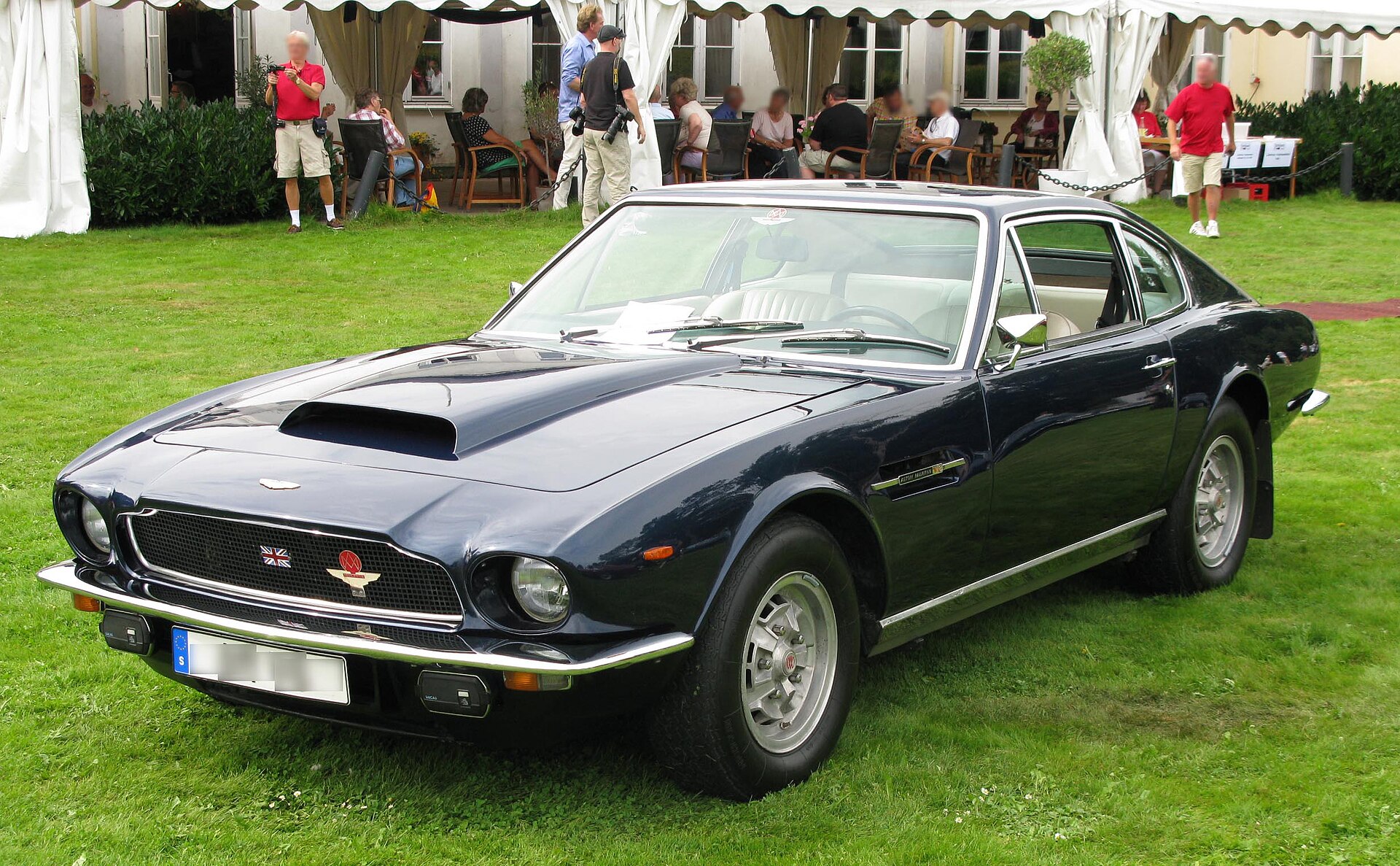
The Series 4, known as "Oscar India", arrived in October 1978. It replaced the bonnet scoop with a closed bulge, added a spoiler integrated into the tail and brought wood trim — the first in an Aston Martin since the DB2/4 of the 1950s. The Series 5 was introduced at the New York International Auto Show in January 1986. Its compact Weber/Marelli fuel injection allowed an almost flat bonnet.

Engine and gearboxes
The engine is the 5,340 cc V8 designed by Tadek Marek. Over its life it was fed by Bosch mechanical injection, by Weber carburettors and finally by Weber/Marelli electronic injection.
Buyers could choose between a ZF five-speed all-synchromesh manual gearbox and the Chrysler TorqueFlite three-speed automatic. On the earlier DBS, the automatic alternative could also be a three-speed Borg-Warner unit. In Japan only the automatic was sold, and Wikipedia notes that about a quarter of the V8 saloons sold there were driven by chauffeurs.
| Dimension | Aston Martin V8 |
|---|---|
| Length | 4,585 mm |
| Width | 1,830 mm |
| Height | 1,330 mm |
| Wheelbase | 2,610 mm |
| Kerb weight | about 1,820 kg |
US-market cars
From the 1980 model year, US cars received much larger "5 mph" bumpers, which added weight and changed the car's lines; many US owners later fitted the slimmer European bumpers. To meet emissions rules, the output of US engines fell to a low of about 183 kW (245 hp) in the early 1980s.
Vantage, Volante and Zagato
The V8 family included several important variants:
| Variant | Built |
|---|---|
| V8 Vantage Series 1 | 38 (+13 US-specification) |
| V8 Vantage Series 2 | 304 (+14 US-specification) |
| V8 Volante Series 1 | 656 |
| V8 Volante Series 2 | 245 (Wikipedia's text gives 216) |
| Vantage Volante | 192 (+56 US-specification) |
| Vantage Zagato and Volante Zagato | 89 |
The Volante convertible was introduced in June 1978. It used the Series 4 bonnet from the start, a few months before the coupé received the Oscar India update. Its frame needed reinforcement, so the Series 1 Volante is 70 kg heavier than the coupé, and each car took about four months to build. The Series 2 Volante received the changes of the Series 5.
The V8 Vantage was the high-performance version, and Wikipedia also lists the later "X-Pack" Vantage (V580X) of 1985 to 1989. The Zagato-bodied Vantage and Volante Zagato were built in 89 examples.

The Lagonda saloons and other specials
The idea of a four-door V8 began with a prototype: chassis MP230/1, registered JPP 5G, which served as David Brown's personal car from 1969. It first ran a 5-litre prototype V8 and later a 5.3-litre unit with four carburettors. Between 1974 and 1976 Aston Martin built seven four-door Lagonda saloons on the V8 platform, with a Lagonda-style grille instead of the Aston Martin one. In 1972 Ogle Design showed a DBS V8 with its own body at the Montreal Motor Show; two such cars were commissioned by W.O. Wills for a cigarette brand.
On screen: The Living Daylights
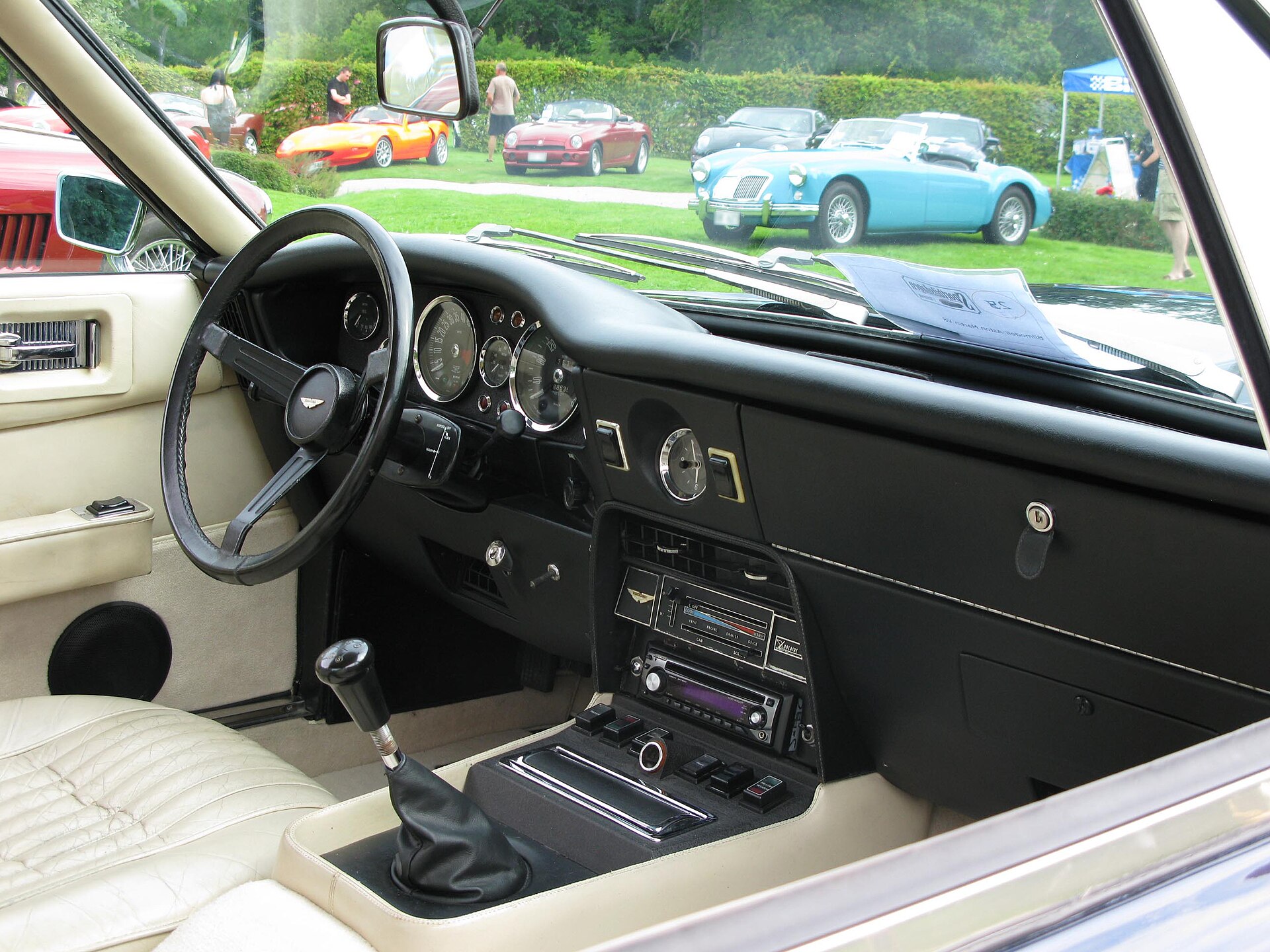
The V8 appears in the 1987 James Bond film "The Living Daylights". Timothy Dalton's Bond drives a V8 Volante, later shown with a hard top; disguised saloons were also used for some scenes. The opening scenes used a V8 Volante owned by Victor Gauntlett, then chairman of Aston Martin Lagonda. The V8 coupé appeared again in "No Time to Die".

Legacy and collectors
The V8 stayed in production for twenty years, until the Virage replaced it in 1989. For collectors the main differences are the series — the early injected DBS V8, the carburettor Series 3 and 4 and the injected Series 5 — and the variant: saloon, Volante, Vantage or Zagato. US-market cars with large bumpers and reduced output form a separate group. More about the company is in our history of Aston Martin.
Photo gallery

Aston Martin V8: first vs latest generation
| Spec | DBS V8 | AM V8 Series 3–5 | Change |
|---|---|---|---|
| Years | 1969–1972 | 1972–1989 | 3 years apart |
| Most powerful version | 239 kW (325 PS) | 231 kW (314 PS) | −8 kW (−3%) |
Oldest and newest generation in the 1cars catalog. Power is the strongest version of each; other rows are shown only when both generations have the figure.
Image credits · Photos from Wikimedia Commons under free licences
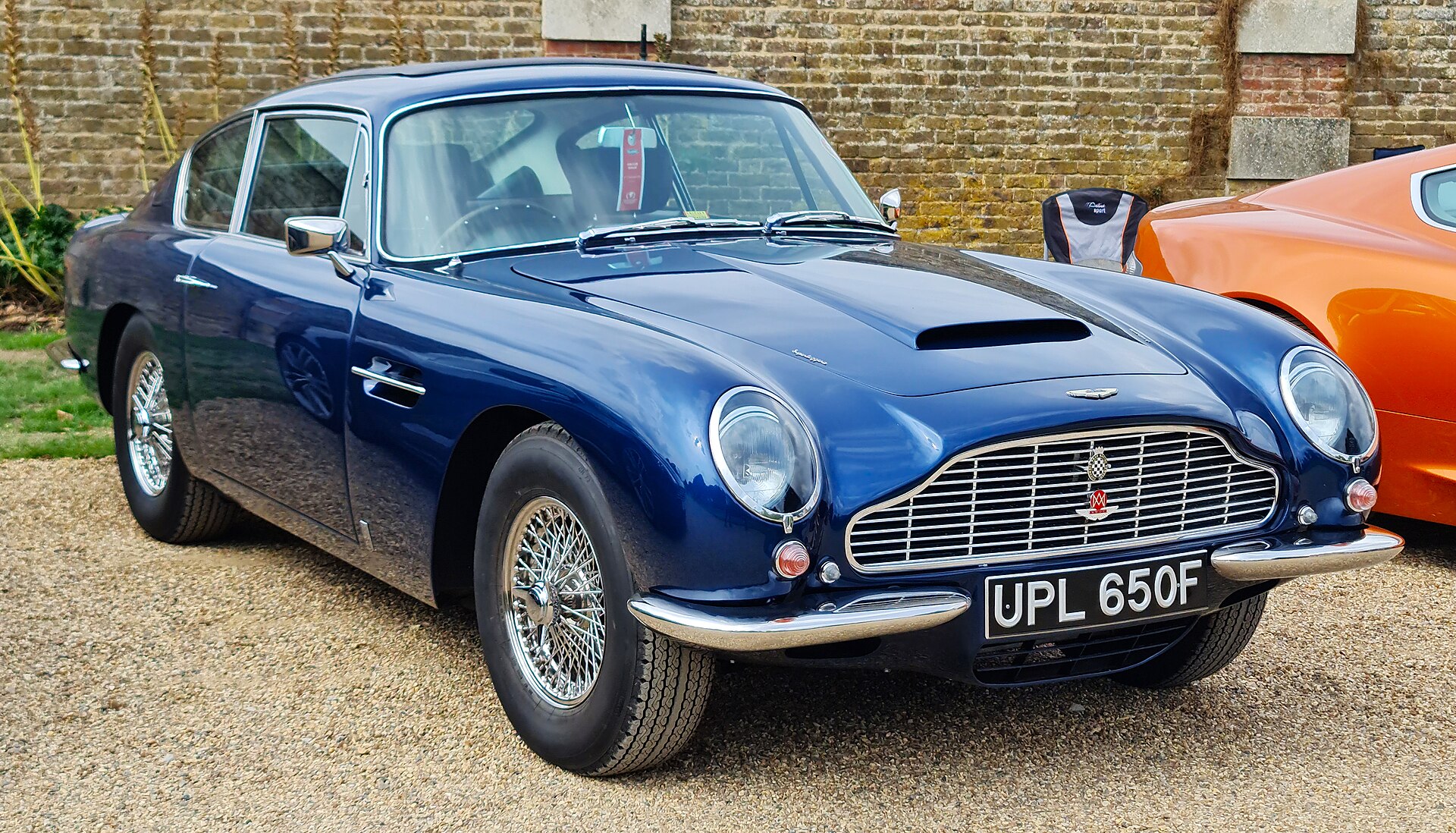
- Aston Martin DBS V8 · Photo: Herranderssvensson / Wikimedia Commons, CC BY-SA 3.0
- Aston Martin AM V8 Series 3–5 · Photo: Herranderssvensson / Wikimedia Commons, CC BY-SA 3.0
Aston Martin V8 in our rankings
- No. 160 of 912 · Longest-running car nameplates (20 years · top 19%)
- No. 393 of 859 · Most powerful cars (239 kW · top 46%)
- No. 68 of 109 · Most powerful British cars (239 kW · top 63%)
- No. 213 of 313 · Most powerful coupes (239 kW · top 69%)
- No. 248 of 345 · Cars with the most generations (2 generations)
In production longer than 81% of ranked nameplates in the 1CARS catalog (No. 160 of 912).
FAQ
How many Aston Martin V8s were built?
Wikipedia gives 4,021 cars from 1969 to 1989, including the DBS V8, the five saloon series, the Volante, the Vantage and the Zagato models.
What engine does the Aston Martin V8 have?
A 5,340 cc V8 designed by Tadek Marek, with Bosch injection at first, then Weber carburettors from 1973 and Weber/Marelli injection from 1986.
What is the Aston Martin V8 "Oscar India"?
The Series 4 of 1978 to 1985, with a closed bonnet bulge, an integrated tail spoiler and wood trim inside.
Which Aston Martin V8 appears in The Living Daylights?
A V8 Volante, later shown with a hard top; disguised saloons were also used.
What replaced the Aston Martin V8?
The Aston Martin Virage, in 1989.
Data sources
Data checked by an editor against the sources below.
- Wikipedia — Aston Martin V8
- Wikipedia — Aston Martin DBS