 Opel Insignia
All generations, specs and history
Published Sources (1) Report an error
By Felix Hartmann, Automotive Technology & EV Contributor
- Built
- 2008–2022
- Generations
- 2
Timeline
Insignia generations
Click a generation for its own page

- Insignia A 2008–2017 · Sedan, Liftback
- Insignia B 2017–2022 · Liftback, Station wagon
Newest first · 2 generations since 2008
All generations by year: Insignia B (2017–2022) · Insignia A (2008–2017)
Which one is mine?
Pick the year of first registration to see which generation it is.
- Insignia B 2017–2022
- Insignia A 2008–2017
The Opel Insignia is a front- or all-wheel-drive large family car — a D-segment model in European terms — that the German company built from 2008 to 2022. The second generation was offered as the Grand Sport liftback and the Sports Tourer estate (the first also as a saloon). The name means an emblem or badge of distinction, and in the United Kingdom the car was sold as the Vauxhall Insignia.
In short
- Two generations: the Insignia A (2008–2017), European Car of the Year 2009, and the Insignia B (2017–2022).
- The Insignia B was first seen online in December 2016 and debuted at the Geneva motor show in 2017; it was facelifted at the Brussels motor show in January 2020.
- The facelift brought IntelliLux LED matrix headlights with 168 LEDs and engines from a 90 kW (122 PS) 1.5 diesel to the 169 kW (230 PS) 2.0 turbo of the GSi.
- Opel ended production in 2022 without a direct successor.
Opel Insignia at a glance
The Insignia story began in 2008, when Opel replaced the Vectra, a nameplate first seen in 1988. The first generation was launched at the British International Motor Show in 2008, won European Car of the Year for 2009 and was given a major facelift in 2013. The second generation appeared online in December 2016 and made its public debut in Geneva in 2017, with elegant styling, an upmarket cabin, turbocharged engines and a long list of equipment. Under the skin it was a General Motors design, also sold as the Buick Regal and as the Holden Commodore in Australia, and production continued after Opel became part of PSA and later Stellantis.
As rivals were updated, Opel facelifted the Insignia at the Brussels motor show, held from 9 to 19 January 2020, covering both the Grand Sport and the Sports Tourer. In February 2022 the company confirmed that the Insignia would be discontinued that year. More of the brand's range is in our Opel catalogue; its predecessor is covered in our Opel Vectra article, and the brand's story in the history of Opel.
Generations
| Generation | Years | Body styles | Notes |
|---|---|---|---|
| Insignia A | 2008–2017 | Saloon, liftback, Sports Tourer estate | European Car of the Year 2009; facelift 2013 |
| Insignia B | 2017–2022 | Grand Sport liftback, Sports Tourer estate | GM platform shared with Buick Regal; facelift 2020 |
Exterior of the facelifted Insignia B
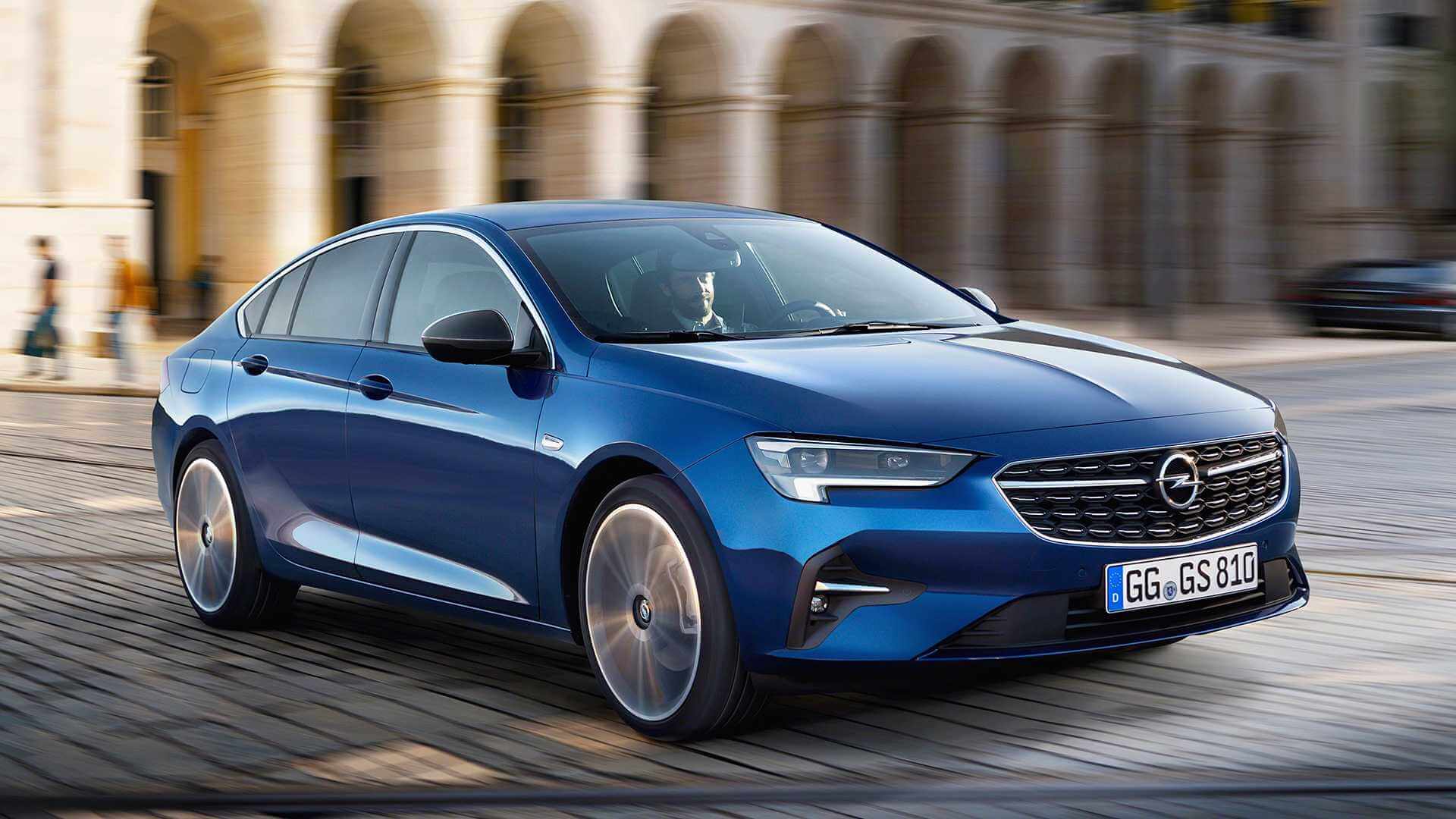
The second generation looks very different from the first, with many decorative details in chrome or gloss black, distinctive headlights, changes in surface height and bold air-intake cut-outs. The facelift made the front more aggressive. It sits low but is substantial and slightly raked, which helps visibility. The bonnet has a thin central crease and slightly raised edges.
The centre of the bumper holds Opel's polygonal grille with a thin chrome frame, a large black mesh and a chrome bar carrying the badge. The headlights are LED, and the facelift introduced IntelliLux LED matrix lights with 168 LEDs, 84 per headlight, a range of up to 400 metres and a beam that follows the steering. Active grille shutters, controlled by an intelligent system that considers many parameters, improve aerodynamics and reduce fuel consumption. The lower bumper has three intakes: a large polygonal one in the centre in unpainted plastic and two triangular side openings in gloss black with chrome surrounds.
In profile, both the liftback and estate have large windows with a thin chrome line and dividing pillars in gloss black or body colour. Triangular gloss-black mirrors carry indicator repeaters on more expensive versions. Stepped, flowing surfaces, slightly prominent sills and strongly flared wheel arches complete the side view. Ground clearance is 160 mm, and wheels range from 17 inches as standard to 18- and 20-inch options. At the rear, the sloping roof flows into the tailgate, whose angle depends on the body, above a large rear window, a small lip and tail lights that echo the front. The bumper has a number-plate recess, a small black diffuser and two wide rectangular chrome exhaust trims.
Interior and practicality
Inside, liftback and estate are identical. The second generation already had more interior space than its predecessor, thanks to a wheelbase 92 mm longer. Upholstery options range from quality cloth to cloth and leather, leather, Nappa leather and perforated leather, with real wood or polished aluminium trim available.
The driver has a sporty three-spoke leather steering wheel with a flat bottom and many buttons — for example for steering-wheel heating and the phone — adjustable for height and reach. Stalks control the cruise control and safety systems, and there is a start/stop button. The instruments combine analogue dials with a large trip-computer screen that can also act as a speedometer, and a head-up display is available. The sports seats offer good side support, electric adjustment and memory, and after the facelift ergonomic AGR-certified seats were offered with many comfort functions. Most physical buttons have moved to the steering wheel or the infotainment system.
The centre console holds an 8-inch IntelliLink touchscreen that works with Android Auto and Apple CarPlay, remains readable in sunlight and shows the image from the upgraded reversing camera. Below it are the media controls, hazard switch and a well-designed dual-zone climate panel with large knobs, buttons and temperature displays. Near the gear lever is a selector for the driving modes, and the parking brake is electric. The two-level armrest contains wireless charging and a storage compartment.
The rear seat has room for three, each with a headrest, plus USB and 12-volt sockets and cupholders in the armrest. The Grand Sport's boot holds 490 litres, rising to 1,450 litres with the seats folded; the Sports Tourer offers 560 litres plus extra lights and nets. A space-saver spare and tools sit under the floor.
Engines and transmissions (2020 facelift)
| Engine | Power (kW / PS) | Torque | 0–100 km/h | Top speed | Consumption |
|---|---|---|---|---|---|
| 1.5 diesel (3-cyl turbo) | 90 kW / 122 PS | 300 Nm | 11.4 s | 205 km/h | 4.4 l/100 km |
| 2.0 diesel (4-cyl turbo) | 128 kW / 174 PS | 380 Nm | 8.0–8.7 s | 228 km/h | 4.6 l/100 km |
| 2.0 turbo petrol | 147 kW / 200 PS | 350 Nm | 7.7 s | 235 km/h | 6.4 l/100 km |
| 2.0 turbo petrol (GSi) | 169 kW / 230 PS | 350 Nm | 7.4 s | 237 km/h | 6.9 l/100 km |
All engines meet the Euro 6d standard. Depending on the engine, power goes through a six-speed manual or an automatic with eight or nine speeds. The most powerful versions are available with Twinster all-wheel drive with torque vectoring. Driving modes include Standard, Tour and Sport, and the GSi adds a Competition mode for the sharpest responses.
Chassis
The facelift did not change the platform, a General Motors design with a transverse engine that is also used by the Buick Regal and Chevrolet Malibu and supports all-wheel drive. The sporty Insignia GSi comes as standard with FlexRide adaptive chassis control, which adjusts the dampers and steering in fractions of a second. Steering is electrically assisted, and the updated car gained a new electro-hydraulic brake system that shortens braking distances.
Safety and equipment
Even base versions have a good list of active and passive safety systems: six airbags, blind-spot monitoring, adaptive cruise control, ABS with cornering brake control, light and rain sensors, keyless entry, a parking assistant, an immobiliser and alarm, brake assist, tyre-pressure monitoring with automatic calibration after a wheel change, a surround-view camera, lane-keeping assistance, pedestrian and traffic-sign recognition and rear cross-traffic alert. Depending on the market, base versions also have heated electric mirrors, 17-inch alloys, a front camera, hill-start assist, LED headlights with 24 LEDs and automatic levelling, a 7-inch touchscreen and climate control with an activated-carbon filter.
Strengths and weaknesses
Owners praise the attractive design, strong engines, comfort, sure-footed handling, adaptive lights, comfortable suspension, ventilated seats on some versions, good safety and a large boot, and they report few problems with build quality or reliability. Complaints include expensive servicing, limited mirror visibility, petrol consumption, thin paint, outdated navigation maps and weak points such as the boot lock and parking sensors. Rivals include the Volkswagen Passat, Skoda Superb, Ford Mondeo, Peugeot 508, Renault Talisman, Toyota Camry and Mazda6.
Image credits · Photos from Wikimedia Commons under free licences
- Opel Insignia B · Photo: Alexander Migl / Wikimedia Commons, CC BY-SA 4.0
Opel Insignia in our rankings
- No. 264 of 912 · Longest-running car nameplates (14 years · top 30%)
- No. 286 of 345 · Cars with the most generations (2 generations)
In production longer than 70% of ranked nameplates in the 1CARS catalog (No. 264 of 912).
FAQ
How many generations of the Opel Insignia are there?
Two: the Insignia A (2008–2017) and the Insignia B (2017–2022).
Is the Opel Insignia still made?
No. Opel confirmed in February 2022 that production would end that year without a direct successor.
What is IntelliLux LED on the Insignia?
A matrix LED headlight system with 168 LEDs (84 per headlight), a range of up to 400 metres and a beam that follows the steering.
How big is the Opel Insignia boot?
The Grand Sport holds 490 litres (1,450 litres with the seats folded); the Sports Tourer estate offers 560 litres.
Did the Opel Insignia win Car of the Year?
Yes, the first-generation Insignia was European Car of the Year for 2009.
Data sources
Data checked by an editor against the sources below.