 Renault Talisman
Specs, engines and history
Published Sources (1) Report an error
By Oleksandr Hnatiuk, Automotive Editor & Used Car Specialist
Verdict
Our verdict · Oleksandr Hnatiuk
The facelifted Talisman is not a different car, and Renault never intended it to be: the company has said that design is the key to the model's appeal, and even years after its launch the car still looks great. The engineers added matrix headlights that see further and made small improvements to the cabin. The Talisman remains spacious, with a huge boot and powerful yet economical engines. It may not outsell the Volkswagen Passat, but it offers a distinctive, comfortable alternative in the class.
The Renault Talisman is a mid-size (D-segment) car from Renault, offered as a saloon and as an estate (Grandtour). It was officially revealed on 6 July 2015 at the Château de Chantilly near Paris, and its public debut followed at the Frankfurt motor show that autumn. It was built at Renault's Douai plant in France. In February 2020 Renault presented a facelifted Talisman with only modest changes: a fresher look, light interior updates and new options. The mechanical side had already been revised in 2018 for the Euro 6d emissions standard. European production ended in February 2022.
In short
- D-segment saloon and estate on the CMF-CD platform, built in Douai, France, from 2015 to 2022; facelift in February 2020.
- TCe petrol engines with 120 and 165 kW (163 and 225 PS) and Blue dCi diesels with 88–147 kW (120–200 PS).
- Front-wheel drive with optional 4Control four-wheel steering and Multi-Sense driving modes.
- 608 litres of boot space in the saloon — one of the largest in its class.
Renault Talisman at a glance
The Talisman replaced the Laguna and Latitude in Renault's range. In South Korea the same car was sold as the Renault Samsung SM6. More Renault models are listed in our Renault catalogue, its predecessor is covered in our Renault Laguna article, and the company's background in our history of Renault.
| Item | Detail |
|---|---|
| Reveal | 6 July 2015, Château de Chantilly |
| Body styles | Four-door saloon, five-door estate (Grandtour) |
| Platform | CMF-CD (Renault-Nissan) |
| Plant | Douai, France |
| Facelift | February 2020 |
| End of European production | February 2022 |
| Drive | Front-wheel drive |
Exterior
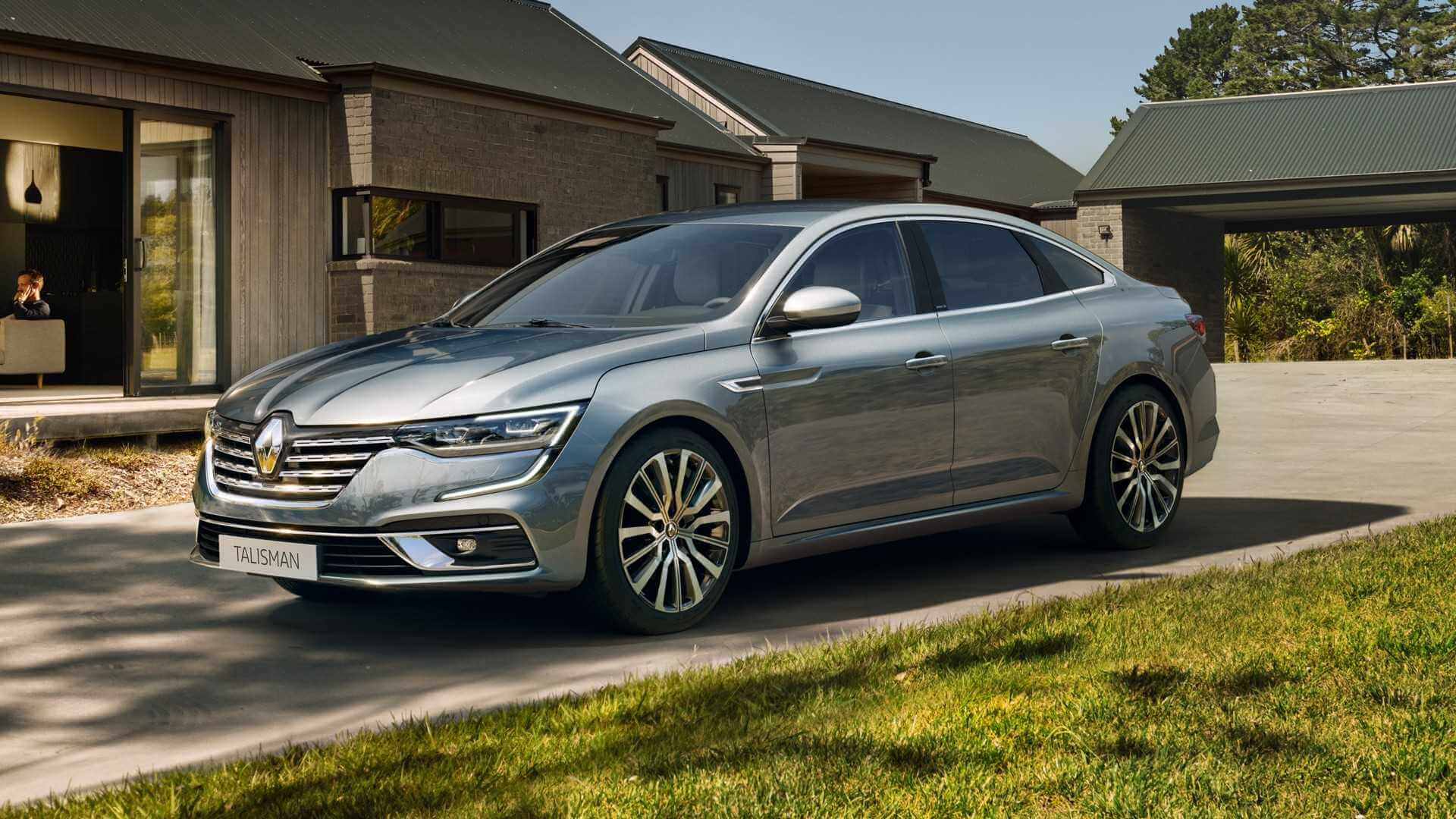
Both the saloon and the estate stand out for their original design and do not get lost in traffic. Some see the Talisman as a summary of Renault design of its time, because it gathers many elements from the brand's other models. The bonnet is beautifully sculpted, with no flat surfaces. The large trapezoidal grille is trimmed in chrome both around its edge and inside, with a big Renault badge in the centre, and the fog lamps sit at the sides of the bumper.
The headlights have a fierce look and continue downwards in thin LED strips that act as daytime running lights. The front of the estate reminds some observers of the Volkswagen Passat Variant.
The side is restrained but has interesting details: slightly flared wheel arches and a shallow recess along the bottom of the doors, while everything else sits almost flush. The mirrors and window surrounds are finished in bright chrome. The conservatively styled saloon rides on 16- to 19-inch wheels, and ground clearance is an average 145 mm.
The rear resembles other Renault models of the period, with long, narrow tail lights, a slightly protruding bumper and wide rectangular exhaust outlets. A special feature is the 3D-effect lighting in the tail lights. The boot lid has an integrated spoiler.
The 2020 facelift added LED Matrix Vision headlights with a longer beam — 220 metres, almost 50 metres more than before — along with revised grille slats, a slightly altered front bumper, a shark-fin antenna, new paint colours and new wheel designs.
Interior
The cabin matches the exterior, with high-quality materials including leather. As a business-class car, the Talisman offers plenty of space and comfortable seats. The driver has a comfortable three-spoke multifunction steering wheel with a flat-bottomed rim and buttons for the infotainment system.
The digital instrument cluster shows all the necessary information, with a combined speedometer and rev counter, an engine temperature gauge on the left and a fuel gauge on the right, plus an information area next to the speedometer. The ambient lighting colour can be changed to suit the driver; the panel above the glovebox and the area to the left of the steering wheel are illuminated too.
The dashboard is also leather-trimmed in the interior colour. The doors have chrome handles at the top and armrests with buttons below; on the driver's side these control the mirrors and all the windows. Long journeys are easy thanks to comfortable seats with massage and heating, electric adjustment and memory for up to five positions. The front seats have an anatomical shape with well-developed side support and many adjustments.
The centre console of the pre-facelift car carries the R-Link 2 infotainment system with a large 8.7-inch portrait touchscreen — some compare it with the screen in a Tesla — while simpler versions have a smaller 7-inch display. The system runs on Android and handles phone calls, rear-camera images and vehicle information. Below the screen are rotary controls for the climate and other functions, then the gear lever and a controller for the menus and suspension settings. The facelift brought a 10.2-inch digital instrument cluster and a 9.3-inch touchscreen.
The rear seat is also comfortable, with a roomy bench and plenty of space: 855 mm from cushion to roof and 262 mm of knee room. The Talisman is one of the roomiest cars in its class. Pockets, boxes and other storage compartments add up to 20 litres. The saloon's boot holds 608 litres — a very good figure for the class — and folding the 60/40 split rear backrests increases this to 1,022 litres, although a small step remains in the floor.
Engines and transmissions
| Engine | Fuel | Power (kW / PS) | Torque | Gearbox |
|---|---|---|---|---|
| 1.3 TCe | Petrol | 120 kW / 163 PS | 270 Nm | 7-speed EDC dual-clutch |
| 1.8 TCe | Petrol | 165 kW / 225 PS | 300 Nm | 7-speed EDC dual-clutch |
| 1.7 Blue dCi 120 | Diesel | 88 kW / 120 PS | 300 Nm | 6-speed manual |
| 1.7 Blue dCi 150 | Diesel | 110 kW / 150 PS | 340 Nm | 6-speed manual |
| 2.0 Blue dCi 160 | Diesel | 118 kW / 160 PS | 360 Nm | 6-speed EDC dual-clutch |
| 2.0 Blue dCi 200 | Diesel | 147 kW / 200 PS | 400 Nm | 6-speed EDC dual-clutch |
The table shows the range after the 2018 update; earlier cars also used 1.5 and 1.6 dCi diesels and a 1.6 TCe petrol engine. Even after the facelift the Talisman did not get a hybrid or electric version, which is surprising given how many European buyers care about the environment.
The TCe petrol engines are turbocharged four-cylinders with direct injection, 16 valves, double overhead camshafts and variable timing on both intake and exhaust camshafts. Depending on the version, they take the car to 100 km/h in 7.4–11.9 seconds and on to 191–240 km/h, using 5.6–7.2 l/100 km on the combined cycle. The 1.7 and 2.0 Blue dCi diesels are turbocharged with common-rail injection and 16 valves and use 4.6–4.9 l/100 km.
Chassis and 4Control
The Talisman uses a version of the Renault-Nissan Common Module Family (CMF-CD) platform with MacPherson struts at the front and a semi-independent torsion beam at the rear; adaptive dampers improve comfort. All versions are front-wheel drive. Electric power steering and disc brakes on all wheels are standard.
The Talisman stands out from most rivals with its optional 4Control four-wheel steering: actuators on the rear axle turn the rear wheels when needed, improving agility at low speed and stability at high speed. The Multi-Sense system offers five modes — Eco, Comfort, Neutral, Sport and Perso — which change the steering, gearbox, adaptive dampers and engine sound.
Safety
The Talisman has front and side airbags, curtain airbags that protect occupants from the side windows in a collision, and seat-belt reminders for the front and rear seats. ISOFIX child seats fit easily in the back. The facelifted car's adaptive cruise control can keep the car in its lane on winding roads, stop automatically behind the car in front and restart, working up to 160 km/h. Pedestrian and cyclist detection, blind-spot monitoring and parking sensors are also available.
Well-equipped entry-level versions have front and side airbags, dual-zone climate control, 17-inch alloy wheels, ABS, EBD and ESP, front and rear parking sensors, a 7-inch display, electric windows all round and heated electric mirrors. Higher trims add 19-inch wheels, an exclusive Amethyste Black paint finish, Nappa leather, special mats and badges and a 13-speaker Bose audio system.
What owners say
Owners praise the Talisman's attractive looks, good handling and high comfort, as well as its build quality, infotainment system, sound insulation and suspension. The roomy cabin and large boot are other highlights. No particular weaknesses have been reported, although ground clearance is sometimes a little low.
Rivals
The Talisman competed with the Toyota Camry, Citroën C5, Volvo S60, Peugeot 508, Ford Mondeo, Volkswagen Passat, Mazda6, Opel Insignia, Volkswagen Arteon and Skoda Superb.
Renault Talisman in our rankings
In production longer than 40% of ranked nameplates in the 1CARS catalog (No. 523 of 912).
FAQ
When was the Renault Talisman launched?
It was revealed on 6 July 2015 and shown publicly at the Frankfurt motor show that autumn. The facelift arrived in February 2020, and European production ended in February 2022.
Is the Renault Talisman all-wheel drive?
No. Every Talisman is front-wheel drive; the optional 4Control system steers the rear wheels but does not drive them.
How big is the Renault Talisman boot?
The saloon's boot holds 608 litres, or 1,022 litres with the rear seats folded.
What engines does the Renault Talisman have?
TCe petrol engines with 120 and 165 kW (163 and 225 PS) and Blue dCi diesels with 88–147 kW (120–200 PS).
Data sources
Data checked by an editor against the sources below.