
 Chevrolet Baldwin-Motion Camaro
All generations, specs and history
Published Sources (5) Report an error
By Felix Hartmann, Automotive Technology & EV Contributor
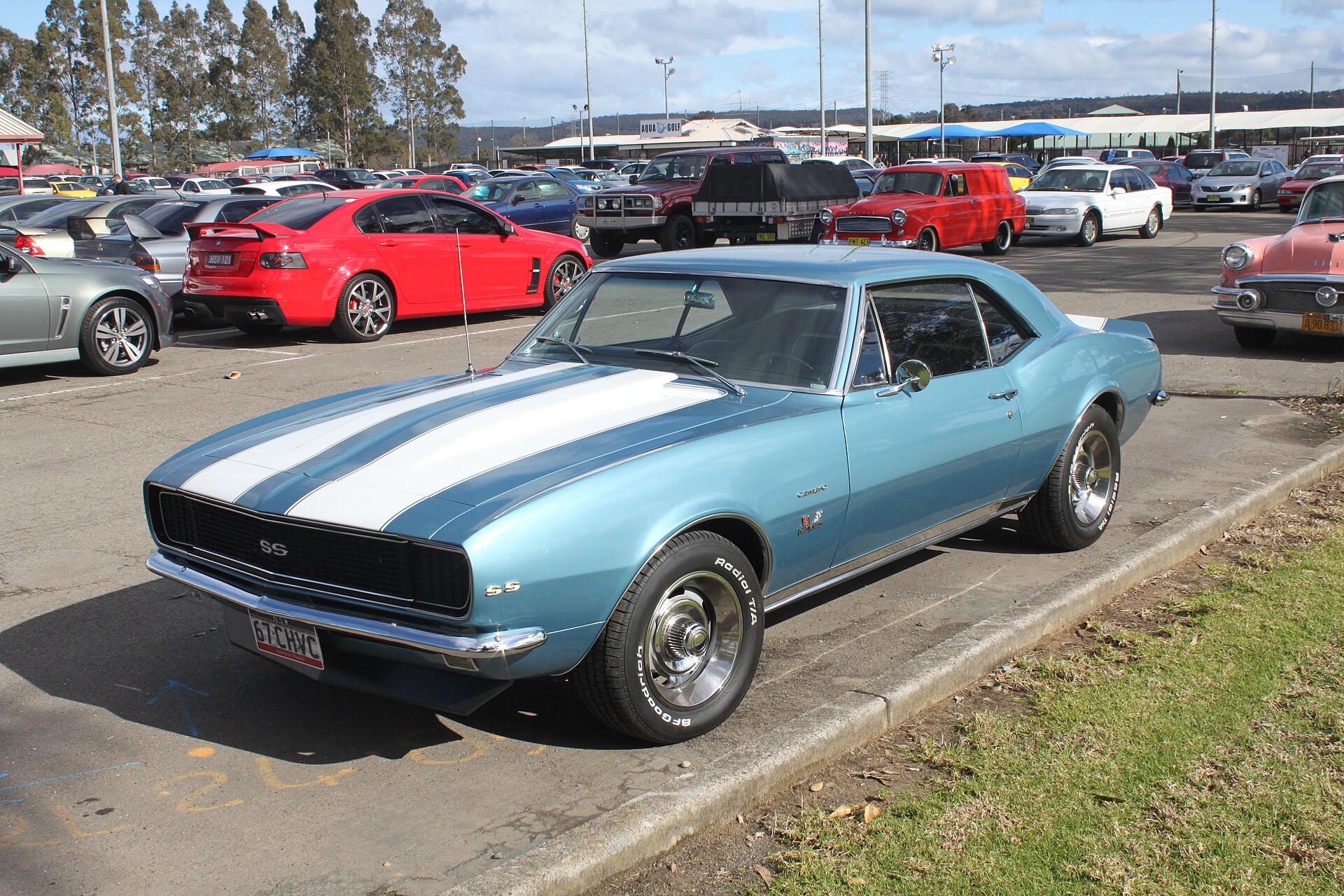
- Built
- 1967–1974
- Generations
- 2
- Top power
- 383 kW (521 PS)
Timeline
Baldwin-Motion Camaro generations
Click a generation for its own page
- Baldwin-Motion 427 Camaro 1967–1969 · Coupe
- Baldwin-Motion Phase III Camaro 1970–1974 · Coupe · 383 kW (521 PS)
Newest first · 2 generations since 1967
- 1970 Baldwin-Motion Phase III Camaro 1970–1974 · Coupe · 383 kW (521 PS)
- 1967 Baldwin-Motion 427 Camaro 1967–1969 · Coupe
All generations by year: Baldwin-Motion Phase III Camaro (1970–1974) · Baldwin-Motion 427 Camaro (1967–1969)
Which one is mine?
Pick the year of first registration to see which generation it is.
- Baldwin-Motion Phase III Camaro 1970–1974
- Baldwin-Motion 427 Camaro 1967–1969
The Baldwin-Motion Camaro was a dealer-built Camaro sold by Baldwin Chevrolet in Baldwin, Long Island, New York, and converted by Joel Rosen's Motion Performance from 1967 to 1974. Early cars received 427 V8s; later Phase III cars used worked 454s, one 1973 car rated at over 383 kW (513 hp). The top cars came with a written guarantee of 11.50 seconds at 120 mph over the quarter mile.
In short
- Partnership of a Chevrolet dealer and a speed shop; about 500 Baldwin-Motion cars of all models were built from 1967 to 1974.
- Phase III guarantee: at least 120 mph in 11.50 seconds or better, with an approved driver on an NHRA or AHRA strip.
- A 1973 Phase III 454 Camaro cost USD 9,073.33 in 1973 including tax, against a base price of USD 3,841.
- The EPA and the Justice Department stopped street conversions in 1974, and Rosen eventually paid a USD 500 fine.
Specs by version
| Version | Engine | Power | Gearbox | Drive | Production years |
|---|---|---|---|---|---|
| Baldwin-Motion 427 Camaro · SS 427 conversion | 7.0 l · 8 cyl · Petrol 6,997 cc | - | - | Rear-wheel drive | 1967–1969 |
| Baldwin-Motion Phase III Camaro · Phase III 454 4-speed manual | 7.4 l · 8 cyl · Petrol 7,440 cc | - | 4-sp Manual | Rear-wheel drive | 1970 |
| Baldwin-Motion Phase III Camaro · Phase III 454 Turbo Hydra-Matic 400 | 7.4 l · 8 cyl · Petrol 7,440 cc | 383 kW 521 PS514 hp | 3-sp Automatic | Rear-wheel drive | 1973 |
Verified Manufacturer and type-approval data from our catalog · Sources and methodology
Baldwin-Motion Camaro at a glance
| Specification | Baldwin-Motion Camaro |
|---|---|
| Years | 1967-1974 |
| Built | not recorded; about 500 Baldwin-Motion cars of all models (Hagerty) |
| Body | two-door coupe, first- and second-generation Camaro |
| Platform | GM F-body pony car |
| Engines | 7.0 L (427 cu in) V8 in early cars; 7.4 L (454 cu in) LS6-based Phase III V8 later |
| Power | over 383 kW (513 hp) claimed for a 1973 Phase III 454; factory LS6 336 kW (450 hp, SAE gross) |
| Gearboxes | M21 four-speed manual or Turbo Hydra-Matic 400 with high-stall converter |
| Rear axle | 12-bolt, 4.10:1, Positraction |
| Quarter mile | guaranteed 11.50 s at 120 mph or better (Phase III) |
| Price new | USD 9,073.33 with tax in 1973 for a Phase III, base car USD 3,841 |
| Builder | Motion Performance, Baldwin, New York; sold by Baldwin Chevrolet |
A Brooklyn speed shop and a Long Island dealer
Joel Rosen started Motion Performance in 1964 in a Sunoco service station in Brooklyn, where it built a reputation for dynamometer tuning of Chevrolets. Rosen raced a 289 Cobra and a fuel-injected 1963 Corvette split-window coupe. In 1966 the shop moved to Baldwin on Long Island, close to Baldwin Chevrolet, a family-run dealership whose general manager was Ed Simonin.
Rosen and Simonin agreed on a simple arrangement: the dealer sold new Chevrolets, Motion converted them into turnkey drag cars, and the customer collected a finished car from the showroom with the standard factory warranty. Hagerty dates the partnership to 1966, other accounts to 1967, when the first 427 Camaros were built. Marty Schorr, editor at CARS Magazine and Performance Media, wrote the Motion catalogues and handled marketing; Car Guy Chronicles calls him a co-founder.
The 427 Camaros of 1967 to 1969
The first-generation Camaro arrived for 1967 with the 396 as its largest regular engine, because General Motors kept larger engines out of its pony cars. Motion installed the 427 at the dealership level, as Yenko did in Pennsylvania, Nickey in Chicago and Dana in California. Wikipedia names Baldwin-Motion among the dealers whose requests led Chevrolet to offer factory 427 Camaros through the COPO system in 1969, described on the Camaro COPO page.
A 1968-1969 Baldwin-Motion 427 Camaro set an NHRA A/MP national record. Motion's advertising used the 1969 SS 427 Camaro of journalist Joe Oldham. Unlike the Yenko Camaro, the Long Island cars were backed by a mail-order business: Motion sold its parts through the catalogues Schorr produced.

Phase III and the 11.50-second guarantee
Phase III was the top Motion specification. Its written guarantee promised at least 120 mph in 11.50 seconds or better over the quarter mile, with a Motion-approved driver on an AHRA- or NHRA-sanctioned strip. Silodrome quotes the guarantee as money-back; Rosen later told Hagerty that he never had to pay out on it.
The equipment list of a surviving 1970 Phase III Camaro shows what the package meant on a second-generation car:
| Item | 1970 Phase III Camaro (Mecum car) | 1973 Phase III Camaro |
|---|---|---|
| Engine | worked 454 LS6, over 373 kW (500 hp); 391 kW (525 hp) in one caption | 454 LS6, over 383 kW (513 hp), 11:1 compression |
| Carburettor | not stated | Holley 850 cfm four-barrel |
| Gearbox | M21 four-speed | Turbo 400 with high-stall converter |
| Axle | 12-bolt Positraction, 4.10:1 | 12-bolt Positraction, 4.10:1 |
| Other parts | COPO 9796 tall rear spoiler, Hooker headers and side pipes, Super Bite suspension, Motion bonnet with pins, Cragar SS wheels | not listed |
The 454 claim of 383 kW (513 hp) compares with 336 kW (450 hp, SAE gross) for the factory LS6. The Motion figures are builder claims, not SAE ratings.
What a Motion Camaro cost
The 1973 car offered at Mecum in January 2027 gives a rare complete invoice. Its base price in 1973 was USD 3,841, and the total with conversion and sales tax reached USD 9,073.33, a premium of USD 5,232.33. Chevrolet built 96,751 Camaros that year, and its strongest regular engine was the Z28's L82 with 183 kW (245 hp, SAE net). Rosen kept his production records close to his chest, so the number of 1973 LS6 Camaros is unknown.
Many cars left the United States. Car Guy Chronicles reports exports to Europe and the Middle East, and Silodrome lists Phase III Corvettes, Novas, Chevelles and Biscaynes beside the Camaro in the Baldwin-Motion range. About ten Phase III Corvettes were built between 1969 and 1971.

Why Baldwin-Motion ended in 1974
The oil embargo of late 1973 hit demand for large-engined cars, and Baldwin Chevrolet closed in 1974. The final blow came from a magazine. Car Craft published "King Kong Lives on in Long Island" in 1974, a feature on a 454-powered Motion Vega, and the article drew the attention of the Environmental Protection Agency.
The Department of Justice sent Rosen a cease-and-desist order against modified street cars that broke emission rules. The threatened penalty in 1974 was USD 10,000 per disabled or removed emission device, about USD 50,000 for the Vega. Rosen paid a USD 500 fine in the end. Motion continued with special orders, with invoices marked "For Export" or "For Off Road Use Only", which kept the shop alive but cut sales. The second-generation Camaro that Motion had converted since 1970 stayed in production until 1981.
Baldwin-Motion Camaro today: revival and documentation
In 2005 Rosen showed a prototype 1969 Camaro Supercoupe at the SEMA Show. Plans for 12 cars were not carried out. In 2012 that prototype and a convertible prototype crossed the block at Barrett-Jackson, and each sold for USD 450,000 in 2012. Yenko, COPO and Hurst cars are ranked alongside the Baldwin-Motion Camaro in the best dealer-built muscle cars.
For original cars, documentation is difficult because no factory paper describes the conversion and no full Motion production list has been published. What buyers look for:
- a Baldwin Chevrolet invoice or delivery papers naming Motion work;
- period Motion parts such as the bonnet with pins, Phase III valve covers, Super Bite suspension and stripes;
- a matching drivetrain story: 427 in 1967-1969 cars, LS6-based 454 in Phase III cars of the 1970s;
- the ownership chain, as auction houses publish for known cars such as the Les Quam collection car restored by Supercar Specialties of Portland, Michigan.
Chevrolet Baldwin-Motion Camaro in our rankings
- No. 1 of 157 · Most powerful cars of the 1970s (383 kW)
- No. 26 of 772 · Biggest engines: cars (7,440 cc · top 4%)
- No. 22 of 250 · Biggest engines: coupes (7,440 cc · top 10%)
- No. 41 of 224 · Most powerful American cars (383 kW · top 19%)
- No. 229 of 1190 · Most powerful cars (383 kW · top 20%)
- No. 63 of 218 · Most powerful V8 cars (383 kW · top 29%)
More powerful than 99% of ranked cars of the 1970s in the 1CARS catalog (No. 1 of 157).
FAQ
What was Baldwin-Motion?
A partnership between Baldwin Chevrolet, a dealer in Baldwin, Long Island, New York, and Joel Rosen's Motion Performance. The dealer sold new Chevrolets and Motion converted them into high-performance cars from 1967 to 1974.
What did the Phase III guarantee promise?
At least 120 mph in 11.50 seconds or better over the quarter mile, with a Motion-approved driver on an NHRA- or AHRA-sanctioned strip. Rosen said he never had to pay a claim.
How many Baldwin-Motion Camaros were built?
The exact number is unknown. Hagerty estimates roughly 500 Baldwin-Motion cars of all models between 1967 and 1974, Camaros included, and no complete Motion production list has been published, so a Camaro-only figure cannot be confirmed.
Why did Baldwin-Motion stop building cars?
After a 1974 Car Craft feature on a 454 Motion Vega, the EPA and the Justice Department ordered Rosen to stop building street cars that broke emission rules. He paid a USD 500 fine, and Baldwin Chevrolet closed in 1974.
Data sources
Data checked by an editor against the sources below.
- Wikipedia - Chevrolet Camaro (first generation)
- Hagerty - Media
- Carguychronicles - Joel Rosen Baldwin Motion Supercars
- Autoevolution - 1973 Camaro Ls6 Cost More Than A New Cadillac But No Caddy Had A 500 Hp Motion Phase Iii 454 276262
- Silodrome - Baldwin Motion Phase Iii Camaro


