
 Chevrolet Yenko Nova
All generations, specs and history
Published Sources (4) Report an error
By Felix Hartmann, Automotive Technology & EV Contributor
- Built
- 1969–1970
- Generations
- 2
- Top power
- 317 kW (431 PS)
Timeline
Yenko Nova generations
Click a generation for its own page
- Yenko Nova 427 1969 · Coupe · 317 kW (431 PS)
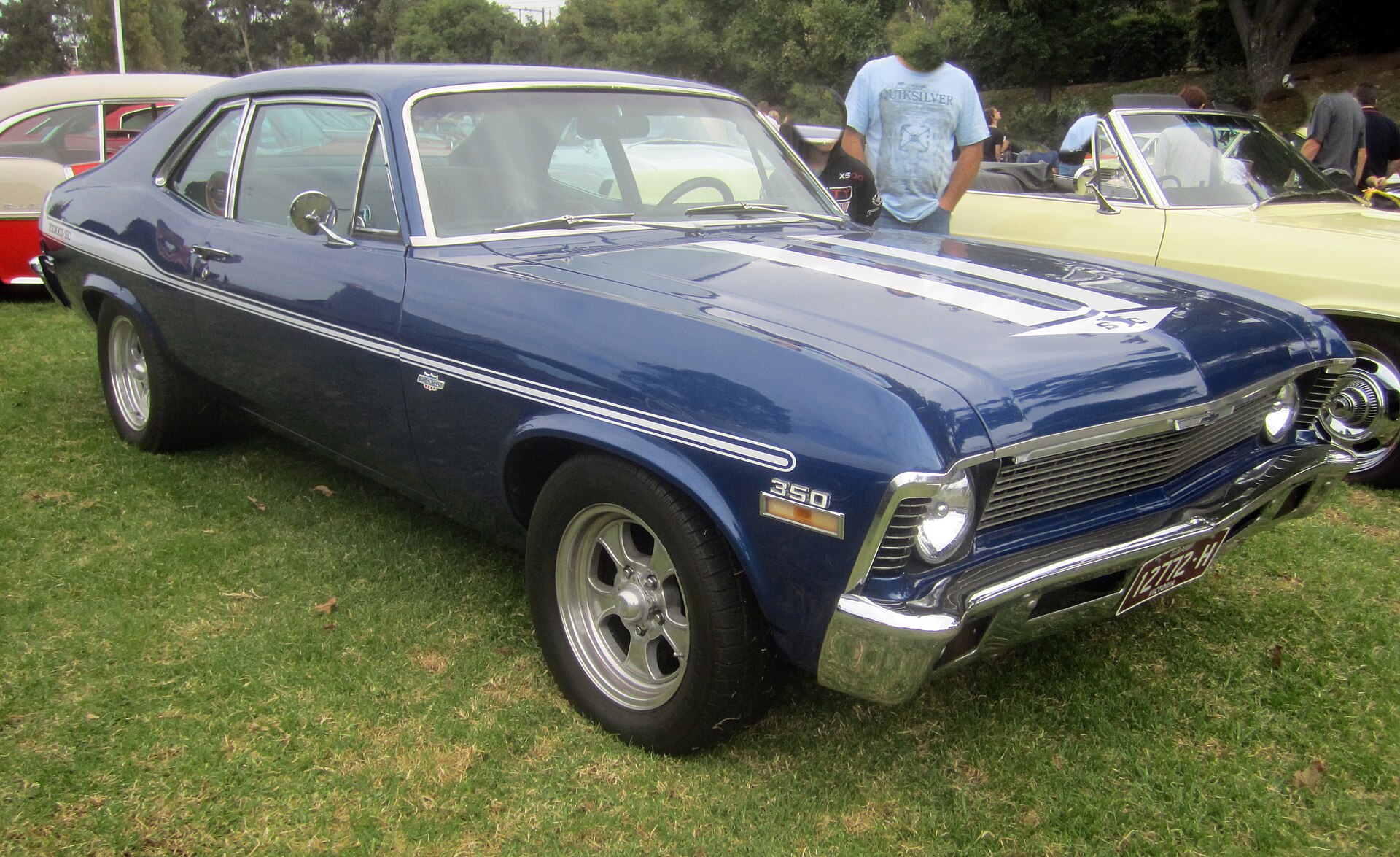
- Yenko Deuce 1970 · Coupe · 268 kW (364 PS)
Newest first · 2 generations since 1969
All generations by year: Yenko Deuce (1970) · Yenko Nova 427 (1969)
Which one is mine?
Pick the year of first registration to see which generation it is.
- Yenko Deuce 1970
- Yenko Nova 427 1969
The Yenko Nova was the compact in Yenko Chevrolet's dealer-built range, sold in two very different forms. The 1969 car carried the L72 427 big-block with 317 kW (425 hp, SAE gross) and fewer than 40 were made. For 1970 the Canonsburg dealer switched to the Yenko Deuce, a Nova with the Corvette's LT1 350 small-block rated at 268 kW (360 hp), and sold 175.
In short
- 1969 Yenko Nova: L72 427 in the Nova coupe, 37 or 38 built depending on the count, USD 4,000 new.
- 1970 Yenko Deuce: LT1 350 with 268 kW (360 hp, SAE gross), ordered through COPO 9010 and 9737.
- Deuce production 175, split into 122 four-speed manuals and 53 automatics.
- Yenko moved to the small-block because big-block cars had become expensive to insure.
Specs by version
| Version | Engine | Power | Torque | Gearbox | Drive | Production years |
|---|---|---|---|---|---|---|
| Yenko Nova 427 · 427 L72 (SAE gross) | 7.0 l · 8 cyl · Petrol L72 | 317 kW 431 PS425 hp | 624 Nm460 lb-ft | - | Rear-wheel drive | 1969 |
| Yenko Deuce · Deuce 350 LT1 4-speed manual (SAE gross) | 5.7 l · 8 cyl · Petrol LT1 | 268 kW 364 PS359 hp | - | 4-sp Manual | Rear-wheel drive | 1970 |
| Yenko Deuce · Deuce 350 LT1 Turbo Hydra-Matic 400 (SAE gross) | 5.7 l · 8 cyl · Petrol LT1 | 268 kW 364 PS359 hp | - | 3-sp Automatic | Rear-wheel drive | 1970 |
Verified Manufacturer and type-approval data from our catalog · Sources and methodology
Yenko Nova at a glance
| Specification | Yenko Nova (1969) and Yenko Deuce (1970) |
|---|---|
| Model years | 1969 (427); 1970 (Deuce) |
| Built | 37 or 38 (1969); 175 (1970) |
| Body | two-door Nova coupe |
| Platform | GM X-body compact (third-generation Nova) |
| Engines | 7.0 L (427 cu in) L72 V8; 5.7 L (350 cu in) LT1 V8 |
| Power | 317 kW (425 hp) L72; 268 kW (360 hp) LT1; both SAE gross |
| Torque | 624 Nm (460 lb-ft) L72; LT1 figure not given in the sources |
| Gearboxes, Deuce | Muncie M21 four-speed or Turbo Hydra-Matic 400, special shifters |
| Rear axle, Deuce | 12-bolt Positraction, 4.10:1 |
| Brakes, Deuce | power front discs |
| Price new | USD 4,000 for the 1969 427 car; Deuce list price not found |
Fitting a 427 into the 1969 Nova
In 1969 the regular Nova SS topped out with the L78 396, sold as part of a USD 312 SS package on a car whose base price ran from USD 2,240 to USD 2,435. Yenko had already put the L72 427 into Camaros and, through Chevrolet's COPO system, into Chevelles. The Nova was the smallest body in that programme and the obvious next step.
The engine was the same L72 used in Yenko's other Super Cars, rated at 317 kW (425 hp) and 624 Nm (460 lb-ft). Yenko charged about USD 4,000 for the finished car, and very few buyers took one. Wikipedia counts 37 cars, the Yenko Chevrolet production table and autoevolution give 38, and Hagerty says fewer than 40. Yenko himself later told Motor Trend that the 427 Novas were "lethal", a word that says a lot about a big-block in a compact chassis on the tyres of 1969.

From big-block to LT1 for 1970
By the end of 1969 insurers were charging heavily for big-block cars, and Yenko changed course. Instead of a larger engine he asked Chevrolet for the high-output LT1 350 shared with the Camaro Z28 and the Corvette. It had a solid-lifter camshaft, an aluminium intake manifold and finned aluminium rocker covers, and in the Nova it was rated at 268 kW (360 hp, SAE gross).
The aim was a fast car that a young buyer could still insure. Sports Car Market adds that the lighter small-block also suited the Nova's handling better than the 280 kW (375 hp) L78 396 in the regular Nova SS. Don Yenko named the result the Deuce, after the Beach Boys' 1963 song "Little Deuce Coupe", itself a reference to the 1932 Ford hot rod.
How the Yenko Deuce was specified
The Deuce used two order codes. COPO 9010 brought the factory-installed LT1, and COPO 9737 added the sports car equipment Yenko wanted. Hagerty and Sports Car Market list:
- dual exhausts and an uprated cooling system;
- power brakes with front discs;
- heavy-duty springs and anti-roll bars front and rear;
- a 12-bolt Positraction axle with 4.10:1 gears;
- an M21 four-speed or a Turbo Hydra-Matic 400, each with a special shifter;
- a bonnet-mounted tachometer.
At the dealership the cars received a blacked-out grille, side stripes ending in the words "Yenko Deuce", Yenko badges and "sYc" marks on the front seats. Wheel choices differ by source: Sports Car Market mentions SS wheels, while autoevolution describes Yenko-specific alloys on a restored car. Known colours include Cortez Silver, Fathom Blue and Cranberry Red, with black stripes on the silver cars.

Yenko Nova and Deuce production numbers
| Year | Model | Engine | Gearbox split | Built |
|---|---|---|---|---|
| 1969 | Yenko Nova 427 | L72 427, 317 kW (425 hp) | not recorded in the sources | 37 or 38 |
| 1970 | Yenko Deuce | LT1 350, 268 kW (360 hp) | 122 four-speed, 53 automatic | 175 |
Chevrolet recorded about 177 COPO Novas for 1970. Yenko converted 175 of them, and the remaining two were sold in Canada. Survivors of the 1969 car are scarce: Wikipedia lists seven registered cars, autoevolution fewer than ten.
The Nova family as a whole is covered in the Chevy II and Nova hub, and the better-known 427 sibling in the Yenko Camaro article.
Yenko Deuce rivals among small-block compacts
The Deuce arrived in the same season as other small-block compacts. The Plymouth Duster 340 appeared for 1970 with a 340 cu in V8, and AMC added the Hornet SC/360 for 1971. Those were factory models that any dealer of the brand could sell in thousands. The Deuce came from one Pennsylvania showroom, was built 175 times and needed two special order codes before the dealer touched it.
The LT1 itself was the main difference. Yenko had to persuade General Motors to install it in the Nova, and COPO 9010 was the paperwork that made it possible; the regular Nova SS of 1970 offered the 350 and the 396 instead. Yenko did not continue the Nova after 1970. His next project was the Stinger II based on the Vega, sold without its turbocharger because the EPA had not certified it.
Yenko Nova today: what to check
Both cars are copied, and the 1969 427 version is valued far above the Deuce. Hagerty lists a #2 value of USD 399,000 for the 427 Nova in an undated article, so a documented car and a clone are separated by a large sum. Points to verify:
- Original COPO paperwork: 9010 and 9737 on a Deuce, together with dealer invoices.
- The VIN: Deuces in Hagerty's sales records begin 114270W, a 1970 V8 Nova coupe.
- LT1 details on a Deuce, such as the solid-lifter cam and aluminium intake, and the 4.10:1 12-bolt.
- Body originality: autoevolution reports a Cortez Silver Deuce that was re-bodied after rust consumed the original shell; it had sold for USD 82,500 in 2009.
- Certification: the COPO Connection, letters of authenticity and the Yenko vehicle verification certificate are used by sellers.
Recent prices for the Deuce are dated. RM Sotheby's sold a car for USD 126,500 including premium in an online auction on 6 November 2024, and Sports Car Market put the market range at USD 90,000 to USD 160,000 in January 2025. Hagerty's valuation tool showed USD 93,600 with a value graph running to April 2025. The highest Deuce sale cited by autoevolution in October 2026 was USD 230,000 for a Fathom Blue car. The Nova also features among the best dealer-built muscle cars.

Chevrolet Yenko Nova: first vs latest generation
| Spec | Yenko Nova 427 | Yenko Deuce | Change |
|---|---|---|---|
| Years | 1969 | 1970 | 1 years apart |
| Most powerful version | 317 kW (431 PS) | 268 kW (364 PS) | −49 kW (−15%) |
Oldest and newest generation in the 1cars catalog. Power is the strongest version of each; other rows are shown only when both generations have the figure.
Chevrolet Yenko Nova in our rankings
- No. 59 of 772 · Biggest engines: cars (6,997 cc · top 8%)
- No. 11 of 157 · Most powerful cars of the 1960s (317 kW · top 13%)
- No. 48 of 250 · Biggest engines: coupes (6,997 cc · top 20%)
- No. 30 of 157 · Most powerful cars of the 1970s (268 kW · top 20%)
- No. 174 of 641 · Most torque: cars (624 Nm · top 28%)
- No. 324 of 1191 · Most powerful cars (317 kW · top 29%)
Bigger engine than 92% of ranked cars in the 1CARS catalog (No. 59 of 772).
FAQ
What is the difference between the Yenko Nova and the Yenko Deuce?
The 1969 Yenko Nova used the L72 427 big-block with 317 kW (425 hp). The 1970 Deuce used the LT1 350 small-block with 268 kW (360 hp), plus brake, suspension and axle upgrades, and was easier to insure.
How many Yenko Deuces were built?
175 in the 1970 model year: 122 with the four-speed manual and 53 with the automatic. Chevrolet built about 177 COPO Novas that year; the two not converted by Yenko went to Canada.
How many 1969 Yenko Novas with the 427 were made?
Counts vary between 37 and 38, and Hagerty says fewer than 40. Seven are registered according to Wikipedia, and autoevolution says fewer than ten are known to survive.
How much is a Yenko Deuce worth?
Most recent Deuce values sit between USD 90,000 and USD 160,000, the range Sports Car Market gave in January 2025. RM Sotheby's sold one for USD 126,500 in November 2024, and autoevolution cites a top sale of USD 230,000 for a Fathom Blue car.
Why is the car called the Deuce?
Don Yenko took the name from the Beach Boys' 1963 song "Little Deuce Coupe". The cars carried side stripes ending in the words "Yenko Deuce".
Data sources
Data checked by an editor against the sources below.
- Wikipedia - Nova
- Autoevolution - 1970 Chevrolet Nova Yenko Deuce Flaunts Lt1 Power One Of 122 Made 277601
- Sportscarmarket - 1970 Chevrolet Nova Yenko Deuce
- Wikipedia - Chevrolet Chevelle


