
 Chevrolet Camaro COPO
All generations, specs and history
Published Sources (3) Report an error
By Felix Hartmann, Automotive Technology & EV Contributor
- Built
- 1969–2012
- Generations
- 2
- Top power
- 749 kW (1,018 PS)
Timeline
Camaro COPO generations
Click a generation for its own page
- COPO 427 1969 · Coupe · 317–321 kW (431–436 PS)
- COPO drag car from 2012 · Coupe, Convertible · 350–749 kW (476–1,018 PS)
Newest first · 2 generations since 1969
- 2012 COPO drag car from 2012 · Coupe, Convertible · 350–749 kW (476–1,018 PS)
- 1969 COPO 427 1969 · Coupe · 317–321 kW (431–436 PS)
All generations by year: COPO drag car (from 2012) · COPO 427 (1969)
Which one is mine?
Pick the year of first registration to see which generation it is.
- COPO drag car 2012
- COPO 427 1969
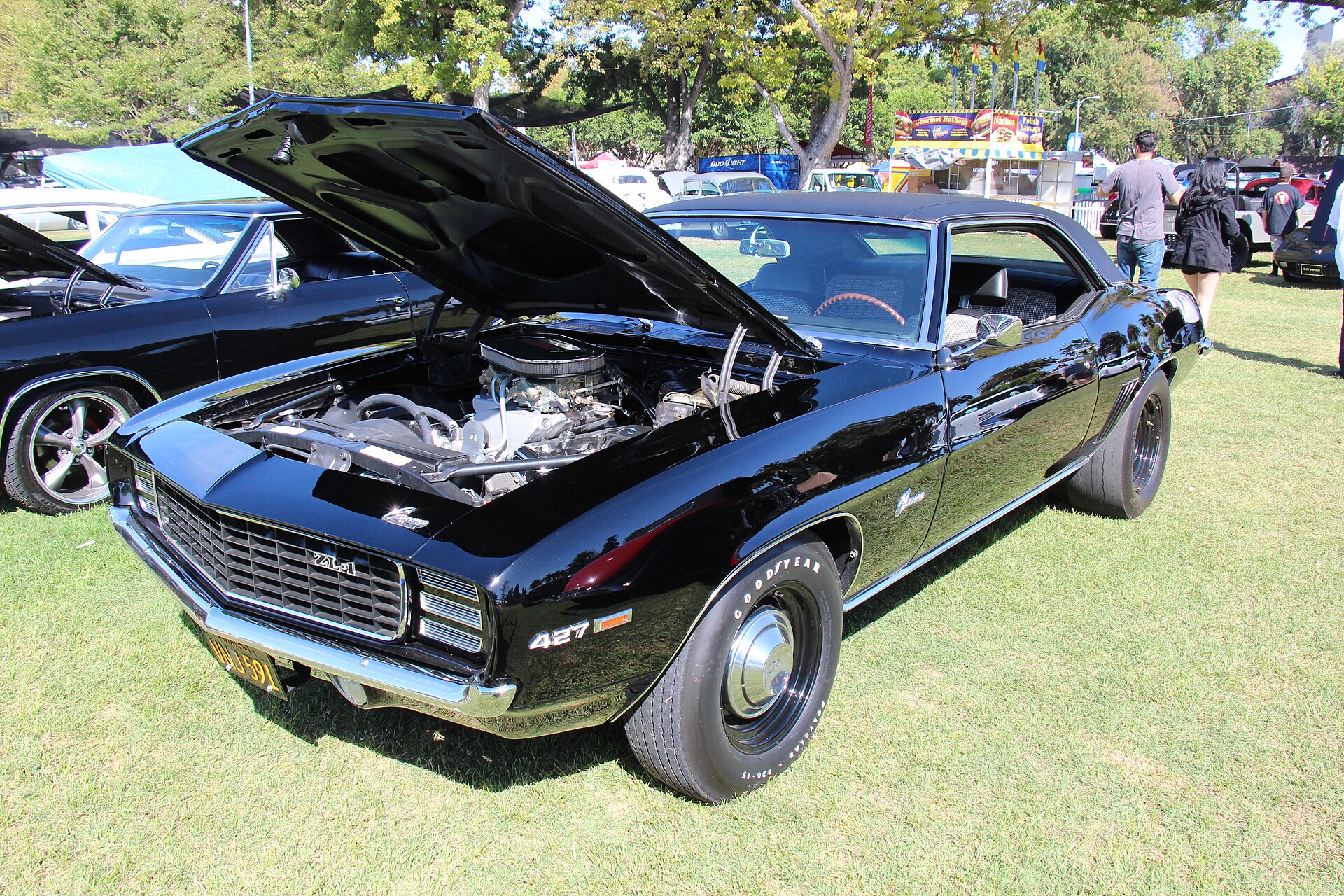
The Camaro COPO takes its name from Chevrolet's Central Office Production Order, a special-order channel that dealers used in 1969 to get 427 cu in V8s into Camaros. COPO 9561 delivered the iron L72 engine and COPO 9560 the aluminium ZL1, of which 69 cars were built. Since 2012 Chevrolet has used the COPO name for a factory-built drag-racing Camaro.
In short
- COPO 9561 (1969): L72 427 with 317 kW (425 hp, SAE gross) and 624 Nm (460 lb-ft); about 1,000 Camaros received the L72.
- COPO 9560 (1969): all-aluminium ZL1 427 with 321 kW (430 hp, SAE gross); 69 built, 47 with four-speed manuals and 22 with automatics.
- 2012: COPO revived as a drag-strip car without a VIN; 69 built, 67 coupes and 2 convertibles.
- 2023: optional ZZ632 big-block with 749 kW (1,004 hp), priced from US$135,900.
Specs by version
| Version | Engine | Power | Torque | Gearbox | Drive | Production years |
|---|---|---|---|---|---|---|
| COPO 427 · COPO 9561 L72 427 V8 (SAE gross) | 7.0 l · 8 cyl · Petrol L72 | 317 kW 431 PS425 hp | 624 Nm460 lb-ft | - | Rear-wheel drive | 1969 |
| COPO 427 · COPO 9560 ZL1 aluminium 427 V8 (SAE gross) | 7.0 l · 8 cyl · Petrol ZL1 | 321 kW 436 PS430 hp | 610 Nm450 lb-ft | - | Rear-wheel drive | 1969 |
| COPO drag car · COPO 427 V8 (NHRA rating) | 7.0 l · 8 cyl · Petrol 6,997 cc | 350 kW 476 PS469 hp | - | 3-sp Automatic | Rear-wheel drive | 2022–2023 |
| COPO drag car · COPO supercharged 350 V8 (NHRA rating) | 5.7 l · 8 cyl · Petrol 5,735 cc | 447 kW 608 PS599 hp | - | 3-sp Automatic | Rear-wheel drive | 2023 |
| COPO drag car · COPO ZZ632 V8 | 10.4 l · 8 cyl · Petrol ZZ632 | 749 kW 1,018 PS1,004 hp | 1,188 Nm876 lb-ft | 3-sp Automatic | Rear-wheel drive | 2023 |
Verified Manufacturer and type-approval data from our catalog · Sources and methodology
Camaro COPO at a glance
| Specification | Chevrolet Camaro COPO |
|---|---|
| Years | 1969 (COPO 9560 and 9561); drag car from 2012 |
| Built | 69 ZL1 (9560); about 1,000 L72 Camaros; 69 in 2012 |
| Body | two-door coupe; two 2012 cars were convertibles |
| Engines 1969 | 7.0 l (427 cu in) L72 iron V8; 7.0 l ZL1 aluminium V8 |
| Power 1969 | 317 kW (425 hp) and 321 kW (430 hp), SAE gross |
| Torque 1969 | 624 Nm (460 lb-ft) L72; 610 Nm (450 lb-ft) ZL1 |
| Engines from 2012 | supercharged 327 and 350, 427, 572 (2022), ZZ632 (2023) |
| Gearbox 2023 | ATI TH400 three-speed automatic with Hurst Quarterstick shifter |
| Quarter mile | 13.16 s at 110.21 mph, 1969 ZL1 (High Performance Cars) |
| Price | US$7,800 for a 1969 ZL1 test car; US$105,000 for the 2022 572 car |
How the Central Office Production Order worked
In 1969 General Motors did not allow engines over 400 cu in in its intermediate and pony cars. The COPO system was meant for special orders that the normal option list did not cover, and performance dealers found it could carry a big-block too.
The route had been tested in 1968. Fred Gibb Chevrolet wanted L78 396 Novas with automatic gearboxes for NHRA stock-class racing, a combination Chevrolet did not offer. Vince Piggins, the Chevrolet man behind the Camaro Z28, had 50 such Novas built through COPO with the Turbo Hydra-Matic 400, enough to meet the NHRA production rule. For 1969, the last year of the first-generation Camaro, the same channel opened three numbers for 427 cars: 9560 and 9561 for the Camaro and 9562 for the Chevelle.
| COPO number | Year | Car | Engine | Rating | Built |
|---|---|---|---|---|---|
| 9560 | 1969 | Camaro | ZL1 427, aluminium block and heads | 321 kW (430 hp) gross | 69, plus two prototypes |
| 9561 | 1969 | Camaro | L72 427, iron block and heads | 317 kW (425 hp) gross | about 1,000 with the L72; Yenko ordered 201 |
| 9562 | 1969 | Chevelle | L72 427 | not given separately | not given in sources |
| COPO Nova | 1970 | Nova | 350 V8 | not given in sources | about 177; 175 converted by Yenko |
COPO 9561: the iron L72
The L72 had a cast-iron block and heads and was rated at 317 kW (425 hp) at 5,600 rpm and 624 Nm (460 lb-ft) at 4,000 rpm, SAE gross. About 1,000 Camaros were fitted with it in 1969. Yenko Chevrolet of Canonsburg, Pennsylvania, ordered 201 of them and sold them as the Yenko Camaro with its own badging and equipment. The rest went out through other Chevrolet dealers, so a 1969 COPO 427 Camaro is not automatically a Yenko.
For Chevrolet the order was a way to sell a 427 Camaro without listing one on the regular option sheet, which kept the car within the letter of the corporate rule.

COPO 9560: the aluminium ZL1
The ZL1 was the racing engine of the two. Its aluminium block and heads saved weight over the front axle, and it carried an 850 cfm Holley carburettor. Chevrolet rated it at 321 kW (430 hp) at 5,200 rpm and 610 Nm (450 lb-ft) at 4,400 rpm. Writing for RM Sotheby's, David Neuhardt estimates that it would show about 429 kW (575 hp) on a dynamometer with open headers.
The engine package alone cost US$4,160. One test car stickered at US$7,800, roughly twice the price of an L78 SS 396 coupe. High Performance Cars ran the quarter mile in 13.16 seconds at 110.21 mph, and in normal street use the car returned 5 to 7 mpg. Chevrolet built 69 ZL1 Camaros for 1969 plus two prototypes; 47 had four-speed manuals and 22 had automatics. Reputedly, 50 went to Fred Gibb and drag racer Dick Harrell of Kansas City, and the other 19 to various dealers.
For 1970 GM dropped its 400 cu in rule. Big-block options returned to the regular order forms, and the high-performance COPO Camaro had no further purpose. The ZL1 name came back in 2012 on the supercharged road-going Camaro ZL1, a different car with no COPO connection.
The factory COPO Camaro since 2012
Chevrolet revived the name for 2012 as the first purpose-built drag-racing version of the Camaro. It built 69 cars that year, the same number as the 1969 ZL1 run: 67 coupes and 2 convertibles. Of these, 43 had a naturally aspirated 427, 20 had a 327 with a 4.0-litre supercharger and 6 had a 327 with a 2.9-litre supercharger. The final 2012 car, an Inferno Orange convertible, was auctioned at Barrett-Jackson in Scottsdale in January 2013 for the American Heart Association.
The modern COPO is built for NHRA Stock and Super Stock eliminator racing. It is sold through US dealers without a title or VIN and is not legal on the road. Production was capped at 69 a year at first. From 2020 Chevrolet dropped the lottery for build slots and took orders first-come, first-served, according to Hagerty.
| Model year | Engine | Rating | Price |
|---|---|---|---|
| 2012 | 427 or supercharged 327 | not given in sources | not given in sources |
| 2022 | supercharged 350 | 432 kW (580 hp), "conservatively rated" | not given in sources |
| 2022 | 427 | 350 kW (470 hp), "conservatively rated" | not given in sources |
| 2022 | 572 (9.4 l) fuel-injected big-block | not published | US$105,000 |
| 2023 | supercharged 350 | 447 kW (600 hp), NHRA rating | from US$141,225 |
| 2023 | 427 | 350 kW (470 hp), NHRA rating | from US$126,420 |
| 2023 | ZZ632 (10.4 l) | 749 kW (1,004 hp), 1,188 Nm (876 lb-ft) | from US$135,900 |
The 572 of 2022 was the first big-block in a Chevrolet COPO Camaro for nearly 50 years. It used a tall-deck iron block with four-bolt mains, Edelbrock aluminium heads and a Holley Hi-Ram intake. For 2023 Chevrolet added the ZZ632, the largest and most powerful engine Chevrolet Performance had made, and paired every engine with a three-speed TH400. A build slot required a US$15,000 deposit.

COPO Camaros today: provenance and rivals
A 1969 COPO car is valued for what the paperwork proves. With 69 ZL1s built and the L72 orders spread across many dealers, the original order and the engine are the core of any car's history, and auction houses list each car's ownership chain in detail. Copies of both are common, so a COPO claim without documents is only a claim.
The modern car competes in NHRA classes against the factory drag cars of other makers. Hagerty names Ford's Cobra Jet Mustang and Mopar's Drag Pak Challenger as its rivals. Racers have reportedly taken naturally aspirated 427 COPOs beyond 597 kW (800 hp), far above the official ratings.
Chevrolet Camaro COPO: first vs latest generation
| Spec | COPO 427 | COPO drag car | Change |
|---|---|---|---|
| Years | 1969 | 2012 | 43 years apart |
| Most powerful version | 321 kW (436 PS) | 749 kW (1,018 PS) | +428 kW (+133%) |
Oldest and newest generation in the 1cars catalog. Power is the strongest version of each; other rows are shown only when both generations have the figure.
Chevrolet Camaro COPO in our rankings
- No. 1 of 184 · Biggest engines: coupes (10,354 cc)
- No. 1 of 636 · Biggest engines: cars (10,354 cc)
- No. 4 of 164 · Most powerful V8 cars (749 kW)
- No. 5 of 98 · Most powerful cars of the 1960s (321 kW)
- No. 6 of 355 · Most powerful cars of the 2010s (749 kW)
- No. 8 of 170 · Most powerful American cars (749 kW)
Bigger engine than 99% of ranked coupes in the 1CARS catalog (No. 1 of 184).
FAQ
What does COPO stand for?
COPO means Central Office Production Order, Chevrolet's channel for special orders outside the regular option list. In 1969 dealers used it to order Camaros with 427 V8s, which GM's 400 cu in limit kept off the normal order form.
How many 1969 ZL1 COPO Camaros were built?
Chevrolet built 69 COPO 9560 ZL1 Camaros for 1969, plus two prototypes. Of the 69, 47 had four-speed manual gearboxes and 22 had automatics.
Is the modern COPO Camaro street legal?
No. The COPO Camaro built since 2012 is a drag-racing car for NHRA Stock and Super Stock classes. It is sold without a title or VIN through US dealers.
What is the difference between a COPO Camaro and a Yenko Camaro?
COPO 9561 was the factory order for an L72 427 Camaro. Yenko Chevrolet ordered 201 of those cars and sold them with its own badges and parts; the other COPO 427 Camaros went through other dealers.
Data sources
Data checked by an editor against the sources below.
- Wikipedia - Chevrolet Camaro (first generation)
- Rmsothebys - R0398 1969 Chevrolet Camaro Zl1
- Gmauthority - 2023 Chevy Copo Camaro Now Available With Zz632 Cubic Inch V8


