 Chevrolet C/K
All generations, specs and history
Published Sources (5) Report an error
By Sarah Whitmore, Senior Automotive Writer
- Built
- 1959–2002
- Generations
- 4
- Top power
- 254 kW (345 PS)
Timeline
C/K generations
Click a generation for its own page
III and IV overlapped in 1988–1991, so IV sits on a second lane
- C/K I 1960–1966 · Pickup, Chassis cab · 101–164 kW (137–223 PS)
- C/K II 1967–1972 · Pickup, Chassis cab · 116–242 kW (158–329 PS)
- C/K III 1973–1991 · Pickup, Chassis cab
- C/K IV 1988–2002 · Pickup, Chassis cab · 119–254 kW (162–345 PS)
Newest first · 4 generations since 1960
-
1988
-
1973
-
1967
-
1960


All generations by year: C/K IV (1988–2002) · C/K III (1973–1991) · C/K II (1967–1972) · C/K I (1960–1966)
Which one is mine?
Pick the year of first registration to see which generation it is.
Check by VINWhich C/K to choose
Our verdict · Sarah Whitmore
- For a classic look: a 1967–1972 Action Line C10 short-bed with its coil-sprung rear axle and optional big-block V8s.
- For an affordable classic: a 1973–1987 square body with the 350 V8, offered with the widest choice of cabs, trims and engines.
- For daily use: a 1996–2000 GMT400 with a Vortec engine, the most modern and most powerful light C/K.
- For performance: the 1990–1993 454 SS.
Our comparison tool helps set these trucks against other pickups, and the four generations with their versions appear in the Chevrolet catalogue.
Chevrolet C/K is the family name of Chevrolet's full-size light pickups from the 1960 to the 2000 model year, with chassis cabs built until 2002. The letter C marks two-wheel drive and K four-wheel drive; the numbers 10, 20 and 30 mark the half-ton, three-quarter-ton and one-ton versions. Four generations ran before the Silverado took over.
In short
- Launched in autumn 1959 as 1960 models; pickups until the 2000 model year, C3500HD chassis cabs to 2002.
- Four generations: 1960–1966, 1967–1972 ("Action Line"), 1973–1991 ("square body") and the GMT400 of 1988–2000.
- Engines from inline sixes to the 7.4-litre V8, plus diesels from 1978; power from 78 kW (105 hp) to 216 kW (290 hp).
- The first generation brought factory four-wheel drive to Chevrolet pickups; the third added the crew cab.
Size at a glance
Chevrolet C/K III
The Chevrolet C/K IV is 76 mm longer and 86 mm taller than the Chevrolet C/K III.
| Dimensions | Chevrolet C/K IV | Chevrolet C/K III | Difference |
|---|---|---|---|
| Length | 4,940 mm194.5 in | 4,864 mm191.5 in | +76 mm+3.0 in |
| Width | 1,951 mm76.8 in | - | - |
| Height | 1,859 mm73.2 in | 1,773 mm69.8 in | +86 mm+3.4 in |
| Wheelbase | 2,985 mm117.5 in | 2,984 mm117.5 in | +1 mm |
Specs by version
Engines
| Version | Engine | Power | Torque | Production years |
|---|---|---|---|---|
| Diesel · 2 versions | ||||
| C/K III · 5.7 Oldsmobile diesel V8 | 5.7 l · 8 cyl · Diesel 5,737 cc | 89 kW 121 PS119 hp | 298 Nm220 lb-ft | 1978–1981 |
| C/K III · 6.2 Detroit Diesel V8 | 6.2 l · 8 cyl · Diesel 6,210 cc | 101 kW 137 PS135 hp | 325 Nm240 lb-ft | 1982–1991 |
| Petrol · 23 versions | ||||
| C/K I · 235 I6 | 3.9 l · 6 cyl · Petrol 3,859 cc | 101 kW 137 PS135 hp | 294 Nm217 lb-ft | 1960–1962 |
| C/K I · 230 I6 Turbo-Thrift | 3.8 l · 6 cyl · Petrol 3,769 cc | 104 kW 141 PS139 hp | 298 Nm220 lb-ft | 1963–1965 |
| C/K I · 283 V8 | 4.6 l · 8 cyl · Petrol 4,638 cc | 119 kW 162 PS160 hp | 366 Nm270 lb-ft | 1960–1966 |
| C/K I · 292 I6 Turbo-Thrift | 4.8 l · 6 cyl · Petrol 4,785 cc | 123 kW 167 PS165 hp | 380 Nm280 lb-ft | 1963–1966 |
| C/K I · 327 V8 | 5.4 l · 8 cyl · Petrol 5,359 cc | 164 kW 223 PS220 hp | 434 Nm320 lb-ft | 1965–1966 |
| C/K II · 250 I6 | 4.1 l · 6 cyl · Petrol 4,093 cc | 116 kW 158 PS156 hp | 319 Nm235 lb-ft | 1967–1972 |
| C/K II · 292 I6 | 4.8 l · 6 cyl · Petrol 4,785 cc | 127 kW 173 PS170 hp | 373 Nm275 lb-ft | 1967–1972 |
| C/K II · 307 V8 | 5.0 l · 8 cyl · Petrol 5,031 cc | 149 kW 203 PS200 hp | 407 Nm300 lb-ft | 1968–1972 |
| C/K II · 350 V8 | 5.7 l · 8 cyl · Petrol 5,735 cc | 186 kW 253 PS249 hp | 475 Nm350 lb-ft | 1969–1972 |
| C/K II · 402 V8 | 6.6 l · 8 cyl · Petrol 6,588 cc | 224 kW 305 PS300 hp | 461 Nm340 lb-ft | 1971–1972 |
| C/K II · 396 V8 | 6.5 l · 8 cyl · Petrol 6,489 cc | 242 kW 329 PS325 hp | 556 Nm410 lb-ft | 1968–1970 |
| C/K III · 250 I6 | 4.1 l · 6 cyl · Petrol 4,093 cc | 78 kW 106 PS105 hp | 251 Nm185 lb-ft | 1973–1979 |
| C/K III · 292 I6 | 4.8 l · 6 cyl · Petrol 4,785 cc | 89 kW 121 PS119 hp | 291 Nm215 lb-ft | 1973–1986 |
| C/K III · 350 LS9 V8 | 5.7 l · 8 cyl · Petrol 5,735 cc | 130 kW 177 PS174 hp | 373 Nm275 lb-ft | 1973 |
| C/K III · 350 V8 TBI | 5.7 l · 8 cyl · Petrol 5,735 cc | 157 kW 213 PS211 hp | 407 Nm300 lb-ft | 1987–1991 |
| C/K III · 454 V8 | 7.4 l · 8 cyl · Petrol 7,440 cc | 172 kW 234 PS231 hp | 488 Nm360 lb-ft | 1973–1986 |
| C/K IV · 4.3 V6 | 4.3 l · 6 cyl · Petrol 4,300 cc | 119 kW 162 PS160 hp | 319 Nm235 lb-ft | 1988–1995 |
| C/K IV · 5.0 V8 | 5.0 l · 8 cyl · Petrol 5,000 cc | 130 kW 177 PS174 hp | 366 Nm270 lb-ft | 1988–1993 |
| C/K IV · Vortec 4300 V6 | 4.3 l · 6 cyl · Petrol 4,300 cc | 149 kW 203 PS200 hp | 346 Nm255 lb-ft | 1996–1998 |
| C/K IV · 5.7 V8 | 5.7 l · 8 cyl · Petrol 5,700 cc | 157 kW 213 PS211 hp | 407 Nm300 lb-ft | 1988–1993 |
| C/K IV · Vortec 5700 V8 | 5.7 l · 8 cyl · Petrol 5,700 cc | 190 kW 258 PS255 hp | 447 Nm330 lb-ft | 1996–2000 |
| C/K IV · 7.4 V8 (454 SS 1991–1993) | 7.4 l · 8 cyl · Petrol 7,400 cc | 190 kW 258 PS255 hp | 549 Nm405 lb-ft | 1991–1993 |
| C/K IV · Vortec 7400 V8 | 7.4 l · 8 cyl · Petrol 7,400 cc | 216 kW 294 PS290 hp | 556 Nm410 lb-ft | 1996–2000 |
Dimensions and weight
Show all 4 versions
| Version | Length | Width | Height | Wheelbase |
|---|---|---|---|---|
| C/K I · 235 I6 | 4,747 mm186.9 in | 2,000 mm78.7 in | 1,810 mm71.3 in | 2,921 mm115.0 in |
| C/K II · 250 I6 | 4,788 mm188.5 in | - | - | 2,921 mm115.0 in |
| C/K III · 250 I6 | 4,864 mm191.5 in | - | 1,773 mm69.8 in | 2,984 mm117.5 in |
| C/K IV · 4.3 V6 | 4,940 mm194.5 in | 1,951 mm76.8 in | 1,859 mm73.2 in | 2,985 mm117.5 in |
Verified Manufacturer and type-approval data from our catalog · Sources and methodology
Chevrolet C/K at a glance
| Parameter | Value | Note |
|---|---|---|
| Production | autumn 1959 – 2000 (pickups), to 2002 (chassis cab) | model years 1960–2000 |
| Bodies | regular cab, extended cab (from 1988), crew cab (from 1973) | Fleetside, Stepside, Sportside beds |
| Payload classes | C/K10 (½ ton), 20 (¾ ton), 30 (1 ton) | 1500/2500/3500 from 1988 |
| Engines | 3.8–4.8 l I6, 4.3 l V6, 4.6–8.1 l V8, 5.7–6.5 l diesel | - |
| Power | 78–216 kW in light pickups | 105–290 hp |
| Gearboxes | 3-, 4- and 5-speed manual; Powerglide; 3- and 4-speed automatics | - |
| Successor | Chevrolet Silverado (GMT800) | for the 1999 model year |
| Twin | GMC C/K, later GMC Sierra | - |
C and K, 10, 20, 30: what the names mean
The C/K names follow a simple code. C stood for a two-wheel-drive truck, K for four-wheel drive, which Chevrolet offered from the factory for the first time with this range. The number gave the payload class, so a C10 was a half-ton two-wheel-drive pickup and a K20 a three-quarter-ton four-by-four. From the 1988 GMT400 trucks onward, the numbers changed to 1500, 2500 and 3500. Between 1987 and 1991 the older square-body trucks that stayed in production were renamed R (two-wheel drive) and V (four-wheel drive) so they could be sold beside the new C/K.
Bed styles also had names. Fleetside meant straight sides, while Stepside had separate rear fenders and a step behind the cab; the GMT400 version of the latter was called Sportside.

Timeline
| Year | Event |
|---|---|
| 1959 (autumn) | first C/K trucks replace the Task Force range |
| 1963 | coil springs replace front torsion bars on two-wheel-drive trucks |
| 1967 | second generation ("Action Line") |
| 1969 | K5 Blazer SUV joins the range |
| 1973 | third generation ("Rounded Line"), crew cab and dually |
| 1978 | Oldsmobile 5.7 diesel, the first diesel in an American full-size pickup |
| 1982 | 6.2 Detroit Diesel V8; four-speed 700R4 automatic |
| 1987 (April) | GMT400 C/K for 1988; old trucks continue as R/V |
| 1999 | Silverado (GMT800) arrives; GMT400 sold as Silverado Classic |
| 2002 | last C3500HD chassis cab in the US |
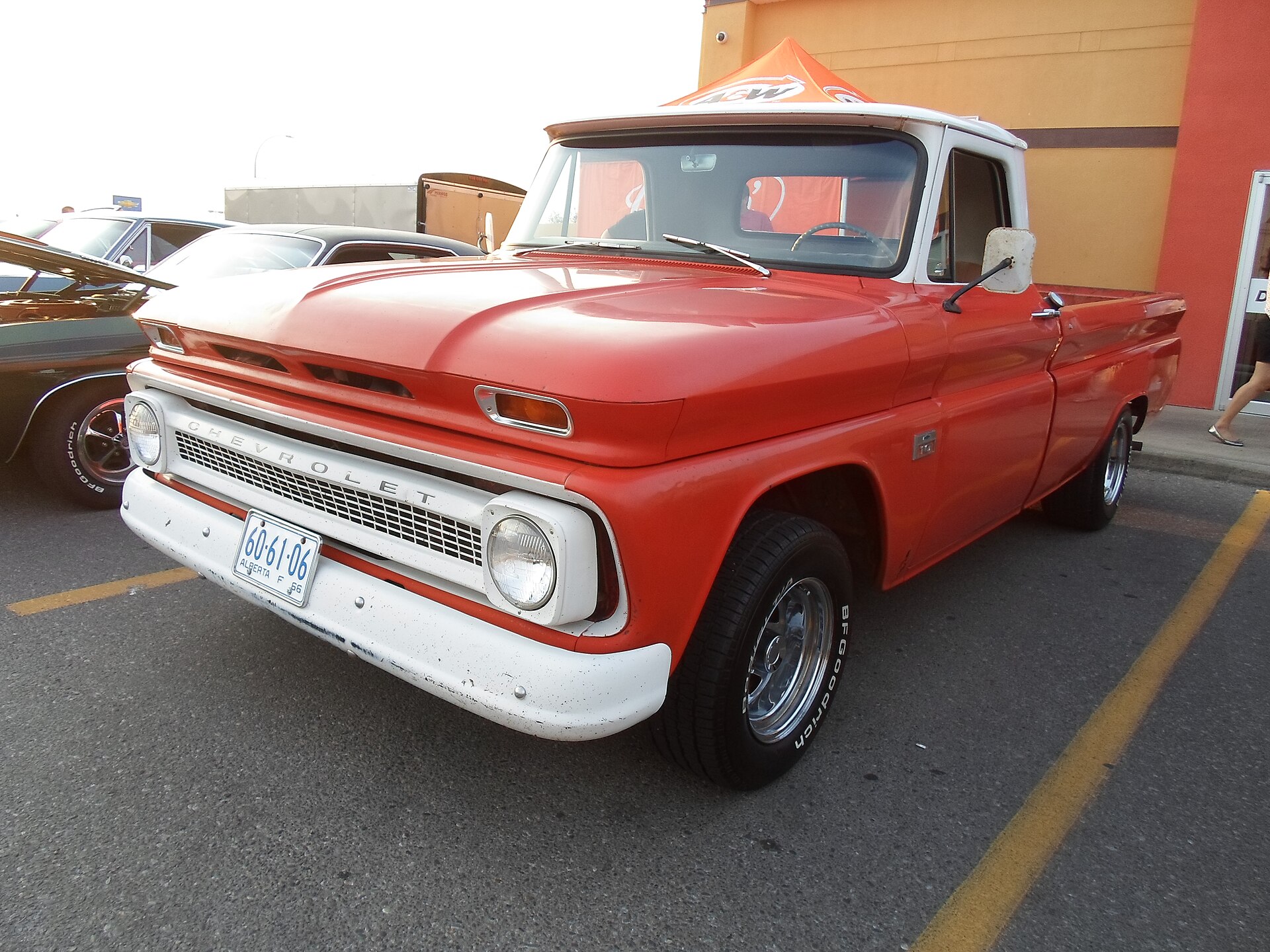
First generation (1960–1966): torsion bars and factory 4×4
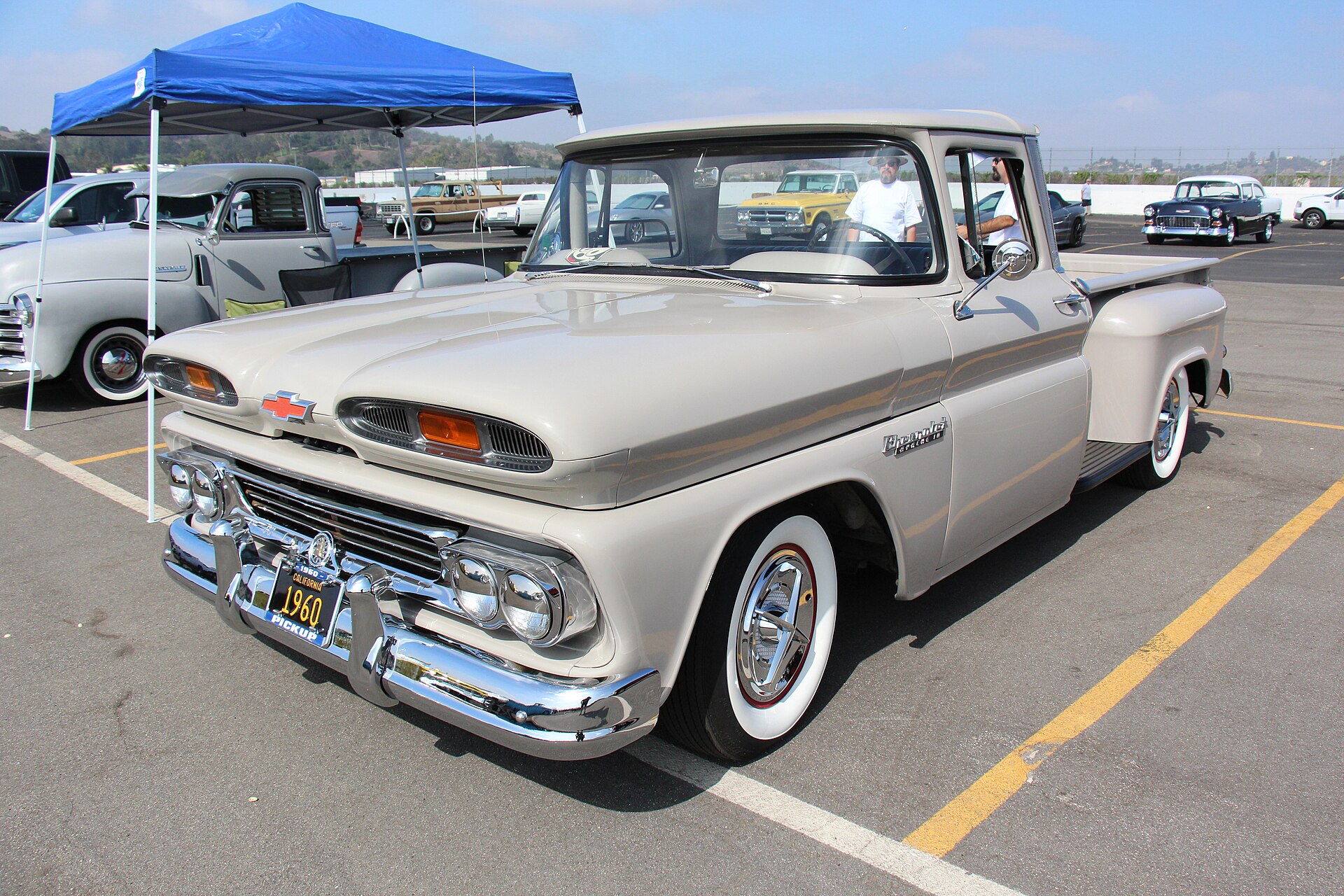
The first C/K trucks had a drop-centre ladder frame and independent front suspension: torsion bars up to 1962, coil springs from 1963 on two-wheel-drive trucks. At the rear most light trucks had a coil-sprung axle with trailing arms. Three wheelbases were offered: 2,921 mm (115 in) for the short half-ton, 3,226 mm (127 in) for the long-bed and three-quarter-ton, and 3,378 mm (133 in) for the one-ton.
| Engine (gross) | Years | Power | Torque |
|---|---|---|---|
| 235 six | 1960–1962 | 101 kW (135 hp) | 294 Nm |
| 261 six | 1960–1962 | 112 kW (150 hp) | 319 Nm |
| 230 six | 1963–1965 | 104 kW (140 hp) | 298 Nm |
| 292 six | 1963–1966 | 123 kW (165 hp) | 380 Nm |
| 283 V8 | 1960–1966 | 119 kW (160 hp) | 366 Nm |
| 327 V8 | 1965–1966 | 164 kW (220 hp) | 434 Nm |
English Wikipedia's text gives 130 kW (175 hp) for the 283 from 1963, while its table keeps 119 kW (160 hp). The trucks were built in more than a dozen plants, from Flint and Baltimore to Oakland, Oshawa in Canada and Buenos Aires.
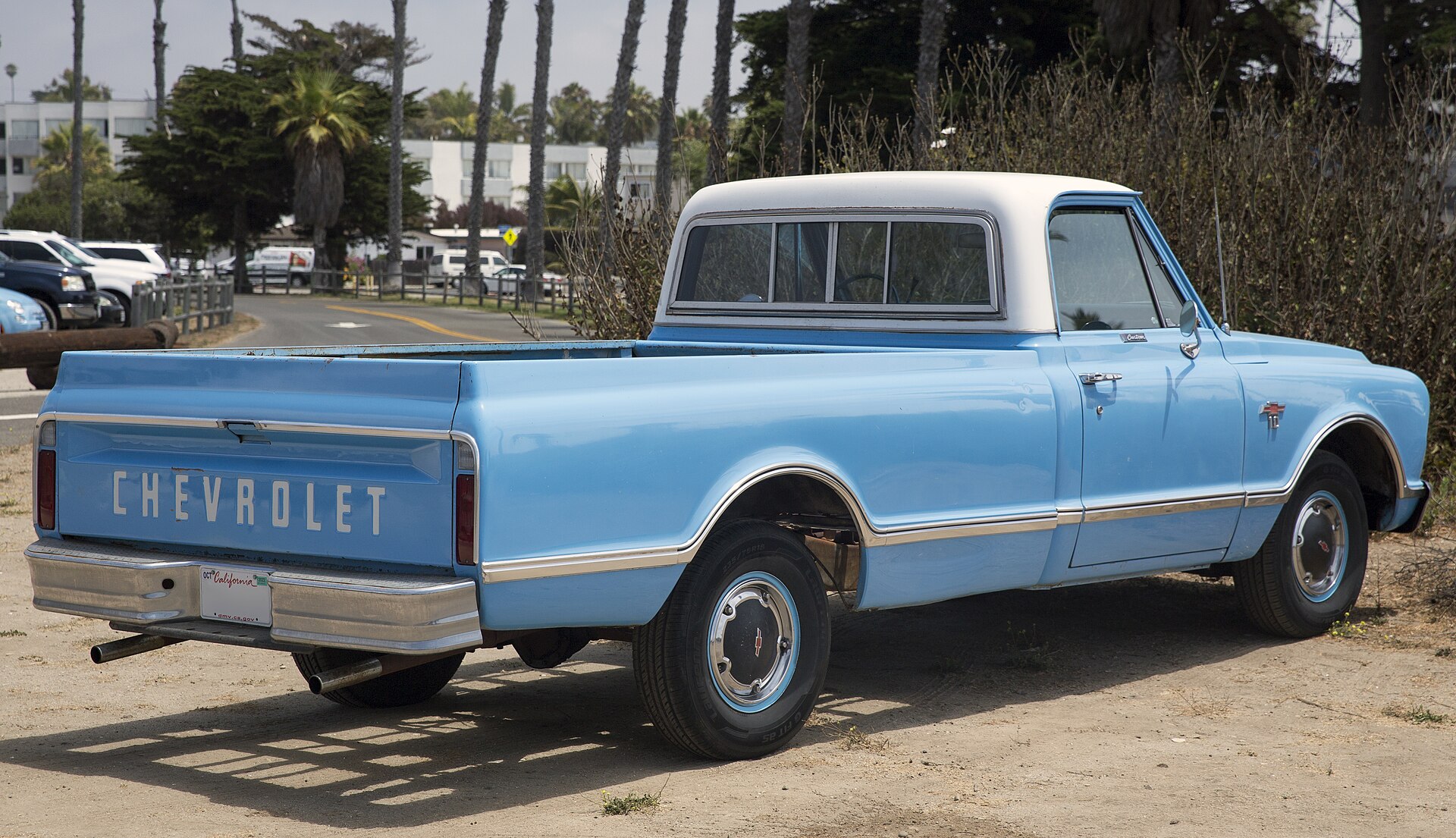
Second generation (1967–1972): Action Line
The 1967 redesign brought a new body on the same drop-centre frame and coil-sprung rear axle. Automatic gearboxes and an AM/FM radio were on the option list, and a big-block V8 arrived in 1968. From 1969 Chevrolet used only its own engines in these trucks. Trim levels climbed from Custom and Custom Deluxe to the CST and, from 1971, the Cheyenne and Cheyenne Super.
| Engine (gross) | Years | Power | Torque |
|---|---|---|---|
| 250 six | 1967–1972 | 116 kW (155 hp) | 319 Nm |
| 292 six | 1967–1972 | 127 kW (170 hp) | 373 Nm |
| 307 V8 | 1968–1972 | 149 kW (200 hp) | 407 Nm |
| 350 V8 | 1969–1972 | 186 kW (250 hp) | 475 Nm |
| 396 V8 | 1968–1970 | 242 kW (325 hp) | 556 Nm |
| 402 V8 | 1971–1972 | 224 kW (300 hp) | 461 Nm |
In 1969 Chevrolet also launched the related K5 Blazer SUV, and the later full-size Chevrolet SUVs are covered in our Chevrolet Tahoe guide.

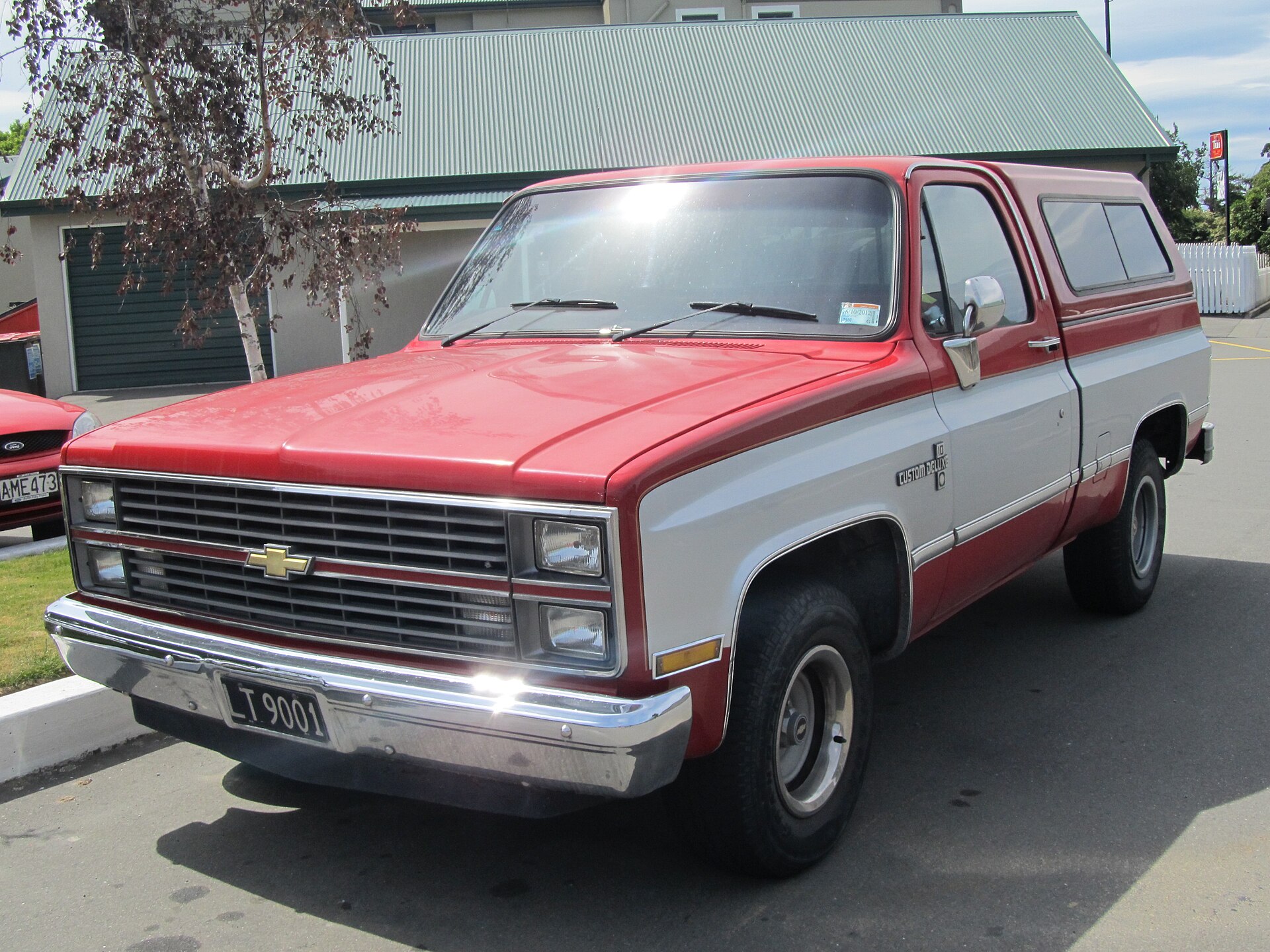
Third generation (1973–1991): the square body
The 1973 trucks, officially the "Rounded Line", were the first Chevrolet pickups designed with computers and wind-tunnel tests. Owners call them "square body" because of the flat, rectangular front. This generation lasted 18 model years, longer than any other C/K. It introduced the four-door crew cab, a "Bonus Cab" crew cab without a rear seat, and the dual-rear-wheel "Big Dooley". The Scottsdale and Silverado trims arrived in 1975, and shift-on-the-fly four-wheel drive came for 1981.
| Engine (net) | Years | Power | Torque |
|---|---|---|---|
| 250 six | 1973–1979 | 78 kW (105 hp) | 251 Nm |
| 292 six | 1973–1986 | 89 kW (120 hp) | 292 Nm |
| 350 V8 (LS9) | from 1973 | 130 kW (175 hp) | 373 Nm |
| 454 V8 | 1973–1986 | 172 kW (230 hp) | 488 Nm |
| 5.7 Oldsmobile diesel V8 | 1978–1981 | 89 kW (120 hp) | 298 Nm |
| 6.2 Detroit Diesel V8 | 1982–1991 | 101 kW (135 hp) | 325 Nm |
| 350 V8 | 1987–1991 | 157 kW (210 hp) | 407 Nm |
The fuel tanks sat outside the frame rails. A 1992 NBC Dateline report claimed they could explode in side impacts; NBC was later found to have staged the explosion shown, and GM sued the network. In April 1994 GM declined a government request to recall the 1973–1987 trucks and instead settled with NHTSA, paying US$51 million towards safety programmes and offering owners US$1,000 trade-in coupons.

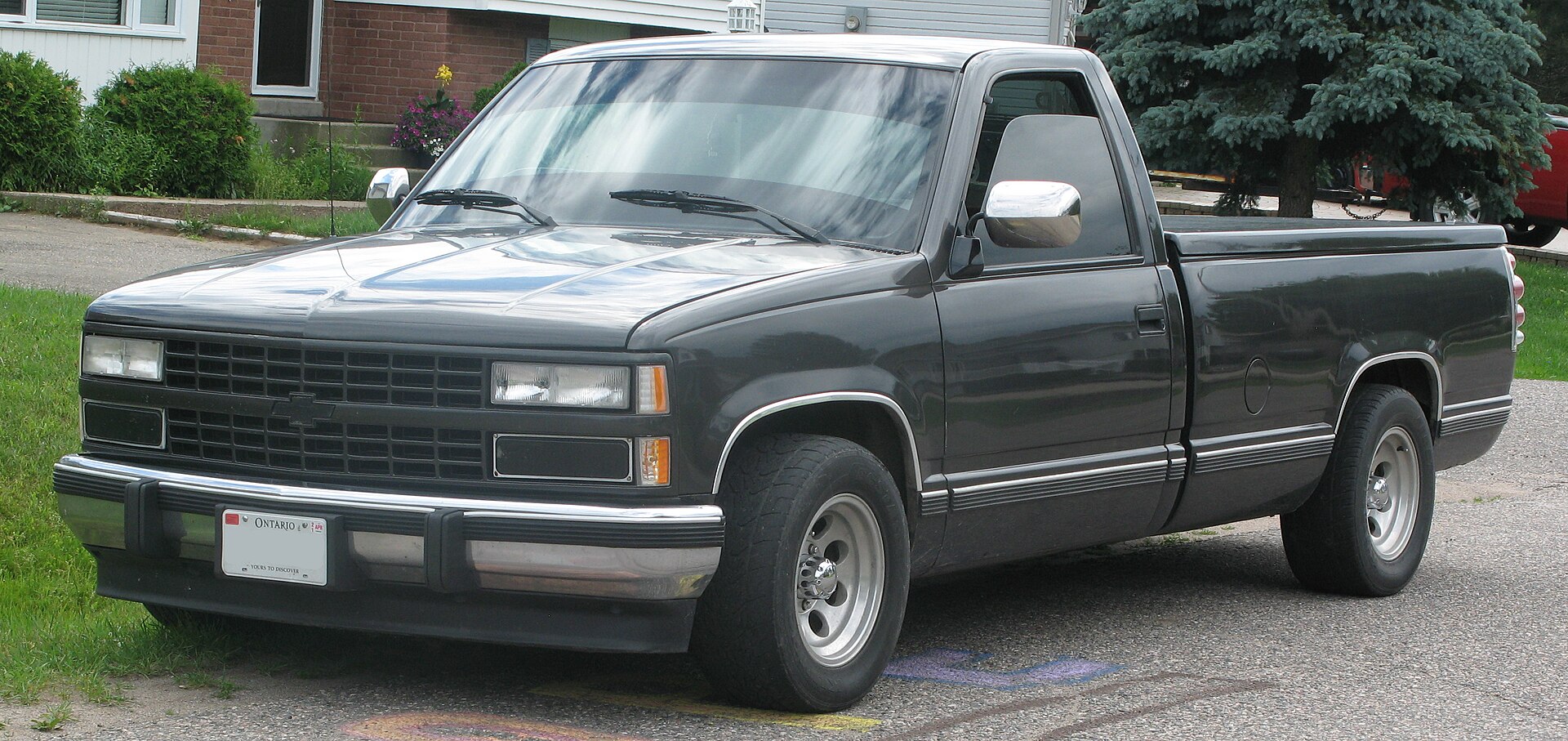
Fourth generation (1988–2002): GMT400
Introduced in April 1987 as a 1988 model, the GMT400 brought a new cab design, an extended cab (a first for GM full-size pickups) and, from 1992, a crew cab. Chevrolet kept the C/K name while GMC switched to Sierra; our GMC Sierra guide follows that side of the family. Packages included the W/T 1500 work truck of 1990, the Z71 off-road package of 1989 and the 454 SS sport truck of 1990–1993, of which about 16,953 were built.
| Engine (net) | Years | Power | Torque |
|---|---|---|---|
| 4.3 V6 | 1988–1995 | 119 kW (160 hp) | 319 Nm |
| Vortec 4300 V6 | 1996–1998 | 149 kW (200 hp) | 346 Nm |
| 5.0 V8 | 1988–1993 | 130 kW (175 hp) | 366 Nm |
| 5.7 V8 | 1988–1993 | 157 kW (210 hp) | 407 Nm |
| Vortec 5700 V8 | 1996–2000 | 190 kW (255 hp) | 447 Nm |
| 7.4 V8 (454 SS) | 1991–1993 | 190 kW (255 hp) | 549 Nm |
| Vortec 7400 V8 | 1996–2000 | 216 kW (290 hp) | 556 Nm |
A regular cab with the 6.5 ft bed had a 2,984 mm (117.5 in) wheelbase and a length of 4,940 mm; the longest crew cab reached 6,353 mm. A driver's airbag arrived in 1995, a rear-hinged third door in 1996 and dual airbags in 1997. When the GMT800 Silverado arrived for 1999, the old pickups were sold as Silverado Classic for one more year; heavy C3500HD chassis cabs, with an 8.1-litre V8 of 254 kW (340 hp) in 2001–2002, ran until 2002.
Photo gallery

Chevrolet C/K evolution in numbers
Did you know?
- The Chevrolet C/K ran for 43 years, from 1959 to 2002, over 4 generations in our catalog.
- The biggest jump in power came with the C/K IV: up to 254 kW (345 PS), 82 kW more than the C/K III.
Most powerful version, kW
Length, mm
Figures from the 1cars catalog: power is the strongest version of each generation; generations without the figure are left out.
Chevrolet C/K: first vs latest generation
| Spec | C/K I | C/K IV | Change |
|---|---|---|---|
| Years | 1960–1966 | 1988–2002 | 28 years apart |
| Most powerful version | 164 kW (223 PS) | 254 kW (345 PS) | +90 kW (+55%) |
| Length | 4,747 mm | 4,940 mm | +193 mm |
| Width | 2,000 mm | 1,951 mm | −49 mm |
| Wheelbase | 2,921 mm | 2,985 mm | +64 mm |
Oldest and newest generation in the 1cars catalog. Power is the strongest version of each; other rows are shown only when both generations have the figure.
Image credits · Photos from Wikimedia Commons under free licences
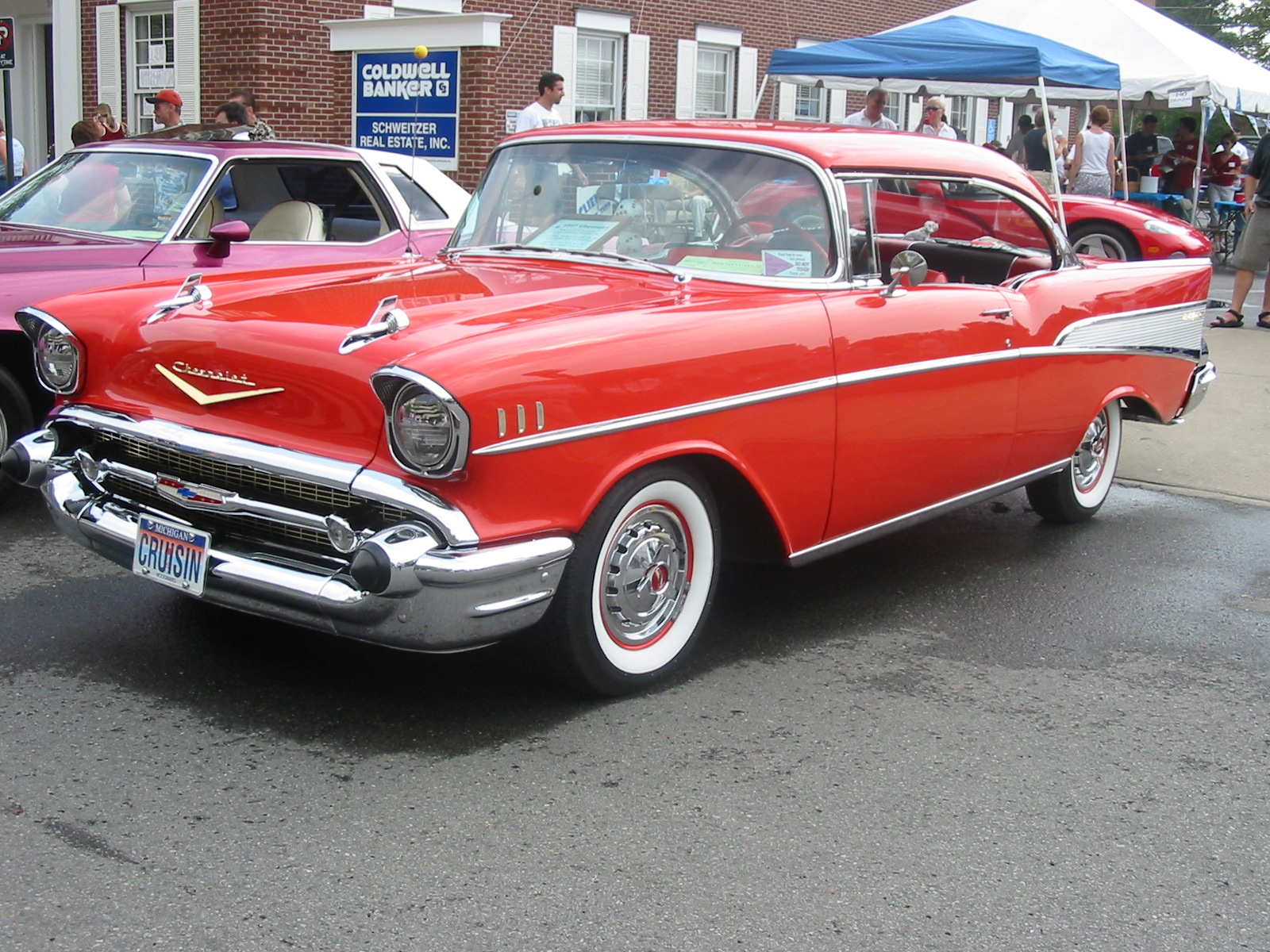
- Chevrolet C/K I · Photo: Sicnag / Wikimedia Commons, CC BY 2.0
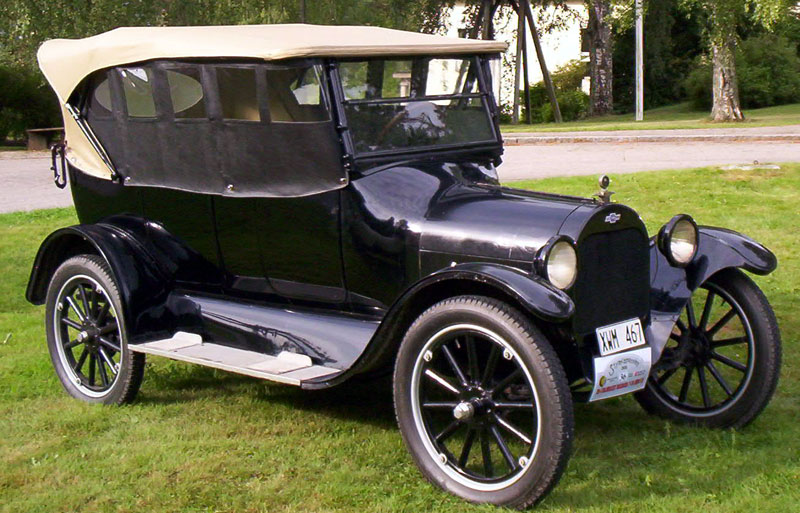
- Chevrolet C/K III · Photo: Riley from Christchurch, New Zealand / Wikimedia Commons, CC BY 2.0
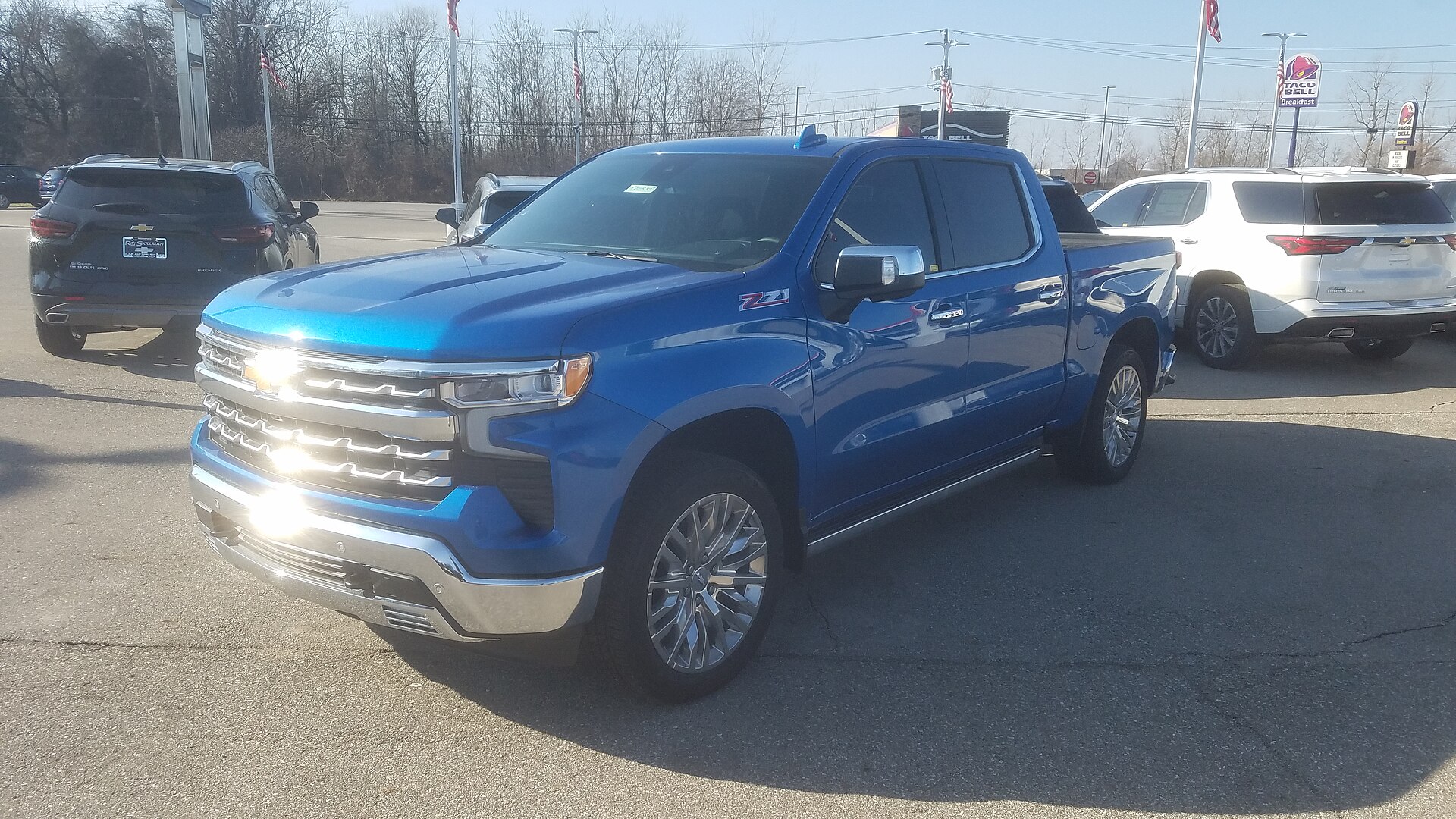
- Chevrolet C/K IV · Photo: SsmIntrigue / Wikimedia Commons, CC BY-SA 4.0
Chevrolet C/K in our rankings
More powerful than 40% of ranked pickup trucks in the 1CARS catalog (No. 12 of 20).
FAQ
What does C/K mean on a Chevrolet truck?
C is a two-wheel-drive truck and K a four-wheel-drive truck. The number that follows (10, 20, 30, later 1500, 2500, 3500) is the payload class.
What years are square body Chevy trucks?
The third-generation C/K of the 1973–1987 model years, continued as the R/V series until 1991.
When did Chevrolet stop making the C/K?
Pickups ended after the 2000 model year, once the Silverado had arrived for 1999; C3500HD chassis cabs were built until 2002.
Which C/K engine is the most powerful?
Among light pickups, the Vortec 7400 V8 of 1996–2000 with 216 kW (290 hp). The heavy-duty chassis cabs of 2001–2002 had an 8.1-litre V8 with 254 kW (340 hp).
What is an OBS Chevy?
"Old body style" is the informal name for the GMT400 trucks, used after the GMT800 Silverado arrived.
Data sources
Data checked by an editor against the sources below.
- Wikipedia
- Wikipedia - K (first Generation)
- Wikipedia - K (second Generation)
- Wikipedia - K (third Generation)
- Wikipedia - K (fourth Generation)