 Chevrolet Orlando
Specs, engines and history
Published Sources (1) Report an error
By Sarah Whitmore, Senior Automotive Writer
- Built
- 2018–2023
- Top power
- 120 kW (163 PS)
The Chevrolet Orlando is a five-door, seven-seat family car based on the Chevrolet Cruze and built by General Motors under the Chevrolet brand. It was first shown as a concept at the Paris motor show in October 2008, intended to replace the Chevrolet HHR. Production was set up in South Korea in 2009, series production began in 2010 and the Orlando was built until 2018, when another model took its place.
In short
- Compact seven-seat MPV built from 2010 to 2018, closely related to the Chevrolet Cruze.
- Engines: 1.8 petrol with 104 kW (141 PS) and 2.0 diesels with 96 or 120 kW (131 or 163 PS).
- Five-speed manual or six-speed automatic; front-wheel drive.
- Five stars in Euro NCAP crash tests; 464-litre boot, 900 litres with the seats folded.
Chevrolet Orlando at a glance
The Orlando is a monocoque compact MPV with a transverse engine and front-wheel drive, built on GM's global Delta II platform shared with the Chevrolet Cruze and Opel Astra J. More Chevrolet models are listed in our Chevrolet catalogue.
Exterior
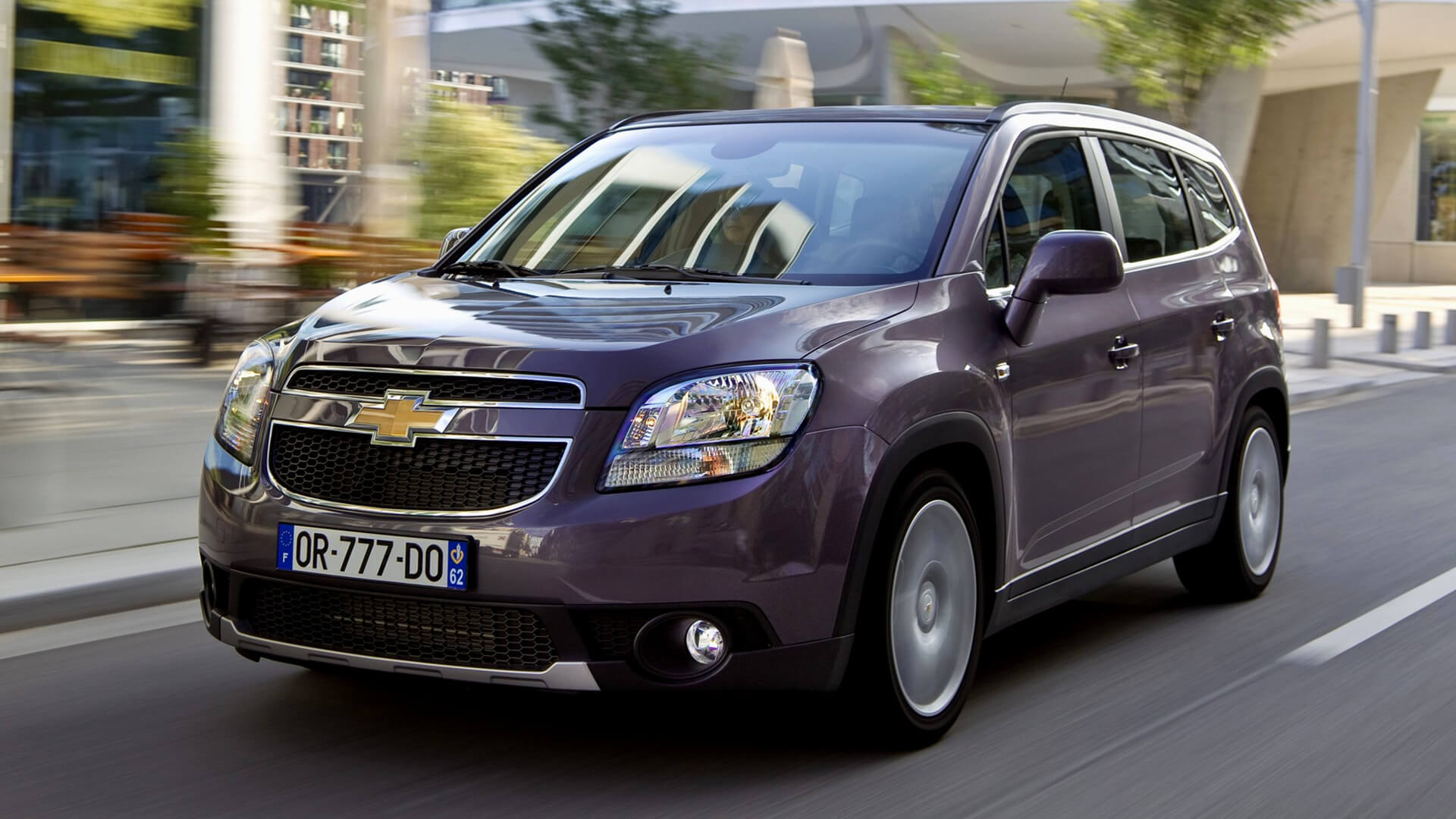
Some say the exterior is the Orlando's weakest point, as it does not stand out among its rivals, yet few would deny that it looks good. Large headlights blend neatly into the design, and the family grille is split in two by a horizontal bar carrying a large Chevrolet bowtie, which makes the car look more solid. The substantial bumper has air intakes, round fog lamps and a lip spoiler that improves aerodynamics.
The side has an interesting, American look with a hint of off-road ability: protective cladding along the lower body and a high window line that gives a sense of solidity and protection. The mirrors are mounted on stalks, unusually for a non-sporting car. Ground clearance is only 164 mm, which rules out serious off-roading and can make high kerbs and deep ruts awkward. The flared wheel arches house 16- to 18-inch wheels depending on version. The rear is traditional for the class, with upright pillars, a huge tailgate and stylish pentagonal lights. The badge sits on a short chrome strip above the number plate, two extra lights are set into the centre of the bumper, a faux-metal insert sits at the bottom and the exhaust is hidden beneath the bumper.
Interior
As a family car, the Orlando focuses on interior space: three rows of seats for seven people, a roomy boot and plenty of storage compartments. A light leather interior looks particularly striking, though like all light interiors it fades over time. Many owners complain that the plastics are too delicate and scratch easily - an odd choice for a car that carries children, pushchairs and pets.
Otherwise the interior is one of the Orlando's strengths, attractive and tasteful, with many parts borrowed from the Cruze. The three-spoke multifunction steering wheel, adjustable for height and reach, comes from the Cruze, but the instrument panel is different, with recessed analogue dials, blue lighting and a large trip computer. The front seats are comfortable and heated, though they offer neither a sporty position nor strong side support. A panoramic roof spans the length of the seating area.
A large infotainment screen sits in the centre console above its controls, followed by the climate controls and the automatic gear selector (cheaper versions have a manual gear lever). The transition from console to tunnel is smooth, and MP3, USB and iPod connections are provided. Three adults fit easily in the second row, which has reclining backrests, enough head- and legroom, its own air vents and a central armrest with cupholders. The third row, reached by folding one second-row seat, has two seats where even adults can sit for short trips. The boot holds 464 litres, or 900 litres with a flat floor when the seats are folded.
Engines and transmissions
| Engine | Fuel | Power (kW / PS) | Torque | 0–100 km/h | Top speed |
|---|---|---|---|---|---|
| 1.8 four-cylinder | Petrol | 104 kW / 141 PS | 176 Nm | 11.6 s | 185 km/h |
| 2.0 four-cylinder | Diesel | 96 kW / 131 PS | - | - | - |
| 2.0 four-cylinder | Diesel | 120 kW / 163 PS | 360 Nm | 11.0 s | 195 km/h |
The petrol engine uses about 7 l/100 km, and the diesels slightly less. Gearboxes are a five-speed manual or a six-speed automatic with manual shift mode, similar to those in the Chevrolet Cruze and Opel Insignia. All versions drive the front wheels; there is no conventional centre tunnel for a propshaft.
Chassis
The Orlando uses GM's Delta II platform with MacPherson struts and aluminium A-arms at the front, using hydraulic mounts instead of rubber bushes, and a torsion beam at the rear, with coil springs all round. The suspension absorbs a lot without bottoming out even on big bumps, but it is slightly firm, transmitting some shakes and jolts. Handling is not its strong point, particularly at higher speeds. The brakes are discs all round, ventilated at the front.
Safety and equipment
Safety equipment includes six airbags, tyre-pressure monitoring, ABS, traction control, stability control, emergency braking assistance, a pedal release system for crashes, front and rear parking sensors, blind-spot monitoring, cruise control and a rear camera. The Orlando earned the maximum five stars in Euro NCAP crash tests and is also considered safe for pedestrians. Four trim levels were offered: LS, LT, LT+ and LTZ, ranging from two airbags, ABS, air conditioning, heated power mirrors, an audio system and front electric windows to stability control, an armrest, climate control, six airbags, cruise control, rain and light sensors, a multifunction steering wheel and parking sensors.
Key specifications
| Parameter | Value |
|---|---|
| Concept | October 2008, Paris |
| Production | 2010–2018 |
| Platform | GM Delta II |
| Seats | 7 |
| Power (kW / PS) | 96–120 kW / 131–163 PS |
| Ground clearance | 164 mm |
| Boot | 464 / 900 l |
| Wheels | 16–18 in |
| Euro NCAP | 5 stars |
Strengths and weaknesses
Owners highlight the affordable price, attractive looks, strong engine, low fuel consumption, inexpensive running costs, decent reliability, generous space, flexible seating, excellent safety, good sound insulation and value for money. On the downside, it can lack power for overtaking, the audio system is mediocre, the suspension is a little firm, ground clearance is modest and the plastics get dirty and scratched quickly. Rivals include the Volkswagen Touran, Opel Zafira, Ford Grand C-Max, Toyota Verso, Renault Grand Scénic and Kia Carens.
Chevrolet Orlando in our rankings
- No. 644 of 859 · Most powerful cars (120 kW · top 76%)
- No. 673 of 912 · Longest-running car nameplates (5 years · top 77%)
- No. 134 of 154 · Most powerful American cars (120 kW · top 88%)
More powerful than 24% of ranked cars in the 1CARS catalog (No. 644 of 859).
FAQ
What is the Chevrolet Orlando based on?
It is based on the Chevrolet Cruze and uses GM's Delta II platform, shared with the Opel Astra J.
How many seats does the Chevrolet Orlando have?
Seven, in three rows; the third row has two seats.
What engines does the Chevrolet Orlando have?
A 1.8 petrol with 104 kW (141 PS) and 2.0 diesels with 96 or 120 kW (131 or 163 PS).
How big is the Chevrolet Orlando boot?
464 litres, or 900 litres with the seats folded.
When was the Chevrolet Orlando made?
From 2010 to 2018; the concept was shown in Paris in October 2008.
Data sources
Data checked by an editor against the sources below.