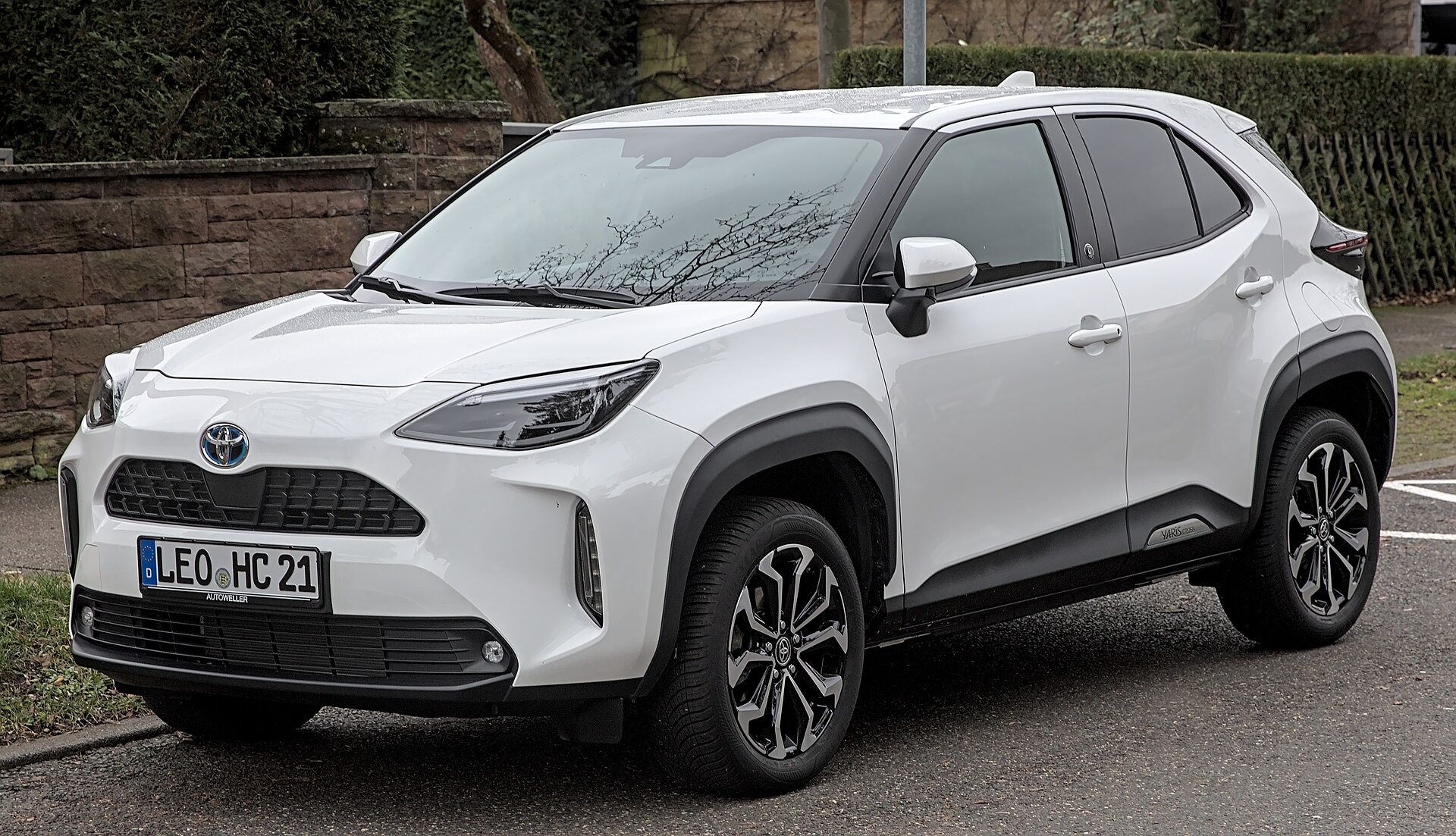
 Toyota Yaris Cross
Specs, engines and history
Published Sources (2) Report an error
By Felix Hartmann, Automotive Technology & EV Contributor
- Built
- 2020–present
- Top power
- 96 kW (131 PS)
Which Yaris Cross to choose
Our verdict · Felix Hartmann
- For economy: the front-wheel-drive Hybrid; 4.4 l/100 km WLTP for the 85 kW version.
- For better pulling power: the Hybrid 130 from late 2023, with 185 Nm.
- For slippery roads: AWD-i, at the cost of about 15 g/km more CO2.
- For a used buy: an early 85 kW (116 PS) hybrid built in France from 2021; the five-star 2021 Euro NCAP result applies to it.
The Yaris Cross is the small sister of the Toyota C-HR and the Toyota RAV4. Toyota's hybrid technology goes back to the Toyota Prius.
The Toyota Yaris Cross is a small crossover based on the fourth-generation Yaris and built since 2020 in Japan and, for Europe, in Onnaing, France. Toyota released the first pictures and data on 23 April 2020, after the planned Geneva show debut was cancelled. In Germany Toyota offers it only as a 1.5-litre full hybrid, with optional AWD-i electric all-wheel drive. European sales passed 200,000 in both 2024 and 2025. A different, larger Yaris Cross on a Daihatsu platform is sold in South-East Asia and Latin America; this guide covers the European and Japanese car.
In short
- Production since 2020 (Kanegasaki, Japan) and since July 2021 in Onnaing (France); GA-B platform of the Yaris.
- Hybrid with 85 kW (116 PS) from launch and 96 kW (130 PS) as the Hybrid 130 since the 2023 update.
- AWD-i: a 3.9 kW electric motor drives the rear axle without a propshaft.
- Euro NCAP five stars (2021); World Urban Car of the Year 2022.
Specs by version
Engines
Dimensions and weight
Verified Manufacturer and type-approval data from our catalog · Sources and methodology
Toyota Yaris Cross at a glance
| Specification | Toyota Yaris Cross (XP210) |
|---|---|
| Production | since 2020; Kanegasaki (Japan), Onnaing (France) |
| Platform | TNGA GA-B, shared with the Yaris hatchback |
| Body | five-door small crossover |
| Length / width | 4,172 to 4,180 mm / 1,765 mm |
| Wheelbase | 2,560 mm (same as the Yaris) |
| Ground clearance | 30 mm more than the Yaris |
| Powertrains | 1.5 full hybrid (M15A-FXE), 1.5 petrol (M15A-FKS) |
| Power | 85 to 96 kW (116 to 130 PS) for the hybrids |
| Gearbox | e-CVT (hybrid); six-speed manual or CVT (petrol) |
| Boot | 320 to 397 litres (Toyota Germany) |
Launch and production
The Yaris Cross was planned for the 2020 Geneva Motor Show. When the show was cancelled because of COVID-19, Toyota published the first pictures and specifications on 23 April 2020. Sales began in Japan in the late summer of 2020 and in Australia in November 2020. Europe followed in mid-2021, after the first French-built car left the Onnaing plant in July 2021.
The crossover uses the GA-B platform and wheelbase of the fourth-generation Yaris. It is about 24 cm longer than the hatchback and has 30 mm more ground clearance. What Car? gives a length of 4,180 mm against 3,940 mm for the Yaris. Its size is similar to that of the Nissan Juke.
Hybrid powertrains and AWD-i
| Version | Engine | System power | Torque | Drive |
|---|---|---|---|---|
| 1.5 Hybrid (2020–2023) | M15A-FXE + electric motor | 85 kW (116 PS) | - | front or AWD-i |
| Hybrid 130 (from 2023) | M15A-FXE + new motor | 96 kW (130 PS) | 185 Nm | front or AWD-i |
| 1.5 petrol | M15A-FKS | 88 kW (120 PS) | 145 Nm | front or all-wheel |
In the original hybrid the 1.5-litre petrol engine contributes 67 kW and the front electric motor 59 kW. The e-CVT combines them to a system output of 85 kW. The 2023 update brought a stronger electric motor and 185 Nm. Wikipedia rounds its output to 97 kW (132 PS), while Toyota Germany lists 96 kW (130 PS). The petrol version is not offered in every market; German Wikipedia gives it 92 kW (125 PS).
AWD-i adds a 3.9 kW electric motor on the rear axle with no mechanical link to the front. The cost is efficiency: WLTP CO2 emissions rise from 120 g/km with front-wheel drive to 135 g/km. All versions are listed in the Toyota catalogue.

Fuel consumption
Toyota Germany lists 4.4 to 5.1 l/100 km and 100 to 116 g/km of CO2 in the WLTP cycle for the current range; the 85 kW hybrid is the most economical at 4.4 l/100 km. In real driving, What Car? recorded 60.1 mpg with the earlier 85 kW (116 PS) model, about 4.7 l/100 km, and around 55 mpg (5.1 l/100 km) with AWD-i. The fuel tank holds 36 litres.
Updates of 2023 and 2026
On 21 November 2023 Toyota Europe announced the Hybrid 130 together with a Premiere Edition, redesigned 18-inch wheels and the Toyota Smart Connect infotainment. Better sound insulation and an updated Toyota Safety Sense package followed. In Japan the GR Sport and Z Adventure versions arrived in July 2022, and a U grade, available only through the Kinto leasing service, followed in 2024.
The European facelift of 16 April 2026 brought a redesigned front with LED headlights and a honeycomb grille. New wheels, paint colours and upholstery completed the update.

Two different cars called Yaris Cross
Toyota uses the Yaris Cross name for two unrelated models. The car described here, code XP210, is built in Japan and France on Toyota's own GA-B platform and sold in Europe, Japan and Australia. A larger Yaris Cross, code AC200, uses the DNGA-B platform developed by Daihatsu. It is sold mainly in South-East Asia, Latin America and the Caribbean. Specifications, engines and safety results of the two cars are not interchangeable.
Space and practicality
Luggage figures differ by source and version: Toyota Germany gives 320 to 397 litres, Parkers 350 litres and What Car? 400 litres. What Car? fits seven carry-on suitcases with the floor at its lowest setting, two more than in a Nissan Juke or Renault Captur hybrid.

Safety and reliability
Euro NCAP awarded the Yaris Cross five stars in 2021. It scored 86 percent for adult occupants, 84 for children, 78 for pedestrians and 81 for the assistance systems. A 2025 retest gave 79, 85, 83 and 76 percent. In the 2025 What Car? Reliability Survey the Yaris Cross finished 20th of 30 small SUVs.
Sales
| Year | Europe | Japan |
|---|---|---|
| 2021 | 22,743 | 98,160 |
| 2022 | 156,086 | 82,710 |
| 2023 | 195,569 | 101,060 |
| 2024 | 204,797 | 79,600 |
| 2025 | 200,477 | - |
Europe overtook Japan as the main market in 2022, the first full year of French production. The Yaris Cross was named World Urban Car of the Year 2022.
Prices in Germany
In Germany Toyota advertised the Yaris Cross Hybrid in 2026 at a promotional price of €24,955.20 for cash or financed purchases, valid to 30 September 2026. This is not a standard list price. A leasing offer without a down payment, valid to 31 December 2026, is calculated on a purchase price of €22,019.52.
Photo gallery

Toyota Yaris Cross in our rankings
- No. 14 of 146 · Smallest SUVs and crossovers (4,172 mm · top 10%)
- No. 74 of 420 · Smallest cars (4,172 mm · top 18%)
- No. 621 of 912 · Longest-running car nameplates (6 years · top 69%)
- No. 224 of 305 · Oldest car models still on sale (6 years · top 75%)
- No. 320 of 403 · Widest cars (1,765 mm · top 80%)
- No. 727 of 859 · Most powerful cars (96 kW · top 85%)
Shorter than 90% of ranked SUVs and crossovers in the 1CARS catalog (No. 14 of 146).
FAQ
Is the Toyota Yaris Cross a hybrid?
In Germany it is offered only as a 1.5-litre full hybrid with 85 or 96 kW. A non-hybrid 1.5 petrol exists in some markets.
Where is the Yaris Cross built?
In Kanegasaki, Japan, and, for Europe, in Onnaing, France, since July 2021.
Is the Yaris Cross four-wheel drive?
It can be. AWD-i adds a 3.9 kW electric motor that drives the rear wheels.
How big is the Yaris Cross boot?
Between 320 and 397 litres according to Toyota Germany, depending on version and floor position.
How reliable is the Yaris Cross?
In the 2025 What Car? Reliability Survey it was 20th of 30 small SUVs.
Data sources
Data checked by an editor against the sources below.
- Wikipedia - Toyota Yaris Cross
- Toyota - Yaris Cross