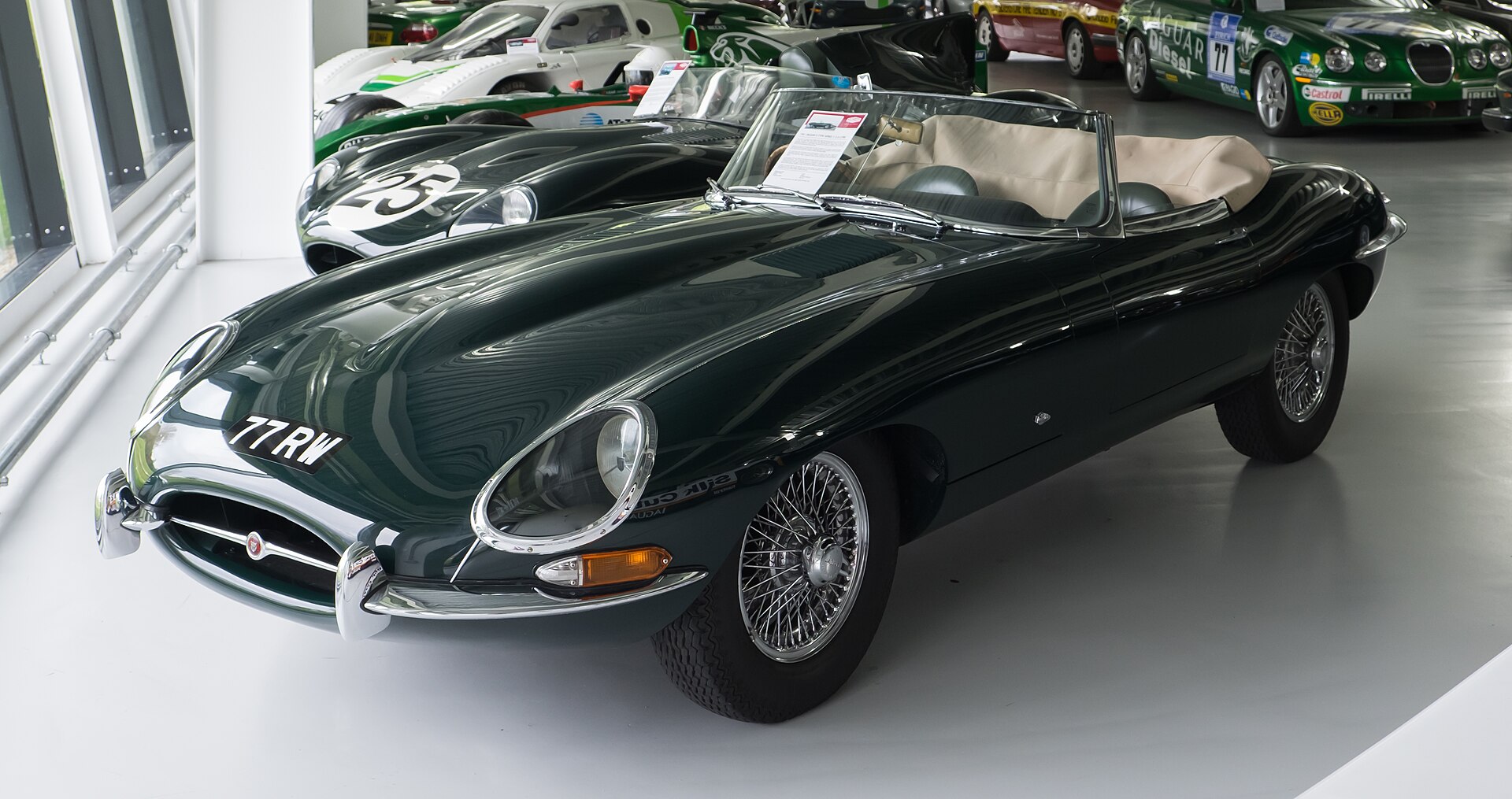
 Jaguar SS Jaguar 100
Specs, engines and history
Published Sources (1) Report an error
By Felix Hartmann, Automotive Technology & EV Contributor
- Built
- 1936–1939
- Top power
- 93 kW (126 PS)
Which SS 100 to choose
Our verdict · Felix Hartmann
- For originality: a 2½-litre car, the more common original with 198 built.
- For performance: a 3½-litre car, 93 kW and a tested 160 km/h; only 116 exist.
- For uniqueness: the single fixed-head coupé.
- For driving on a budget: a well-built replica, but buy it as a replica.
The company's later sports cars start with the Jaguar XK120; the whole story is in our history of Jaguar, and models are listed in the Jaguar catalogue.
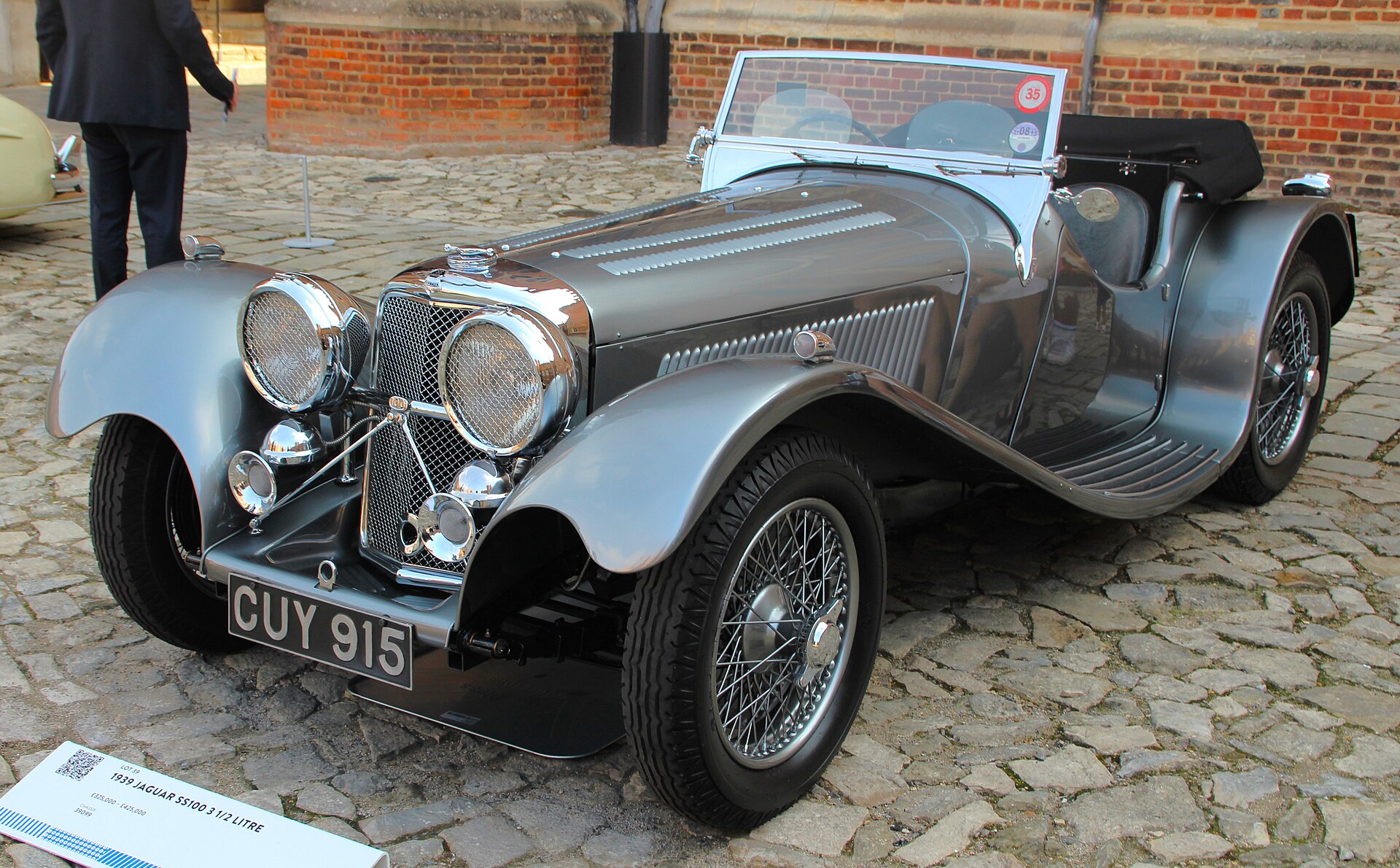
The SS Jaguar 100 is the two-seat sports car that SS Cars Ltd built in Coventry from 1936 to 1939, and the car that made the Jaguar name famous. The "100" stood for a theoretical top speed of 100 mph (161 km/h), which the 3½-litre version reached in an Autocar test. Only 314 were made, 198 with the 2½-litre engine and 116 with the 3½-litre, and one fixed-head coupé. Its successor after the war was the Jaguar XK120.
In short
- Straight-six with overhead valves: 2,663 cc and 70 kW (100 bhp), from 1938 also 3,485 cc and 93 kW (125 bhp).
- Autocar, 1937: 0–60 mph in 10.4 seconds and 160 km/h (100 mph) for the 3½-litre car.
- The first Jaguar "leaper" mascot appeared on an SS 100 in 1936.
- 314 built, of which 49 were exported; the company became Jaguar Cars Limited in 1945.
SS Jaguar 100 at a glance
| Parameter | Metric | Imperial |
|---|---|---|
| Maker | SS Cars Ltd, Coventry | — |
| Production | 1936–1939 | — |
| Built | 314: 198 × 2½ litre, 116 × 3½ litre | — |
| Body | open two-seater; one fixed-head coupé | — |
| Engine | OHV straight-six, 2,663 cc (1936–1938) or 3,485 cc (1938–1939) | 162.5 / 212.7 cu in |
| Power | 70 kW (100 bhp) / 93 kW (125 bhp) | — |
| Carburettors | two SU, bolted to the cylinder head | — |
| Gearbox | four-speed manual, synchromesh on the top three gears | — |
| Suspension | rigid axles on half-elliptic springs front and rear | — |
| Brakes | Girling | — |
| Wheelbase | 2,642 mm | 104 in |
| Length × width | 3,886 × 1,600 mm | 153 × 63 in |
| Weight | about 1,150 kg (English Wikipedia gives "just over 23 cwt", 2,600 lb) | 2,600 lb |
| Successor | Jaguar XK120 | — |
From Swallow Sidecar to SS Jaguar
The company behind the car began in 1922 as Swallow Sidecar, founded by William Walmsley and William Lyons. The SS name dates from 1934 and kept the link with the Swallow Sidecar origins. In 1935 the name "Jaguar" was first given to an SS saloon and then to all new SS models. In March 1945 the shareholders agreed to rename the company Jaguar Cars Limited.
The firm's own history page fills in the steps. Swallow made motorcycle sidecars in Cocker Street, Blackpool, and then coachbuilt bodies on Austin, Morris, Standard, Fiat and Wolseley Hornet chassis. In the winter of 1928–1929 it moved to a former munitions factory at Foleshill, Coventry. In 1929 Lyons and John Black of the Standard Motor Company built a one-off boat-tailed two-seater, the "First SS". The SS 1 was shown at the Motor Show in October 1931, and the SS 1 and SS 2 went on sale in 1932 with Standard engines and chassis.
| Date | Step (Wikipedia EN, SS Cars Ltd) |
|---|---|
| 1922 | Swallow Sidecar founded by William Lyons and William Walmsley |
| 1928–1929 | move from Blackpool to Foleshill, Coventry |
| 1932 | SS 1 and SS 2 on sale |
| 26 October 1933 | S. S. Cars Limited incorporated; trading from 1 February 1934 |
| January 1935 | shares offered to the public; Walmsley sells his holding |
| March 1935 | SS 90 two-seater, 23 made |
| 21 September 1935 | 2½-litre SS Jaguar saloon launched at the Mayfair Hotel, London |
| 1936 | SS Jaguar 100 introduced |
| 1940 | car production stops for the war |
| 23 March 1945 | shareholders vote to rename the company Jaguar Cars Limited |
The direct forerunner was the SS 90 of March 1935, the company's first open two-seater sports car. It used the 2½-litre side-valve six in a shortened SS 1 chassis and was named after a claimed top speed of 90 mph (145 km/h); only 23 were made. The SS 100 was introduced in 1936 as the "SS Jaguar 2½ Litre 100 Model". Its chassis was a shortened version of the frame designed for the 2½-litre saloon and first seen on the SS 90 of 1935. Our article on Swallow Sidecars and SS Cars tells the company's early history in detail.
Engine: the Standard six with a new head
The engine started life as the 2½-litre side-valve six from the Standard Motor Company. For SS it was converted to overhead valves with a new cylinder head designed by William Heynes and Harry Weslake, and twin SU carburettors were bolted directly to the head. The output rose from about 52 kW (70 bhp) in side-valve form to 70 kW (100 bhp); the SS Cars article credits Weslake's head with 76 kW (102 bhp). Lyons had hired Heynes as chief engineer from Hillman, where he had come from Humber, and Weslake for engine tuning. Standard manufactured the new head for SS and also supplied the engines and chassis, while Swallow styled the bodies.
| Version | Years | Displacement | Power | Built |
|---|---|---|---|---|
| SS 100 2½ Litre | 1936–1938 | 2,663 cc | 70 kW (100 bhp) | 198 |
| SS 100 3½ Litre | 1938–1939 | 3,485 cc | 93 kW (125 bhp) | 116 |
| Fixed-head coupé | — | — | — | 1 |
With about 1,150 kg, the 3½-litre car had about 81 kW per tonne, against about 61 kW per tonne for the 2½-litre. That is a difference of 23 kW for an engine 822 cc larger; the power-to-weight calculator puts the figure next to modern sports cars.

Chassis and performance
The chassis was simple even for the 1930s: rigid axles at both ends on half-elliptic leaf springs, Girling brakes and 18-inch wire wheels with 5.50 or 5.25 × 18 tyres. The four-speed gearbox had synchromesh on the top three ratios. The wheelbase was only 2,642 mm and the length 3,886 mm.
The SS Cars article gives the company's own claims for the SS 100 as 160 km/h (100 mph) and 0–60 mph in 11 seconds. Autocar tested both versions in 1937:
| Measurement | 2½ Litre (windscreen lowered) | 3½ Litre |
|---|---|---|
| Top speed | 153 km/h (95 mph) | 160 km/h (100 mph) |
| Best quarter-mile speed | — | 163 km/h (101 mph) |
| 0–60 mph | 13.5 s | 10.4 s |
The 3½-litre car therefore justified its name. Some chassis were sold to outside coachbuilders, but almost all cars carried the factory two-seater body.

The leaper and notable cars
The first Jaguar "leaper" mascot was shown on an SS 100 in the middle of 1936, in a design described by William Lyons. A revised leaper on the radiator cap of the car registered CKV 250, photographed early in 1937, became the company's trademark. CKV 250 was ordered as a gift for the young King Mihai I of Romania, who reportedly drove it until he was forced out by the communists.
Other cars have their own stories. The politician Alan Clark owned an SS 100. CNP 947 was raced in the USA by the broadcaster Dave Garroway; it has alligator-hide trim and a 3.8-litre XK engine supplied by Jaguar. A 1937 3½-litre roadster won at Pebble Beach before it was sold at auction in 2010. Auction prices for the SS 100 are quoted by the sources in pounds sterling, so they are not given here.

Replicas
The SS 100's looks and rarity have led to several replica series:
| Maker | Years | Notes |
|---|---|---|
| Birchfield Sports | 1982–2004 | 18 built in the UK on Jaguar XJ6 mechanicals; production later moved to Australia |
| Steadman TS100 | late 1980s – early 1990s | up to 28 built by Ottercraft Ltd in Hayle, Cornwall, with XJ6 running gear |
| Suffolk Sportscars | 1990–2020 | glass-fibre bodies, more than 315 built, more than the original production |
| Finch Motor Company | 1992 onwards | Mount Barker, South Australia; timber frame and aluminium body to the original design |
A Finch car has won the Australian Concours d'Elegance. Because the replicas use different running gear, the chassis number and engine are the first things to check on any car offered as an original.

Jaguar SS Jaguar 100 in our rankings
- No. 735 of 859 · Most powerful cars (93 kW · top 86%)
- No. 756 of 912 · Longest-running car nameplates (3 years · top 89%)
- No. 102 of 109 · Most powerful British cars (93 kW · top 94%)
More powerful than 14% of ranked cars in the 1CARS catalog (No. 735 of 859).
FAQ
Why is it called the SS 100?
"SS" was the company's name from 1934, linked to Swallow Sidecar, and "100" referred to a theoretical top speed of 100 mph (161 km/h).
How many SS Jaguar 100s were built?
314 from 1936 to 1939: 198 with the 2½-litre engine and 116 with the 3½-litre; 49 were exported. One fixed-head coupé was also made.
How fast is an SS Jaguar 100?
Autocar recorded 153 km/h (95 mph) for the 2½-litre car with the windscreen lowered and 160 km/h (100 mph) for the 3½-litre in 1937.
What engine does the SS 100 have?
An overhead-valve straight-six developed from a Standard side-valve unit, with a cylinder head by William Heynes and Harry Weslake. It produced 70 kW (100 bhp) from 2,663 cc or 93 kW (125 bhp) from 3,485 cc.
Is the SS 100 a Jaguar?
Yes. It was sold as the SS Jaguar 100, and the company took the Jaguar name in 1945. The leaper mascot first appeared on this car.
Data sources
Data checked by an editor against the sources below.