 Ferrari GT4
All generations, specs and history
Published Sources (1) Report an error
By Felix Hartmann, Automotive Technology & EV Contributor
- Built
- 1973–1980
- Generations
- 2
- Top power
- 188 kW (256 PS)
Timeline
GT4 generations
Click a generation for its own page
308 GT4 and 208 GT4 overlapped in 1975–1980, so 208 GT4 sits on a second lane
Newest first · 2 generations since 1973
-
1975
-
1973
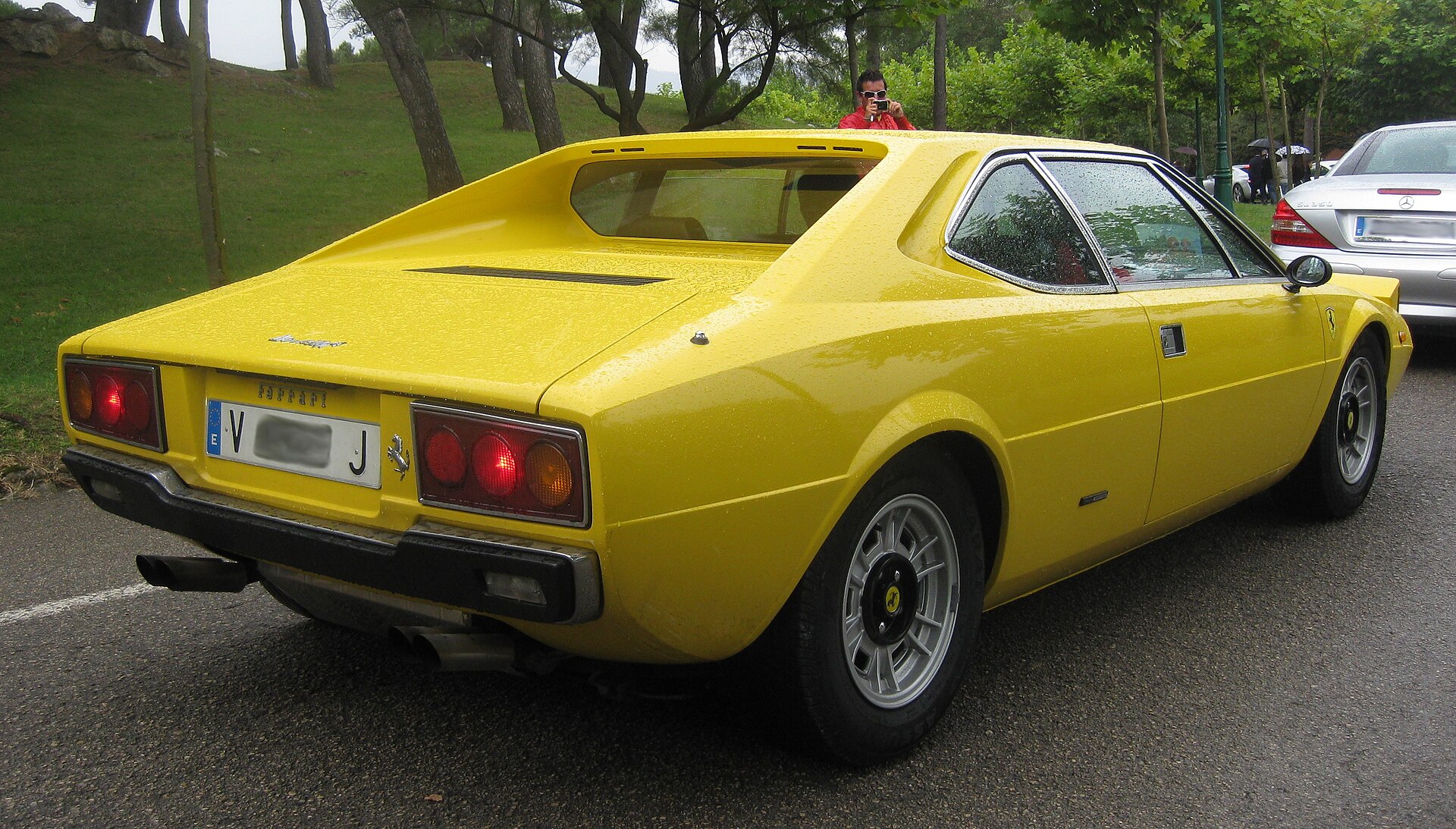


All generations by year: 208 GT4 (1975–1980) · 308 GT4 (1973–1980)
Which one is mine?
Pick the year of first registration to see which generation it is.
- 208 GT4 1975–1980
- 308 GT4 1973–1980
The Ferrari Dino 308 GT4 is a mid-engined 2+2 coupé built from 1973 to 1980, together with the two-litre 208 GT4 for the Italian market. It was the first V8 road car from Maranello, it was sold at first under the Dino name, and it is the only production Ferrari whose body was designed by Bertone rather than Pininfarina. Its angular shape by Marcello Gandini was very different from the Ferraris before it, and its V8 engine started Ferrari's long line of V8 road cars.
In short
- Built 1973–1980: 2,826 Dino 308 GT4 and 840 Dino 208 GT4, according to Wikipedia.
- Transverse 2,927 cc V8 with four overhead camshafts and four Weber carburettors: 188 kW (255 hp) in European form, 179 kW (240 hp) in the USA.
- Body designed by Marcello Gandini at Bertone; tubular spaceframe based on the Dino 246, stretched for two rear seats.
- Ferrari's Prancing Horse badges replaced the Dino badges in May 1976.
Ferrari GT4 at a glance
| Specification | Dino 308 GT4 |
|---|---|
| Production | 1973–1980 (208 GT4 from 1975) |
| Cars built | 2,826 (308 GT4) and 840 (208 GT4) |
| Body | two-door 2+2 coupé, designed by Bertone |
| Chassis | tubular steel spaceframe, 2,550 mm wheelbase |
| Engine | 2,927 cc V8, four overhead camshafts, transverse mid-engine |
| Power | 188 kW (255 hp) Europe; 179 kW (240 hp) USA |
| Gearbox | five-speed manual, in unit with the engine |
| Dry weight | 1,150 kg |
| Dimensions | 4,300 mm long (4,488 mm USA), 1,800 mm wide, 1,180 mm high |
| Predecessor / successor | Dino 206/246 GT / Mondial 8 |
The GT4 followed the six-cylinder Dino 206 and 246 GT and was itself followed by the Mondial; its two-seat sister models were the 308 GTB and GTS. For the brand's later V8 cars, see the Ferrari F430; all models are listed in the Ferrari catalogue.
Launch in 1973 and the two-litre 208 GT4
The 308 GT4 was presented at the Paris Motor Show in October 1973. Only one car, chassis 07202 in light blue metallic, was built that year; sales began with the 1974 model year. Like the smaller Dino 206 and 246 GT, the new car was sold under the Dino name, which Ferrari used for its smaller-engined models.
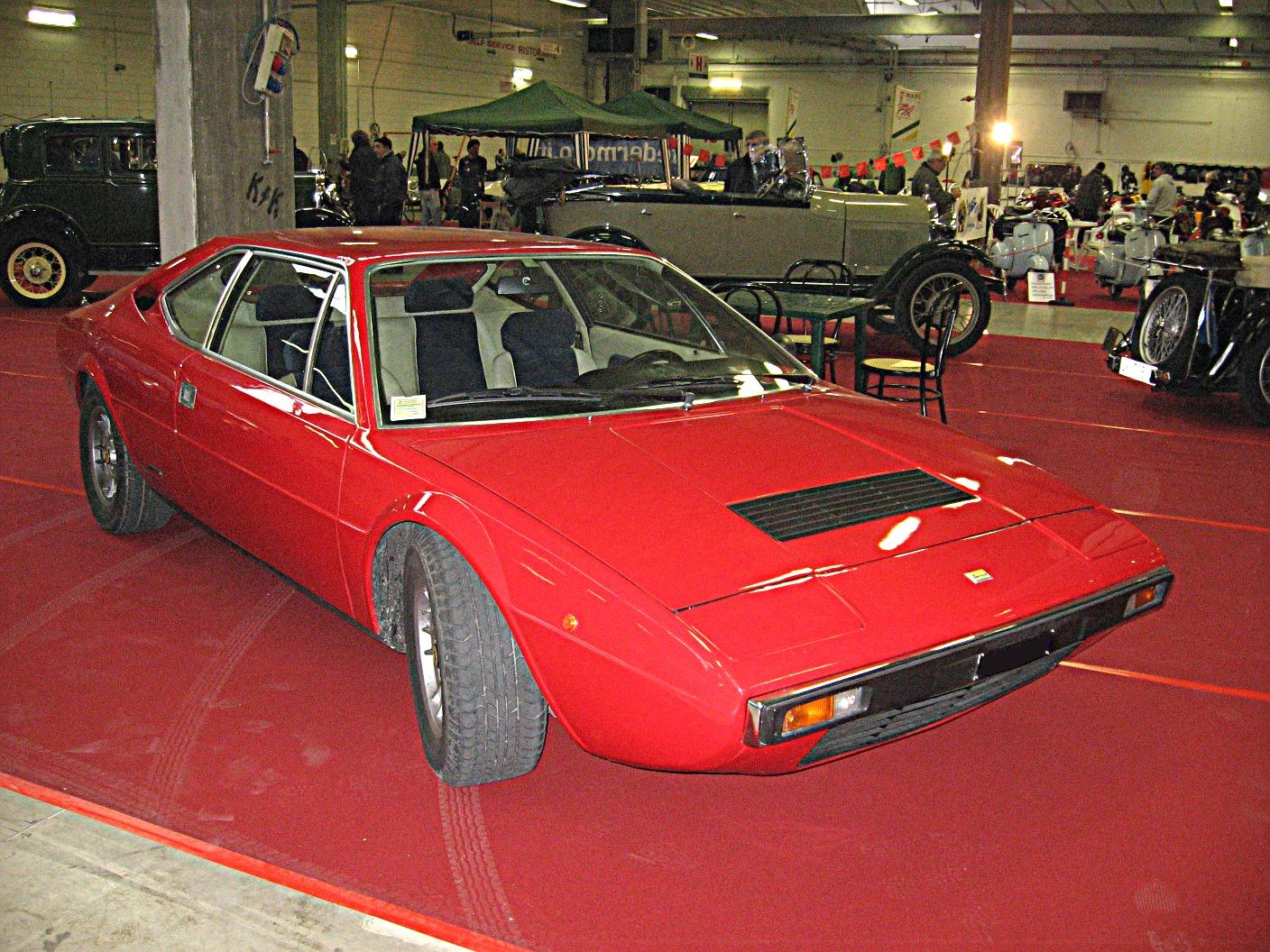
In 1975 Ferrari added the 208 GT4 at the Geneva Motor Show. It was intended for Italy, where cars with engines over two litres were taxed at a VAT rate of 38 per cent. Its V8 was reduced to 1,991 cc — according to Wikipedia, the smallest production V8 ever fitted to a road car — and produced 125 kW (170 hp) at 7,700 rpm. The 208 GT4 had smaller Weber carburettors, a lower final drive, narrower tyres, chrome instead of black exterior trim and a top speed of about 220 km/h. 840 were built.
The 308 GT4 was also important in the United States: in 1975 it was the only Ferrari that could be legally imported there.
Design by Bertone
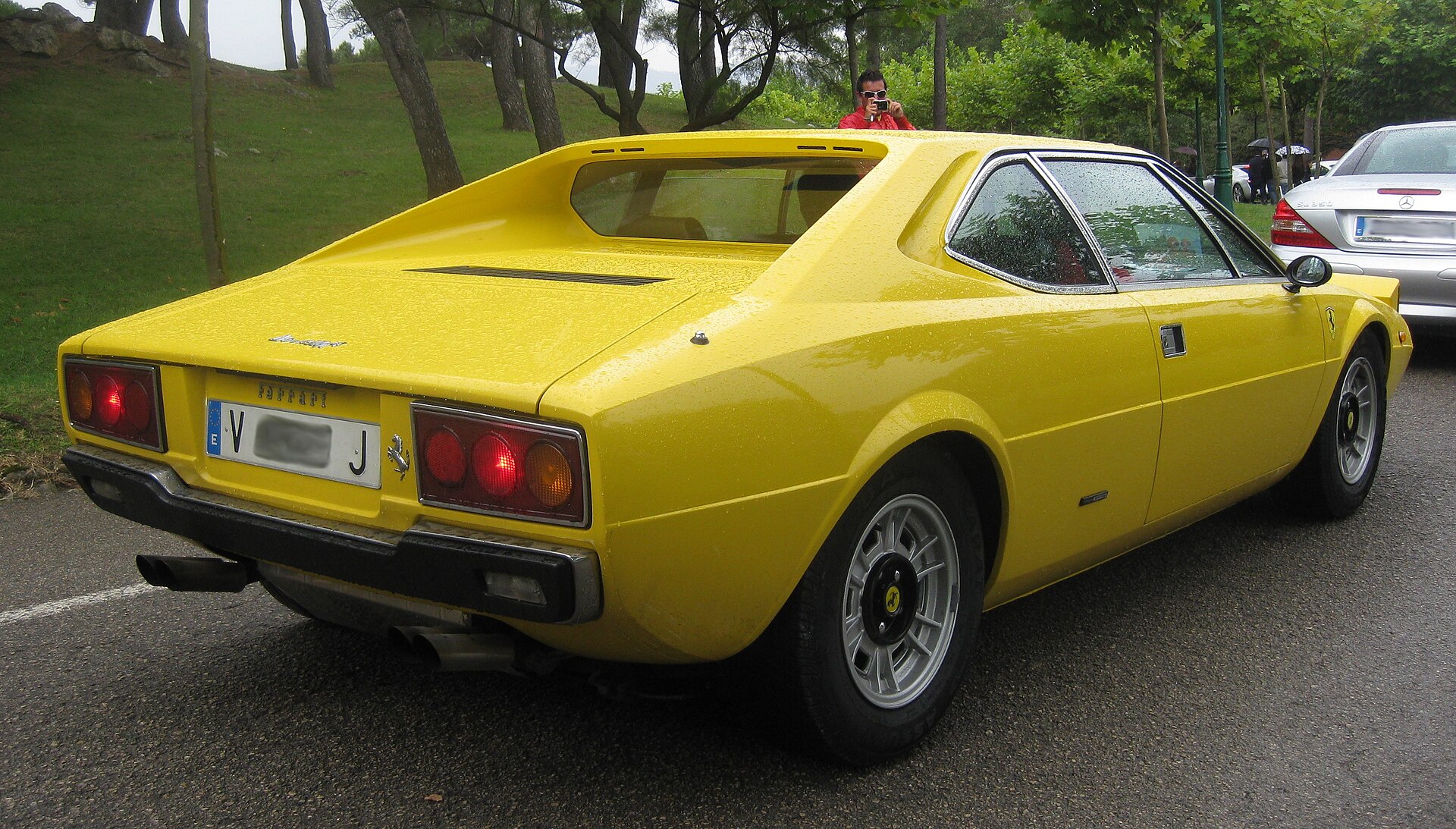
The GT4 is the only production Ferrari designed by Bertone. Marcello Gandini gave it sharp, angular lines, very different from the curves of the 246 GT. Journalists compared it with the Lancia Stratos and, above all, with the Lamborghini Urraco, both also drawn by Gandini. Ferrari never commissioned Gandini again.
Enzo Ferrari took a close interest in the design. He had a mock-up built to test the steering wheel, the pedals and the seating positions,. The wheelbase of 2,550 mm is longer than that of the Dino 246, and the overall length is 4,300 mm (4,488 mm for American cars with larger bumpers).

Engine and chassis
The 2,927 cc V8 was Ferrari's first V8 for a road car. It has an aluminium block and heads, two overhead camshafts per bank driven by toothed belts, 16 valves and four Weber 40 DCNF carburettors. It is mounted across the car behind the rear seats, with the five-speed gearbox built into the same unit.
| Version | Engine | Power |
|---|---|---|
| Dino 308 GT4 (Europe) | 2,927 cc V8 | 188 kW (255 hp) |
| Dino 308 GT4 (USA) | 2,927 cc V8 | 179 kW (240 hp) |
| Dino 208 GT4 (Italy) | 1,991 cc V8 | 125 kW (170 hp) at 7,700 rpm |
The chassis is a tubular spaceframe based on that of the Dino 246, stretched to make room for the rear seats. Suspension is fully independent with double wishbones, coil springs, coaxial telescopic dampers and anti-roll bars at both ends. The 308 GT4 ran on 205/70 VR14 Michelin XWX tyres. The dry weight is 1,150 kg.
Over the years the car was updated several times. A factory update in July 1975 was applied unevenly by dealers, so 1975 cars vary. The second series received a wider, flatter grille with the fog lamps behind it, European cars moved to a single distributor, and Magneti Marelli electronic ignition arrived in July 1978.

From Dino to Ferrari
In May 1976 Ferrari replaced the Dino badges with its own Prancing Horse emblems, and the car became the Ferrari 308 GT4 — although the "Dino 308 GT4" script remained on the boot lid of later cars.
The GT4 was the only 2+2 Ferrari ever raced with factory support. In 1980 it was replaced by the Mondial 8, another mid-engined 2+2; the 208 GTB took over the role of the two-litre 208 GT4.

Rivals and reception
The GT4 competed directly with the Lamborghini Urraco, which shared its layout and its designer, and indirectly with the Lancia Stratos. With 2,826 308 GT4s and 840 208 GT4s, it found a substantial number of buyers for a Ferrari of the 1970s, and it remains the only Ferrari of its era with a Bertone body. The wider history of the company is told in our history of Ferrari.

Ferrari GT4: first vs latest generation
| Spec | 308 GT4 | 208 GT4 | Change |
|---|---|---|---|
| Years | 1973–1980 | 1975–1980 | 2 years apart |
| Most powerful version | 188 kW (256 PS) | 125 kW (170 PS) | −63 kW (−34%) |
Oldest and newest generation in the 1cars catalog. Power is the strongest version of each; other rows are shown only when both generations have the figure.
Image credits · Photos from Wikimedia Commons under free licences
- Ferrari 308 GT4 · Photo: Spanish Coches / Wikimedia Commons, CC BY 2.0
- Ferrari 208 GT4 · Photo: No machine-readable author provided. Luc106 assumed (based on copyright claims). / Wikimedia Commons, Public domain
Ferrari GT4 in our rankings
- No. 494 of 912 · Longest-running car nameplates (7 years · top 60%)
- No. 507 of 859 · Most powerful cars (188 kW · top 60%)
- No. 95 of 127 · Most powerful Italian cars (188 kW · top 76%)
- No. 254 of 313 · Most powerful coupes (188 kW · top 82%)
- No. 250 of 345 · Cars with the most generations (2 generations)
In production longer than 40% of ranked nameplates in the 1CARS catalog (No. 494 of 912).
FAQ
Why is it called Dino 308 GT4?
Ferrari sold its smaller-engined cars under the Dino name; 308 stands for 3.0 litres and eight cylinders, GT4 for a grand tourer with four seats.
Who designed the Ferrari 308 GT4?
Marcello Gandini at Bertone — the only Bertone design among Ferrari's production cars.
How many GT4s were built?
2,826 308 GT4s and 840 208 GT4s, according to Wikipedia.
What replaced the GT4?
The Mondial 8 in 1980; the 208 GTB replaced the two-litre 208 GT4.
Data sources
Data checked by an editor against the sources below.