 Ferrari 550
All generations, specs and history
Published Sources (1) Report an error
By Felix Hartmann, Automotive Technology & EV Contributor
- Built
- 1996–2002
- Generations
- 2
- Top power
- 357 kW (485 PS)
Timeline
550 generations
Click a generation for its own page
Maranello and Barchetta Pininfarina overlapped in 2000–2001, so Barchetta Pininfarina sits on a second lane
- 550 Maranello 1996–2001 · Coupe · 357 kW (485 PS)
- 550 Barchetta Pininfarina 2000–2001 · Coupe · 357 kW (485 PS)
Newest first · 2 generations since 1996
-
2000
-
1996
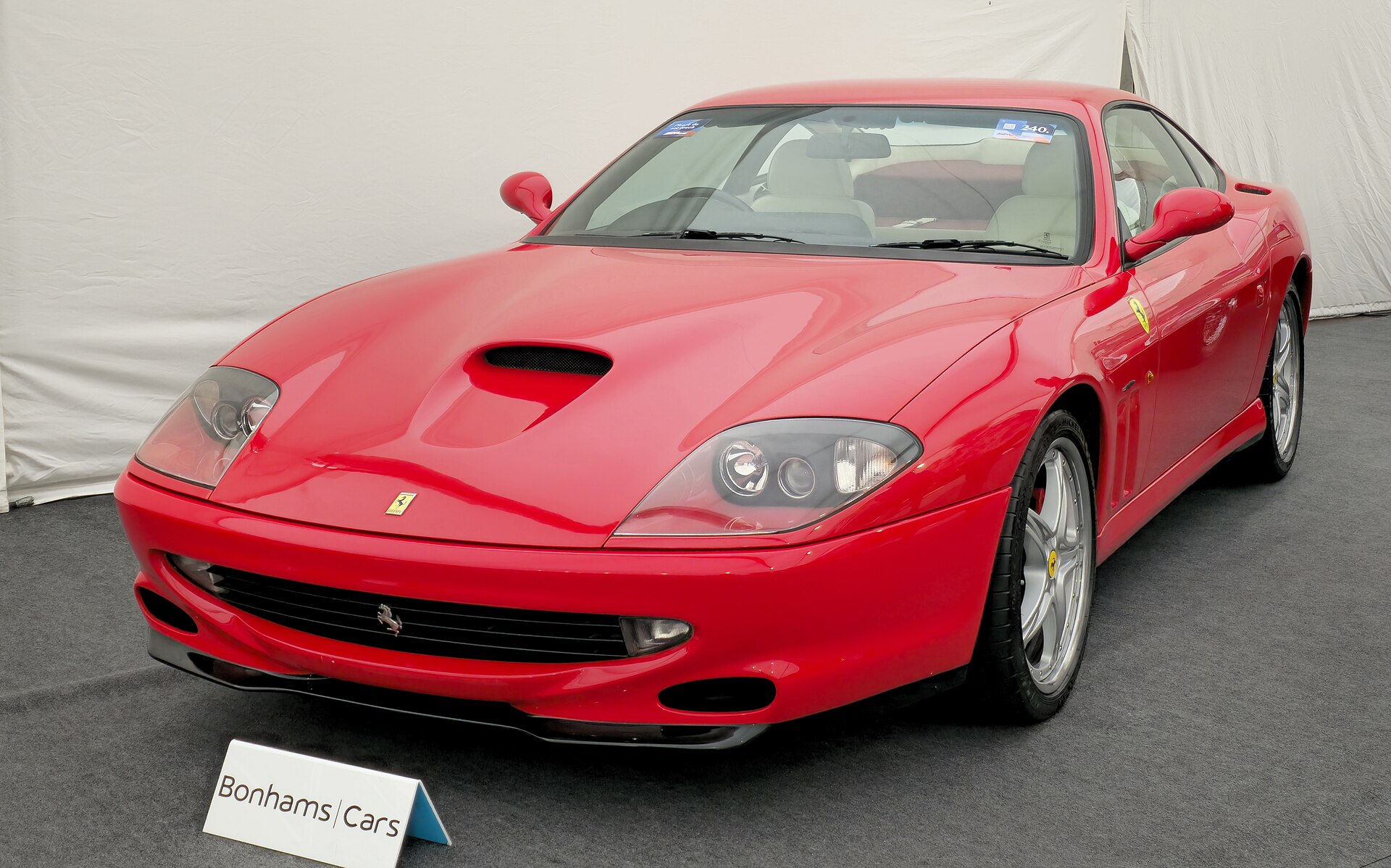


All generations by year: 550 Barchetta Pininfarina (2000–2001) · 550 Maranello (1996–2001)
Which one is mine?
Pick the year of first registration to see which generation it is.
- 550 Barchetta Pininfarina 2000–2001
- 550 Maranello 1996–2001
The Ferrari 550 Maranello is the front-engined V12 two-seater that Ferrari built from 1996 to 2002. It brought the engine back to the front of the car for the first time in a two-seat V12 Ferrari since the 365 GTB/4 Daytona, which had given way to the Berlinetta Boxer in 1973. Its name combines the 5.5-litre displacement with Maranello, the home of the factory. About 3,083 coupés were built, plus 448 open Barchetta Pininfarina cars.
In short
- Unveiled at the Nürburgring in July 1996 after about 30 months of development; built until 2002 and replaced by the 575M Maranello.
- F133 A 5,474 cc 65° V12: 357 kW (485 PS) at 7,000 rpm and 568 Nm at 5,000 rpm, six-speed manual transaxle.
- Ferrari's figures: 0–100 km/h in 4.4 seconds and 320 km/h; kerb weight 1,774 kg.
- The Prodrive-built 550 GTS won the GTS class at Le Mans in 2003 and the FIA GT title in 2004.
At a glance: Ferrari 550 Maranello
| Specification | Ferrari 550 Maranello |
|---|---|
| Production | 1996–2002, Maranello (Italy) |
| Cars built | 3,083 coupés; 448 Barchetta Pininfarina |
| Body | two-seat berlinetta; Barchetta roadster from 2000 |
| Layout | front engine, rear-wheel drive, rear transaxle |
| Engine | F133 A, 5,474 cc 65° V12, 48 valves |
| Power | 357 kW (485 PS) at 7,000 rpm |
| Torque | 568 Nm at 5,000 rpm |
| Gearbox | six-speed manual, limited-slip differential |
| Kerb weight | 1,774 kg |
| Successor | 575M Maranello |
The 550 began the modern line of front-engined V12 Ferraris that continued with the Ferrari 599 and the Ferrari F12berlinetta. Every model is listed in the Ferrari catalogue.
Back to the front engine
From 1973 Ferrari's twelve-cylinder two-seaters had been mid-engined, starting with the Berlinetta Boxer. With the 550 Maranello Ferrari went back to the layout of the Daytona — a long bonnet, a V12 ahead of the cabin and a gearbox at the rear axle. The car was unveiled at the Nürburgring in Germany in July 1996, after about 30 months of development.
The 550 shares its frame and the main engine components with the Ferrari 456, a four-seat grand tourer, but its wheelbase is 100 mm shorter, at 2,500 mm. It was replaced in 2002 by the 575M Maranello, an improved version with a 5.75-litre engine.
Design by Pininfarina
The body and the interior were designed by Pininfarina. The exterior was drawn by Elvio D'Aprile under the supervision of Lorenzo Ramaciotti between 1993 and 1996, with contributions from Maurizio Corbi; Goran Popović designed the interior. The drag coefficient is 0.33.
The car is 4,550 mm long, 1,935 mm wide and 1,277 mm high. The body panels are aluminium, attached to a tubular steel space frame.
Engine and performance
The F133 A engine is a naturally aspirated 65° V12 with 5,474 cc, two overhead camshafts per bank, four valves per cylinder and a variable-length intake manifold. Bore and stroke are 88 × 75 mm. It produces 357 kW (485 PS) at 7,000 rpm and 568 Nm at 5,000 rpm, and it won the over-4-litre class of the International Engine of the Year awards in 2000 and 2001.
The six-speed manual gearbox sits at the rear axle together with a limited-slip differential, in a transaxle layout. The final drive ratio is 3.91:1.
| Version | Engine | Power | Torque | 0–100 km/h | Top speed |
|---|---|---|---|---|---|
| 550 Maranello (1996) | F133 A, 5,474 cc | 357 kW (485 PS) at 7,000 rpm | 568 Nm at 5,000 rpm | 4.4 s | 320 km/h |
| 550 Barchetta Pininfarina (2000) | F133 C, 5,474 cc | 357 kW (485 PS) | 568 Nm | 4.4 s | 300 km/h |
Ferrari's figures are 0–100 km/h in 4.4 seconds and 320 km/h. In a test published in 2000, Motor Trend recorded a standing quarter mile of 12.5 seconds.
In October 1998 a lightly modified 550 set three speed records on the 12 km oval of the Transportation Research Center in East Liberty, Ohio: 100 miles at an average of 306 km/h, 100 km at 304 km/h and one hour at 296 km/h. Ferrari then built 33 road cars to the specification of the record car, sold as the 550 WSR with the Fiorano handling pack, a roll cage and a commemorative plaque. The records were broken in 2002 by a pre-production Lamborghini Murciélago at Nardò.

Chassis and cabin
The suspension uses double wishbones with coaxial coil springs and dampers at all four corners, plus anti-roll bars front and rear. Steering is rack-and-pinion with speed-sensitive power assistance. The vented brake discs measure 330 mm at the front and 310 mm at the rear, with four-channel ABS, and the car rides on 18-inch magnesium alloy wheels. Traction control can be set to two levels or switched off.
In 2004 the 550 Maranello won evo magazine's "Greatest Drivers' Car" contest, years after production had ended.

The 550 Barchetta Pininfarina
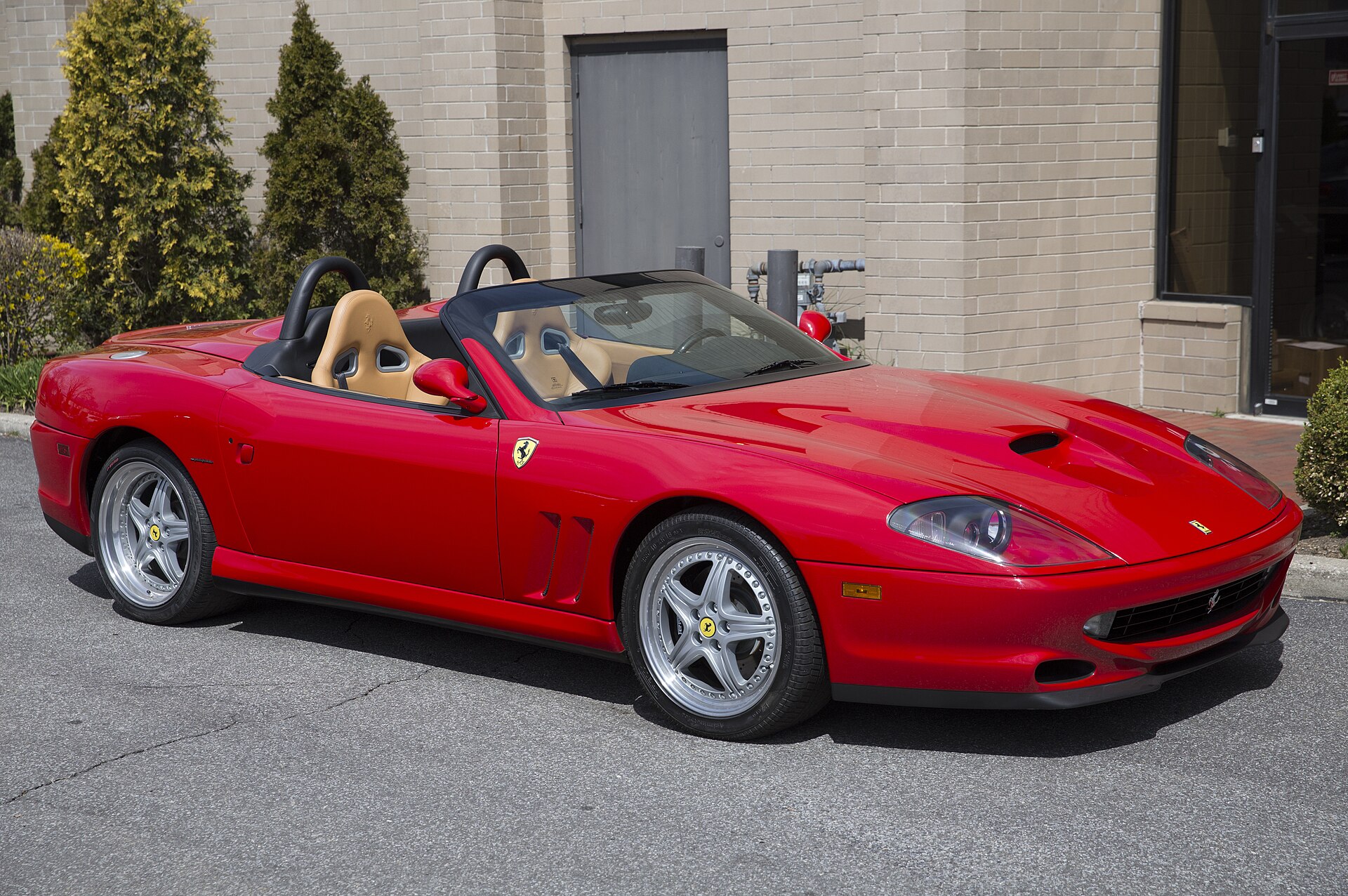
To mark Pininfarina's 70th anniversary, Ferrari presented the 550 Barchetta Pininfarina at the Paris motor show in 2000. Production was limited to 448 cars; the number was raised from 444 partly because the number four is considered unlucky in Japan. Twelve prototypes, numbered P01 to P12, came before production.
The Barchetta has a more steeply raked windscreen, roll-over hoops behind the seats, a longer rear section and 19-inch wheels. It has no proper convertible roof: a cloth cover was supplied for emergencies, and it was not considered safe above about 113 km/h. Top speed is 300 km/h; acceleration is the same as the coupé. Each car has a numbered plaque on the dashboard ("x of 448") signed by Sergio Pininfarina.
The Barchetta later inspired coachbuilt cars: the 550 GTZ Barchetta by Zagato (2009, three cars with an electrically operated roof) and the Superleggera Veloce12 by Touring Superleggera, shown at Monterey Car Week in 2024 with 30 cars planned.
Racing: 550 GTS and others
Private teams and specialists built several racing versions of the 550. The most successful was the 550 GTS by Prodrive, commissioned by Care Racing Development; ten were built over four years. It won twice in its first FIA GT season in 2001. In 2003 Prodrive won the GTS class at the Le Mans 24 Hours and took four wins in the American Le Mans Series, and BMS Scuderia Italia won eight FIA GT races. BMS won the FIA GT Championship in 2004 and the Le Mans Series in 2005, while Larbre Compétition won the GT1 class of the new Le Mans Series in 2004.
Other versions included the 550 GT by Italtecnica for French GT racing, the 550 Millennio for FIA GT and the ALMS, and the 550 GTS built for Wieth Racing. The Prodrive car's success led Ferrari to develop the 575 GTC racer from the 575M.

Photo gallery


Ferrari 550: first vs latest generation
| Spec | 550 Maranello | 550 Barchetta Pininfarina | Change |
|---|---|---|---|
| Years | 1996–2001 | 2000–2001 | 4 years apart |
| Most powerful version | 357 kW (485 PS) | 357 kW (485 PS) | same (0%) |
Oldest and newest generation in the 1cars catalog. Power is the strongest version of each; other rows are shown only when both generations have the figure.
Image credits · Photos from Wikimedia Commons under free licences
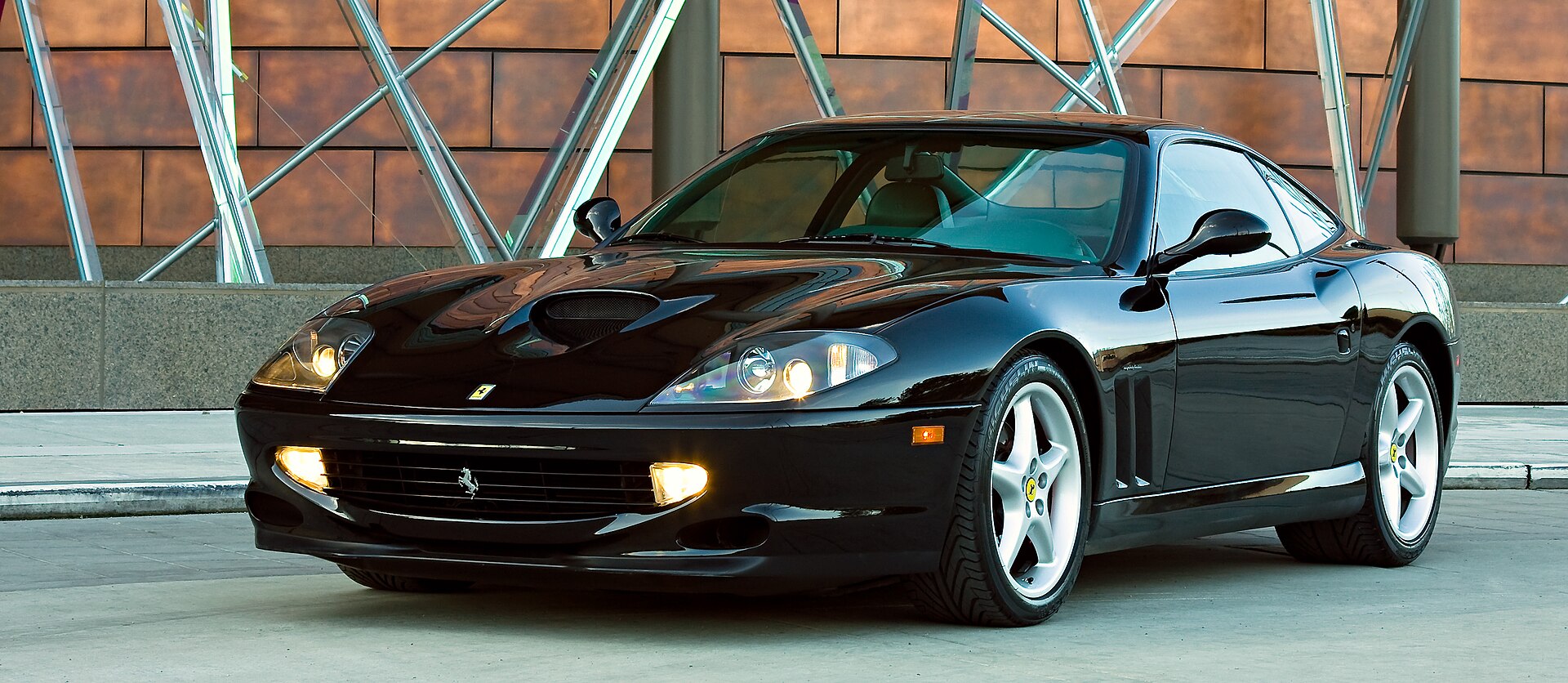
- Ferrari 550 Maranello · Photo: Calreyn88 / Wikimedia Commons, CC BY-SA 4.0
- Ferrari 550 Barchetta Pininfarina · Photo: Mr.choppers / Wikimedia Commons, CC BY-SA 3.0
Ferrari 550 in our rankings
- No. 40 of 170 · Most powerful cars of the 2000s (357 kW · top 24%)
- No. 212 of 859 · Most powerful cars (357 kW · top 25%)
- No. 122 of 313 · Most powerful coupes (357 kW · top 39%)
- No. 50 of 127 · Most powerful Italian cars (357 kW · top 40%)
- No. 646 of 912 · Longest-running car nameplates (5 years · top 77%)
- No. 255 of 345 · Cars with the most generations (2 generations)
More powerful than 76% of ranked cars of the 2000s in the 1CARS catalog (No. 40 of 170).
FAQ
How many Ferrari 550 Maranellos were built?
About 3,083 coupés between 1996 and 2002, plus 448 Barchetta Pininfarina roadsters.
How powerful is the 550 Maranello?
The 5.5-litre V12 produces 357 kW (485 PS) at 7,000 rpm and 568 Nm at 5,000 rpm.
How fast is the Ferrari 550?
Ferrari quotes 0–100 km/h in 4.4 seconds and a top speed of 320 km/h for the coupé; the Barchetta reaches 300 km/h.
Why is it called 550 Maranello?
"550" refers to the 5.5-litre engine and "Maranello" to the town where Ferrari has its headquarters and factory.
What replaced the 550?
The 575M Maranello in 2002, with a larger 5.75-litre V12.
Data sources
Data checked by an editor against the sources below.