 Aston Martin DB12
Specs, engines and history
Published Sources (1) Report an error
By Felix Hartmann, Automotive Technology & EV Contributor
- Built
- 2023–present
- Top power
- 515 kW (700 PS)
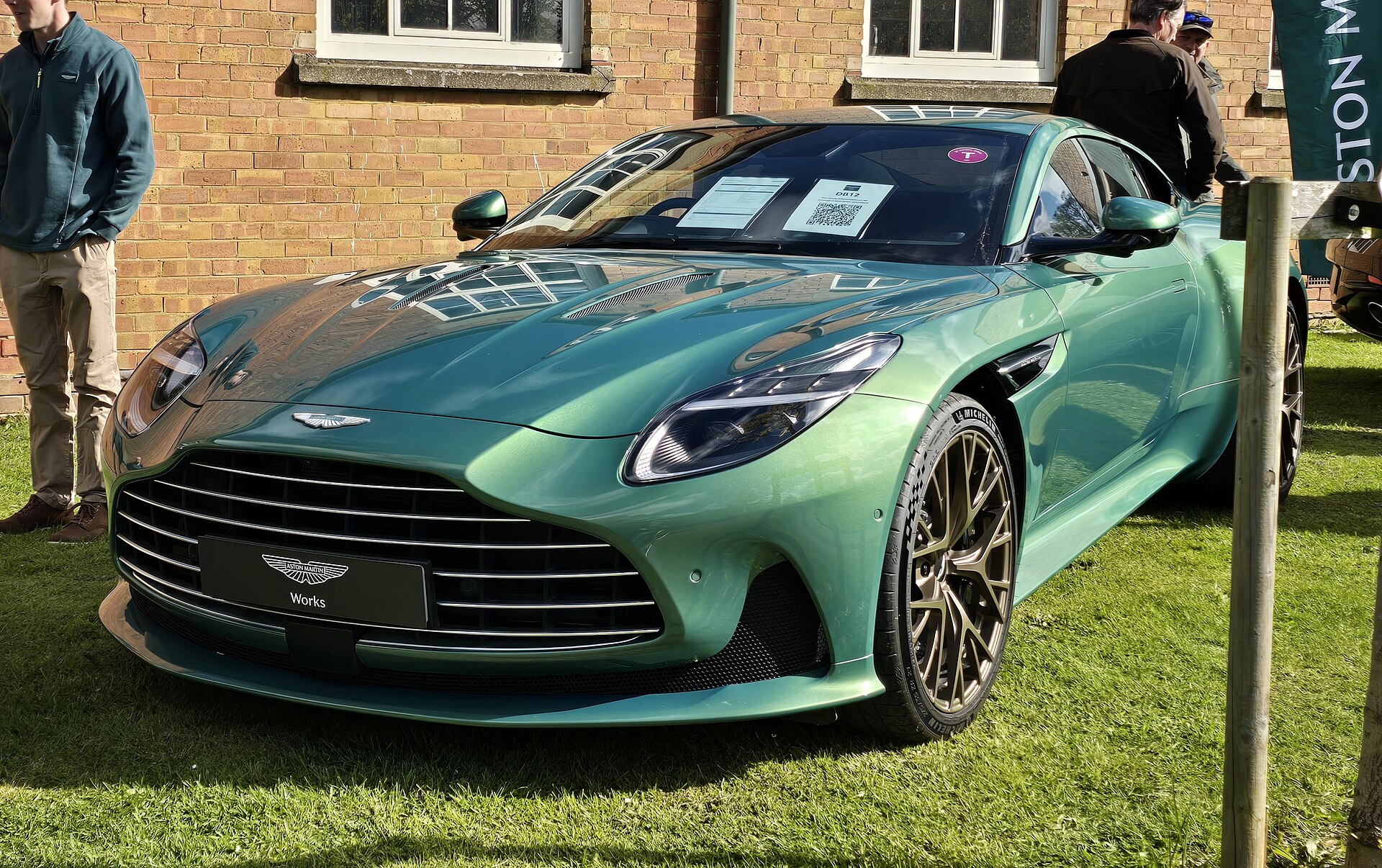
The Aston Martin DB12 is the front-engined grand tourer that replaced the DB11 in 2023. Aston Martin calls it the world's first "Super Tourer". The idea is a car with the comfort and range of a traditional GT, but with a 500 kW (680 PS) twin-turbo V8 and a chassis that feels closer to a sports car. Built in Gaydon, England, it is offered as a coupé and as the DB12 Volante convertible, and from late 2025 as the more powerful DB12 S.
In short
- Revealed on the evening of 24 May 2023 at the Cannes Film Festival; built in Gaydon from 2023, first deliveries in the third quarter of 2023.
- 4.0-litre twin-turbo V8 with 500 kW (680 PS) at 6,000 rpm and 800 Nm from 2,750 to 6,000 rpm; eight-speed automatic, rear-wheel drive.
- 0–100 km/h in 3.6 seconds and a top speed of 325 km/h for the coupé.
- The first Aston Martin with an electronic rear differential in the DB line and the first car to wear the brand's new wings badge.
Aston Martin DB12 at a glance
| Specification | Aston Martin DB12 |
|---|---|
| Production | 2023–present, Gaydon (England) |
| Model code | AM572 |
| Body | two-door coupé with swan doors; Volante convertible from 2023 |
| Layout | front mid-engine, rear-wheel drive |
| Engine | 4.0-litre V8, two turbochargers |
| Power | 500 kW (680 PS) at 6,000 rpm; DB12 S: 515 kW (700 PS) |
| Torque | 800 Nm at 2,750–6,000 rpm |
| Gearbox | eight-speed automatic |
| Kerb weight | 1,685 kg (coupé), 1,796 kg (Volante) |
| Predecessor | DB11 |
The DB12 continues a line of "DB" grand tourers that Aston Martin traces back 75 years to the David Brown era. It is the direct successor of the Aston Martin DB11, and all models of the brand are listed in the Aston Martin catalogue.
History and launch
The DB12 was unveiled on the evening before 25 May 2023 at the Hotel du Cap-Eden-Roc near Cap d'Antibes, during the Cannes International Film Festival. The cover was pulled by the two drivers of the Aston Martin Formula One team, Fernando Alonso and Lance Stroll. The launch was timed to the company's 110th anniversary. Aston Martin was also presenting sponsor of the amfAR Gala in Cannes, where the first customer DB12 was auctioned to support AIDS research.
The design team worked under Marek Reichman, Aston Martin's head of design. Technically the DB12 is a deep update of the DB11 rather than a clean-sheet car. It keeps the "swan" doors of its predecessor. The interior, the engine output, the track widths, the structure and the chassis were all reworked. At its launch Group Chief Technology Officer Roberto Fedeli called it "a statement car", and Chief Executive Amedeo Felisa said it would lead Aston Martin "into a new era".
The most important decision was what the DB12 would not have. The DB11 had been offered with a 5.2-litre twin-turbo V12; the DB12 dropped it and was launched only with the V8. Aston Martin argued that the new car's target — a GT that is also sharp enough to drive hard — was better met by a lighter, more powerful V8.

Design and interior
From the outside the DB12 is recognisable by a larger radiator grille, a reshaped front splitter and new LED headlights with a different daytime running light signature. The wing mirrors are smaller and frameless, the tracks are wider than on the DB11, and the car wears the latest version of the Aston Martin wings badge. The DB12 was the first Aston Martin to carry this new logo. Some styling details were borrowed from the DBS, the brand's former flagship coupé.
The cabin was the area that changed most. The interior was redesigned around an all-new infotainment system with Apple CarPlay and Android Auto, and Aston Martin described the layout as a driver-centred cockpit with integrated technology. The stability-control setting is chosen with a dedicated button on the centre console.

Engine and performance
The engine is a 4.0-litre twin-turbo V8, hand-built and tuned by Aston Martin; the factory code in Wikipedia's data is AE23. Compared with the V8 of the DB11, it gains higher compression, larger turbochargers and improved cooling. The result is 500 kW (680 PS) at 6,000 rpm and 800 Nm over a wide band from 2,750 to 6,000 rpm. Power goes to the rear wheels through an eight-speed automatic transmission.
| Figure | DB12 coupé | DB12 Volante | DB12 S coupé |
|---|---|---|---|
| Power | 500 kW (680 PS) | 500 kW (680 PS) | 515 kW (700 PS) |
| Torque | 800 Nm | 800 Nm | 800 Nm |
| 0–100 km/h | 3.6 s | 3.7 s | 3.5 s |
| Top speed | 325 km/h | 325 km/h | 325 km/h |
| Kerb weight | 1,685 kg | 1,796 kg | — |
When it was launched, Aston Martin described the output as the best in its class. With 800 Nm available from 2,750 rpm, the engine gives the car strong pulling power at everyday speeds as well as a high top speed.
Chassis, brakes and tyres
The DB12 has an all-new suspension set-up. It uses a new generation of adaptive dampers, which Aston Martin calls "intelligent", stiffer anti-roll bars and electronic power steering. For the first time on a DB model, the car has an electronic rear differential (E-Diff). It varies the locking between the rear wheels instead of relying on a mechanical limited-slip unit. The electronic stability control uses a six-axis inertial measurement unit to estimate how much grip is available.
The driver chooses between five drive modes — GT, Sport, Sport+, Individual and Wet — and four stability-control settings: Wet, On, Track and Off.
The standard brakes are grooved and drilled cast-iron discs, 400 mm in diameter at the front and 360 mm at the rear, with a retuned brake booster. Carbon-ceramic brakes are optional; they resist fade at temperatures up to 800 °C and save 27 kg of unsprung mass.
The DB12 was the first Aston Martin to use the Michelin Pilot Sport 5 S tyre as original equipment. The tyres were made to Aston Martin's specification and have noise-cancelling foam inside. Sizes are 275/35 R21 at the front and 315/30 R21 at the rear, on standard 21-inch forged wheels (9.5J front, 10.5J rear).
| Item | Specification |
|---|---|
| Wheelbase | 2,805 mm |
| Length / width / height | 4,725 / 1,980 / 1,295 mm |
| Front brakes | 400 mm cast-iron discs (carbon-ceramic optional) |
| Rear brakes | 360 mm cast-iron discs |
| Tyres | Michelin Pilot Sport 5 S, 275/35 R21 front, 315/30 R21 rear |

DB12 Volante
The convertible, the DB12 Volante, was unveiled on 14 August 2023. It has an eight-layer fabric roof that opens in 14 seconds and closes in 16 seconds, and can be operated at speeds up to 50 km/h. Aston Martin claimed 5 per cent more torsional rigidity than the DB11 Volante. The Volante uses the same 500 kW (680 PS) engine, reaches 100 km/h in 3.7 seconds and has the same top speed as the coupé. It weighs 1,796 kg, 111 kg more than the coupé.

DB12 S
The DB12 S was unveiled on 8 October 2025. Orders opened that month for both the coupé and the Volante, with deliveries planned for the first quarter of 2026. Its V8 produces 515 kW (700 PS), 15 kW (20 PS) more than the standard car, with torque unchanged at 800 Nm. Aston Martin recalibrated the transmission for gear changes that it says are 50 per cent faster. The 0–100 km/h time falls to 3.5 seconds for the coupé and 3.6 seconds for the Volante. The top speed stays at 325 km/h.
Carbon-ceramic brakes are standard on the S, which saves 27 kg. The Bilstein DTX adaptive dampers and the electronic differential were recalibrated. Visually, the S has a new front splitter with matching side sills, new bonnet vents, a new rear diffuser and a sports exhaust with four tailpipes stacked in pairs. Inside there are "S" logos on the front wings and headrests, a red anodised drive-mode selector and new leather and Alcantara combinations.
Place in the range and legacy
Aston Martin presented the DB12 as the car that leads its next generation of sports cars. Its related models are the Aston Martin Vantage and the Vanquish. Within the DB line it marks a change of emphasis. The "Super Tourer" label says that the car should be judged on its performance and handling as much as on its comfort over long distances.
The decision to offer the DB12 only with a V8, followed two years later by the 515 kW DB12 S, shows the same direction. Instead of a V12 version at the top of the range, Aston Martin added power, standard carbon-ceramic brakes and sharper chassis settings to the V8 car. The background of the company and its DB line is told in our history of Aston Martin.
Photo gallery


Aston Martin DB12 in our rankings
- No. 90 of 859 · Most powerful cars (515 kW · top 11%)
- No. 18 of 109 · Most powerful British cars (515 kW · top 18%)
- No. 64 of 313 · Most powerful coupes (515 kW · top 21%)
- No. 52 of 239 · Most powerful cars of the 2020s (515 kW · top 22%)
- No. 797 of 912 · Longest-running car nameplates (3 years · top 89%)
- No. 267 of 305 · Oldest car models still on sale (3 years · top 92%)
More powerful than 89% of ranked cars in the 1CARS catalog (No. 90 of 859).
FAQ
How much power does the Aston Martin DB12 have?
The standard DB12 has a 4.0-litre twin-turbo V8 with 500 kW (680 PS) and 800 Nm. The DB12 S, unveiled in October 2025, has 515 kW (700 PS).
Is there a V12 Aston Martin DB12?
No. The DB12 is offered only with the 4.0-litre twin-turbo V8; the 5.2-litre V12 that was available in the DB11 is no longer offered.
How fast is the Aston Martin DB12?
Aston Martin quotes 0–100 km/h in 3.6 seconds for the coupé (3.7 seconds for the Volante) and a top speed of 325 km/h.
What does "Super Tourer" mean?
It is Aston Martin's own term for the DB12: a grand tourer with the comfort of a GT and the performance and chassis responses of a sports car.
Data sources
Data checked by an editor against the sources below.