
 Ford Courier
All generations, specs and history
Published Sources (2) Report an error
By Oleksandr Hnatiuk, Automotive Editor & Used Car Specialist
- Built
- 1952–2013
- Generations
- 3 · Mazda B-Series to Fiesta pickup
- Top power
- 154 kW (209 PS)
Timeline
Courier generations
Click a generation for its own page

Mazda B-Series and Fiesta Mk3/Mk4 van overlapped in 1991–2006, so Fiesta Mk3/Mk4 van sits on a second lane
- Courier Mazda B-Series 1972–2006 · Pickup · 49–154 kW (67–209 PS)
- Courier Fiesta Mk3/Mk4 van 1991–2002 · Van · 44–55 kW (60–75 PS)
- Courier Fiesta pickup 1998–2013 · Pickup
Newest first · 3 generations since 1972
- 1998 Fiesta pickup 1998–2013 · Pickup
-
1991
- 1972 Mazda B-Series 1972–2006 · Pickup · 49–154 kW (67–209 PS)
All generations by year: Courier Fiesta pickup (1998–2013) · Courier Fiesta Mk3/Mk4 van (1991–2002) · Courier Mazda B-Series (1972–2006)
Which one is mine?
Pick the year of first registration to see which generation it is.
- Fiesta pickup 1998–2013
- Fiesta Mk3/Mk4 van 1991–2002
- Mazda B-Series 1972–2006
The Ford Courier is a name Ford has used on five different commercial vehicles since 1952: an American sedan delivery, a Mazda-built compact pickup sold in North America from 1972 to 1982, the Australian and New Zealand pickup that lasted until 2006, a Fiesta-based van built in Europe from 1991 to 2002, and a Fiesta-based pickup made in Brazil until 2013. Which one you mean depends mostly on where you live.
In short
- US sedan delivery 1952-1960; Mazda B-Series pickup in North America 1972-1982, replaced by the Ranger for 1983.
- Australia and New Zealand kept the Mazda-based Courier until 2006, built in Thailand from 1998, with a 2.6 petrol, a 2.5 turbodiesel and from January 2005 a 4.0 V6 with 154 kW.
- European Courier van (Fiesta Mk3 and Mk4) from June 1991 to August 2002, built in Dagenham and Cologne, then replaced by the Transit Connect.
- Brazilian Courier pickup 1998-2013 with a 700 kg payload; the later Transit Courier is a separate model.
Size at a glance
Ford Courier Fiesta Mk3/Mk4 van
The Ford Courier Fiesta pickup is 342 mm longer, 143 mm wider and 358 mm lower than the Ford Courier Fiesta Mk3/Mk4 van.
| Dimensions | Ford Courier Fiesta pickup | Ford Courier Fiesta Mk3/Mk4 van | Difference |
|---|---|---|---|
| Length | 4,457 mm175.5 in | 4,115 mm162.0 in | +342 mm+13.5 in |
| Width | 1,793 mm70.6 in | 1,650 mm65.0 in | +143 mm+5.6 in |
| Height | 1,477 mm58.1 in | 1,835 mm72.2 in | −358 mm−14.1 in |
| Wheelbase | 2,830 mm111.4 in | - | - |
Running cost
Fuel · Courier Mazda B-Series 2.5 Turbodiesel 82 kW
about 2,500 EUR fuel a year at 15,000 km
10.1 l/100 km · diesel at 1.65 EUR/l · change mileage, fuel price or version
Specs by version
Engines
| Version | Engine | Power | Torque | Gearbox | Drive | Production years |
|---|---|---|---|---|---|---|
| Diesel · 3 versions | ||||||
| Mazda B-Series · 2.5 Turbodiesel 82 kW | 4 cyl · Diesel | 82 kW 111 PS110 hp | 271 Nm200 lb-ft | 5-sp Manual | - | - |
| Fiesta Mk3/Mk4 van · 1.8 Diesel 44 kW | 4 cyl · Diesel | 44 kW 60 PS59 hp | 110 Nm81 lb-ft | 5-sp Manual | Front-wheel drive | - |
| Fiesta Mk3/Mk4 van · 1.8 Turbodiesel 55 kW | 4 cyl · Diesel | 55 kW 75 PS74 hp | - | 5-sp Manual | Front-wheel drive | 1999–2002 |
| Petrol · 4 versions | ||||||
| Mazda B-Series · 1.8 55 kW | 4 cyl · Petrol | 55 kW 75 PS74 hp | 125 Nm92 lb-ft | 4-sp Manual | Rear-wheel drive | 1972 |
| Mazda B-Series · 2.6 92 kW | 4 cyl · Petrol | 92 kW 125 PS123 hp | 210 Nm155 lb-ft | 5-sp Manual | - | - |
| Mazda B-Series · 4.0 V6 154 kW | 6 cyl · Petrol | 154 kW 209 PS207 hp | 323 Nm238 lb-ft | 5-sp Manual | - | 2005–2006 |
| Fiesta pickup · 1.6 Zetec Rocam | 4 cyl · Petrol | - | - | - | Front-wheel drive | 2000–2013 |
Performance
Show all 3 versions
| Version | 0–100 km/h | Top speed | Fuel consumption |
|---|---|---|---|
| Diesel · 1 version | |||
| Mazda B-Series · 2.5 Turbodiesel 82 kW | - | - | 10.1 l/100 km23.3 mpg US · 28.0 mpg UK |
| Petrol · 2 versions | |||
| Mazda B-Series · 2.6 92 kW | - | - | 13.0 l/100 km18.1 mpg US · 21.7 mpg UK |
| Fiesta pickup · 1.6 Zetec Rocam | 10.0 s 0–62 mph | 180 km/h112 mph | - |
Dimensions and weight
Verified Manufacturer and type-approval data from our catalog · Sources and methodology
Ford Courier at a glance
| Courier | Years | Built in | Base | Engines | Successor |
|---|---|---|---|---|---|
| Sedan delivery (US) | 1952-1960 | USA | full-size Ford two-door wagon | as Ford passenger cars | Econoline van, Falcon sedan delivery |
| Compact pickup (North America) | 1972-1982 model years | Hiroshima, Japan (Mazda) | Mazda B-Series | 1.8, 2.0, 2.3 petrol; 2.2 diesel | Ford Ranger (1983) |
| Pickup (Australia, NZ, other markets) | to 2006 | Japan, then AutoAlliance Thailand from 1998 | Mazda B-Series (UF, UN) | 2.2, 2.6 petrol; 2.5 turbodiesel; 4.0 V6 | Ranger (2006) |
| Van and Kombi (Europe) | June 1991-August 2002 | Dagenham (UK), Cologne (Germany) | Fiesta Mk3, Mk4 from 1995 | 1.3 petrol; 1.8 diesel and turbodiesel | Transit Connect (2002) |
| Coupe utility (Brazil, Latin America) | 1998-2013 | São Bernardo do Campo, Camaçari | Fiesta | 1.3, 1.4, 1.6 petrol | none |
Which Ford Courier is which
The first Courier was a sedan delivery, a two-door Ford station wagon with steel panels in place of the rear side windows and a cargo floor in place of the rear seats. It ran from 1952 to 1960; early versions had a side-hinged rear door, the 1957-1958 cars took the two-piece tailgate of the Parklane and Del Rio wagons, and the last two years used the Ranch Wagon body. The Econoline van replaced it for 1961.
From 1972 the name moved to small pickups built by Mazda, and from 1991 Ford of Europe used it on a van. The Brazilian Courier of 1998 was a Fiesta-based pickup, the Latin American cousin of the South African Ford Bantam. In 2013 Ford revealed the Transit Courier, a small van from Ford Otosan in Turkey, and the name went to that different vehicle.

Ford Courier pickup by Mazda in North America, 1972-1982
The Courier was Ford's first compact pickup and the first joint product of Ford and Mazda, an alliance that lasted for decades. It was a rebadged Mazda B-Series, sold to fill the gap left when the Ford Ranchero moved to a larger platform. Ford imported it as a cab-chassis and fitted the load box locally, which meant a 4 percent tariff instead of the 25 percent chicken tax on light trucks. Rated load was 1,400 lb (635 kg).
The 1972 Courier had a 1.8-litre overhead-cam four with 55 kW (74 hp) and 125 Nm (92 lb-ft), a four-speed manual and an optional three-speed automatic. A five-speed manual arrived in 1976, together with a cab 76 mm (3 in) longer. The 1977 restyle brought squarer bodywork, and for 1979 the base engine grew to 2.0 litres, with a Ford-built 2.3 as an option. A 2.2-litre Perkins-derived diesel with 49 kW (66 hp) followed in 1980. The North American Courier ended with the 1982 model year, and the Ford Ranger took over for 1983.

Ford Courier in Australia and New Zealand, to 2006
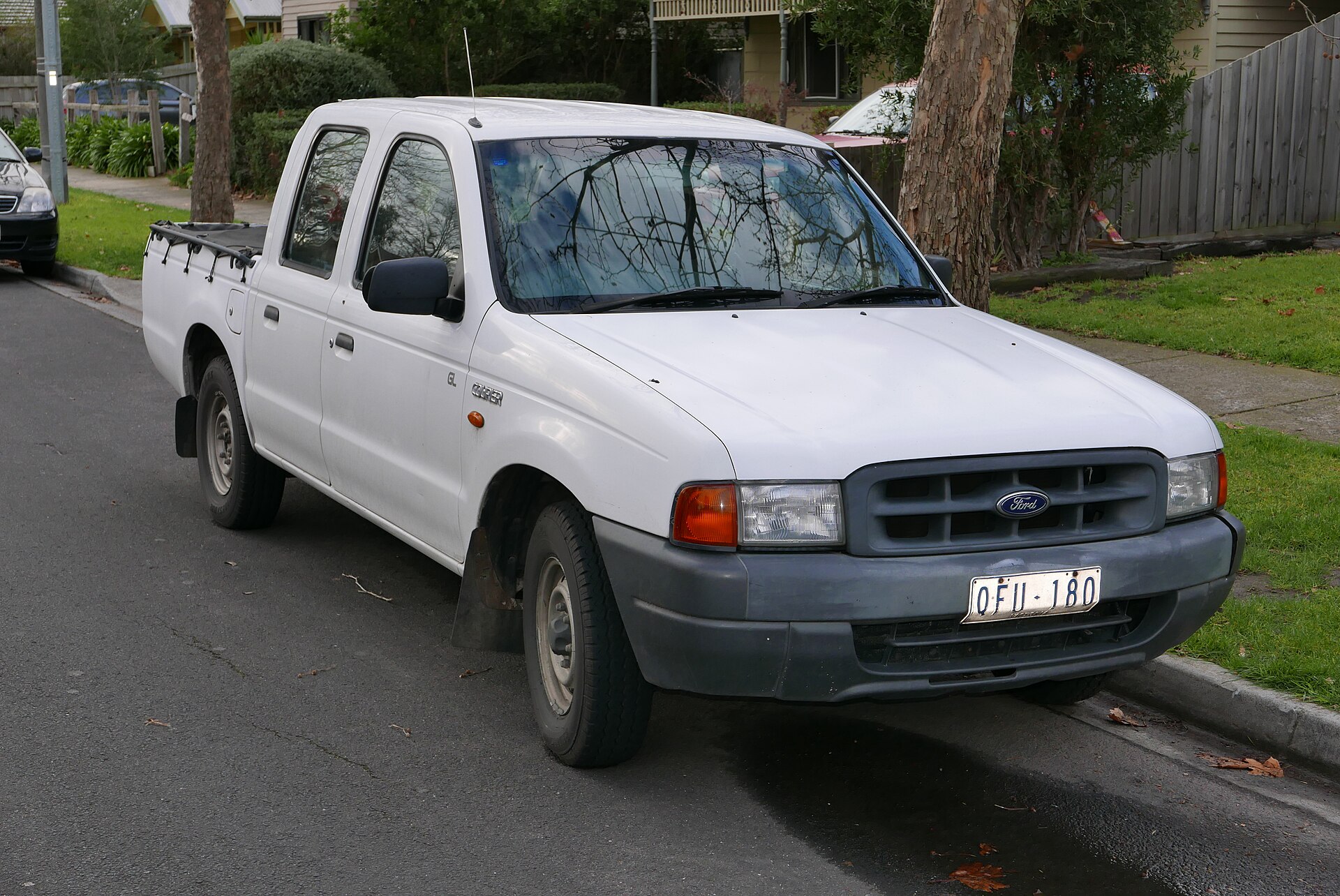
Ford Australia kept the Courier name on its Mazda B-Series twin, sold next to the Mazda Bravo, long after it disappeared in America. The 1985 UF generation (PC series in Australia) added extended and four-door cabs, four-wheel drive and bigger engines. The UN generation followed for 1998, built by AutoAlliance Thailand from May 1998, and was sold as the PE, PG and PH series.
| Engine (Australia) | Power and torque | Gearboxes | Source and year |
|---|---|---|---|
| 2.6 petrol four | 92 kW, 210 Nm | 5-speed manual, 4-speed automatic | GoAuto, 2005 |
| 2.5 turbodiesel four, intercooled | 82 kW, 271 Nm (86 kW quoted in 2003) | 5-speed manual | GoAuto 2005, Carsales 2003 |
| 4.0 V6 (from January 2005) | 154 kW, 323 Nm | 5-speed manual or 5-speed automatic | GoAuto, 2005 |
Ford expected diesels to make up 45 percent of 2005 sales, against 30 percent for the 2.6 petrol and 25 percent for the V6. The V6, derived from the Explorer's engine, was added in January 2005 to the Super Cab and Crew Cab in GL and XLT trim, with 20 mm more ride height. The Super Cab had small rear-hinged rear doors that open only after the front doors.
List prices for the updated range ran from AUD 19,670 for a 2.6 GL single cab chassis (NRMA) to AUD 43,190 for the 4x4 V6 XLT Crew Cab automatic in January 2005 (GoAuto). Airbags and ABS cost an extra AUD 2,400 on most versions. Ford sold 7,077 Couriers in Australia in 2004, its best year, while the Toyota HiLux found 28,077 buyers. Braked towing is 1,800 kg, and CarsGuide lists 10.1 L/100 km for a 2.5 diesel 4x4 and 13.0 L/100 km for the 2.6 petrol. In 2006 the B-Series gave way to the Mazda BT-50, and Ford's version of the new pickup took the Ranger name.
European Ford Courier van, 1991-2002
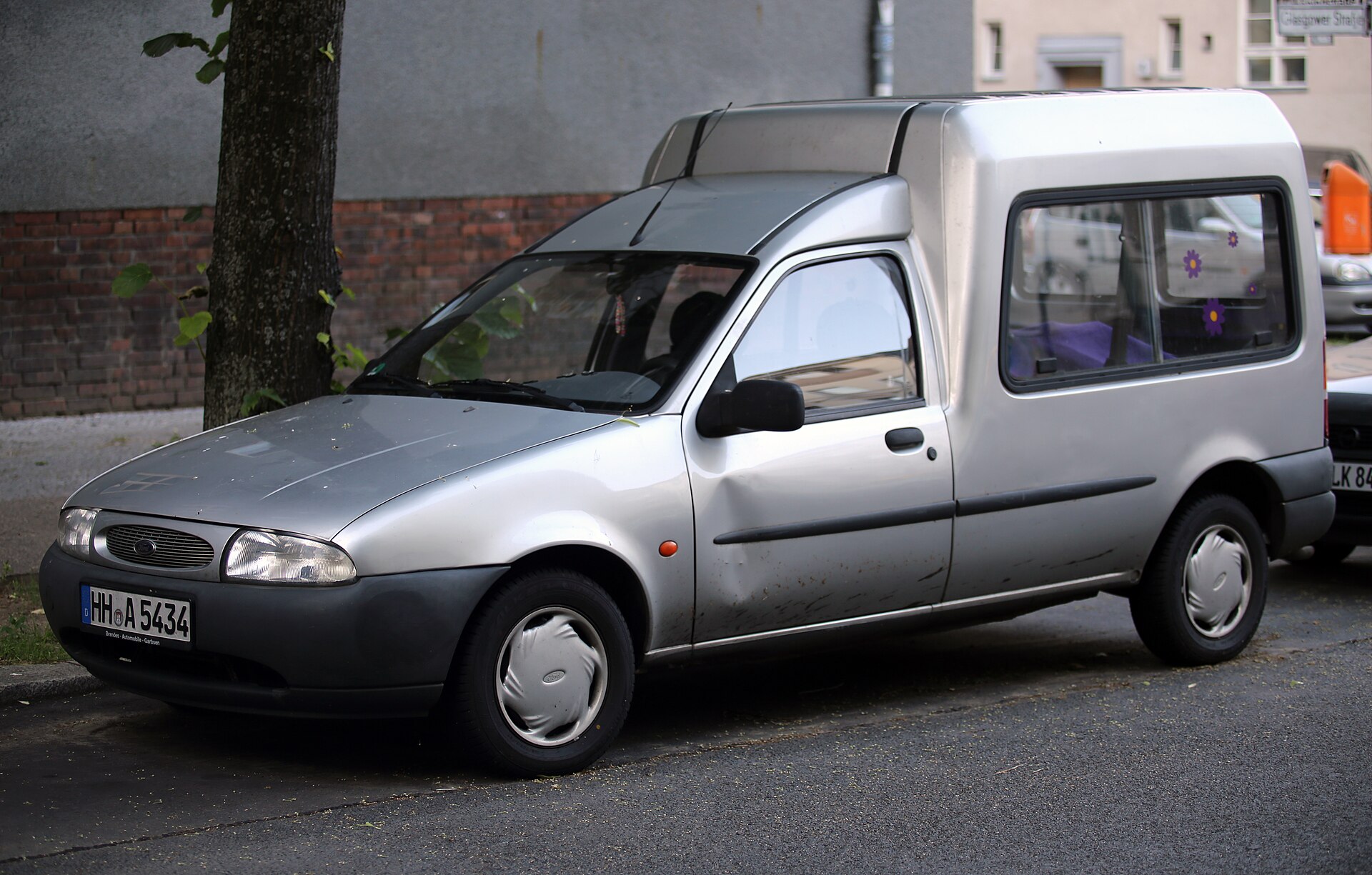
The European Courier, launched in June 1991, was a car-derived van with the front of the Fiesta Mk3, a longer wheelbase and a tall load box with torsion-bar rear suspension. From August 1995 it used the front of the Ford Fiesta Mk4, and a facelift followed in 1999. Ford built it at Dagenham in England and Cologne in Germany.
Engines were a 1.3 petrol and a 1.8 diesel with 44 kW (60 PS) and 110 Nm, with a 55 kW (75 PS) 1.8 turbodiesel as an option from 1999 to 2002. The van was 4,115 mm long and 1,835 mm high, carried 590 kg and had a five-speed manual. A glazed five-seat Courier Kombi was offered for passengers. In September 2002 the Ford Transit Connect replaced it.

Brazilian Ford Courier pickup, 1998-2013
Ford Brazil's Courier was a coupe utility on a Fiesta base, sold across Latin America. It shared its front end with the South African Ford Bantam but had its own load box, rated at 700 kg. The wheelbase was 2,830 mm and the length 4,457 mm.
Early cars had the 1.3 Endura or the 1.4 Zetec-SE 16-valve, which reached 170 km/h and 0-100 km/h in 12 seconds. From 2000 the 1.6 Zetec Rocam took over, with 180 km/h and 0-100 km/h in about 10 seconds. Production moved to São Bernardo do Campo in May 2002 and was later shared with Camaçari in Bahia. Wikipedia's Fenabrave figures, which are registrations rather than factory output, show 6,373 to 9,563 Couriers a year from 2002 to 2012, with the peak in 2007 and 3,053 in 2013, the year production was suspended.
| Year | 2002 | 2005 | 2007 | 2010 | 2012 | 2013 |
|---|---|---|---|---|---|---|
| Couriers registered in Brazil (Fenabrave) | 7,306 | 7,004 | 9,563 | 7,309 | 7,264 | 3,053 |
Ford Courier today: values and what to check
In Australia, CarsGuide's used price guide (viewed November 2026) places 2002-2006 Couriers between about AUD 1,820 and AUD 7,040, depending on cab and condition. ANCAP gave it two stars in 2005, according to CarsGuide. Road tests of the time point to the weak spots: vague steering with little feel, cramped rear seats in the Super Cab and Crew Cab, and a diesel that is slow away from rest. On a 4x4, check that the limited-slip differential and low range work. Mechanical parts are shared with the Mazda B-Series twin, sold as the Bravo in Australia and the Bounty in New Zealand.
The rest of Ford's light commercials, from the Ranger to the Transit range, are listed in the Ford catalogue.
Ford Courier in our rankings
- No. 26 of 33 · Most powerful pickup trucks (154 kW · top 79%)
- No. 24 of 26 · Most torque: pickup trucks (323 Nm · top 93%)
- No. 20 of 21 · Most powerful vans and minibuses (55 kW)
More powerful than 21% of ranked pickup trucks in the 1CARS catalog (No. 26 of 33).
FAQ
Is the Ford Courier a Mazda?
The Courier pickups sold in North America from 1972 to 1982 and in Australia and New Zealand until 2006 were Mazda B-Series trucks with Ford badges. The European van and the Brazilian pickup were Fiesta-based Fords with no Mazda connection.
Is the Ford Transit Courier the same as the Courier?
No. The Transit Courier is a small van built by Ford Otosan in Turkey, revealed in 2013 after Ford retired the stand-alone Courier name. It is a separate model from the earlier Courier pickups and the 1991-2002 European Courier van.
When did Ford stop making the Courier?
North American sales ended with the 1982 model year, the European van in August 2002, the Australian and New Zealand pickup in 2006, and Brazilian production of the Fiesta-based Courier in 2013.
What engine does the Brazilian Ford Courier have?
Early Brazilian Couriers used a 1.3 Endura or a 1.4 Zetec-SE 16-valve. From 2000 the pickup used the 1.6 Zetec Rocam petrol engine, good for 180 km/h and about 10 seconds from 0 to 100 km/h.
Data sources
Data checked by an editor against the sources below.
- Wikipedia - Ford Courier
- Com


