
 Ford Everest
All generations, specs and history
Published Sources (5) Report an error
By Sarah Whitmore, Senior Automotive Writer
- Built
- 2003–present
- Generations
- 3 · U268 to U704
- Top power
- 231 kW (314 PS)
Timeline
Everest generations
Click a generation for its own page

- Everest U268 2003–2015 · SUV
- Everest U375/UA 2015–2022 · SUV · 143 kW (194 PS)
- Everest U704/UB Current 2022–now · SUV · 125–231 kW (170–314 PS)
Newest first · 3 generations since 2003
- 2022 U704 In production 2022–now · SUV · 125–231 kW (170–314 PS)
- 2015 U375 2015–2022 · SUV · 143 kW (194 PS)
-
2003
All generations by year: Everest U704/UB (2022–now) · Everest U375/UA (2015–2022) · Everest U268 (2003–2015)
Which one is mine?
Pick the year of first registration to see which generation it is.
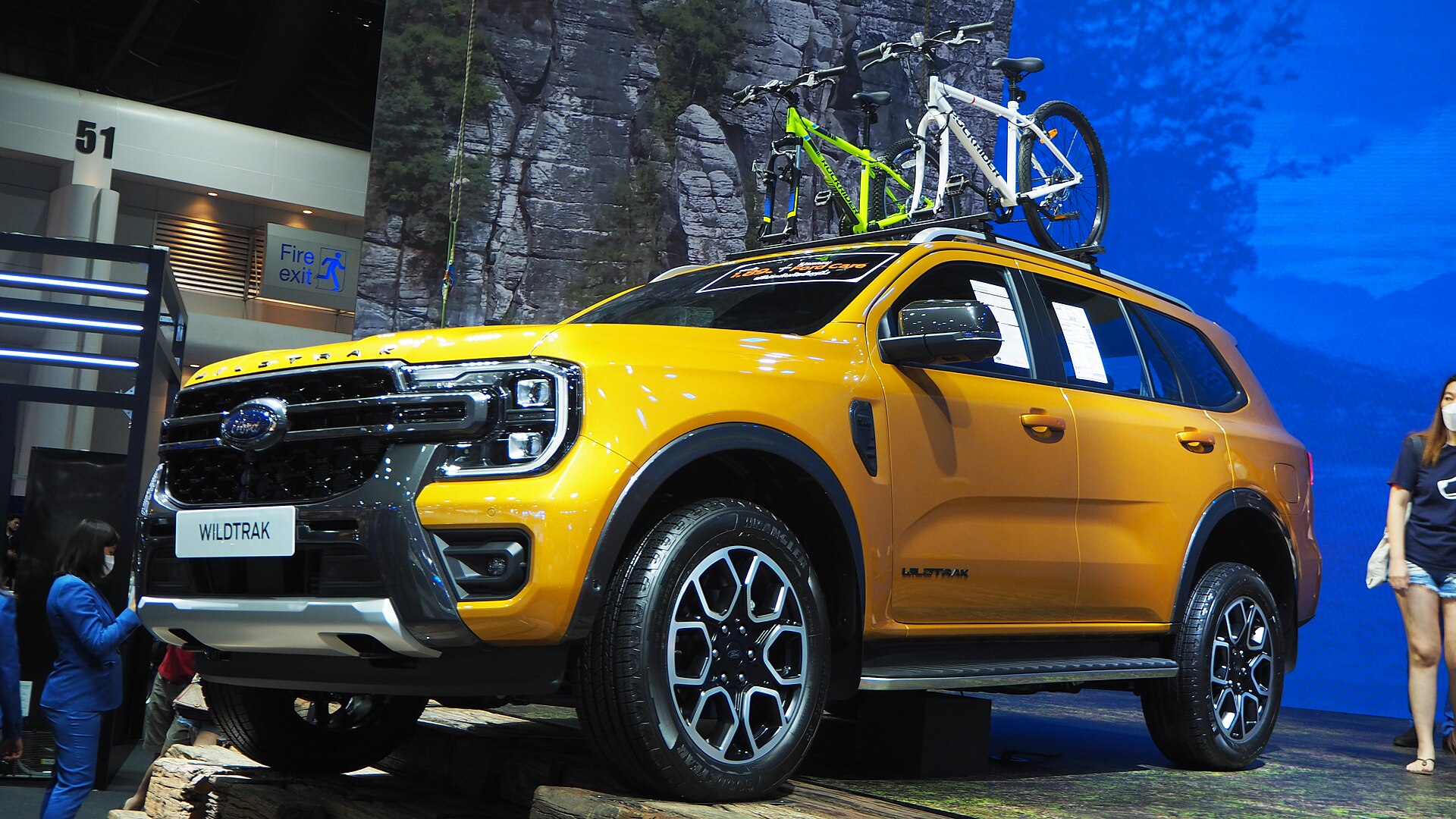
The Ford Everest is a seven-seat, body-on-frame SUV that Ford has built on Ranger pickup underpinnings since 2003. The current third generation, coded U704 and engineered by Ford Australia, arrived in 2022 with 2.0-litre four-cylinder and 3.0-litre V6 diesels, a 10-speed automatic and a 3,500 kg towing rating. In India the first two generations were sold as the Ford Endeavour.
In short
- Three generations: U268 (2003-2015), U375/UA (2015-2022) and U704/UB (since 2022), all built alongside the Ranger.
- Current diesels: 2.0 single-turbo 125 kW (405 Nm), 2.0 bi-turbo 154 kW (500 Nm) and 3.0 V6 184 kW (600 Nm); the Middle East gets 2.3 and 2.7 EcoBoost petrol engines.
- ANCAP five stars (2022), 800 mm wading depth, 3,500 kg braked towing.
- From AUD 58,990 before on-road costs in Australia for the 2026 Active; Australians bought 26,161 in 2025.
Size at a glance
| Dimensions | Ford Everest U704/UB |
|---|---|
| Length | 4,940 mm194.5 in |
| Width | 1,923 mm75.7 in |
| Height | 1,841 mm72.5 in |
| Wheelbase | 2,900 mm114.2 in |
| Boot | 898 L31.7 cu ft |
Running cost
Fuel · Everest U704 2.0 EcoBlue Bi-Turbo 154 kW
about 1,800 EUR fuel a year at 15,000 km
7.2 l/100 km · diesel at 1.65 EUR/l · change mileage, fuel price or version
Specs by version
Engines
| Version | Engine | Power | Torque | Gearbox | Drive | Production years |
|---|---|---|---|---|---|---|
| Diesel · 4 versions | ||||||
| U375 · 3.2 TDCi 143 kW | 5 cyl · Diesel | 143 kW 194 PS192 hp | 470 Nm347 lb-ft | 6-sp Automatic | Four-wheel drive (4×4) | 2015 |
| U704 · 2.0 EcoBlue 125 kW | 4 cyl · Diesel | 125 kW 170 PS168 hp | 405 Nm299 lb-ft | 10-sp Automatic | Four-wheel drive (4×4) | 2026 |
| U704 · 2.0 EcoBlue Bi-Turbo 154 kW | 4 cyl · Diesel | 154 kW 209 PS207 hp | 500 Nm369 lb-ft | 10-sp Automatic | Four-wheel drive (4×4) | 2022–2025 |
| U704 · 3.0 V6 Diesel 184 kW | 6 cyl · Diesel | 184 kW 250 PS247 hp | 600 Nm443 lb-ft | 10-sp Automatic | Four-wheel drive (4×4) | 2022 |
| Petrol · 2 versions | ||||||
| U704 · 2.3 EcoBoost 221 kW | 4 cyl · Petrol | 221 kW 300 PS296 hp | 420 Nm310 lb-ft | 10-sp Automatic | Four-wheel drive (4×4) | 2023 |
| U704 · 2.7 EcoBoost V6 231 kW | 6 cyl · Petrol | 231 kW 314 PS310 hp | 542 Nm400 lb-ft | 10-sp Automatic | Four-wheel drive (4×4) | 2025 |
Performance
Show all 4 versions
| Version | Fuel consumption |
|---|---|
| U375 · 2015–2022 | |
| U375 · 3.2 TDCi 143 kW | 8.5 l/100 km27.7 mpg US · 33.2 mpg UK |
| U704 · 2022–present | |
| U704 · 2.0 EcoBlue 125 kW | 7.1 l/100 km33.1 mpg US · 39.8 mpg UK |
| U704 · 2.0 EcoBlue Bi-Turbo 154 kW | 7.2 l/100 km32.7 mpg US · 39.2 mpg UK |
| U704 · 3.0 V6 Diesel 184 kW | 8.5 l/100 km27.7 mpg US · 33.2 mpg UK |
Dimensions and weight
Show all 2 versions
Verified Manufacturer and type-approval data from our catalog · Sources and methodology
Ford Everest at a glance
| Specification | Ford Everest (third generation, U704) |
|---|---|
| Body and segment | five-door, seven-seat mid-size SUV, body-on-frame |
| Production | since 2022; main plant AutoAlliance Thailand, Rayong |
| Platform | Ford T6, shared with the P703 Ranger |
| Drive | rear-wheel drive or 4WD with rear locking differential (all 4WD in Australia from 2025) |
| Engines | 2.0 EcoBlue diesel (single- or bi-turbo), 3.0 V6 diesel, 2.3 and 2.7 EcoBoost petrol |
| Power | 125 kW (2.0 single-turbo) to 184 kW (3.0 V6 diesel) |
| Gearbox | 10-speed automatic; 6-speed automatic on some Philippine 4x2 versions |
| Consumption (ADR combined) | 7.1 L/100 km (2.0 diesel) to 8.5 L/100 km (3.0 V6) |
| Length, width, wheelbase | 4,940 mm, 1,923 mm, 2,900 mm |
| Boot | 259 l (seven seats), 898 l (five seats), 1,823 l maximum |
| Towing | 3,500 kg braked, 750 kg unbraked |
| ANCAP | five stars (2022) |
| Price from | AUD 58,990 (Active, Australia, MY26.5); PHP 1,864,000 (Philippines, 2026) |
Where the Ford Everest is sold and what it replaced
The Everest was conceived for emerging markets that wanted a seven-seat SUV tougher than a car-based crossover, and Ford does not sell it in Europe or North America. Today Ford sells it in Australia and New Zealand, Thailand, Vietnam, the Philippines, Malaysia, Indonesia, South Africa and the Middle East. Australians took it as the indirect successor of the locally built Territory, which ended in 2016. Australian sales reached 26,494 in 2024 and 26,161 in 2025. Vietnam is the second-biggest market, with 13,056 sales in 2025, ahead of Thailand with 7,110.
India is the gap in the map. The second-generation car was sold there as the Endeavour until Ford stopped building cars in Chennai on 9 September 2021, and the third generation has not been launched in India.
Ford Everest generations from U268 to U704
| Generation | Years | Platform | Main engines | Built in |
|---|---|---|---|---|
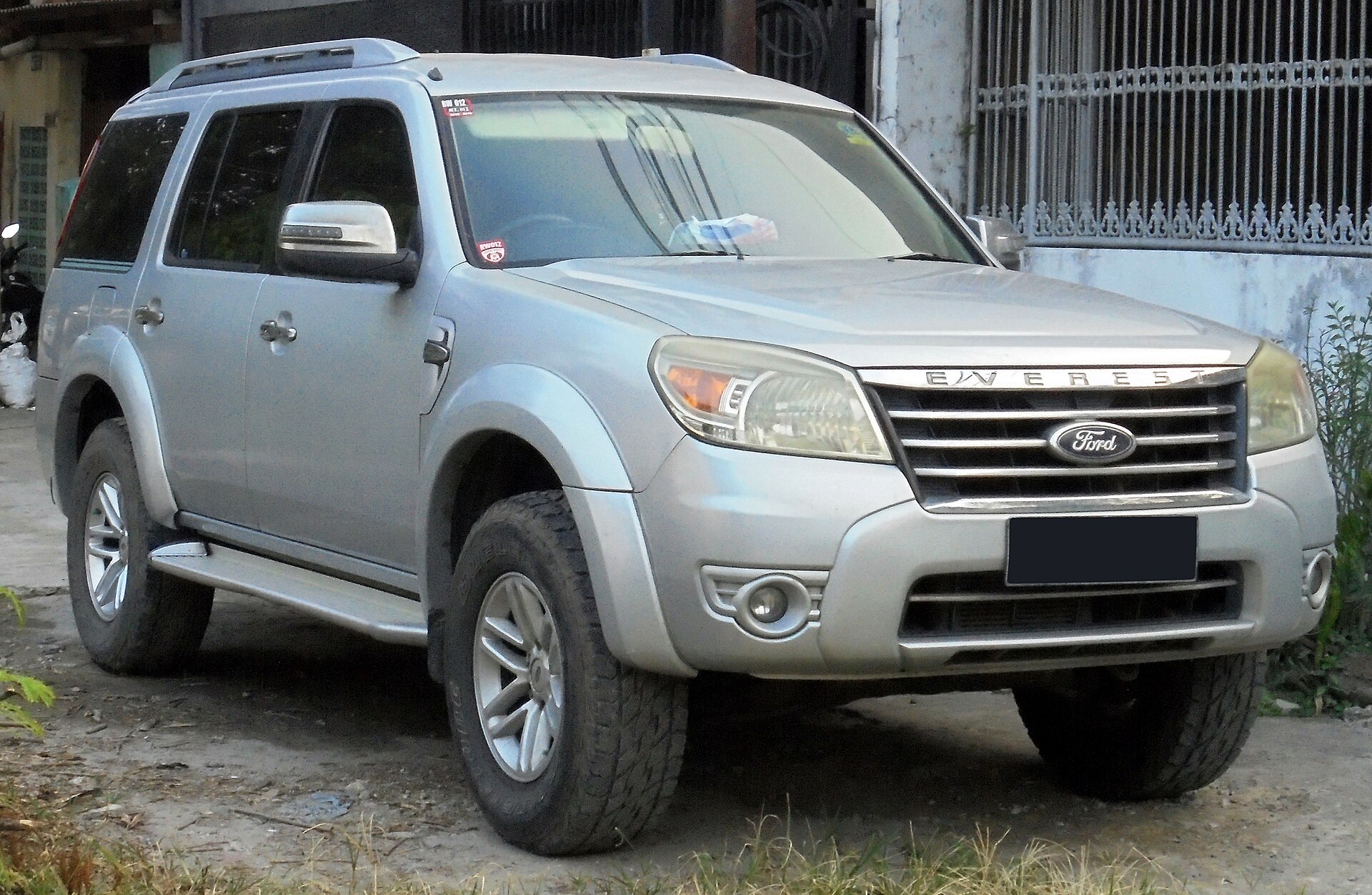
| First (U268) | 2003-2015 | Mazda-derived Ranger | 2.5 WL and 3.0 Duratorq diesels, 2.6 petrol | Thailand, Vietnam, India |
| Second (U375/UA) | 2015-2022 | T6 Ranger | 2.2 and 3.2 TDCi, 2.0 bi-turbo, 2.0 EcoBoost | Thailand, China, South Africa, India, Cambodia |
| Third (U704/UB) | since 2022 | T6, P703 Ranger front end | 2.0 EcoBlue, 3.0 V6 diesel, 2.3 and 2.7 EcoBoost | Thailand |
The first Everest was shown at the Bangkok motor show in March 2003. Development took about four years and USD 100 million, and roughly 60 percent of the parts came from the Mazda-based Ranger, including the double-wishbone front suspension and the leaf-sprung live rear axle. It had a 2,860 mm wheelbase, seven seats or, in Indonesia, a ten-seat layout with facing third-row benches. Ford facelifted it in 2006, when a five-speed automatic arrived, and again in 2009, 2012 and 2013.
The second generation was revealed on 13 November 2014 in Beijing and moved to the T6 Ranger chassis developed by Ford Australia. Its Terrain Management dial offered Normal, Snow/Gravel/Grass, Sand and Rock modes, and a rear locker became available. Australian cars had the 3.2-litre five-cylinder TDCi with 143 kW and 470 Nm and cost AUD 54,990 to AUD 76,990 in 2015. The 2018 facelift added a 2.0 bi-turbo diesel, a 10-speed automatic and autonomous emergency braking. France's army uses a militarised version, the Arquus Trapper VT4.
The third generation was revealed on 1 March 2022. It keeps the T6 frame but takes its front structure from the P703 Ranger, with 50 mm more wheelbase and track. In 4WD versions an electromechanical clutch pack replaces the centre differential, so the system can run in full-time mode on sealed roads.


Ford Everest engines and fuel consumption
| Engine | Markets | Power | Torque | Gearbox | Combined consumption |
|---|---|---|---|---|---|
| 2.0 EcoBlue single-turbo diesel | Australia from MY26.5, Philippines, South Africa, Middle East | 125 kW (170 PS) | 405 Nm | 10-speed or 6-speed auto | 7.1 L/100 km (ADR) |
| 2.0 EcoBlue bi-turbo diesel | Australia to 2025, Asia | 154 kW | 500 Nm | 10-speed auto | 7.1-7.2 L/100 km (ADR) |
| 3.0 V6 turbo diesel | Australia, Asia, South Africa | 184 kW | 600 Nm | 10-speed auto | 8.5 L/100 km (ADR) |
| 2.3 EcoBoost petrol | Middle East, Vietnam | 221 kW (296 hp) | 420 Nm | 10-speed auto | not published |
| 2.7 EcoBoost V6 petrol | Middle East Tremor | 231 kW (310 hp) | 542 Nm | 10-speed auto | not published |
All engines carry the same 3,500 kg tow rating in Australia. In November 2025 Ford dropped the bi-turbo 2.0 in Australia and fitted the single-turbo version with 125 kW, 29 kW less than before. CarExpert recorded about 9.0 L/100 km in mixed driving with a bi-turbo Trend against a 7.2 L/100 km claim, so the 80-litre tank gives a real range of about 890 km.
Ford Everest trims and prices by market
Trim names vary by country. Australia now lists Active, Sport, Tremor and Platinum; the Philippines keeps Trend, Sport, Titanium+, Wildtrak and Platinum; the Middle East sells Active, Sport, Tremor and Platinum.
| Market (year) | Entry version | Top version |
|---|---|---|
| Australia (MY26.5, before on-road costs) | Active 2.0, AUD 58,990 | Platinum V6, AUD 83,490 |
| Philippines (2026 SRP) | Trend 2.0 4x2, PHP 1,864,000 | Platinum 3.0 V6 4x4, PHP 2,869,000 |
| Australia (MY24, before on-road costs) | Ambiente 4x2 bi-turbo, AUD 53,990 | Platinum V6, AUD 79,490 |
The Australian MY26.5 list also includes Active V6 at AUD 66,990, Sport at AUD 68,990, Sport V6 at AUD 76,990 and Tremor V6 at AUD 79,990. Rear-wheel-drive versions left the Australian range in August 2025 because of the New Vehicle Efficiency Standard. Middle East prices vary by dealer and country and Ford's regional site does not publish them.
Ford Everest safety, towing and practicality
ANCAP awarded the third-generation Everest five stars in 2022 under the 2020-2022 protocol, with 86 percent for adult occupants, 93 percent for children, 74 percent for vulnerable road users and 86 percent for safety assist. The result draws on tests of the closely related Ranger. The second generation was rated by ANCAP and ASEAN NCAP in 2015.
Every current Everest is rated to tow 3,500 kg braked and 750 kg unbraked, with a gross combination mass of 6,250 kg. Ground clearance is 226 mm and the approach, departure and breakover angles are 30.4, 25.3 and 22.2 degrees. Behind the third row there are 259 litres, 898 litres with it folded and 1,823 litres with both rear rows down; Platinum versions have power-folding third-row seats.
Ford Everest problems and what to check
The most discussed fault concerns the 2.0 bi-turbo diesel, which uses a wet timing belt running in oil. Owners have reported belt deterioration, and Ford's newer single-turbo 2.0 uses a timing chain instead. When buying a used bi-turbo Everest, ask for the oil-change history and whether the belt has been inspected. Some owners also report vibration on gear changes with the 10-speed automatic; dealers check engine mounts first. A 2.0 Everest is slower than the V6: CarsGuide puts 0-100 km/h at about 12.5 s against about 9.5 s for the 3.0 V6. Ford Australia covers the car with a five-year, unlimited-kilometre warranty and 12-month or 15,000 km service intervals.
Ford Everest vs Fortuner, Pajero Sport and Prado
The Everest's direct rivals are the Toyota Fortuner, the Isuzu MU-X and the Mitsubishi Pajero Sport, all ladder-frame SUVs derived from pickups, and CarExpert also lists the SsangYong Rexton. The Toyota Land Cruiser Prado costs more and is a step up in size. Buyers who need a tray rather than a third row can look at the Ford Ranger, which shares the Everest's frame, engines and plant.
For towing a caravan or boat, the 3.0 V6 Sport or Platinum is the version to buy. The single-turbo Active suits buyers who stay mostly on sealed roads, and in the Philippines the 4x2 Titanium+ is the value choice. The rest of the range is in the Ford catalogue.
Photo gallery

Ford Everest evolution in numbers
Did you know?
- The Ford Everest has been around for 23 years: 3 generations in our catalog since 2003.
- The longest-running generation is the Everest U268 (2003–2015): 12 years.
Ford Everest in our rankings
- No. 160 of 1322 · Longest-running car nameplates (23 years · top 13%)
- No. 68 of 557 · Heaviest cars (2,344 kg · top 13%)
- No. 42 of 273 · Longest SUVs and crossovers (4,940 mm · top 16%)
- No. 110 of 710 · Longest cars (4,940 mm · top 16%)
- No. 38 of 217 · Most powerful diesel cars (184 kW · top 18%)
- No. 24 of 127 · Most torque: diesel cars (600 Nm · top 20%)
In production longer than 87% of ranked nameplates in the 1CARS catalog (No. 160 of 1322).
FAQ
Is the Ford Everest the same as the Ford Endeavour?
Yes. Ford sold the first two generations of the Everest in India under the Endeavour name from 2003 until production in Chennai ended in September 2021. The third-generation Everest has not been launched in India.
How much can the Ford Everest tow?
The third-generation Ford Everest is rated to tow 3,500 kg with a braked trailer and 750 kg unbraked, with a gross combination mass of 6,250 kg. The second generation was rated at 3,000 kg with the factory tow kit.
What is the fuel consumption of the Ford Everest?
Official combined figures are 7.1 L/100 km for the 2.0 diesel and 8.5 L/100 km for the 3.0 V6 diesel on the Australian ADR cycle. Real-world tests of the 2.0 bi-turbo return about 9.0 L/100 km.
Is the Ford Everest a good car?
Australian reviewers rate it highly: it won Wheels Car of the Year 2022 and holds five ANCAP stars. Its strengths are comfort, towing and the V6 diesel; the main known weakness is the wet timing belt of the 2.0 bi-turbo engine.
Is the Ford Everest sold in the USA or Europe?
No. Ford sells the Everest in Asia-Pacific, Africa and the Middle East. North American buyers are offered the Explorer and Expedition instead, and Ford Europe has no ladder-frame seven-seat SUV.
Data sources
Data checked by an editor against the sources below.
- Wikipedia - Ford Everest
- Com - Ford Everest 2015 Review 52880
- Com - 40c59663 4352 4a0f 9cc1 54a2d05ce7f5
- Com - 2024 Ford Everest Review
- Com - 2026 Ford Everest Price And Specs My265 Updates Detailed


