 Toyota Fortuner
All generations, specs and history
Published Sources (1) Report an error
By Sarah Whitmore, Senior Automotive Writer
- Built
- 2004–present
- Generations
- 2 · AN50/AN60 to AN150/AN160
Timeline
Fortuner generations
Click a generation for its own page


- Fortuner AN50/AN60 2004–2015 · SUV
- Fortuner AN150/AN160 Current 2015–now · SUV
Newest first · 2 generations since 2004
All generations by year: Fortuner AN150/AN160 (2015–now) · Fortuner AN50/AN60 (2004–2015)
Which one is mine?
Pick the year of first registration to see which generation it is.
- AN150/AN160 2015–present
- AN50/AN60 2004–2015
The Toyota Fortuner is a mid-size, body-on-frame SUV with four-wheel drive and seven seats, based on the Toyota Hilux pickup. Two generations have been built; the second was officially presented in Australia in summer 2015. The name comes from the English word "fortune".
In short
- Two generations: 2005–2015/16 and from 2015; both closely related to the Toyota Hilux.
- First generation: 2.7 and 4.0 V6 petrol engines with 120–183 kW (163–249 PS) and 2.5–3.0 turbodiesels with 75–126 kW (102–171 PS).
- Second generation: 2.8 turbodiesel with 130 kW (177 PS) and 450 Nm, or 2.7 petrol with 122 kW (166 PS).
- Part-time four-wheel drive with low range and a lockable rear differential; 220–225 mm of ground clearance.
Toyota Fortuner at a glance
The Fortuner is a seven-seat ladder-frame SUV with a longitudinal engine and part-time four-wheel drive, created for emerging markets. More Toyota models are listed in our Toyota catalogue, and its larger sibling is covered in our Toyota Land Cruiser 200 article.
History
Work on the Fortuner began in 2003, a prototype followed in 2004 and the production model was unveiled in 2005. At first it was built only in Thailand, later also in Indonesia and other countries, extending the success of the Hilux to a family SUV sold in many markets.
Toyota Fortuner generations
First generation (2005–2016)
The first Fortuner, also known as the Toyota SW4, is a typical mid-size SUV for emerging markets. It was unveiled in 2005, received a minor update in 2008 that refreshed the exterior, interior details and equipment, and a final update at the end of 2011.
Although somewhat dated, the styling has a rugged, masculine character with sharp edges, slanted headlights, a massive grille and a high front bumper that clears kerbs and obstacles more easily than a city crossover. Round fog lamps sit at the corners of the bumper. The side is typical of a traditional off-roader, with big doors, wide openings and fixed side steps. Ground clearance is an impressive 220 mm, and the Fortuner sits on 17-inch wheels. Large tail lights extend onto the heavy tailgate, topped by a prominent spoiler with a third brake light.
The interior matches the exterior: simple, solid and tasteful. A comfortable four-spoke multifunction steering wheel faces clean instruments with white markings. Ergonomics, materials and build quality are good. A colour infotainment screen sits in the centre console above a neat climate panel with its own monochrome display, and the gear lever and drive controls are below. Despite the seven seats there is plenty of room; the front seats have basic side support, and the second-row backrest splits 60/40. The first two rows are comfortable, while the third row really suits only children. In five-seat configuration the boot holds 620 litres, and folding the second row increases it considerably. The full-size spare is mounted under the car.
Petrol engines were a 2.7-litre four-cylinder with 120 kW (163 PS) and 214 Nm and a 4.0-litre V6 with 183 kW (249 PS) and 380 Nm, both with multi-point injection. Diesels were 2.5- to 3.0-litre four-cylinder turbodiesels with direct injection and 16 valves, producing 75–126 kW (102–171 PS) and 260–360 Nm. Gearboxes were a five-speed manual or a four- or five-speed automatic. Drive went to the rear wheels or, with part-time four-wheel drive, to all four via a selector on the centre console, with a mechanical rear differential lock and low range. The ladder frame carried independent double-wishbone front suspension and a five-link rigid rear axle, with coil springs and anti-roll bars at both ends. Steering was rack-and-pinion with hydraulic assistance, and the brakes were front discs and rear drums with ABS and EBD. Equipment could include front airbags, 17-inch wheels, fog lamps, climate control, a six-speaker audio system, electric windows all round and heated front seats.
Second generation (2015 onwards)
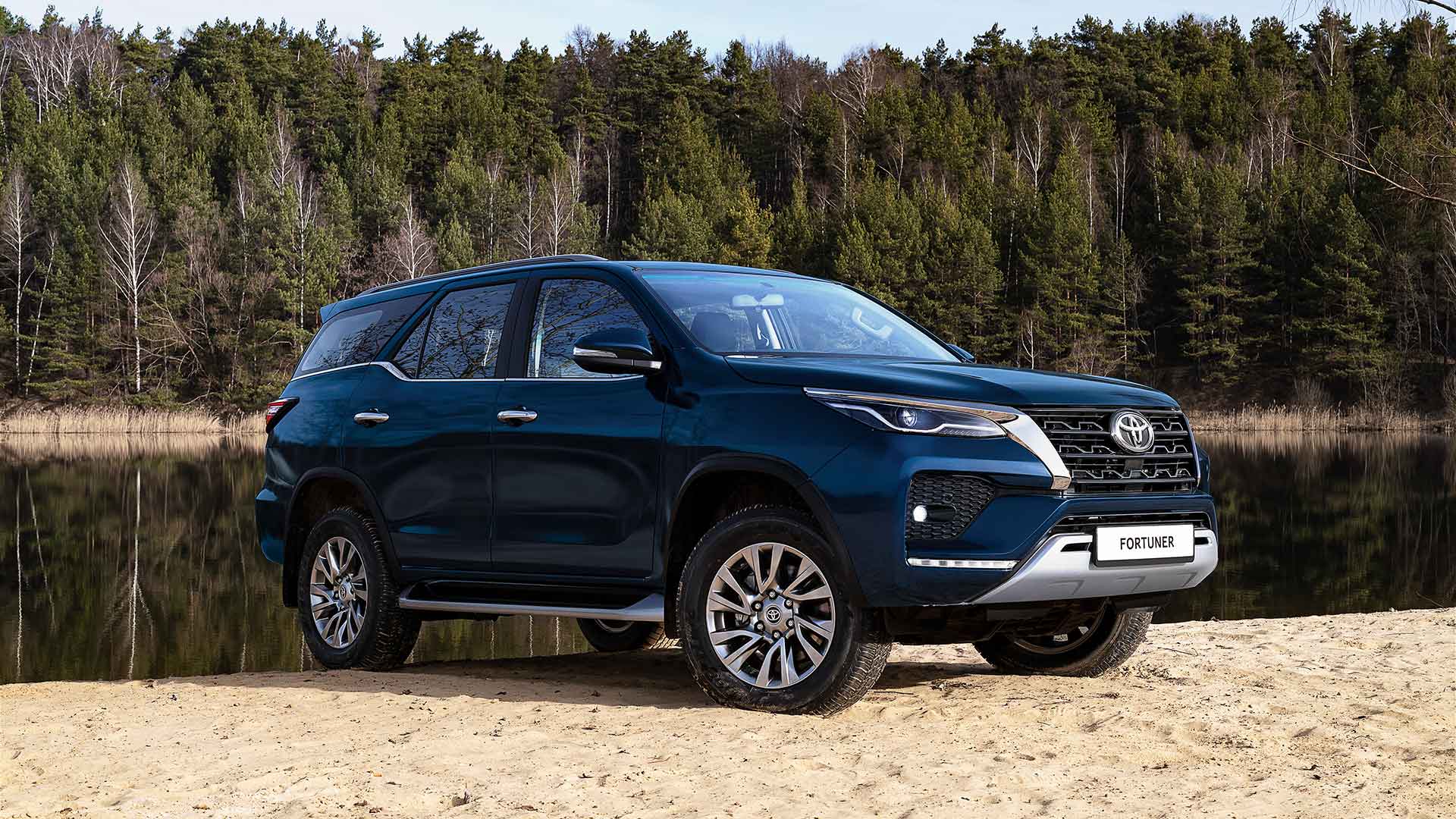
The second Fortuner was unveiled in Australia in summer 2015 and later updated. It kept its substantial dimensions and combines cues from other Toyota models with unique details: completely new grilles, wave-like surfacing, protective trim in various materials and menacing lights. The short, tall front is slightly inclined to improve visibility. A short bonnet with gentle ribs at the sides leads to a large trapezoidal grille set into the body, with a gloss-black mesh and a large chrome Toyota badge. The unusually shaped headlights look fierce and use LED technology on every version, with small chrome extensions framing the intakes below. Triangular side intakes cool the engine bay and brakes, slim fog lamps sit low down, and a central intake sits above a massive metal skid plate with the number-plate mount.
A long, wide window line with gloss-black frames and a thin chrome strip runs along the side, with large oval mirrors carrying indicators on every version, chrome door handles, near-square wheel arches with unpainted plastic cladding and fixed side steps. Ground clearance is 225 mm. Base versions have 17-inch steel wheels and more expensive versions 18-inch alloys. The almost square, upright rear has a spoiler with brake lights, a large rear window, plenty of chrome, triangular tail lights, a loading step, rear fog lamps and a black metal protective insert.
The seven seats are arranged two, three and two. Materials are good and build quality excellent. A three-spoke steering wheel with a silver lower spoke, leather on some versions and many audio and phone buttons faces two large analogue dials with fuel and temperature gauges and an informative trip computer between them, with chrome surrounds. The dashboard is partly leather-covered. At the top of the new centre console, small vents flank a digital clock, above the hazard switch and an 8-inch touchscreen infotainment and navigation system. Below are a conventional climate panel, an off-road drive selector with two extra buttons, USB, AUX and a 12 V socket. The tunnel has a large storage box with cupholders, a chunky gear selector and a mechanical parking brake, followed by an armrest. Leather front seats have modest side support; the leather second-row bench has a fold-down armrest with cupholders, and the two-seat third row suits children. Luggage space is 297 litres with all three rows in use, 621 litres with the third row folded and 1,934 litres with the second row folded too. The full-size spare is under the car.
Engines and transmissions (second generation)
| Engine | Power (kW / PS) | Torque | Gearbox | 0–100 km/h | Consumption |
|---|---|---|---|---|---|
| 2.8 four-cylinder turbodiesel, intercooler, common rail, 16 valves | 130 kW / 177 PS | 450 Nm | 6-speed automatic | 10.8 s | 8.6 l/100 km |
| 2.7 four-cylinder petrol, multi-point injection, DOHC, variable timing | 122 kW / 166 PS | 245 Nm | 6-speed automatic or 5-speed manual | — | 11.1–11.3 l/100 km |
The diesel reaches 180 km/h. Part-time four-wheel drive with a rigidly engaged front axle can be engaged at up to 100 km/h, with no restrictions on its use, and includes a rear differential lock and low range.
The second Fortuner is technically very close to the latest Toyota Hilux without being a straight copy. It has a ladder frame, double-wishbone front suspension and a five-link rear on coil springs. All four brakes are discs (ventilated at the front), with ABS and EBD.
Safety and equipment
The second generation offers ABS, EBD, emergency brake assist, A-TRC traction control, stability control, hill-start assist and trailer sway control, a lockable rear differential, front and side airbags, curtain airbags and a driver's knee airbag, ISOFIX anchorages, active head restraints, hill descent control, a rear camera, tyre-pressure sensors, LED headlights and tail lights and daytime running lights. The rigid frame and programmed crumple zones reduce impact forces in a collision. The base version has three airbags, 17-inch steel wheels, ABS and ESP, fabric upholstery, two air-conditioning units, a light sensor, a four-speaker audio system, heated power mirrors and electric windows.
Key specifications by generation
| Parameter | First generation | Second generation |
|---|---|---|
| Years | 2005–2016 | 2015 onwards |
| Petrol engines | 2.7 I4, 4.0 V6 (120–183 kW / 163–249 PS) | 2.7 I4 (122 kW / 166 PS) |
| Diesel engines | 2.5–3.0 I4 (75–126 kW / 102–171 PS) | 2.8 I4 (130 kW / 177 PS) |
| Ground clearance | 220 mm | 225 mm |
| Seats | 7 | 7 |
| Luggage space | 620 l (5 seats) | 297 / 621 / 1,934 l |
Strengths and weaknesses
Owners say Toyota has built a good SUV, with attractive looks and a high-quality, comfortable interior, although some dislike the hard plastic on the dashboard. The diesel takes a long time to warm up in winter, and the suspension is somewhat firm — though that benefits handling. Despite its size and weight, it brakes like a regular car, the high seating position gives excellent visibility, and four-wheel drive takes it where others get stuck. Rivals include the Mitsubishi Pajero Sport, Ford Everest, Isuzu MU-X, Nissan Terra (Navara-based) and Chevrolet Trailblazer — other pickup-based seven-seat SUVs.
Image credits · Photos from Wikimedia Commons under free licences
- Toyota Fortuner AN50/AN60 · Photo: Wilzz99 / Wikimedia Commons, CC BY-SA 4.0
- Toyota Fortuner AN150/AN160 · Photo: Wilzz99 / Wikimedia Commons, CC BY-SA 4.0
Toyota Fortuner in our rankings
- No. 145 of 912 · Longest-running car nameplates (22 years · top 16%)
- No. 95 of 305 · Oldest car models still on sale (22 years · top 32%)
- No. 274 of 345 · Cars with the most generations (2 generations)
In production longer than 84% of ranked nameplates in the 1CARS catalog (No. 145 of 912).
FAQ
What is the Toyota Fortuner based on?
It is based on the platform of the Toyota Hilux pickup.
How many seats does the Toyota Fortuner have?
Seven, in a 2+3+2 layout; the third row is best suited to children.
What engines does the second-generation Toyota Fortuner have?
A 2.8 turbodiesel with 130 kW (177 PS) and 450 Nm and a 2.7 petrol with 122 kW (166 PS) and 245 Nm.
What is the Toyota Fortuner ground clearance?
220 mm for the first generation and 225 mm for the second.
Data sources
Data checked by an editor against the sources below.