 Toyota Celica 1600 GT
Specs, engines and history
Published Sources (1) Report an error
By Felix Hartmann, Automotive Technology & EV Contributor
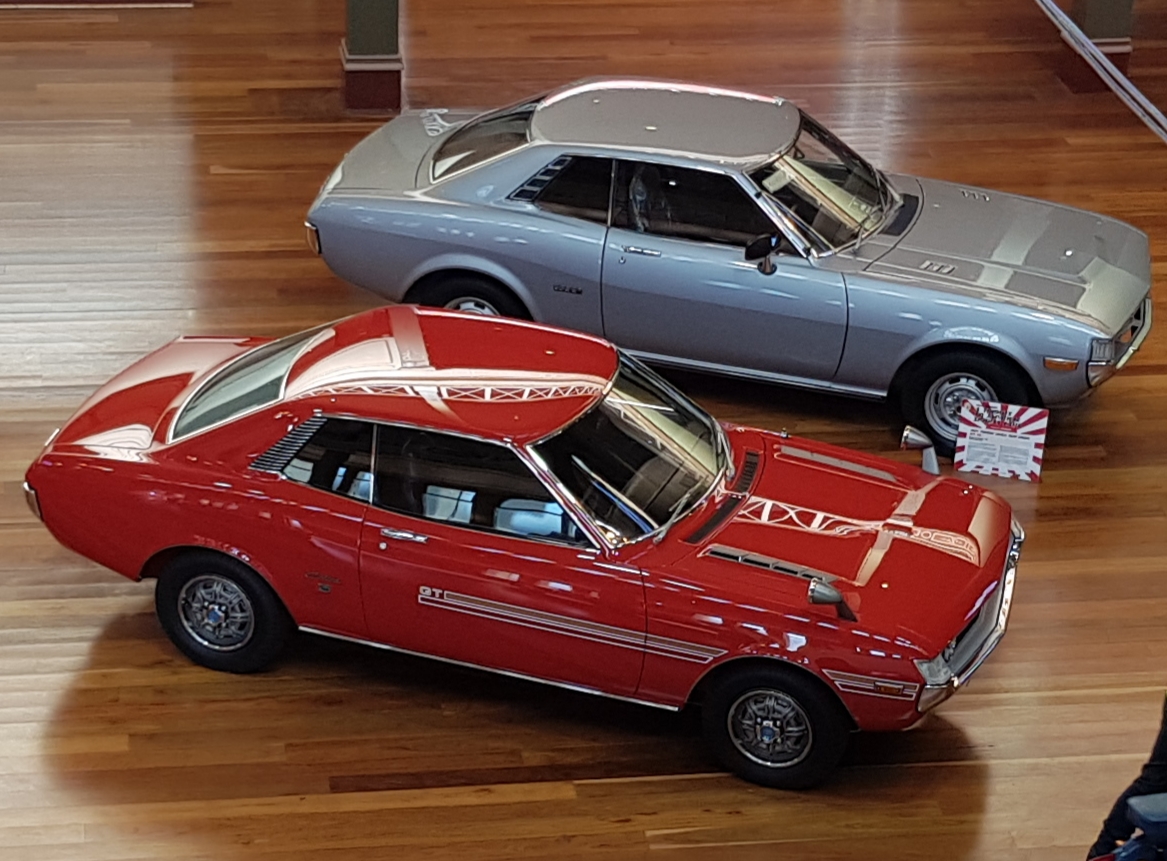
The Toyota Celica 1600 GT was the sporting top model of the first-generation Celica, Toyota's new specialty coupé of 1970. Under its pillarless hardtop body sat the 2T-G, a 1.6-litre twin-cam four with a Yamaha-cast cylinder head and twin Mikuni-Solex carburettors, rated at 85 kW (115 PS), always with a five-speed gearbox. Known by the chassis code TA22 as a coupé and TA27 as the liftback of 1973, it began the twin-cam tradition that Toyota later described as part of the Celica's identity.
In short
- Shown at the Tokyo Motor Show in October 1970 and on sale in Japan from December 1970; the catalogue lists the 1600 GT for 1970–1975.
- 1,588 cc 2T-G DOHC four, 85 kW (115 PS) at 6,400 rpm and 142 Nm, five-speed manual.
- Coupé (TA22) and, from April 1973, Liftback (TA27, 995 kg).
- A lighter, stiffer GTV joined in 1972 with the same engine.
Celica 1600 GT at a glance
| Item | Details |
|---|---|
| Maker | Toyota Motor Corporation, Japan (Tsutsumi plant for the Liftback) |
| Production | December 1970 to the mid-1970s (first-generation Celica 1970–1977) |
| Chassis codes | TA22 (coupé), TA27 (Liftback) |
| Body | two-door pillarless hardtop coupé; three-door Liftback from 1973 |
| Platform | shared with the Toyota Carina |
| Engine | 2T-G 1,588 cc DOHC inline-four, twin Mikuni-Solex carburettors |
| Power / torque | 85 kW (115 PS) at 6,400 rpm / 142 Nm |
| Gearbox | five-speed manual (P51 in Japan, W-50 for export) |
| Related versions | 1600 GTV (1972), 2000 GT (18R-G engine) |
The Celica and the other Toyota coupés of the period are in the Toyota catalogue on 1cars, and the history of Toyota explains how the company grew in those years.
Production timeline
| Year | Event |
|---|---|
| October 1970 | Celica and Carina shown at the Tokyo Motor Show |
| December 1970 | Celica on sale in Japan; GT is the top trim with the 2T-G |
| 1971 | SV-1 liftback concept at the Tokyo Motor Show |
| 1972 | 1600 GTV added |
| April 1973 | Celica Liftback launched in Japan, including the 1600 GT (TA27) |
| January 1974 | facelift with a flatter nose for Japan |
| October 1975 | global facelift with new bumper and grille |
| August 1977 | second-generation Celica replaces the first |
Development and production history
Toyota launched the Celica together with the Carina sedan, with which it shared its platform, one size above the Corolla. The name is Spanish for "celestial" or "heavenly". In Japan the Celica was sold only through Toyota Corolla Store dealers and took the place of the small Toyota Sports 800 of 1965–1969, while in North America it was meant as Toyota's answer to the Ford Mustang.
The Japanese range started with the ET, with a 1.4-litre engine and a four-speed gearbox, and continued through the LT and ST with 1.6-litre engines to the GT. Buyers could combine bodies, engines, gearboxes and interiors widely; with the Liftback added in 1973, the series offered seven body variations, 15 interiors, nine engines and six transmissions. Export markets received only the LT, ST and GT.
The GT was the most complete Celica. Besides the twin-cam engine and the five-speed gearbox, it had flutes in the bonnet, power windows, air conditioning, a full-length centre console and extra gauges for oil pressure and charging current. In 1972 Toyota added the GTV with the same engine, a thicker front anti-roll bar and firmer suspension, but a simpler interior to save weight.

Design and engineering
The first Celica was a two-door hardtop without a B-pillar, with what Wikipedia calls "coke bottle" styling. The original "slant-nose" coupés, including the TA22 GT, have a 2,400 mm (95 in) wheelbase.
In April 1973 Toyota added the Liftback, based on the SV-1 concept of the 1971 Tokyo show. Its large tailgate gave the body type its name, a term Toyota coined that year, and its folding rear seat backs made space for sports equipment. The fastback styling, inspired by the 1969 Mustang, earned it the nickname "Japanese Mustang". From January 1974 the Japanese cars received a flatter nose with a new bonnet and wings, and North American cars got 5 mph (8 km/h) impact bumpers for the 1975 model year.

Engine and drivetrain
The heart of the 1600 GT is the 2T-G, a twin-cam version of Toyota's 1.6-litre T engine. All 2T-G cylinder heads were cast by Yamaha, the company that had also worked on the Toyota 2000GT. Two 40 mm Mikuni-Solex PHH sidedraft carburettors fed the engine, and with a 9.8:1 compression ratio it produced 85 kW (115 PS) at 6,400 rpm and 142 Nm at 5,200 rpm. A version with air injection for emissions, the 2T-GR, gave 81 kW (110 PS).
The GT always came with a five-speed manual gearbox. Japanese cars usually had the Porsche-designed P51 gearbox, export cars the W-50. The 2T-G was also used in the Corolla Levin and Sprinter Trueno and in the Carina, a lineage that led to the later Toyota AE86.
Celica 1600 GT specifications
| Parameter | Metric | Imperial |
|---|---|---|
| Engine | 1,588 cc DOHC inline-four (2T-G) | 96.9 cu in |
| Power | 85 kW (115 PS) at 6,400 rpm | 85 kW (113 hp) |
| Torque | 142 Nm at 5,200 rpm | 105 lb-ft |
| Compression ratio | 9.8:1 | - |
| Wheelbase, coupé TA22 | 2,400 mm | 95 in |
| Wheelbase, Liftback TA27 | 2,425 mm | 95.5 in |
| Length × width × height, Liftback | 4,215 × 1,620 × 1,280 mm | 165.9 × 63.8 × 50.4 in |
| Kerb weight, Liftback 1600 GT | 995 kg | 2,194 lb |
| Gearbox | five-speed manual | - |
The Liftback figures are Toyota's own data for the TA27 1600 GT; Toyota does not publish the same set for the coupé on its heritage site.
Variants and derivatives
| Variant | Years | Body / purpose | Engine | Notes |
|---|---|---|---|---|
| 1600 GT (TA22) | from 1970 | hardtop coupé | 2T-G 1.6 DOHC | top model at launch |
| 1600 GTV | from 1972 | lighter, sportier coupé | 2T-G 1.6 DOHC | firmer suspension, simpler interior |
| 1600 GT Liftback (TA27) | from 1973 | three-door liftback | 2T-G 1.6 DOHC | 995 kg |
| 2000 GT Liftback (RA25/RA28) | from 1973 | liftback | 18R-G 2.0 DOHC | 107 kW (145 PS) per Toyota |
| 1600 ST | from 1970 | coupé | 1.6 | four- or five-speed manual or three-speed automatic |
In service and in other markets
The GT was one of only three trims offered for export, alongside the LT and ST. In Australia, the 1971 TA22 was sold with the 1.6-litre 2T engine, and the GT was never officially imported; a red 1971 TA22 GT brought in for evaluation by the importer AMI was a show winner at the Motorclassica concours in 2019. European markets mostly received liftbacks with 1.6-litre 2T-B or 2.0-litre 18R engines. The first-generation Celica was replaced in August 1977, and Toyota kept a twin-cam engine in the second-generation range.
Collecting the 1600 GT today
Original twin-cam cars are the most interesting first-generation Celicas for collectors of Japanese classics. When buying, check the engine code (2T-G), the chassis code (TA22 or TA27), the five-speed gearbox and the GT details such as the bonnet flutes and extra gauges. Twin-carburettor engines need correct synchronisation, and the Yamaha-cast twin-cam head should be checked for its service history. Other classics of the period are in the classics section.

Photo gallery


Toyota Celica 1600 GT in our rankings
In production longer than 23% of ranked nameplates in the 1CARS catalog (No. 757 of 1082).
FAQ
When was the Toyota Celica 1600 GT produced?
From the Celica's launch in December 1970; the catalogue lists the 1600 GT up to 1975, and the first-generation Celica was built until 1977.
What engine does the Celica 1600 GT have?
The 2T-G, a 1,588 cc twin-cam four with twin Mikuni-Solex carburettors: 85 kW (115 PS) and 142 Nm.
What is the difference between TA22 and TA27?
TA22 is the 1600 GT coupé, TA27 the 1600 GT Liftback introduced in April 1973.
What was the Celica 1600 GTV?
A 1972 version with the same engine but firmer suspension, a thicker front anti-roll bar and a simpler, lighter interior.
Was the Celica GT sold outside Japan?
Yes, the GT was one of three export trims. For Europe, Wikipedia mentions right-hand-drive Liftbacks with the 1.6-litre 2T-B or 2.0-litre 18R engines, while Australia never officially received the GT.
Data sources
Data checked by an editor against the sources below.