 Lamborghini Sesto Elemento
Specs, engines and history
Published Sources (1) Report an error
By Felix Hartmann, Automotive Technology & EV Contributor
- Built
- 2012
- Top power
- 419 kW (570 PS)
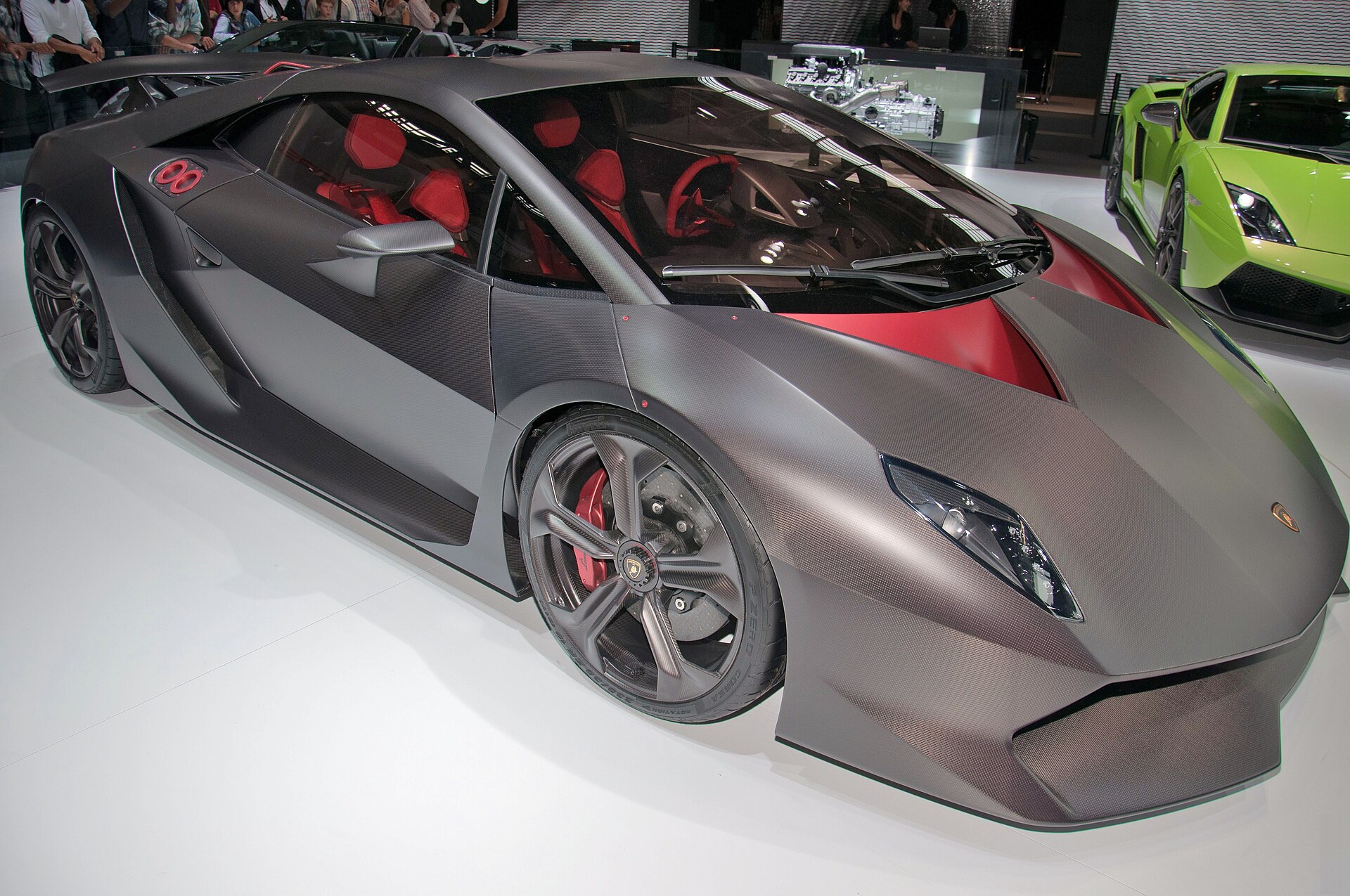
The Lamborghini Sesto Elemento is a track-only, carbon-fibre version of the Gallardo idea: a 419 kW (570 PS) V10 in a car weighing 999 kg. Shown as a concept at the 2010 Paris Motor Show, it went into limited production for 20 customers at US$2.92 million each and was the most expensive Lamborghini until the Veneno. Its name, Italian for "sixth element", refers to carbon, element number 6 in the periodic table.
In short
- Concept at the Paris Motor Show in October 2010; 20 track-only cars announced in 2011 and built in 2012 at Sant'Agata Bolognese.
- 5.2-litre V10 from the Gallardo Superleggera: 419 kW (570 PS), 540 Nm, all-wheel drive.
- Kerb weight 999 kg, or about 2.4 kg per kW; Lamborghini claimed 0–100 km/h in 2.5 seconds.
- About 80% of the car is carbon fibre, including the first use of forged carbon fibre in a car's tub and suspension arms.
Size at a glance
| Dimensions | Lamborghini Sesto Elemento I |
|---|---|
| Length | 4,580 mm180.3 in |
| Width | 2,045 mm80.5 in |
| Height | 1,135 mm44.7 in |
| Wheelbase | 2,560 mm100.8 in |
Specs by version
Engines
Performance
Show all 1 versions
| Version | 0–100 km/h |
|---|---|
| 5.2 V10 | 2.5 s 0–62 mph |
Dimensions and weight
Verified Manufacturer and type-approval data from our catalog · Sources and methodology
Sesto Elemento at a glance
| Item | Details |
|---|---|
| Maker | Automobili Lamborghini, Sant'Agata Bolognese (Italy) |
| Designer | Filippo Perini |
| Shown | Paris Motor Show, October 2010 (concept) |
| Production | 2012; 20 cars announced (track use only) |
| Layout | mid-engine, all-wheel drive |
| Engine | 5.2-litre V10 (from the Gallardo Superleggera) |
| Power / torque | 419 kW (570 PS) / 540 Nm |
| Gearbox | six-speed "e-gear" automated manual |
| Weight | 999 kg |
| Price | US$2.92 million each (2011 announcement) |
Lamborghini's other limited and current models are listed in the Lamborghini catalogue on 1cars, and the history of Lamborghini gives the background of the Audi-era company that built it.
From Paris concept to 20 track cars
Lamborghini unveiled the Sesto Elemento at the Paris Motor Show in October 2010 as a technology demonstrator. It showed what the company had learned about carbon-fibre reinforced plastics, and chief executive Stephan Winkelmann summed it up as "extreme lightweight engineering, combined with extreme performance results in extreme driving fun."
In mid-2011 Lamborghini announced that it would build 20 cars for customers, for use on race tracks only, at US$2.92 million each (about €2.1 million at the 2011 average exchange rate). One reference cited by Wikipedia gives US$2.2 million instead. Wikipedia lists 2012 as the production year and 20 cars as the total, but notes that some observers believe only 10 were completed, based on chassis numbers; Lamborghini has not confirmed this.

Carbon fibre: the "sixth element"
Carbon fibre makes up about 80% of the car: the chassis, the body, the drive shafts, the wheels and suspension parts. The passenger cell is a tub of forged carbon fibre (Forged Composite) fixed to a carbon-fibre monocoque, and the front frame, roof, floor and outer panels are also made of carbon-fibre reinforced plastic. According to Wikipedia, the Sesto Elemento was the first car to use forged carbon fibre in its tub and suspension arms. Lamborghini developed the material with the Callaway Golf Company, and Boeing helped with the carbon-fibre work. A demonstration chassis is on display at the Boeing factory in Everett, Washington.
The design by Filippo Perini uses sharp, wedge-like shapes and repeated triangles. Deep lines run from the front wheel arches to the bulging rear haunches, two intakes feed air to the mid-mounted engine, and ten hexagonal holes in the engine cover let heat escape. The exhaust pipes exit just behind the base of the rear wing.

Engine, gearbox and performance
| Item | Figure |
|---|---|
| Engine | 5.2-litre V10, mid-mounted |
| Power | 419 kW (570 PS) |
| Torque | 540 Nm |
| Gearbox | six-speed e-gear automated manual |
| Drive | all-wheel drive |
| 0–100 km/h | 2.5 s (Lamborghini) |
| 0–200 km/h | 8.0 s |
| Power-to-weight | 2.38 kg per kW (1.75 kg per PS) |
The V10 came from the Lamborghini Gallardo Superleggera, so the Sesto Elemento's performance came from weight saving rather than more power. Wikipedia also quotes a top speed of 387 km/h, but marks the figure as unsourced, so it should be treated with caution.

Dimensions and weight
| Parameter | Metric | Imperial |
|---|---|---|
| Length | 4,580 mm | 180.3 in |
| Width | 2,045 mm | 80.5 in |
| Height | 1,135 mm | 44.7 in |
| Wheelbase | 2,560 mm | 100.8 in |
| Kerb weight | 999 kg | 2,202 lb |
At 999 kg, including the V10 drivetrain, the Sesto Elemento weighs about as much as a small hatchback, while its engine produces more than 400 kW.

Inside: no seats and no air conditioning
The cabin is as stripped as the outside is dramatic. There are no separate seats: foam pads are bonded directly to the carbon tub. There is no air conditioning and no audio system. The interior shows its carbon fibre openly, in line with the purpose of the car as a showcase for the material.
Owners, road conversions and where the cars went
The Sesto Elemento was never homologated for public roads, and it was not sold in the United States. Singapore received the most cars, four of which arrived in 2014. Wikipedia reports that two owners have had their cars converted to road-legal versions. Among later limited Lamborghinis, the Lamborghini Veneno took over as the most expensive Lamborghini, and the Essenza SCV12 continued the idea of a track-only Lamborghini. More cars of this kind are collected in the supercars section.
Photo gallery


Lamborghini Sesto Elemento in our rankings
- No. 2 of 38 · Quickest Italian cars, 0–100 (2.5 s)
- No. 3 of 143 · Quickest cars of the 2010s, 0–100 (2.5 s)
- No. 6 of 98 · Widest coupes (2,045 mm)
- No. 6 of 85 · Lightest coupes (999 kg)
- No. 6 of 68 · Quickest coupes, 0–100 (2.5 s)
- No. 7 of 343 · Quickest cars, 0–100 (2.5 s)
Quicker from 0 to 100 km/h than 97% of ranked cars of the 2010s in the 1CARS catalog (No. 3 of 143).
FAQ
How many Lamborghini Sesto Elemento were made?
Lamborghini announced 20 cars, built in 2012. Some observers believe only 10 were completed, which Lamborghini has not confirmed.
What does Sesto Elemento mean?
"Sixth element" in Italian: carbon, which has atomic number 6 and makes up about 80% of the car.
How much did the Sesto Elemento cost?
US$2.92 million each when the production run was announced in 2011, about €2.1 million at the time.
Is the Sesto Elemento street legal?
No, it was built for the track only. Two owners have had their cars converted for road use.
How heavy is the Sesto Elemento?
999 kg, giving about 2.4 kg per kW from its 419 kW (570 PS) V10.
Data sources
Data checked by an editor against the sources below.