 Lamborghini Gallardo Superleggera
Specs, engines and history
Published Sources (2) Report an error
By Felix Hartmann, Automotive Technology & EV Contributor
- Built
- 2007–2013
- Top power
- 419 kW (570 PS)
Which lightweight Gallardo to choose
Our verdict · Felix Hartmann
- For the purest early car: the 2007 Superleggera with the 5.0-litre V10; only 618 were built.
- For the most performance: the LP 570-4 Superleggera, with 29 kW more from the 5.2-litre V10.
- For open-air driving: the Spyder Performante, with the same engine and a folding roof.
- For the most track equipment: an Edizione Tecnica with the fixed wing and carbon-ceramic brakes.
The Gallardo's successor, the Lamborghini Huracán, carried the V10 on from 2014. Every other model from Sant'Agata appears in our Lamborghini catalogue, and rivals in the supercars section.
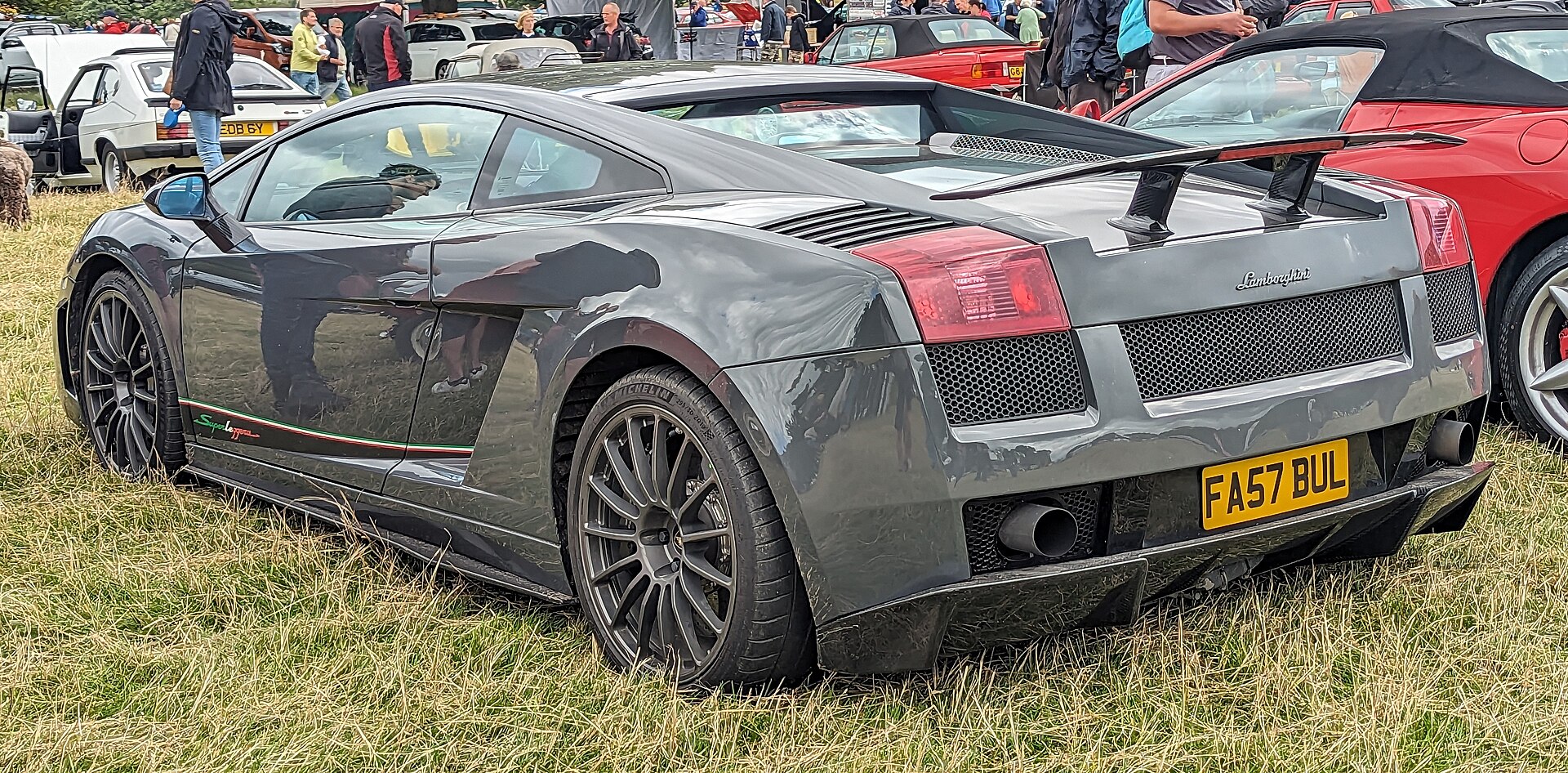
The Lamborghini Gallardo Superleggera is the lightweight version of the Gallardo, and Lamborghini offered it twice. The 2007 car had a 5.0-litre V10 with 390 kW and weighed about 100 kg less than the standard coupé. The LP 570-4 of 2010 used the 5.2-litre engine with 419 kW. Both used carbon fibre in place of metal and kept all-wheel drive. The Italian word means "super light". The whole Gallardo range of 2003–2013 is covered on our Lamborghini Gallardo page; this page is about the two Superleggera cars and their relatives.
In short
- Superleggera (2007): 390 kW (530 PS), 3.8 seconds from 0 to 100 km/h, 315 km/h, 618 built in about a year.
- LP 570-4 Superleggera (2010): 419 kW (570 PS) and 540 Nm, 1,340 kg dry, 3.4 seconds by Lamborghini's figures, 325 km/h.
- Carbon fibre for the engine cover, rear diffuser, undertray, door panels, mirror housings and seat shells; polycarbonate windows on the 2010 car.
- Related cars: the LP 570-4 Spyder Performante (2010) and the LP 570-4 Edizione Tecnica (2012).
Size at a glance
| Dimensions | Lamborghini Gallardo |
|---|---|
| Length | 4,300 mm169.3 in |
| Width | 1,900 mm74.8 in |
| Height | 1,165 mm45.9 in |
| Wheelbase | 2,560 mm100.8 in |
Specs by version
Engines
| Version | Engine | Power | Torque | Gearbox | Drive | Production years |
|---|---|---|---|---|---|---|
| Superleggera 5.0 V10 | 5.0 l · 10 cyl · Petrol 4,961 cc | 390 kW 530 PS523 hp | — | 6-sp | — | 2007 |
| LP 570-4 Superleggera 5.2 V10 | 10 cyl · Petrol | 419 kW 570 PS562 hp | 540 Nm398 lb-ft | 6-sp Automated manual | All-wheel drive | 2010 |
| LP 570-4 Spyder Performante 5.2 V10 | 5.2 l · 10 cyl · Petrol 5,204 cc | 419 kW 570 PS562 hp | — | — | All-wheel drive | 2010 |
Performance
Show all 3 versions
| Version | 0–100 km/h | Top speed |
|---|---|---|
| Superleggera 5.0 V10 | 3.8 s 0–62 mph | 315 km/h196 mph |
| LP 570-4 Superleggera 5.2 V10 | 3.4 s 0–62 mph | 325 km/h202 mph |
| LP 570-4 Spyder Performante 5.2 V10 | 3.9 s 0–62 mph | 325 km/h202 mph |
Dimensions and weight
Show all 2 versions
| Version | Length | Width | Height | Wheelbase | Kerb weight |
|---|---|---|---|---|---|
| Superleggera 5.0 V10 | 4,300 mm169.3 in | 1,900 mm74.8 in | 1,165 mm45.9 in | 2,560 mm100.8 in | 1,558 kg3,435 lb |
| LP 570-4 Spyder Performante 5.2 V10 | — | — | — | — | 1,485 kg3,274 lb |
Verified Manufacturer and type-approval data from our catalog · Sources and methodology
Gallardo Superleggera at a glance
| Parameter | Superleggera (2007) | LP 570-4 Superleggera (2010) |
|---|---|---|
| Debut | Geneva Motor Show, March 2007 | Geneva Motor Show, 2 March 2010 |
| Engine | 4,961 cc V10 | 5,204 cc V10 |
| Power | 390 kW (530 PS) at 8,000 rpm | 419 kW (570 PS) at 8,000 rpm |
| Torque | 510 Nm at 4,500 rpm (CAR) | 540 Nm at 6,500 rpm |
| Weight | 1,330 kg, about 100 kg below the standard car | 1,340 kg dry, 70 kg below the LP 560-4 |
| Gearbox | six-speed e-gear or six-speed manual | six-speed e-gear, manual at no cost in Europe |
| 0–100 km/h | 3.8 s | 3.4 s (Lamborghini), 3.2 s (Wikipedia EN) |
| Top speed | 315 km/h | 325 km/h |
| Built | 618 | no total published |
Why a lighter Gallardo
The Gallardo was Lamborghini's V10 model of the Audi era, built from 2003 to 2013 in 14,022 examples. Italdesign drew the first proposal and Luc Donckerwolke the final car, and the 5.0-litre engine of the early cars gave way to a 5.2-litre unit in 2008. The Superleggera was the sharper, more track-focused version. Instead of adding much power, Lamborghini removed weight. Each version gained only 7 kW (10 PS): the 2007 car over the standard coupé, the 2010 car over the LP 560-4.
The first car: 5.0-litre V10, 2007
Lamborghini showed the first Superleggera at the Geneva show in March 2007 and offered it from that month. Small changes to the inlet and exhaust raised output to 390 kW (530 PS) at 8,000 rpm. CAR Magazine quoted 376 lb ft, or 510 Nm, at 4,500 rpm.
Many small changes added up. Outside, carbon fibre replaced metal for the engine cover, rear wing, rear diffuser, undertray, sill extensions and mirror housings. Inside, the door panels and centre tunnel were carbon too, and carbon shell seats with Alcantara trim replaced the standard seats. Titanium wheel nuts, thinner glass and the removal of the hi-fi system saved more. Wikipedia DE and CAR give 1,330 kg, about 100 kg less than the standard Gallardo. The specification table in Wikipedia EN lists 1,558 kg, which appears to be a kerb weight.
Lamborghini's claim was 3.8 seconds to 100 km/h, against 4.0 seconds for the standard car according to CAR, and a top speed of 315 km/h. US cars came with the e-gear automated manual as standard and a six-speed manual at no extra cost. CAR's Georg Kacher found the car firm, stable and well balanced on a circuit, with power split 30:70 between the axles. On the road it was noisy, and with the stability control off a slide was hard to catch.
The car was never meant to stay long in the range. When the Gallardo LP 560-4 arrived at Geneva in March 2008, Lamborghini ended Superleggera production. Wikipedia EN counts 618 cars; Wikipedia DE gives 619, of them 172 for the United States.

The 2010 car: LP 570-4 with 419 kW
The second Superleggera was revealed at Geneva on 2 March 2010, based on the LP 560-4. Its 5.2-litre V10 produced 419 kW (570 PS) at 8,000 rpm and 540 Nm at 6,500 rpm, or 80.5 kW per litre. Dry weight was 1,340 kg, 70 kg less than the 1,410 kg of the all-wheel-drive LP 560-4. Forged aluminium wheels with titanium bolts saved 13 kg on their own.
Carbon fibre went into the centre console, door panels, seat shells, sill covers and mirror casings. The rear diffuser, underbody panels and standard rear spoiler were carbon as well. Polycarbonate replaced glass for the rear screen and side windows, and also formed the engine cover. A sharper V-shaped nose with daytime running lights increased front downforce, and a larger rear wing was available for track use.
GoAuto reported Lamborghini's figures: 3.4 seconds to 100 km/h, 10.2 seconds to 200 km/h and 325 km/h. Wikipedia EN gives 3.2 seconds for the sprint. Consumption was rated at 13.5 l/100 km and CO2 at 319 g/km (344 g/km with the manual), which Lamborghini described as 20.5 percent better than the first Superleggera. With 419 kW for 1,340 kg dry, the car had about 313 kW per tonne, against roughly 293 kW per tonne for the 2007 model.
In Australia the LP 570-4 Superleggera cost A$542,500 in October 2010 (about €376,000), and 15 cars were allocated to the country. Wikipedia EN mentions matt black (Nero Nemesis) and matt white (Bianco Canopus) among the colours.


Spyder Performante and Edizione Tecnica
The LP 570-4 Spyder Performante, announced in November 2010, was the open version of the Superleggera with the same 419 kW engine. Carbon fibre for the engine cover, underbody, diffuser and interior saved 65 kg compared with the LP 560-4 Spyder. Wikipedia EN gives a kerb weight of 1,485 kg, 3.9 seconds to 100 km/h and 325 km/h. The very last Gallardo, built on 25 November 2013, was a Spyder Performante in Rosso Mars.
The LP 570-4 Edizione Tecnica, shown at the Paris Motor Show in 2012, was based on the Superleggera and the Spyder Performante. It added a fixed rear wing, carbon-ceramic brakes and a contrasting colour for the roof arch and front air intakes, for example a matt black body with orange details.
| Version | Year | Body | Power | Weight | 0–100 km/h |
|---|---|---|---|---|---|
| Superleggera | 2007 | coupé | 390 kW (530 PS) | 1,330 kg | 3.8 s |
| LP 570-4 Superleggera | 2010 | coupé | 419 kW (570 PS) | 1,340 kg dry | 3.4 s |
| LP 570-4 Spyder Performante | 2010 | convertible | 419 kW (570 PS) | 1,485 kg kerb | 3.9 s |
| LP 570-4 Edizione Tecnica | 2012 | coupé or convertible | 419 kW (570 PS) | — | — |
Photo gallery

Lamborghini Gallardo Superleggera in our rankings
- No. 3 of 21 · Fastest convertibles and roadsters (325 km/h)
- No. 4 of 24 · Power-to-weight: convertibles and roadsters (282 kW/t)
- No. 6 of 15 · Quickest convertibles and roadsters, 0–100 (3.9 s)
- No. 7 of 47 · Quickest cars of the 2000s, 0–100 (3.8 s)
- No. 8 of 27 · Widest convertibles and roadsters (1,900 mm)
- No. 35 of 301 · Power-to-weight: cars (282 kW/t · top 12%)
Better power-to-weight than 88% of ranked cars in the 1CARS catalog (No. 35 of 301).
FAQ
What does Superleggera mean?
It is Italian for "super light": Lamborghini cut about 100 kg from the 2007 Gallardo and 70 kg from the 2010 car.
How many Gallardo Superleggera were built?
618 of the 2007 car according to Wikipedia EN (619 in Wikipedia DE). No total has been published for the LP 570-4 Superleggera.
How much power does the Gallardo Superleggera have?
390 kW (530 PS) for the 2007 car and 419 kW (570 PS) with 540 Nm for the LP 570-4 Superleggera.
How fast is the LP 570-4 Superleggera?
Lamborghini gave 3.4 seconds from 0 to 100 km/h, 10.2 seconds to 200 km/h and 325 km/h.
What did a Gallardo Superleggera cost new?
About €186,000 in Germany in 2007 and £145,000 in the UK; the LP 570-4 cost A$542,500 in Australia in 2010.
Data sources
Data checked by an editor against the sources below.