 Lamborghini 350 GT
Specs, engines and history
Published Sources (1) Report an error
By Felix Hartmann, Automotive Technology & EV Contributor
- Built
- 1964–1966
- Top power
- 206 kW (280 PS)
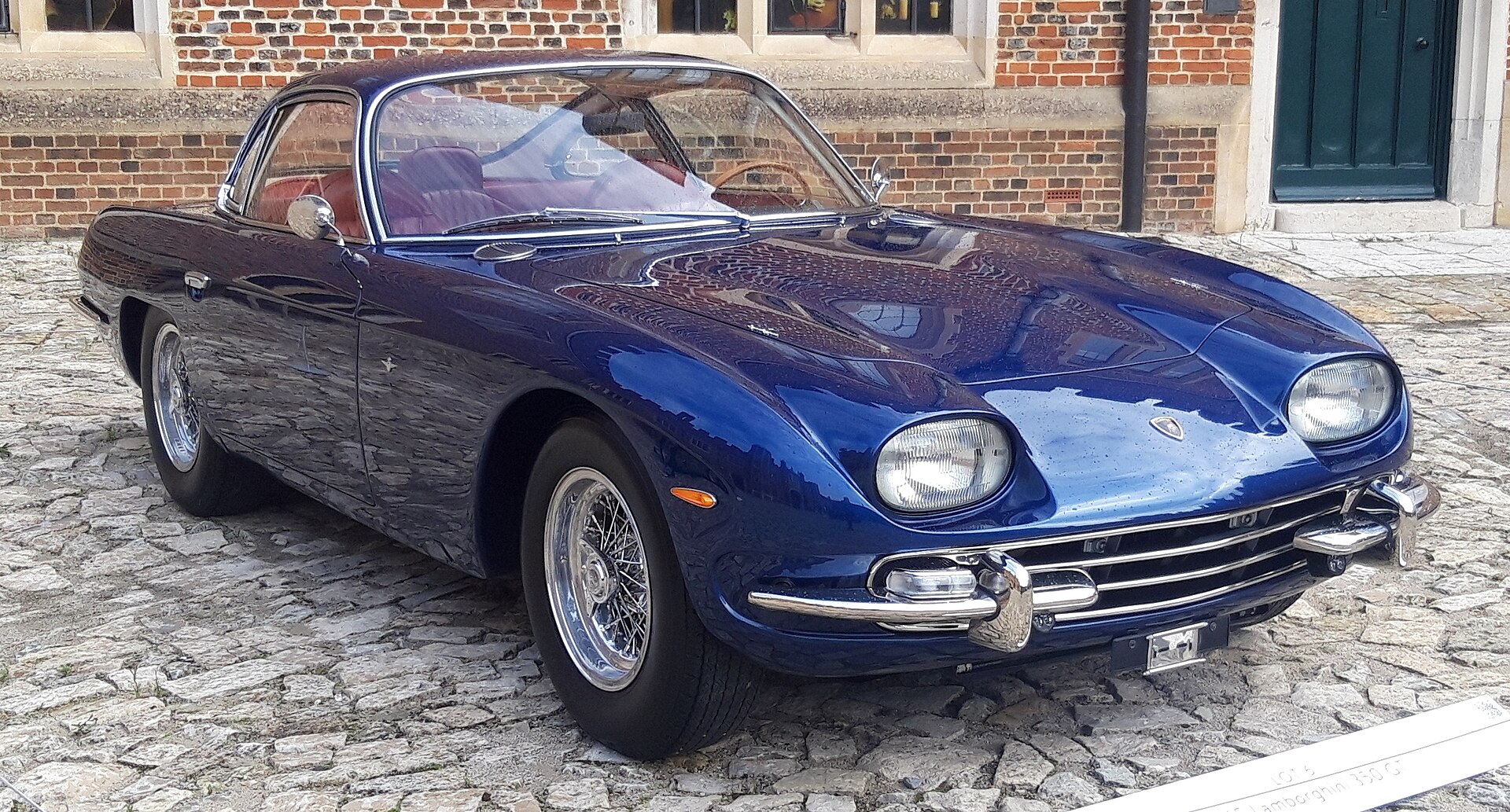
The Lamborghini 350 GT is the first production car of Automobili Lamborghini, built from 1964 to 1966. Developed from the 350 GTV prototype, it combined a four-camshaft 3.5-litre V12 with an aluminium coupé body by Carrozzeria Touring of Milan. It made its debut at the Geneva motor show in March 1964, only five months after the prototype, and 120 cars were built before the 400 GT replaced it. Its success helped the young company survive and turned it into a real rival for Ferrari.
In short
- Lamborghini's first production car: shown at Geneva in March 1964, production from May 1964 to 1966, 120 cars.
- 3,464 cc all-aluminium V12 with four overhead camshafts, designed by Giotto Bizzarrini: 209 kW (280 hp) at 6,500 rpm and 325 Nm.
- Five-speed ZF gearbox, Salisbury limited-slip differential, independent suspension and disc brakes all round.
- Superleggera aluminium body by Touring; 0–100 km/h in 6.8 seconds and a top speed of 254 km/h.
Lamborghini 350 GT at a glance
| Specification | Lamborghini 350 GT |
|---|---|
| Production | 1964–1966, Italy; bodies by Touring, Milan |
| Cars built | 120 |
| Body | two-door coupé; front engine, rear-wheel drive |
| Engine | 3,464 cc V12, all aluminium, four overhead camshafts, Weber 40 DCOE carburettors |
| Power | 209 kW (280 hp) at 6,500 rpm |
| Torque | 325 Nm at 4,500 rpm |
| Gearbox | five-speed manual (ZF), Salisbury limited-slip differential |
| Kerb weight | 1,450 kg |
| Dimensions | 4,640 × 1,730 × 1,220 mm, wheelbase 2,550 mm |
| Successor | 400 GT |
The 350 GT is the starting point of the brand's V12 line, which continued with the Miura and the Countach. All models are listed in the Lamborghini catalogue.
From 350 GTV prototype to production
Ferruccio Lamborghini set out to build a grand tourer that could compete with Ferrari. The engine was entrusted to Giotto Bizzarrini, who designed a racing-style V12. After testing the first engine, Bizzarrini left the company in May 1963. The following month Lamborghini gave the task of turning the 350 GTV prototype into a production car to the young engineer Giampaolo Dallara, assisted by Paolo Stanzani and test driver Bob Wallace.
The 350 GTV was shown at the Turin motor show in October 1963, but it was not a working car: on the stand the suspension arms were tack-welded in place and there was no engine under the bonnet. The reaction was lukewarm, and Ferruccio postponed production. The car was redesigned, and the result, the 350 GT, appeared at Geneva in March 1964. It kept the profile of the prototype but replaced its rotating hidden headlights with fixed lamps.
Production started in May 1964. The first chassis, number 101, reached the factory on 9 March 1964, and the first customer car, number 104, was delivered on 31 July 1964. The original plan was to build ten cars a week, but fewer than 25 reached customers in 1964. In total 120 cars were made before the 400 GT took over in 1966.
Touring Superleggera body and chassis
The bodies were built by Carrozzeria Touring in Milan, using its patented Superleggera method: aluminium panels fixed to a framework of small tubes. Touring also joined the bodies to the chassis and delivered complete cars, including bumpers, to Lamborghini's factory. The first frames were made by Neri and Bonacini; later the chassis production moved to Marchesi.
The chassis uses 60 mm square-section steel tubes for the central floor, with front and rear cradles in 50 mm and 25 mm tubing. Suspension is fully independent, with unequal-length wishbones, coil-over dampers and anti-roll bars at both ends. Vacuum-assisted Girling disc brakes are fitted to all four wheels, and the original tyres were 205-section Pirelli Cinturato HS.
The car is 4,640 mm long, 1,730 mm wide and 1,220 mm high, with a wheelbase of 2,550 mm and front and rear tracks of 1,380 mm. It weighs 1,450 kg.

The Bizzarrini V12
Bizzarrini's original engine was a racing unit: a 3.5-litre V12 with four overhead camshafts, dry-sump lubrication and a compression ratio of 11:1 or more, rated at about 298 kW (400 hp) at 11,000 rpm. That was too much for a road car, so Dallara and Wallace detuned it. They changed it to a wet sump, lowered the compression ratio to 9.4:1 and replaced the 36 mm racing carburettors with Weber 40 DCOE side-draught carburettors. The first detuned engine ran on 3 October 1963 and produced 201 kW (270 hp).
| Engine stage | Power | Notes |
|---|---|---|
| Bizzarrini racing V12 | about 298 kW (400 hp) at 11,000 rpm | dry sump, compression 11:1 or more |
| First detuned engine (October 1963) | 201 kW (270 hp) | wet sump, Weber 40 DCOE |
| 350 GT production engine | 209 kW (280 hp) at 6,500 rpm | 325 Nm at 4,500 rpm, compression 9.4:1 |
The production V12 has a capacity of 3,464 cc and is made entirely of aluminium. Each engine ran for 24 hours on a dynamometer and then covered at least 500 km of road testing with Bob Wallace before delivery.
Power goes to the rear wheels through a five-speed ZF manual gearbox and a Salisbury limited-slip differential. The 350 GT accelerates from 0 to 100 km/h in 6.8 seconds and from 0 to 161 km/h in 16.3 seconds, with a top speed of 254 km/h.
| Parameter | Metric | Imperial |
|---|---|---|
| Engine capacity | 3,464 cc | 211 cu in |
| Power | 209 kW at 6,500 rpm | 280 hp |
| Torque | 325 Nm at 4,500 rpm | 240 lb-ft |
| Wheelbase | 2,550 mm | 100.4 in |
| Length | 4,640 mm | 182.7 in |
| Kerb weight | 1,450 kg | 3,197 lb |
| Top speed | 254 km/h | 158 mph |

The 350 GTS and 3500 GTZ
350 GTS. An open spider version was shown at the Turin motor show in November 1965. Touring built only two in 1965: chassis 0328 in black with an emerald green interior and chassis 0325 in gold with a brown interior.
3500 GTZ. Zagato built two coupés on a shortened 350 GT chassis, designed by Ercole Spada (chassis 0310 and 0320). Chassis 0310 was shown at the London Motor Show in 1965.
Many standard 350 GTs were later fitted with the 4.0-litre engine of the 400 GT.
| Year | Event |
|---|---|
| May 1963 | Giotto Bizzarrini leaves after testing the first engine |
| October 1963 | 350 GTV prototype at the Turin motor show; first detuned engine runs |
| March 1964 | 350 GT debuts at the Geneva motor show |
| May 1964 | Series production starts |
| July 1964 | First customer car (chassis 104) delivered |
| 1965 | 350 GTS spider (Turin) and 3500 GTZ (London) |
| 1966 | 400 GT replaces the 350 GT after 120 cars |

Successor: the 400 GT
The 350 GT evolved directly into the 400 GT in 1966. The first step, the 400 GT Interim, was essentially a 350 GT with a larger 3,929 cc V12 of 239 kW (320 hp); only 23 were built, three of them with aluminium bodies. The 400 GT 2+2, presented at the Geneva motor show in 1966, had a steel body, a new roofline with larger side windows and a beltline 66 mm higher. Together with a slightly lower floor, this made room for two real rear seats — the 350 GT had space only for luggage or a rarely ordered third seat. It also received a gearbox designed by Lamborghini, with synchromesh on all gears. 224 were built until 1968; after Touring went bankrupt in 1967, Marazzi took over body production. The 400 GT was followed by the Islero.
Legacy
The 350 GT proved that Ferruccio Lamborghini's plan could work. A new company had built, within a few months, a refined V12 grand tourer with advanced engineering, and its success kept the company alive and established it as a competitor to Ferrari. Its basic layout — a front-mounted four-cam V12, independent suspension at both ends and a 2,550 mm wheelbase — carried over to the 400 GT and defined Lamborghini's front-engined grand tourers of the 1960s. Today Lamborghini's heritage department, Polo Storico, restores these early cars. For collectors, the 350 GT matters as the car that started it all: chassis 101 was the first Lamborghini to leave the line. The full story of the brand is told in our history of Lamborghini.

Photo gallery


Lamborghini 350 GT in our rankings
- No. 464 of 859 · Most powerful cars (206 kW · top 56%)
- No. 54 of 94 · Most powerful cars of the 1960s (206 kW · top 58%)
- No. 86 of 127 · Most powerful Italian cars (206 kW · top 69%)
- No. 238 of 313 · Most powerful coupes (206 kW · top 78%)
- No. 823 of 912 · Longest-running car nameplates (2 years · top 96%)
More powerful than 44% of ranked cars in the 1CARS catalog (No. 464 of 859).
FAQ
What was the first Lamborghini car?
The 350 GT, presented at the Geneva motor show in March 1964 and built from May 1964. It was developed from the 350 GTV prototype of 1963.
How many Lamborghini 350 GTs were built?
120 cars between 1964 and 1966, plus two 350 GTS spiders and two 3500 GTZ coupés by Zagato.
What engine does the 350 GT have?
A 3,464 cc all-aluminium V12 with four overhead camshafts, producing 209 kW (280 hp) at 6,500 rpm and 325 Nm.
Who designed the 350 GT's engine?
Giotto Bizzarrini designed the original racing V12; Giampaolo Dallara and Bob Wallace adapted it for road use.
How fast is the Lamborghini 350 GT?
It accelerates from 0 to 100 km/h in 6.8 seconds and reaches 254 km/h.
Data sources
Data checked by an editor against the sources below.