 Lamborghini Diablo
Specs, engines and history
Published Sources (1) Report an error
By Felix Hartmann, Automotive Technology & EV Contributor
- Built
- 1990–2001
- Top power
- 438 kW (596 PS)
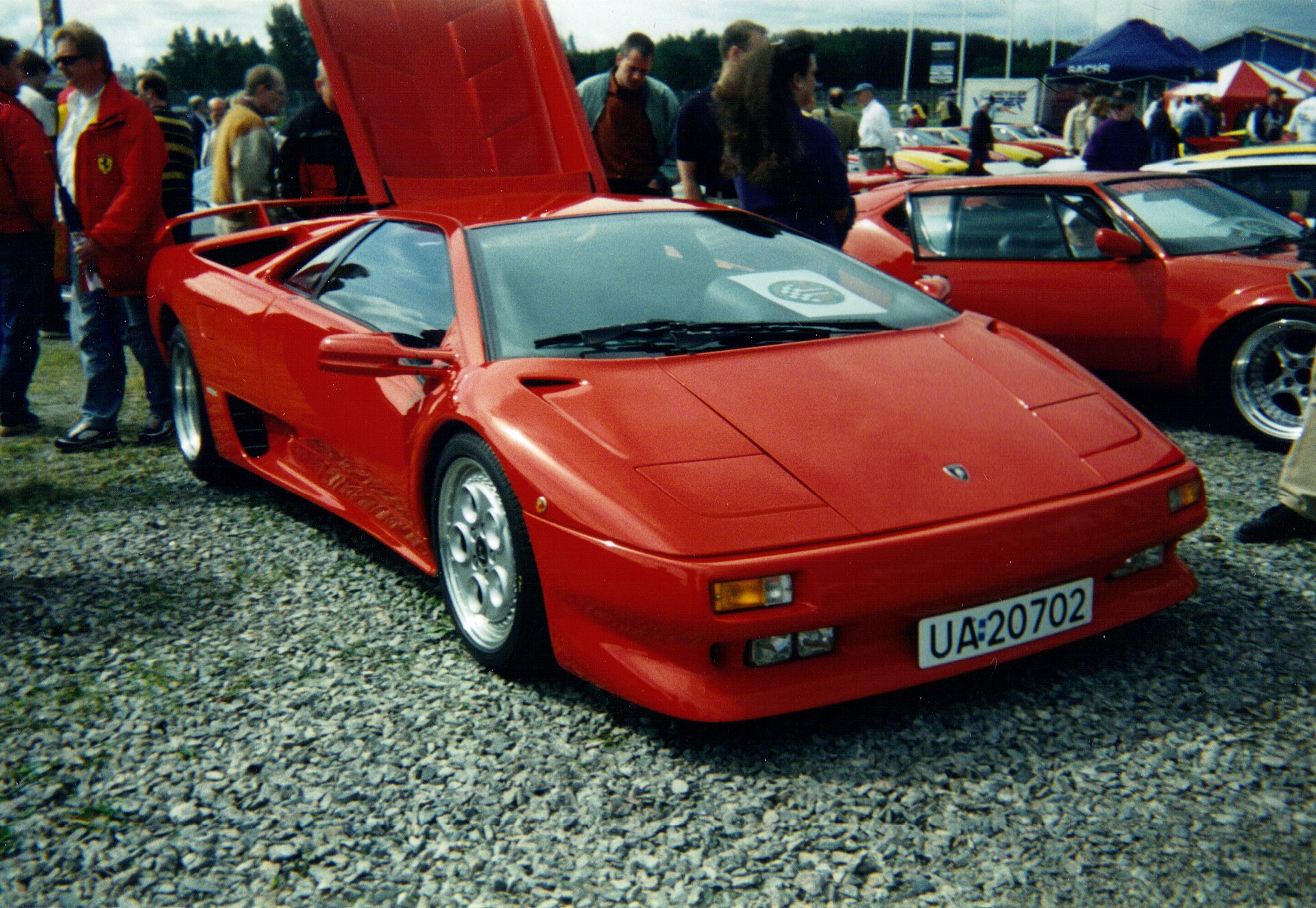
The Lamborghini Diablo is the mid-engined V12 supercar that Lamborghini built at Sant'Agata Bolognese from 1990 to 2001 as the successor to the Countach. It was the first production Lamborghini with a top speed of more than 320 km/h, and with the VT of 1993 it became the brand's first all-wheel-drive sports car. Developed under Chrysler ownership and finished under Audi, the Diablo ran through many versions, from the 362 kW (492 PS) original to the 6.0-litre VT and the track-only GTR, with 2,903 cars built in total.
In short
- Built 1990–2001 at Sant'Agata Bolognese (Italy); 2,903 cars; successor of the Countach, replaced by the Murciélago.
- Longitudinal mid-mounted V12 of 5.7 litres, later 6.0 litres: from 362 kW (492 PS) and 580 Nm to 423 kW (575 PS) in the Diablo GT.
- Five-speed manual gearbox; rear-wheel drive or, in the VT versions, all-wheel drive with a viscous coupling.
- Top speed of 325 km/h for the original Diablo; 0–100 km/h in 4.5 seconds measured by Auto Motor und Sport.
Lamborghini Diablo at a glance
| Specification | Lamborghini Diablo |
|---|---|
| Production | 1990–2001, Sant'Agata Bolognese (Italy) |
| Cars built | 2,903 |
| Body | two-door coupé with scissor doors; VT Roadster with removable targa roof |
| Engine | V12, 5.7 litres (5,707 cc), later 6.0 litres, four valves per cylinder |
| Power | 362 kW (492 PS) in 1990; up to 423 kW (575 PS) in the GT |
| Torque | 580 Nm (original) to 630 Nm (GT) |
| Gearbox | five-speed manual |
| Kerb weight | 1,576 kg (Diablo), 1,625 kg (VT), 1,460 kg (GT) |
| Dimensions | length 4,460–4,470 mm, width 2,040 mm, wheelbase 2,650 mm |
| Predecessor / successor | Countach / Murciélago |
The Diablo sits between the Lamborghini Countach and the Murciélago in the line of Lamborghini's V12 flagships, which continues today with the Aventador and the Revuelto. All models are in the Lamborghini catalogue.
History: Project 132
Work on a successor to the Countach, called Project 132, began in June 1985. The brief asked for a top speed of at least 315 km/h. At that time Lamborghini was financed by the Swiss brothers Jean-Claude and Patrick Mimran, and the design was given to Marcello Gandini, who had drawn both the Miura and the Countach.
In 1987 Chrysler bought Lamborghini and funded the rest of the development. Chrysler's management did not like Gandini's sharp-edged proposal, and the Chrysler styling centre in Detroit under Tom Gale carried out a major redesign that softened the lines. Gandini later used his original idea for the Cizeta-Moroder V16T.
The name follows Lamborghini's custom of naming cars after fighting bulls. Diablo — "devil" in Spanish — was a bull raised by the Duke of Veragua that fought in Madrid on 11 July 1869. The car was presented for sale on 21 January 1990.
During the 1990s Lamborghini changed owners again: in 1995 the company passed to Indonesian and Malaysian investors, and in June 1998 Audi, part of the Volkswagen Group, bought it. The last Diablos, the VT 6.0 of 2000–2001, were redesigned under Audi by Luc Donckerwolke, who then designed the Murciélago.
Engine and performance
The original Diablo used a 5.7-litre (5,707 cc) V12 with double overhead camshafts, four valves per cylinder and multi-point fuel injection. It produced 362 kW (492 PS) and 580 Nm, drove the rear wheels through a five-speed manual gearbox and reached 325 km/h. Auto Motor und Sport measured 0–100 km/h in 4.5 seconds, 0–160 km/h in 9.3 seconds and 0–200 km/h in 13.7 seconds.
The engine was developed throughout the car's life. Variable valve timing arrived in 1998, and the 1999 update raised the SV and VT to 390 kW (530 PS) and 605 Nm. For the Diablo GT the stroke was lengthened from 80 to 84 mm, giving 6.0 litres; this block was later used in the VT 6.0.
| Version | Years | Power | Torque | Kerb weight |
|---|---|---|---|---|
| Diablo | 1990–1998 | 362 kW (492 PS) | 580 Nm | 1,576 kg |
| Diablo VT (AWD) | 1993–1998 | 362 kW (492 PS) | 580 Nm | 1,625 kg |
| Diablo SE30 | 1993–1995 | 386 kW (525 PS) | — | 1,430 kg |
| Diablo SV | 1995–1998 | 375 kW (510 PS) at 7,100 rpm | 580 Nm at 5,900 rpm | 1,576 kg |
| Diablo VT Roadster | 1995–1998 | 362 kW (492 PS) | 580 Nm | 1,625 kg |
| SV, VT, VT Roadster (facelift) | 1999–2000 | 390 kW (530 PS) | 605 Nm | — |
| Diablo GT | 1999–2000 | 423 kW (575 PS) | 630 Nm | 1,460 kg |
| Diablo VT 6.0 | 2000–2001 | 405 kW (550 PS) | 620 Nm | 1,625–1,656 kg |


Diablo VT and the roadsters
Diablo VT (1993). VT stands for "viscous traction". The all-wheel-drive system, adapted from the LM002 off-roader, uses a viscous centre coupling that sends up to 25% of the torque to the front wheels when the rear wheels slip. The VT also brought brake-cooling intakes in the front bumper, larger intakes in front of the rear wheels, a more ergonomic interior, electronically adjustable dampers, four-piston brake calipers and power steering. Most of these changes, except the four-wheel drive, later spread to the rear-wheel-drive Diablo.
VT Roadster (1995). After a barchetta-style roadster concept at the 1992 Geneva motor show, Lamborghini introduced its first open-top V12 production car in December 1995. The carbon-fibre targa roof is stored on top of the engine cover. About 200 were built until 1998; the 1998 update gave it 18-inch wheels, variable valve timing, 390 kW (530 PS) and a top speed of 335 km/h.
SV Roadster. A rear-wheel-drive roadster based on the SV was planned in 1998 but stopped after one prototype. A second car was completed on 6 April 1998 for the Milan dealer Emanuele Conforti, making it the rarest Diablo of all.
SE30, SV, GT and VT 6.0
SE30 (1993). Built for Lamborghini's 30th anniversary, the SE30 had 386 kW (525 PS), rear-wheel drive, adjustable anti-roll bars, fixed plexiglass side windows and no air-conditioning, stereo or power steering. 150 were made, 25 of them for the United States. A factory "Jota" kit, intended for track use and not road-legal, raised output to 438 kW (595 PS) and 639 Nm; about 15 cars were converted.
SV (1995). Shown at the 1995 Geneva motor show, the SV revived the "Super Veloce" name of the Miura SV. It was rear-wheel drive, slightly cheaper than the standard Diablo and became the entry model, with 375 kW (510 PS), an adjustable rear spoiler and larger front brakes. About 250 were built between 1995 and 1998. The SV was also the cover car of the video game Need for Speed III: Hot Pursuit.
1999 facelift. The base Diablo was dropped and the SV became the entry model. The pop-up headlights were replaced by fixed lenses from the Nissan 300ZX, used under licence. The cars received 18-inch wheels, a new wave-shaped dashboard and Lamborghini's first ABS.
Diablo GT (1999–2000). A road car for Europe with a carbon-fibre body (except the steel roof and aluminium doors), a stripped interior with racing seats and the new 6.0-litre V12 with 423 kW (575 PS). All-wheel drive was removed to save weight. Lamborghini announced 80 cars; some sources give 83.
Diablo VT 6.0 and VT 6.0 SE (2000–2001). The last Diablos, reworked by Luc Donckerwolke with new front intakes and bumpers, used the GT's 6.0-litre block with 405 kW (550 PS) and 620 Nm. 343 VT 6.0 and 42 VT 6.0 SE were built, the latter in gold or bronze-maroon paint with a magnesium intake manifold and short gear ratios.

Racing versions
Lamborghini used the Diablo to return to racing. The Diablo SV-R, shown at the 1996 Geneva motor show, was the first Lamborghini built specifically for motorsport: 397 kW (540 PS), a six-speed manual gearbox, a roll cage and 1,385 kg, 191 kg less than the SV. Lamborghini created its own one-make series, the Lamborghini Supertrophy, whose first round supported the 1996 24 Hours of Le Mans; 31 SV-Rs were built.
The Diablo GTR of 1999 followed for the 2000 season, with a 6.0-litre engine of 434 kW (590 PS) and a weight of 1,395 kg; 40 were built. In Australia, Paul Stokell won the 2003 and 2004 Australian Nations Cup Championships in a Diablo GTR. A GT1 car built by Signes Advanced Technologies in France had 482 kW (655 PS) and weighed 1,050 kg. It was homologated in 1997 and raced in Japan by the Japan Lamborghini Owners Club until 2004.
Legacy
The Diablo carried Lamborghini through a decade of changing owners and kept the brand's V12 tradition alive until Audi took control. It brought all-wheel drive to Lamborghini's flagship, an idea every later V12 model has kept, and it introduced the open roadster to the line. Its successor, the Murciélago, appeared in 2001, designed by Luc Donckerwolke after Ferdinand Piëch rejected an earlier proposal based on Diablo running gear. The story of the company is told in our history of Lamborghini.
Photo gallery


Lamborghini Diablo in our rankings
- No. 151 of 859 · Most powerful cars (438 kW · top 18%)
- No. 100 of 313 · Most powerful coupes (438 kW · top 32%)
- No. 40 of 127 · Most powerful Italian cars (438 kW · top 32%)
- No. 328 of 912 · Longest-running car nameplates (11 years · top 39%)
More powerful than 82% of ranked cars in the 1CARS catalog (No. 151 of 859).
FAQ
How many Lamborghini Diablos were built?
2,903 cars were built between 1990 and 2001, across all versions.
How fast is the Lamborghini Diablo?
The original Diablo had a top speed of 325 km/h, making it the first production Lamborghini to exceed 320 km/h. The 1998 VT Roadster reached 335 km/h.
What does VT mean on the Diablo?
VT stands for "viscous traction", the all-wheel-drive system with a viscous centre coupling that sends up to 25% of the torque to the front wheels.
What is the most powerful road-going Diablo?
The Diablo GT of 1999–2000, with a 6.0-litre V12 producing 423 kW (575 PS) and 630 Nm.
What replaced the Diablo?
The Lamborghini Murciélago, introduced in 2001 under Audi ownership.
Data sources
Data checked by an editor against the sources below.