 Audi Q4 e-tron
Specs, engines and history
Published Sources (1) Report an error
By Felix Hartmann, Automotive Technology & EV Contributor
- Built
- 2021–present
- Top power
- 250 kW (340 PS)
Which Q4 e-tron to choose
Our verdict · Felix Hartmann
- For the longest range: the rear-wheel-drive Q4 45 e-tron from 2024, with 210 kW and up to 544 km WLTP.
- For all-weather traction: a 45 or 55 e-tron quattro with two motors.
- For performance: the 55 e-tron quattro, 250 kW and 5.4 seconds to 100 km/h.
- For more luggage space with the seats up: the Sportback, 535 litres.
- For a used buy: a 2021–2024 Q4 40 e-tron with the 77 kWh battery and 509 km WLTP; the 35 e-tron has only 341 km.
The Q4 is the compact electric SUV below the larger Audi e-tron and Q8 e-tron. Its combustion-engined counterparts are the Audi Q3 and the Audi Q5. The Volkswagen ID.5 is the closest sister model to the Sportback, and the history of Audi explains the brand behind it.
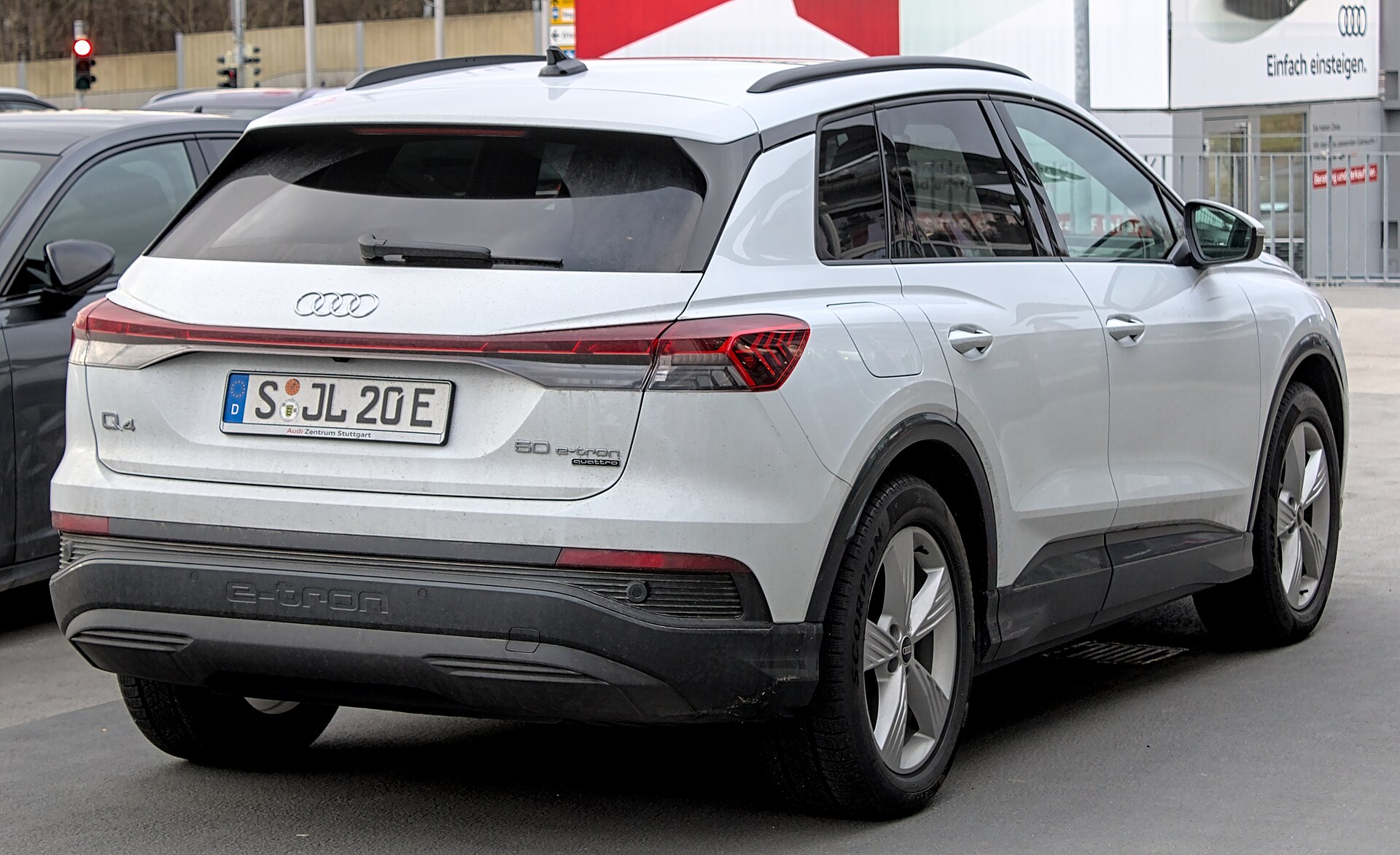
The Audi Q4 e-tron is a compact electric SUV built on the Volkswagen Group's MEB platform since March 2021. It is Audi's fourth fully electric model, offered as a conventional SUV and as the coupé-style Q4 Sportback e-tron. Production takes place in Zwickau, Germany, the first Audi built there since before the Second World War. Cars for China come from Foshan. A mid-2024 update brought stronger motors and new model names, and a facelift was presented on 27 April 2026.
In short
- Concept at Geneva 2019; production since March 2021; unveiled in April 2021.
- Batteries of 52, 59 (from 2024) and 77 kWh usable capacity.
- Outputs from 125 kW in the first Q4 35 e-tron to 250 kW in the Q4 55 e-tron quattro.
- WLTP range up to 544 km (Q4 45 e-tron after the 2024 update); boot 520 litres in the SUV and 535 litres in the Sportback.
Size at a glance
| Dimensions | Audi Q4 e-tron I |
|---|---|
| Length | 4,588 mm180.6 in |
| Width | 1,865 mm73.4 in |
| Height | 1,632 mm64.3 in |
| Wheelbase | 2,764 mm108.8 in |
| Boot | 520 L18.4 cu ft |
Specs by version
Engines
| Version | Engine | Power | Torque | Drive | Production years |
|---|---|---|---|---|---|
| 35 e-tron | Electric | 125 kW 170 PS168 hp | 310 Nm229 lb-ft | Rear-wheel drive | 2021–2024 |
| 40 e-tron | Electric | 150 kW 204 PS201 hp | 310 Nm229 lb-ft | Rear-wheel drive | 2021–2024 |
| 45 e-tron quattro | Electric | 195 kW 265 PS261 hp | 425 Nm313 lb-ft | All-wheel drive | 2021–2024 |
| 45 e-tron (2024) | Electric | 210 kW 286 PS282 hp | 545 Nm402 lb-ft | Rear-wheel drive | 2024 |
| 50 e-tron quattro | Electric | 220 kW 299 PS295 hp | 460 Nm339 lb-ft | All-wheel drive | 2021–2024 |
| 55 e-tron quattro (2024) | Electric | 250 kW 340 PS335 hp | — | All-wheel drive | 2024 |
Performance
Show all 6 versions
| Version | 0–100 km/h | Top speed | Range |
|---|---|---|---|
| 35 e-tron | 9.0 s 0–62 mph | 160 km/h99 mph | 341 km212 mi |
| 40 e-tron | 8.5 s 0–62 mph | — | 509 km316 mi |
| 45 e-tron quattro | 6.9 s 0–62 mph | 180 km/h112 mph | 490 km304 mi |
| 45 e-tron (2024) | 6.6 s 0–62 mph | — | 544 km338 mi |
| 50 e-tron quattro | 6.2 s 0–62 mph | — | 485 km301 mi |
| 55 e-tron quattro (2024) | 5.4 s 0–62 mph | — | — |
Dimensions and weight
Show all 6 versions
| Version | Length | Width | Height | Wheelbase | Kerb weight | Boot | Battery |
|---|---|---|---|---|---|---|---|
| 35 e-tron | 4,588 mm180.6 in | 1,865 mm73.4 in | 1,632 mm64.3 in | 2,764 mm108.8 in | 1,890 kg4,167 lb | 520 l18.4 cu ft | 52 kWh |
| 40 e-tron | 4,588 mm180.6 in | 1,865 mm73.4 in | 1,632 mm64.3 in | 2,764 mm108.8 in | 2,020 kg4,453 lb | 520 l18.4 cu ft | 77 kWh |
| 45 e-tron quattro | 4,588 mm180.6 in | 1,865 mm73.4 in | 1,632 mm64.3 in | 2,764 mm108.8 in | 2,210 kg4,872 lb | 520 l18.4 cu ft | 77 kWh |
| 45 e-tron (2024) | 4,588 mm180.6 in | 1,865 mm73.4 in | 1,632 mm64.3 in | 2,764 mm108.8 in | — | 520 l18.4 cu ft | 77 kWh |
| 50 e-tron quattro | 4,588 mm180.6 in | 1,865 mm73.4 in | 1,632 mm64.3 in | 2,764 mm108.8 in | — | 520 l18.4 cu ft | 77 kWh |
| 55 e-tron quattro (2024) | 4,588 mm180.6 in | 1,865 mm73.4 in | 1,632 mm64.3 in | 2,764 mm108.8 in | — | 520 l18.4 cu ft | 77 kWh |
Verified Manufacturer and type-approval data from our catalog · Sources and methodology
Audi Q4 e-tron at a glance
| Specification | Audi Q4 e-tron |
|---|---|
| Production | since March 2021; Zwickau (Germany), Foshan (China) |
| Platform | MEB |
| Bodies | five-door SUV; Q4 Sportback e-tron |
| Drive | rear-wheel drive or quattro all-wheel drive (two motors) |
| Battery (usable) | 52, 59 or 77 kWh |
| Power | 125 to 250 kW (170 to 340 PS) |
| Length / width / height | 4,588 / 1,865 / 1,632 mm |
| Wheelbase | 2,764 mm |
| Drag coefficient | Cd 0.28 (SUV), 0.26 (Sportback) |
| Boot | 520 / 1,490 l (SUV), 535 / 1,460 l (Sportback) |
| Kerb weight | 1,890 kg (35) to 2,210 kg (45 quattro) |
Concept and launch
Audi showed the Q4 e-tron as a near-production concept at the 2019 Geneva Motor Show. Series production started in Zwickau in March 2021, and the production model was unveiled in April 2021. The Sportback with a sloping roof was launched alongside the SUV. It has a lower drag coefficient (0.26 against 0.28) and a slightly larger boot behind the rear seats: 535 litres against 520. With the seats folded the SUV holds more, 1,490 against 1,460 litres. In China the FAW-Volkswagen plant in Foshan started building the Sportback in November 2023.
The Q4 shares the MEB platform with the Volkswagen ID.4 and the Škoda Enyaq. Like the ID.4, it is built in Zwickau.


Versions from 2021
| Version | Drive | Power | Torque | 0–100 km/h | WLTP range | DC 5–80 % |
|---|---|---|---|---|---|---|
| Q4 35 e-tron | rear | 125 kW (170 PS) | 310 Nm | 9.0 s | 341 km | 36 min |
| Q4 40 e-tron | rear | 150 kW (204 PS) | 310 Nm | 8.5 s | 509 km | 29 min |
| Q4 45 e-tron quattro | all-wheel | 195 kW (265 PS) | 425 Nm | 6.9 s | 490 km | 29 min |
| Q4 50 e-tron quattro | all-wheel | 220 kW (299 PS) | 460 Nm | 6.2 s | 485 km | 29 min |
The Q4 35 uses the 52 kWh battery (55 kWh gross) and reaches 160 km/h. The other versions have the 77 kWh battery (82 kWh gross); the 45 quattro is limited to 180 km/h. The PS values are converted from Wikipedia's kW figures. All versions are listed in the Audi catalogue.


The 2024 update
In mid-2024 Audi revised the range with more powerful motors and new version names. A 63 kWh battery (59 kWh usable) was added.
| Version (from 2024) | Power | Torque | 0–100 km/h | WLTP range | DC 10–80 % |
|---|---|---|---|---|---|
| Q4 40 e-tron | 150 kW (204 PS) | — | 8.1 s | 388–404 km | 27 min |
| Q4 45 e-tron | 210 kW (286 PS) | 545 Nm | 6.6–6.7 s | 518–544 km | 29 min |
| Q4 45 e-tron quattro | — | 545 Nm | 6.6 s | 492–515 km | — |
| Q4 55 e-tron quattro | 250 kW (340 PS) | — | 5.4 s | — | 27 min |
The 40 e-tron gained a push-to-pass function. The rear-wheel-drive 45 e-tron, with 210 kW and 545 Nm, became the long-range version. The new top model, the 55 e-tron quattro with 250 kW, reaches 100 km/h in 5.4 seconds. After the update the 40 e-tron charges from 10 to 80 percent in 27 minutes, and the rear-wheel-drive 45 e-tron in 29 minutes.
Batteries
| Battery | Gross / usable capacity | Used in |
|---|---|---|
| Small | 55 / 52 kWh | Q4 35 e-tron (2021–2024) |
| Medium | 63 / 59 kWh | added with the 2024 update |
| Large | 82 / 77 kWh | Q4 40 (2021–2024), 45, 50 and 55 e-tron |
The large battery gives the rear-wheel-drive 45 e-tron its 544 km WLTP range after the 2024 update, while the small 52 kWh pack limited the original 35 e-tron to 341 km. Gross capacity is the total energy stored in the cells; the usable figure is the part the car can actually draw on.
Facelift of 2026
Audi presented a facelifted Q4 e-tron on 27 April 2026. EV database evkx.net lists the current model-year versions as Q4 e-tron "performance" and "quattro performance" in SUV and Sportback form. For the quattro performance it gives 250 kW, 679 Nm, 76.6 kWh usable, up to 541 km WLTP and 175 kW peak DC charging, with 10 to 80 percent in about 27 minutes.
Charging and consumption
The 52 kWh Q4 35 charges from 5 to 80 percent in 36 minutes; the 77 kWh versions need 29 minutes. After the 2024 update the 10 to 80 percent times are 27 to 29 minutes, depending on the version. On evkx.net's data the current quattro performance consumes 14.2 to 17.0 kWh/100 km in the WLTP cycle, depending on equipment and wheels.
Safety
Euro NCAP tested the Q4 e-tron in 2021. It scored 93 percent for adult occupants, 89 for children, 66 for pedestrians and 80 for the assistance systems. In 2025 a Q4 e-tron 45 was tested again and reached 91, 87, 79 and 73 percent. Between the two tests the pedestrian result improved from 66 to 79 percent, while the assistance score dropped from 80 to 73 percent.
Photo gallery


Audi Q4 e-tron in our rankings
- No. 47 of 304 · Heaviest cars (2,210 kg · top 16%)
- No. 65 of 243 · Biggest boot: cars (520 l · top 28%)
- No. 23 of 81 · Quickest SUVs and crossovers, 0–100 (5.4 s · top 31%)
- No. 33 of 99 · Heaviest SUVs and crossovers (2,210 kg · top 34%)
- No. 18 of 48 · Heaviest electric cars (2,210 kg · top 38%)
- No. 37 of 103 · Quickest cars of the 2020s, 0–100 (5.4 s · top 39%)
Heavier than 84% of ranked cars in the 1CARS catalog (No. 47 of 304).
FAQ
What is the range of the Audi Q4 e-tron?
From 341 km WLTP for the first Q4 35 e-tron to up to 544 km for the rear-wheel-drive Q4 45 e-tron after the 2024 update.
What is the difference between the Q4 e-tron and the Q4 Sportback e-tron?
The Sportback has a sloping roof, a lower drag coefficient of 0.26 and a 535-litre boot, 15 litres more than the SUV with the seats up.
Where is the Audi Q4 e-tron built?
In Zwickau, Germany, and, for China, in Foshan.
How fast does the Q4 e-tron charge?
After the 2024 update, 10 to 80 percent on DC takes 27 to 29 minutes depending on the version.
Is the Q4 e-tron related to the VW ID.4?
Yes. Both are built on the MEB platform, and both are produced in Zwickau.
Data sources
Data checked by an editor against the sources below.