 Volkswagen ID.5
Specs, engines and history
Published Sources (6) Report an error
By Felix Hartmann, Automotive Technology & EV Contributor
- Built
- 2022–present
- Top power
- 250 kW (340 PS)
Which ID.5 to choose
Our verdict · Felix Hartmann
For most drivers a rear-drive Pro from the 2024 model year onwards is the best buy: 210 kW, 180 km/h top speed and faster charging make it better than both early rear-drive cars. The GTX makes sense for regular towing up to 1,400 kg or for winter roads, at the cost of about 40 km of range. Early 128 kW cars are cheaper on the used market and suit drivers who mostly cover short distances.
AUTO BILD found more than 400 used ID.5 for sale in Germany in March 2025, over half of them with less than 20,000 km and prices starting below €28,000. When buying, check that the car has received the software updates and ask for a battery health report. Direct rivals are the Audi Q4 Sportback e-tron, the Škoda Enyaq Coupé, the Cupra Tavascan and the Ford Capri; more electric models are collected on our electric cars page.
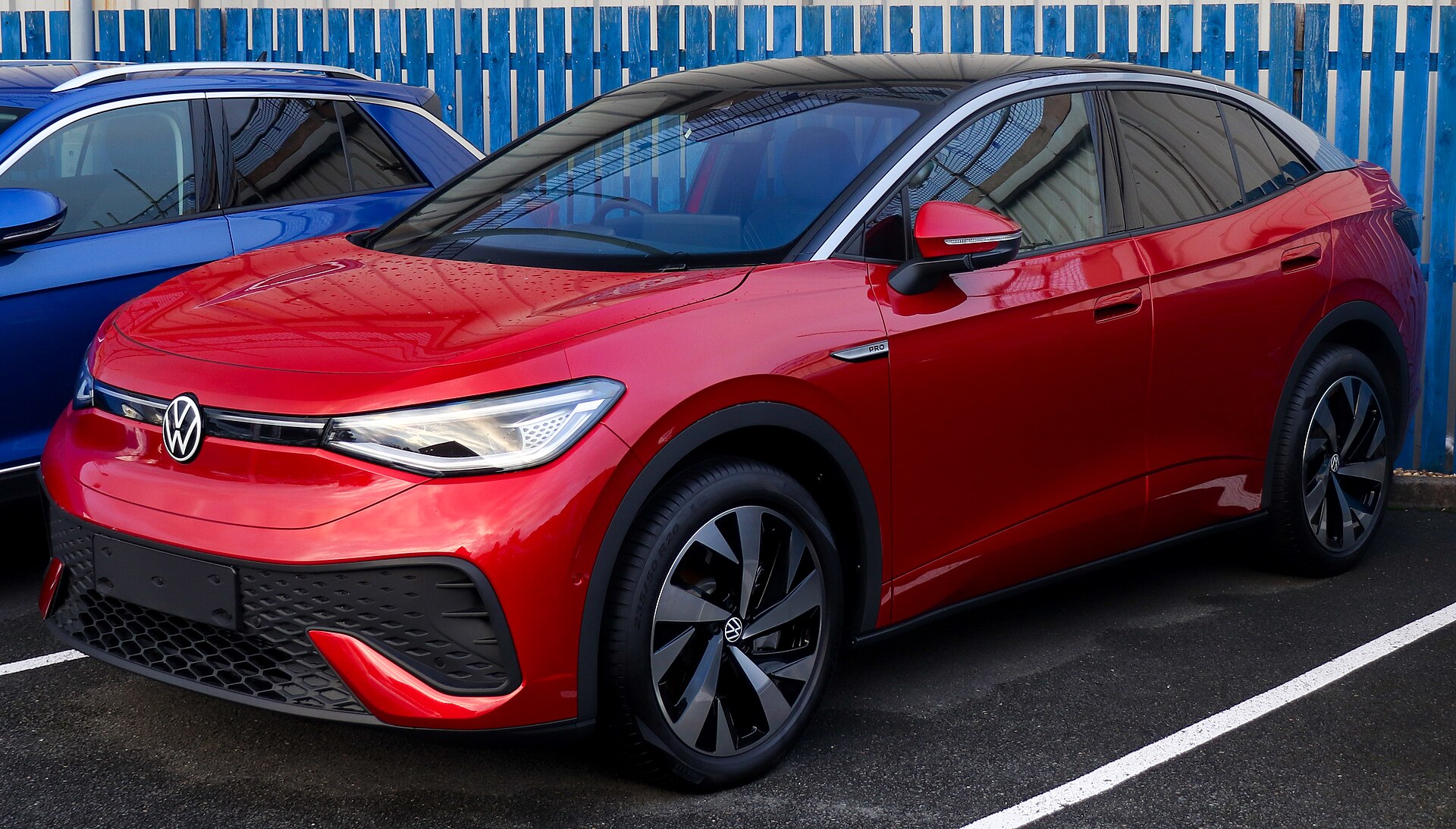
The Volkswagen ID.5 is the coupé-styled version of the ID.4 electric SUV, built on the MEB platform at Zwickau since January 2022. Volkswagen revealed it on 3 November 2021 as the brand's first all-electric SUV coupé, with 128 to 220 kW at launch and a 77 kWh net battery. Updates in 2023 and 2024 raised the GTX to 250 kW and the rear-drive Pro to 210 kW. It shares its wheelbase, battery and most of its cabin with the ID.4; the difference is mainly the sloping roof.
In short
- Revealed 3 November 2021, production at Zwickau from January 2022, deliveries from May 2022.
- At launch: Pro 128 kW and Pro Performance 150 kW with rear drive, GTX 220 kW with all-wheel drive; all with 77 kWh net.
- WLTP range 520 km for the rear-drive cars and 480 km for the GTX; DC charging up to 135 kW at launch.
- Boot 549 litres, the same as the ID.4 with the seats up; towing 1,200 kg (rear drive) or 1,400 kg (GTX).
Size at a glance
| Dimensions | Volkswagen ID.5 I |
|---|---|
| Length | 4,599 mm181.1 in |
| Width | 1,852 mm72.9 in |
| Height | 1,613 mm63.5 in |
| Wheelbase | 2,766 mm108.9 in |
Specs by version
Engines
| Version | Engine | Power | Gearbox | Drive | Production years |
|---|---|---|---|---|---|
| Pure | Electric | 125 kW 170 PS168 hp | 1-sp Single-speed | Rear-wheel drive | 2024 |
| Pro | Electric | 128 kW 174 PS172 hp | 1-sp Single-speed | Rear-wheel drive | 2022–2023 |
| Pro Performance | Electric | 150 kW 204 PS201 hp | 1-sp Single-speed | Rear-wheel drive | 2022–2023 |
| Pro (210 kW) | Electric | 210 kW 286 PS282 hp | 1-sp Single-speed | Rear-wheel drive | 2024 |
| GTX | Electric | 220 kW 299 PS295 hp | 1-sp Single-speed | All-wheel drive | 2022–2023 |
| GTX (250 kW) | Electric | 250 kW 340 PS335 hp | 1-sp Single-speed | All-wheel drive | 2023 |
Performance
Show all 6 versions
| Version | 0–100 km/h | Top speed | Fuel consumption | Range |
|---|---|---|---|---|
| Pure | — | — | 17.0 kWh/100 km27.4 kWh/100 mi | — |
| Pro | 10.4 s 0–62 mph | 160 km/h99 mph | 16.6 kWh/100 km26.7 kWh/100 mi | 520 km323 mi |
| Pro Performance | 8.4 s 0–62 mph | 160 km/h99 mph | 16.8 kWh/100 km27.0 kWh/100 mi | 520 km323 mi |
| Pro (210 kW) | — | 180 km/h112 mph | 16.2 kWh/100 km26.1 kWh/100 mi | — |
| GTX | 6.3 s 0–62 mph | 180 km/h112 mph | 16.1 kWh/100 km25.9 kWh/100 mi | 480 km298 mi |
| GTX (250 kW) | — | — | 16.9 kWh/100 km27.2 kWh/100 mi | — |
Dimensions and weight
Show all 6 versions
| Version | Length | Width | Height | Wheelbase | Kerb weight | Battery |
|---|---|---|---|---|---|---|
| Pure | — | 1,852 mm72.9 in | — | 2,766 mm108.9 in | 1,966 kg4,334 lb | — |
| Pro | 4,599 mm181.1 in | 1,852 mm72.9 in | 1,613 mm63.5 in | 2,766 mm108.9 in | 2,117 kg4,667 lb | 77 kWh |
| Pro Performance | 4,599 mm181.1 in | 1,852 mm72.9 in | 1,613 mm63.5 in | 2,766 mm108.9 in | 2,118 kg4,669 lb | 77 kWh |
| Pro (210 kW) | — | 1,852 mm72.9 in | — | 2,766 mm108.9 in | 2,131 kg4,698 lb | — |
| GTX | 4,582 mm180.4 in | 1,852 mm72.9 in | 1,619 mm63.7 in | 2,766 mm108.9 in | 2,141 kg4,720 lb | 77 kWh |
| GTX (250 kW) | — | 1,852 mm72.9 in | — | 2,766 mm108.9 in | 2,243 kg4,945 lb | — |
Verified Manufacturer and type-approval data from our catalog · Sources and methodology
Volkswagen ID.5 at a glance
| Parameter | Volkswagen ID.5 |
|---|---|
| Production | since January 2022, Zwickau (Germany) |
| Body | five-door coupé-SUV (crossover) |
| Platform | MEB, rear motor; GTX with a second motor at the front |
| Length / width / height | 4,599 mm / 1,852 mm / 1,613 mm (GTX 4,582 mm and 1,619 mm) |
| Wheelbase | 2,766 mm |
| Battery | 77 kWh net (79 kWh net in later cars) |
| Power | 128 kW at launch, up to 250 kW (GTX from late 2023) |
| WLTP range | 480–520 km at launch |
| Charging | 11 kW AC; 135 kW DC at launch, up to 175 kW after the 2024 update |
| Boot | 549 litres, 1,561 litres with the rear seats folded |
Concept and launch
The ID.5 started as the ID. Crozz concept, shown at Shanghai in April 2017 and at the Frankfurt IAA in September 2017. The production car arrived more than four years later. Wikipedia DE notes that the original concept was longer and more powerful than the car Volkswagen finally built.
Production began at Zwickau in January 2022, on the same line that builds the ID.3, the ID.4 and the Cupra Born. A shortage of wiring harnesses delayed the market launch, so the first customer cars reached Germany only in May 2022. The ID.5 shipped with software generation 3.0 and was meant to receive over-the-air updates every twelve weeks. Volkswagen also announced bidirectional charging as a future feature for its brand models.
Wikipedia EN cites a launch price of €46,515 for the base ID.5 in Germany in 2022. For the GTX with 250 kW, AUTO BILD quoted a list price of €58,755 without options in March 2025. The other models in the current range are on the Volkswagen catalogue page, and the company background is in our Volkswagen history.
Versions, motors and range
Every ID.5 at launch used the large battery with 77 kWh net, built from 12 modules of 24 pouch cells and cooled by water. Volkswagen did not offer the 52 kWh pack of the ID.4 at first. The rear-drive cars use a permanent-magnet synchronous motor at the back.
| Version (period) | Power | Drive | 0–100 km/h | Top speed | WLTP |
|---|---|---|---|---|---|
| Pro (2022–2023) | 128 kW (174 PS) | rear | 10.4 s | 160 km/h | 520 km |
| Pro Performance (2022–2023) | 150 kW (204 PS) | rear | 8.4 s | 160 km/h | 520 km |
| GTX (2022–2023) | 220 kW (299 PS) | all-wheel | 6.3 s | 180 km/h | 480 km |
| Pro with APP 550 motor (from 2024) | 210 kW (286 PS) | rear | — | 180 km/h | — |
| GTX (from late 2023) | 250 kW (340 PS) | all-wheel | — | — | — |
| Pure (from mid-2024) | 125 kW (170 PS) | rear | — | — | — |
The new APP 550 rear motor of the 2024 model year delivers 210 kW and, depending on the source, 545 or 550 Nm; top speed rose from 160 to 180 km/h. AUTO BILD counts six power outputs since launch. Blank cells mean that our sources give no reliable figure for that version.
The GTX gives up 40 km of WLTP range against the rear-drive cars, about 8 per cent. In return it gets a second motor and reaches 100 km/h 1.9 seconds sooner than the Pro Performance. To translate PS, hp and kW between markets, the power converter helps.
Charging and battery
The launch cars accepted 11 kW from a wallbox and 135 kW from a fast charger; the ID.4 had started at 125 kW. InsideEVs gave about 30 minutes of fast charging for roughly 390 km of WLTP range in the rear-drive car and 320 km in the GTX. That works out at about 13 km of range per minute for the rear-drive model and just under 11 km per minute for the GTX.
For the 2024 model year Wikipedia EN lists DC charging of up to 175 kW with the 79 kWh net pack. A charge from 10 to 80 per cent then takes about 28 minutes, against 30 to 36 minutes for earlier packs, depending on the cell supplier.
ID.5 GTX: two motors and all-wheel drive
The GTX adds an asynchronous motor at the front axle, which works with the rear motor for all-wheel drive. At launch the system produced 220 kW and 460 Nm. From late 2023 the GTX got 250 kW, according to AUTO BILD. Its towing limit is 1,400 kg on an 8 per cent gradient, 200 kg more than the rear-drive versions.
Wikipedia DE gives the GTX a slightly higher drag coefficient of 0.27 against 0.26 for the Pro models. InsideEVs lists it at 4,582 mm long and 1,619 mm high, so it is a little shorter and taller than the rear-drive cars.

ID.5 or ID.4
The two cars share the 2,766 mm wheelbase, the battery, the motors and the dashboard. The ID.5 is about 15 mm longer, and its roof slopes into a small spoiler on the tailgate. With the rear seats folded, the ID.4 holds a little more.
| Specification | ID.5 | ID.4 |
|---|---|---|
| Boot, seats up | 549 l | 549 l |
| Boot, seats folded | 1,561 l | 1,574 l |
| Drag coefficient | 0.26 | about 0.28 |
| DC charging at launch | 135 kW | 125 kW |
German registration statistics do not separate the two cars: the KBA counted 24,847 ID.4 and ID.5 in 2022 and 36,353 in 2023. Wikipedia DE ranks the pair second among electric cars in Germany in 2023, behind the Tesla Model Y.

Safety and equipment
Euro NCAP did not crash the ID.5 separately. Because it shares most of its structure and components with the ID.4, it carries over the ID.4's five-star result from spring 2021, as Wikipedia DE explains. A 12-inch infotainment screen was available with the Discover Pro package at launch; the 2024 update brought revised software and infotainment.
German reviews were mostly positive. ADAC praised comfort, practicality and interior quality but criticised the unlit volume control and the window switches. Auto Motor und Sport liked the balance of performance and efficiency and the acceleration of the GTX, and criticised the infotainment and the limited rear view.

Volkswagen ID.5 in our rankings
- No. 45 of 304 · Heaviest cars (2,243 kg · top 15%)
- No. 31 of 99 · Heaviest SUVs and crossovers (2,243 kg · top 32%)
- No. 32 of 97 · Power-to-weight: SUVs and crossovers (112 kW/t · top 33%)
- No. 17 of 48 · Heaviest electric cars (2,243 kg · top 36%)
- No. 34 of 81 · Quickest SUVs and crossovers, 0–100 (6.3 s · top 42%)
- No. 83 of 197 · Most powerful SUVs and crossovers (250 kW · top 43%)
Heavier than 85% of ranked cars in the 1CARS catalog (No. 45 of 304).
FAQ
What is the difference between the VW ID.4 and ID.5?
The ID.5 has a sloping coupé roof and a small rear spoiler. Platform, wheelbase, battery and motors are the same, and the boot holds 549 litres in both with the seats up.
What is the range of the Volkswagen ID.5?
At launch the WLTP range was 520 km for the rear-drive Pro and Pro Performance and 480 km for the all-wheel-drive GTX, all with the 77 kWh net battery.
How fast does the ID.5 charge?
Up to 135 kW DC and 11 kW AC at launch. The 2024 update raised DC charging to up to 175 kW, with 10–80 per cent in about 28 minutes.
Where is the ID.5 built?
At Volkswagen's Zwickau plant in Saxony, Germany, since January 2022.
How much can the ID.5 tow?
1,200 kg braked for the rear-drive versions and 1,400 kg for the GTX, measured on an 8 per cent gradient.
Data sources
Data checked by an editor against the sources below.
- Wikipedia — Volkswagen ID.4
- Wikipedia — Volkswagen ID.5
- Wikipedia — VW ID.5
- Euro NCAP — 29b2cdf1 2e05 4087 A389 Fb08bc5be87c
- Insideevs — Volkswagen Id5 Gtx Vorstellung Elektrosuv
- EEA CO₂ monitoring (European Environment Agency, CC BY 4.0)