 Volkswagen ID.4
Specs, engines and history
Published Sources (1) Report an error
By Felix Hartmann, Automotive Technology & EV Contributor
- Built
- 2020–present
- Top power
- 250 kW (340 PS)
Which ID.4 to choose
Our verdict · Felix Hartmann
- For most drivers: a Pro from model year 2024, with 210 kW, 77 kWh and up to 574 km WLTP.
- For the lowest price: the ID.4 Pure, from €42,915 before Volkswagen's purchase premium of €3,000 for the Pure (valid to 31 December 2026).
- For towing and winter roads: the Pro 4MOTION or the GTX with two motors.
- For a used buy: a car from model year 2024 or later; the earlier 77 kWh cars have the older motor and up to 135 kW charging.
- For a sportier shape: the Volkswagen ID.5 with the same technology.
The smaller Volkswagen ID.3 was the first MEB car. The Škoda Enyaq is the ID.4's sister model from Mladá Boleslav, and the Volkswagen Tiguan is its petrol and plug-in hybrid counterpart.
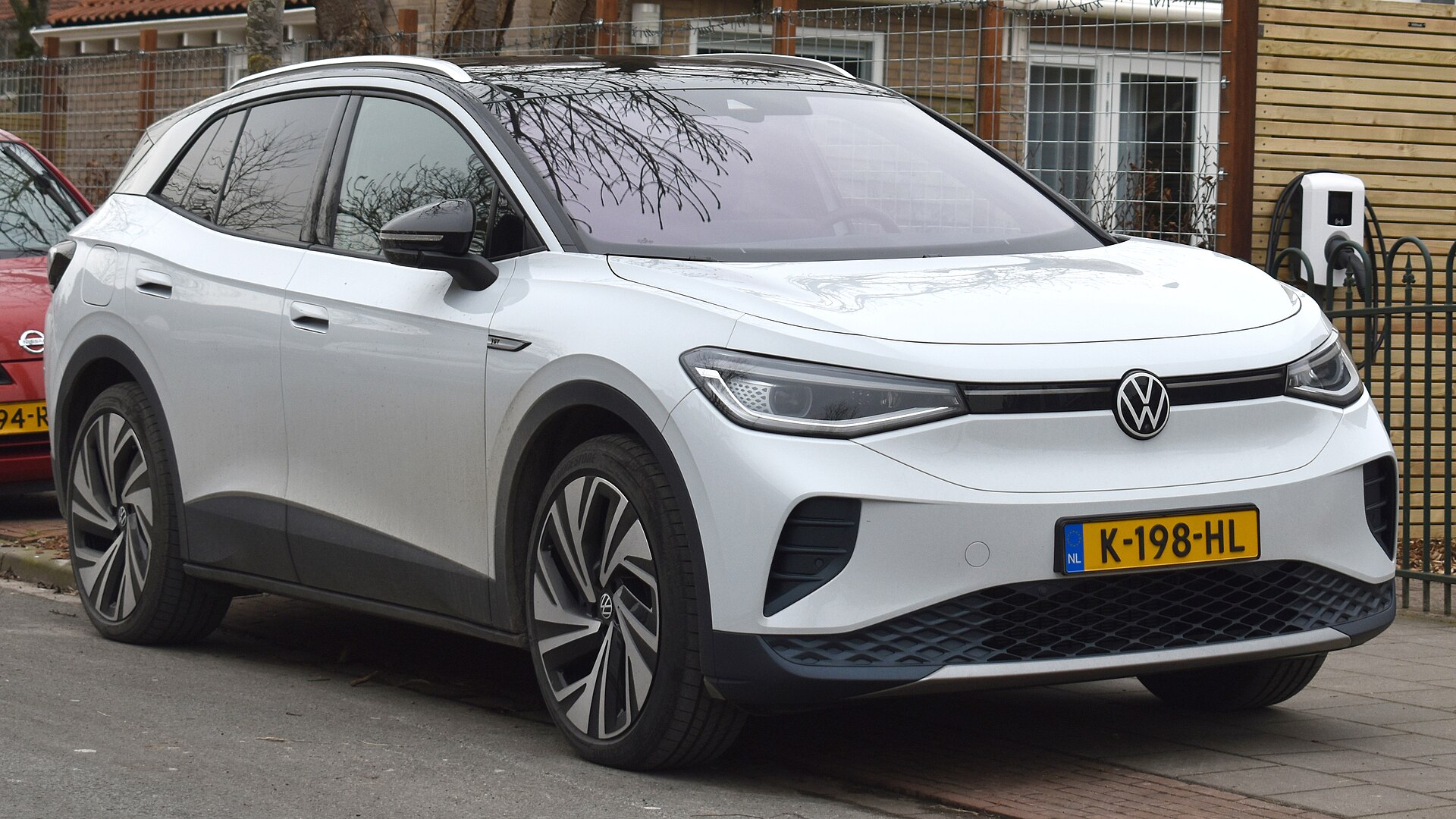
The Volkswagen ID.4 is a compact electric SUV on the MEB platform and the second model of VW's ID. family after the ID.3. The production car was presented on 23 September 2020 and won World Car of the Year 2021. It is built in Zwickau and Emden in Germany and in two plants in China. From July 2022 it was also built in Chattanooga, Tennessee. With the model-year 2024 update the larger battery versions received the APP 550 motor with up to 210 kW in rear-wheel-drive form.
In short
- Production since 2020; World Car of the Year 2021; coupé-style sister model ID.5 since 2022.
- Batteries of 52, 58 and 77 kWh usable (55, 62 and 82 kWh gross).
- Outputs from 109 kW in the first ID.4 Pure to 250 kW in the GTX from model year 2024.
- German list price from €42,915 (Volkswagen Germany, 2026); WLTP range up to 574 km.
Size at a glance
| Dimensions | Volkswagen ID.4 I |
|---|---|
| Length | 4,584 mm180.5 in |
| Width | 1,852 mm72.9 in |
| Height | 1,636 mm64.4 in |
| Wheelbase | 2,765 mm108.9 in |
| Boot | 543 L19.2 cu ft |
Specs by version
Engines
| Version | Engine | Power | Torque | Drive | Production years |
|---|---|---|---|---|---|
| Pure 52 kWh | Electric | 109 kW 148 PS146 hp | 220 Nm162 lb-ft | Rear-wheel drive | 2021–2023 |
| Pure 52 kWh (MY2024) | Electric | 125 kW 170 PS168 hp | 310 Nm229 lb-ft | Rear-wheel drive | 2024 |
| Pro 77 kWh | Electric | 150 kW 204 PS201 hp | 310 Nm229 lb-ft | Rear-wheel drive | 2021–2023 |
| Pro 77 kWh (MY2024) | Electric | 210 kW 286 PS282 hp | 545 Nm402 lb-ft | Rear-wheel drive | 2024 |
| GTX | Electric | 220 kW 299 PS295 hp | 460 Nm339 lb-ft | All-wheel drive | 2021–2023 |
| GTX (MY2024) | Electric | 250 kW 340 PS335 hp | 679 Nm501 lb-ft | All-wheel drive | 2024 |
Performance
Show all 6 versions
| Version | 0–100 km/h | Top speed | Range |
|---|---|---|---|
| Pure 52 kWh | 10.9 s 0–62 mph | 160 km/h99 mph | 363 km226 mi |
| Pure 52 kWh (MY2024) | 9.0 s 0–62 mph | - | - |
| Pro 77 kWh | 10.4 s 0–62 mph | 160 km/h99 mph | 546 km339 mi |
| Pro 77 kWh (MY2024) | 8.5 s 0–62 mph | 180 km/h112 mph | - |
| GTX | 6.2 s 0–62 mph | 180 km/h112 mph | 512 km318 mi |
| GTX (MY2024) | 5.4 s 0–62 mph | 180 km/h112 mph | - |
Dimensions and weight
Show all 6 versions
| Version | Length | Width | Height | Wheelbase | Boot | Battery |
|---|---|---|---|---|---|---|
| Pure 52 kWh | 4,584 mm180.5 in | 1,852 mm72.9 in | 1,636 mm64.4 in | 2,765 mm108.9 in | 543 l19.2 cu ft | 52 kWh |
| Pure 52 kWh (MY2024) | 4,584 mm180.5 in | 1,852 mm72.9 in | 1,636 mm64.4 in | 2,765 mm108.9 in | 543 l19.2 cu ft | 52 kWh |
| Pro 77 kWh | 4,584 mm180.5 in | 1,852 mm72.9 in | 1,636 mm64.4 in | 2,765 mm108.9 in | 543 l19.2 cu ft | 77 kWh |
| Pro 77 kWh (MY2024) | 4,584 mm180.5 in | 1,852 mm72.9 in | 1,636 mm64.4 in | 2,765 mm108.9 in | 543 l19.2 cu ft | 77 kWh |
| GTX | 4,584 mm180.5 in | 1,852 mm72.9 in | 1,636 mm64.4 in | 2,765 mm108.9 in | 543 l19.2 cu ft | 77 kWh |
| GTX (MY2024) | 4,584 mm180.5 in | 1,852 mm72.9 in | 1,636 mm64.4 in | 2,765 mm108.9 in | 543 l19.2 cu ft | 77 kWh |
Verified Manufacturer and type-approval data from our catalog · Sources and methodology
Volkswagen ID.4 at a glance
| Specification | Volkswagen ID.4 |
|---|---|
| Production | since 2020; Zwickau, Emden (Germany), Anting and Foshan (China); Chattanooga (USA) from 2022 |
| Platform | MEB |
| Body | five-door electric SUV |
| Drive | rear-wheel drive or 4MOTION all-wheel drive (two motors) |
| Battery (usable) | 52, 58 or 77 kWh (GTX partly 79 kWh) |
| Power | 109 to 250 kW (148 to 340 PS) |
| Length / width / height | 4,584 / 1,852 / 1,636 mm |
| Wheelbase | 2,765 mm |
| Boot | 543 litres, 1,575 litres with seats folded |
| Kerb weight | about 1,960 to 2,260 kg |
Launch and production
The ID.4 was the second MEB car after the ID.3, and the first electric SUV of the series. Volkswagen presented the production model on 23 September 2020, and the first cars came from Zwickau-Mosel. Emden joined in May 2022. In China, SAIC-Volkswagen builds the ID.4 X in Anting and FAW-Volkswagen the ID.4 Crozz in Foshan. For North America, Chattanooga started production on 26 July 2022; Wikipedia reports that US production stopped in April 2026.
In 2021 the ID.4 won the World Car of the Year award ahead of the Honda e and the Toyota Yaris. A sister model with a sloping roof, the ID.5, has been built since January 2022. It is 16 mm longer, 23 mm lower and has a drag coefficient of 0.26, against about 0.28 for the ID.4.
Versions, batteries and performance
| Version | Battery (usable) | Drive | Power | Torque | 0–100 km/h | WLTP range |
|---|---|---|---|---|---|---|
| Pure (to MY2023) | 52 kWh | rear | 109 kW (148 PS) | 220 Nm | 10.9 s | 363 km |
| Pure (from MY2024) | 52 kWh | rear | 125 kW (170 PS) | 310 Nm | 9.0 s | - |
| Pro (to MY2023) | 77 kWh | rear | 128 / 150 kW | 310 Nm | 10.4 s | 546 km |
| Pro (from MY2024) | 77 kWh | rear | 210 kW (286 PS) | 545 Nm | 8.5 s | up to 574 km |
| GTX (to MY2023) | 77 kWh | all-wheel | 220 kW (299 PS) | 460 Nm | 6.2 s | 512 km |
| GTX (from MY2024) | 77–79 kWh | all-wheel | 250 kW (340 PS) | 679 Nm | 5.4 s | - |
The 574 km figure is Volkswagen Germany's current WLTP maximum for the ID.4 Pro. Top speed is 160 km/h for the early rear-drive cars and 180 km/h for the all-wheel-drive versions and the later rear-drive cars. In 2026 Volkswagen Germany lists the ID.4 Pure with a 58 kWh battery and 140 kW (190 PS). North American cars used a 62 kWh gross (58 kWh usable) battery in the Standard and S trims from 2022. All versions are in the Volkswagen catalogue.

The 2024 update: APP 550 motor and new software
Volkswagen announced the model-year 2024 update in 2023. The ID.4 and ID.5 received a 12.9-inch infotainment screen and new software. The 77 kWh versions got the new APP 550 rear motor, which raised the Pro to 210 kW and 545 Nm. Its acceleration improved from 10.4 to 8.5 seconds, and top speed rose to 180 km/h. The GTX went to 250 kW and 679 Nm, and its 0–100 km/h time dropped from 6.2 to 5.4 seconds.
Charging and consumption
The first 77 kWh battery charged at up to 135 kW DC, and the North American 58 kWh battery at up to 140 kW. From model year 2024, Wikipedia gives up to 175 kW and about 28 minutes from 10 to 80 percent. Volkswagen Germany states up to 165 kW and about 29 minutes for its current cars.
| Version (Germany, 2026) | Combined consumption |
|---|---|
| ID.4 Pure | 15.9 kWh/100 km |
| ID.4 Pro | 15.4 to 17.6 kWh/100 km |
| ID.4 Pro 4MOTION | 15.9 to 18.3 kWh/100 km |
| ID.4 GTX 4MOTION | 16.3 to 18.2 kWh/100 km |
On the EPA cycle the 82 kWh American versions are rated at up to 468 km and the 62 kWh versions at 336 km.
ID.4 GTX
The GTX adds a front motor for all-wheel drive. At launch it had 220 kW and 460 Nm, enough for 0–100 km/h in 6.2 seconds. From model year 2024 it has 250 kW (340 PS) and 679 Nm and reaches 100 km/h in 5.4 seconds. Its top speed is 180 km/h and its WLTP range was 512 km in its first version.


Space and practicality
The boot holds 543 litres and 1,575 litres with the rear seats folded, according to Wikipedia. Volkswagen Germany quotes up to 533 and 1,565 litres. The ID.5 has a slightly larger boot of 549 litres (1,561 litres with the seats folded). Volkswagen Germany allows a vertical load of up to 75 kg on the tow bar.

Safety
Euro NCAP tested the rear-wheel-drive ID.4 in 2021. It scored 93 percent for adult occupants, 89 for children, 76 for pedestrians and 85 for the assistance systems. A new test of the ID.4 Pro in 2025 gave 89, 87, 84 and 76 percent. In the US the IIHS named the ID.4 a Top Safety Pick+ for 2021, 2022 and 2023.
Sales
| Year | Production (worldwide) | Europe | United States |
|---|---|---|---|
| 2021 | 134,319 | 53,605 | 16,742 |
| 2022 | 207,934 | 67,655 | 20,511 |
| 2023 | 223,425 | - | 37,789 |
| 2024 | 182,000 | - | 17,021 |
| 2025 | 163,400 | - | - |
The best year was 2023, with 223,425 cars built. China accounted for a large share: 33,761 ID.4 X and 34,273 ID.4 Crozz in 2022.
Photo gallery


Volkswagen ID.4 in our rankings
- No. 51 of 243 · Biggest boot: cars (543 l · top 21%)
- No. 28 of 118 · Most torque: SUVs and crossovers (679 Nm · top 24%)
- No. 86 of 368 · Most torque: cars (679 Nm · top 24%)
- No. 25 of 81 · Quickest SUVs and crossovers, 0–100 (5.4 s · top 31%)
- No. 35 of 100 · Biggest boot: SUVs and crossovers (543 l · top 35%)
- No. 22 of 59 · Longest-range electric cars (546 km · top 38%)
Bigger boot than 79% of ranked cars in the 1CARS catalog (No. 51 of 243).
FAQ
What is the range of the Volkswagen ID.4?
Up to 574 km WLTP for the current ID.4 Pro with the 77 kWh battery (Volkswagen Germany). The first ID.4 Pure reached 363 km.
How fast does the ID.4 charge?
Up to 135 kW DC for the first 77 kWh cars and up to 165 to 175 kW from model year 2024, with 10 to 80 percent in about 28 to 29 minutes.
What is the difference between the ID.4 and the ID.5?
The ID.5 has a coupé-style roof, a lower drag coefficient of 0.26 and a slightly larger boot. It shares the batteries and motors.
Where is the ID.4 built?
In Zwickau and Emden (Germany), in Anting and Foshan (China) and, from 2022 to 2026, in Chattanooga, Tennessee.
How much does the Volkswagen ID.4 cost?
In Germany the list price starts at €42,915 (Volkswagen Germany, 2026), before a purchase premium of €3,000 to €5,000 that runs until 31 December 2026.
Data sources
Data checked by an editor against the sources below.