 Alfa Romeo 8C
All generations, specs and history
Published Sources (1) Report an error
By Felix Hartmann, Automotive Technology & EV Contributor
- Built
- 1931–1941
- Generations
- 2
- Top power
- 168 kW (228 PS)
Timeline
8C generations
Click a generation for its own page
- 8C 2300 1931–1934 · Convertible, Roadster · 104–131 kW (141–178 PS)
- 8C 2900 1935–1941 · Coupe, Convertible · 134–168 kW (182–228 PS)
Newest first · 2 generations since 1931
-
1935
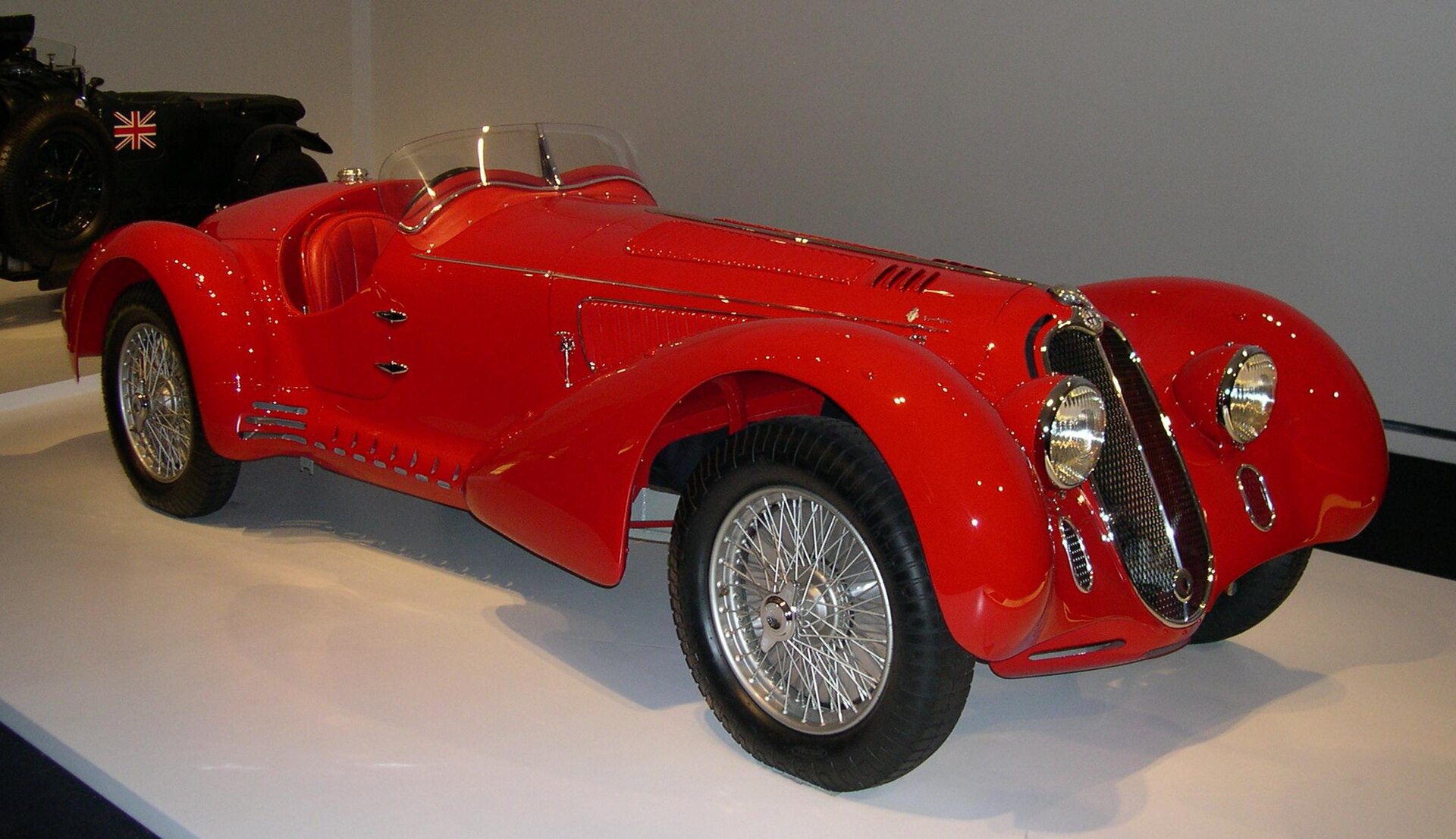
- 1931 2300 1931–1934 · Convertible, Roadster · 104–131 kW (141–178 PS)

All generations by year: 8C 2900 (1935–1941) · 8C 2300 (1931–1934)
Which one is mine?
Pick the year of first registration to see which generation it is.
- 8C 2900 1935–1941
- 8C 2300 1931–1934
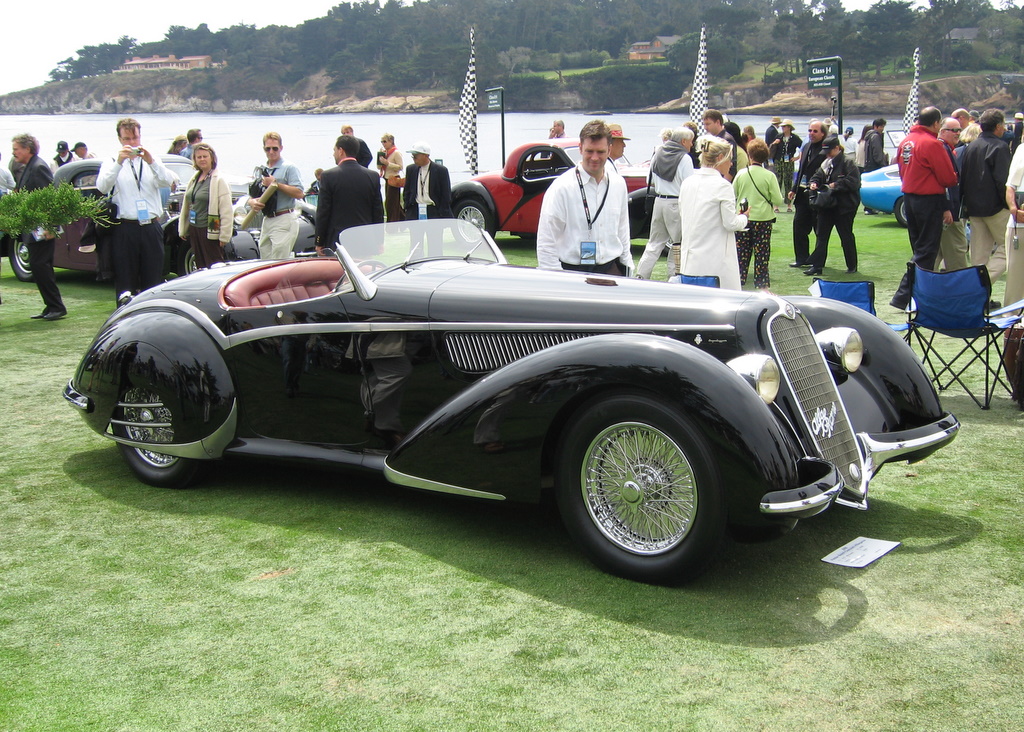
The Alfa Romeo 8C 2900 is the twin-supercharged straight-eight sports car that Alfa Romeo built in Milan from 1935 to 1939, with one more car assembled from parts in 1941. Derived from the 8C 35 Grand Prix car and designed under Vittorio Jano, it won the Mille Miglia three years running, from 1936 to 1938. Only about 40 to 43 were made in the 2900A and 2900B versions, most with Carrozzeria Touring bodies. It was the last and largest of the pre-war 8C family that began with the 8C 2300 of 1931.
In short
- 2,905 cc straight-eight with two Roots superchargers: 134 kW (180 bhp) in the road-going 2900B, 164 kW (220 bhp) in the 2900A racer.
- Fully independent suspension: Dubonnet-type trailing arms in front, swing axles and a transverse leaf spring at the rear.
- Mille Miglia winners: Antonio Brivio in 1936, Carlo Pintacuda in 1937 and Clemente Biondetti in 1938.
- 10 2900A and 30–32 2900B were built, plus one assembled from parts in 1941 (English Wikipedia).
Alfa Romeo 8C 2900 at a glance
| Parameter | Metric | Imperial |
|---|---|---|
| Maker | Alfa Romeo, Milan | - |
| Production | 1935–1939; one more car in 1941 | - |
| Built | 2900A: 10; 2900B: 32 (English Wikipedia text) or 30 (its table) | - |
| Designer | Vittorio Jano (engine and chassis) | - |
| Engine | straight-eight, DOHC, two Roots superchargers, 2,905 cc | 177 cu in |
| Bore × stroke | 68 × 100 mm | - |
| Power | 164 kW (220 bhp) at 5,300 rpm (2900A); 134 kW (180 bhp) at 5,200 rpm (2900B) | - |
| Suspension | independent all round; front trailing arms with coil springs, rear swing axles | - |
| Brakes | hydraulic drums, 432 mm (17 in), on 19-inch rims | - |
| Wheelbase | 2,718 mm (2900A); 2,799 mm (2900B Corto); 3,000 mm (2900B Lungo) | 107.0 / 110.2 / 118.1 in |
| Top speed | 185 km/h (German Wikipedia) | 115 mph |
| Predecessor | 8C 2300 (1931–1934) | - |
From the 8C 2300 to the 2900
The 8C story began with Vittorio Jano's 8C 2300, with a 65 mm bore, 88 mm stroke and 2,336 cc. English Wikipedia's production table counts 188 cars from 1931 to 1934 in short and long wheelbase. The racing version gave Tazio Nuvolari the Targa Florio in 1931 and 1932, won the 1931 Italian Grand Prix at Monza, which gave the "Monza" name to the twin-seat Grand Prix car, and won the 24 Hours of Le Mans four years running from 1931 to 1934. German Wikipedia gives 104 kW (142 PS) for the standard car and 131 kW (178 PS) for the Monza.
| 8C 2300 | Detail (English Wikipedia) |
|---|---|
| Built per year | 24 (1931), 68 (1932), 89 (1933), 7 (1934) |
| Le Mans 1931 | Earl Howe and Sir Henry Birkin |
| Le Mans 1932 | Luigi Chinetti and Raymond Sommer |
| Le Mans 1933 | Tazio Nuvolari and Raymond Sommer |
| Le Mans 1934 | Luigi Chinetti and Philippe Étancelin |
| Targa Florio | Nuvolari, 1931 and 1932 |
For racing, the engine grew. The 8C 2600, with a 68 mm bore and 2,557 cc, went into the Tipo B and the Scuderia Ferrari Monzas from 1933 with an initial 160 kW (215 hp). English Wikipedia later gives the Tipo B displacement as 2,665 cc, so the figure is uncertain. For 1934 the race engines were enlarged to 2.9 litres. From 1933 Scuderia Ferrari ran Alfa Romeo's racing programme; in 1938 the factory's own Alfa Corse took it over. That chapter is covered in our history of Ferrari.

Engine and chassis
The 8C 2900 was based on the chassis of the 8C 35 Grand Prix car. Its 2,905 cc straight-eight had a 68 mm bore and a 100 mm stroke. Two Roots-type superchargers were fed by two updraught Weber carburettors. The output depended on the version and its compression ratio:
| Version | Compression | Power | Use |
|---|---|---|---|
| 2900A | 6.5:1 | 164 kW (220 bhp) at 5,300 rpm | racing sports car |
| 2900B | 5.75:1 | 134 kW (180 bhp) at 5,200 rpm | road car |
| 2900B Mille Miglia (1938) | - | 168 kW (225 bhp) | three Alfa Corse roadsters |
| Biondetti's 1938 MM car | - | 220 kW (295 bhp) | fitted with a Tipo 308 Grand Prix engine |
The suspension was fully independent, which was rare at the time. At the front, Dubonnet-type trailing arms worked with coil springs and hydraulic dampers. At the rear, swing axles were located by a transverse leaf spring. The 2900B rode on 19-inch rims with 432 mm (17 in) hydraulic drum brakes. German Wikipedia describes the front suspension as a crank-arm axle and gives a top speed of 185 km/h.
The difference between the racing and road engines is 30 kW, about 18% of the 2900B's output. Our power converter shows the same figures in PS and hp.
2900A and 2900B: the versions
| Version | Years | Built | Wheelbase | Notes |
|---|---|---|---|---|
| 8C 2900A | 1935–1936 | 10 (5 + 5) | 2,718 mm | shown at the 1935 London Motor Show; racing two-seater |
| 8C 2900B Corto | 1937–1938 | part of 30–32 | 2,799 mm | short chassis; spiders and berlinettas |
| 8C 2900B Lungo | 1937–1938 | part of 30–32 | 3,000 mm | long chassis for touring bodies |
| 8C 2900B Mille Miglia | 1938 | 4 prepared | 2,799 mm | Alfa Corse roadsters with Touring Superleggera bodies |
| 8C 2900B Speciale Le Mans | 1938 | 1 | - | Touring streamlined coupé, chassis 412033 |
The 2900B was softened for comfort and reliability. English Wikipedia's text gives 32 built (10 in 1937 and 22 in 1938), while its table shows 30 (10 and 20); one more was assembled from parts in 1941. German Wikipedia says 30 and mentions other sources with 43. Most cars were bodied by Carrozzeria Touring and a few by Pinin Farina. Other coachbuilders named for the 8C range include Zagato, Castagna, Brianza, Graber, Worblaufen, Tuscher and Figoni.
Racing: three Mille Miglia wins
| Year | Event | Result |
|---|---|---|
| 1936 | Mille Miglia | 2900A one-two-three for Scuderia Ferrari: Antonio Brivio, Giuseppe Farina, Carlo Pintacuda |
| 1936 | Spa 24 Hours | win, Raymond Sommer and Francesco Severi |
| 1937 | Mille Miglia | Pintacuda first, Farina second; Clemente Biondetti retired |
| 1938 | Mille Miglia | Biondetti first, Pintacuda second, Piero Dusio third in a private 2900A |
| 1938 | Spa 24 Hours | win, Pintacuda and Severi |
| 1938 | 24 Hours of Le Mans | Speciale coupé of Sommer and Biondetti led most of the race, then retired with tyre trouble and a dropped valve |
For 1938 Alfa Corse, which had taken over the racing department from Scuderia Ferrari, prepared four 2900B roadsters on the short chassis with Touring Superleggera bodies for the Mille Miglia. Three had engines tuned to 168 kW (225 bhp), while Biondetti's car used the 220 kW (295 bhp) Tipo 308 Grand Prix engine and won. Pintacuda's second-placed car went on to win the Spa 24 Hours with Severi. In 1936 Scuderia Ferrari had entered three 2900A cars in the Mille Miglia and taken the first three places, a result repeated in part in 1937.
The 1938 Le Mans coupé had a streamlined Touring body. In a 1987 test its drag coefficient was measured at 0.42, falling to 0.37 with the air intakes closed, a reduction of about 12% from the intakes alone. Across the family, the step from the standard 8C 2300 with 104 kW to the 2900A with 164 kW meant about 58% more power from a 24% larger engine. Vittorio Jano had left Alfa Romeo at the end of the 1937 season, so the 1938 cars were among the last results of his design. The Museo Alfa Romeo has published a short film about the Le Mans coupé.


Legacy and collecting the 8C 2900
German Wikipedia describes the 8C 2900 as one of the most expensive classic cars on the market. The auction figures quoted by the sources are not in euros, so they are not given here. A later Alfa Romeo sports racer is described in our article on the Alfa Romeo 6C 3000 CM, and the 8C name returned in 2007 on the 8C Competizione.
- For racing history: a 2900A, the version that won the Mille Miglia in 1936 and 1937.
- For road use: a 2900B Lungo, with a lower-compression engine and a longer chassis for touring bodies.
- For design: a Touring Superleggera berlinetta or spider on the short 2900B chassis.
- Check the record: with 30–43 cars depending on the source, every chassis has a known history.
The rest of the company's story is in our history of Alfa Romeo, and other models are in the Alfa Romeo catalogue.
Photo gallery


Alfa Romeo 8C: first vs latest generation
| Spec | 8C 2300 | 8C 2900 | Change |
|---|---|---|---|
| Years | 1931–1934 | 1935–1941 | 4 years apart |
| Most powerful version | 131 kW (178 PS) | 168 kW (228 PS) | +37 kW (+28%) |
Oldest and newest generation in the 1cars catalog. Power is the strongest version of each; other rows are shown only when both generations have the figure.
Image credits · Photos from Wikimedia Commons under free licences
- Alfa Romeo 8C 2900 · Photo: Simon Davison from Los Gatos, United States / Wikimedia Commons, CC BY-SA 3.0
Alfa Romeo 8C in our rankings
- No. 351 of 912 · Longest-running car nameplates (10 years · top 43%)
- No. 550 of 859 · Most powerful cars (168 kW · top 65%)
- No. 54 of 79 · Most powerful convertibles and roadsters (131 kW · top 69%)
- No. 103 of 127 · Most powerful Italian cars (168 kW · top 82%)
- No. 233 of 345 · Cars with the most generations (2 generations)
In production longer than 57% of ranked nameplates in the 1CARS catalog (No. 351 of 912).
FAQ
How many Alfa Romeo 8C 2900s were built?
English Wikipedia counts 10 2900A and 32 or 30 2900B, plus one car assembled from parts in 1941. German Wikipedia gives 30 and mentions sources with 43.
What engine does the 8C 2900 have?
A 2,905 cc twin-cam straight-eight with two Roots superchargers: 164 kW (220 bhp) in the 2900A and 134 kW (180 bhp) in the 2900B.
Did the 8C 2900 win the Mille Miglia?
Yes, three times in a row: Brivio in 1936, Pintacuda in 1937 and Biondetti in 1938.
Did the 8C 2900 win Le Mans?
No. The 1938 Speciale coupé led most of the race but retired. The earlier 8C 2300 won Le Mans four times, from 1931 to 1934.
Who designed the Alfa Romeo 8C?
Vittorio Jano designed the 8C engine and the cars; most 8C 2900 bodies were by Carrozzeria Touring.
Data sources
Data checked by an editor against the sources below.