 Alfa Romeo 75
Specs, engines and history
Published Sources (1) Report an error
By Felix Hartmann, Automotive Technology & EV Contributor
- Built
- 1985–1992
- Top power
- 141 kW (192 PS)
Which Alfa Romeo 75 to buy
Our verdict · Felix Hartmann
- The all-rounder: the 2.0 Twin Spark from 1987, with fuel injection, variable valve timing and a limited-slip differential.
- For character: the 3.0 V6, the most powerful version at up to 141 kW (192 PS), also with a limited-slip differential.
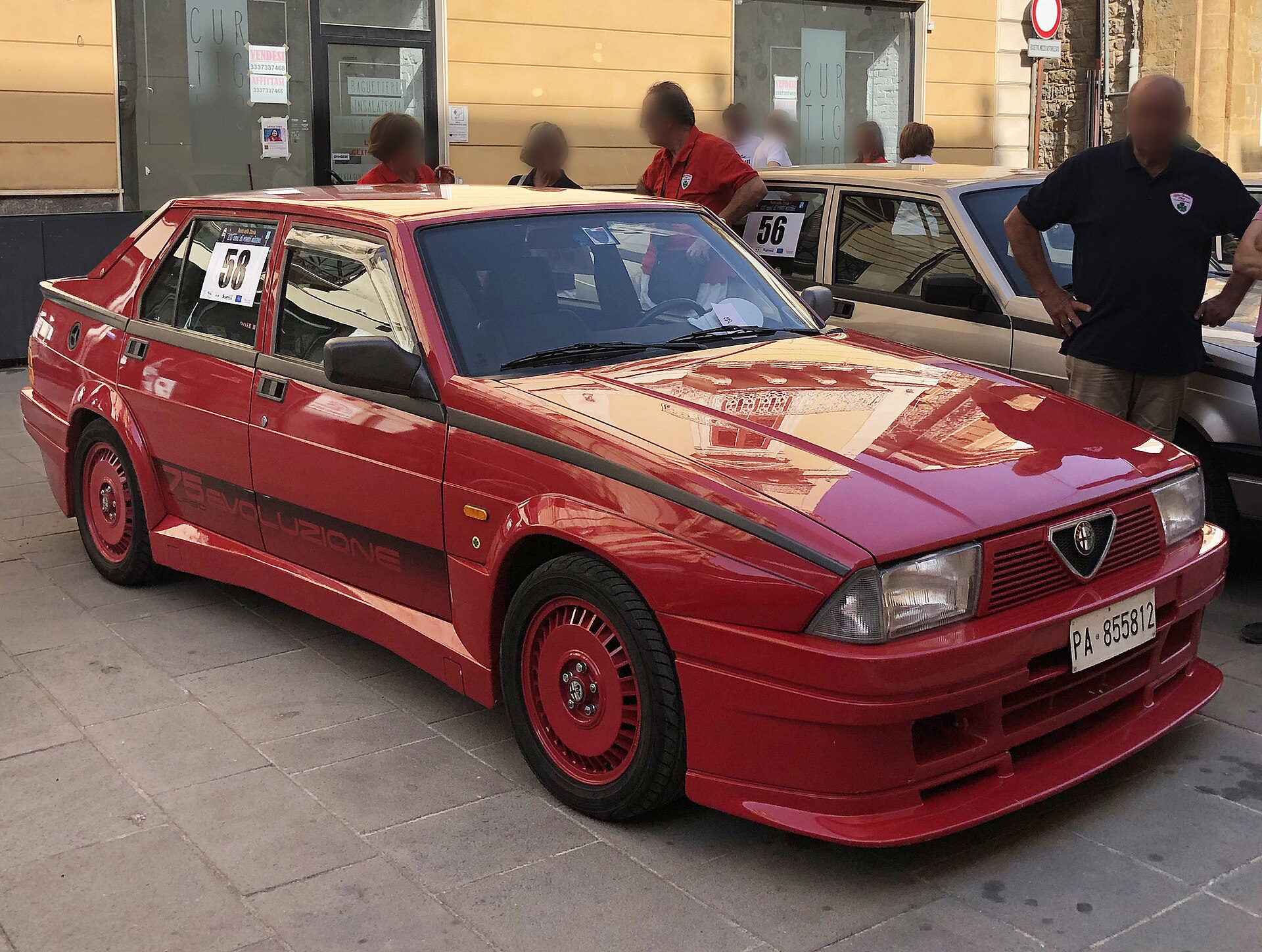
- For rarity: the 1.8 Turbo Evoluzione, one of about 500 homologation cars, nearly all in Italy.
- For economy: the 2.4 TD from 1988, the stronger of the two turbodiesels.
The Alfa Romeo 75 is a compact executive saloon that Alfa Romeo built at Arese, near Milan, from 1985 to 1992. Named after the company's 75th anniversary, it put a wedge-shaped four-door body on a transaxle chassis with the gearbox at the rear, a de Dion rear axle and close to 50:50 weight distribution. It was the last new model Alfa Romeo launched before Fiat took control of the company, and around 386,767 were built.
In short
- Four-door saloon, front engine, rear-wheel drive, built at Arese in Lombardy from May 1985 to 1992; sold in North America as the Milano.
- Engines from the 70 kW (95 PS) 2.0 turbodiesel to the 141 kW (192 PS) 3.0 V6, with a 1.8 Turbo and a 2.0 Twin Spark in between.
- The five-speed gearbox and clutch sit at the back, joined to the differential; a three-speed ZF automatic was offered only on the North American 2.5 V6.
- Predecessor: Giulietta (116). Successor: Alfa Romeo 155.
Alfa Romeo 75 at a glance
| Specification | Alfa Romeo 75 |
|---|---|
| Segment | Compact executive car (D-segment) |
| Production | May 1985 - 1992 |
| Plant | Arese, Lombardy, Italy |
| Designer | Ermanno Cressoni, head of Centro Stile Alfa Romeo |
| Layout | Front engine, rear transaxle, rear-wheel drive |
| Body style | Four-door saloon |
| Type codes | 161 / 162B |
| Length / wheelbase | 4,331 mm / 2,510 mm |
| Power range | 70-141 kW (95-192 PS) |
| Built | about 386,767 (the per-model table adds up to 375,257) |
Other cars of the brand are in our Alfa Romeo catalogue, and the wider world of older models is collected in the classic cars section.
History: an anniversary car on Alfetta foundations
The 75 was launched in May 1985 and named to mark 75 years of Alfa Romeo. Under the skin it continued the mechanical layout of the Alfetta and the GTV6, while the body was new: a sharp wedge that tapers towards the nose, square headlights and a matching grille. Ermanno Cressoni's studio also drew the Alfa Romeo 33, and the two cars share the same visual language.
The car's corporate history is unusually tangled. It was built by Alfa Romeo Auto in 1985 and 1986, by Alfa-Lancia Industriale from 1987 to 1991 and by Fiat Auto in its final year. Alfa Romeo explored an estate version: a prototype was shown in Turin in 1986, and at the 1987 Geneva Motor Show two more appeared, the Turbo Wagon built by Rayton Fissore and a 2.0-litre Sportwagon. None went into production once Fiat was in charge, although the idea later resurfaced as the 156 Sportwagon.
A detail typical of the period is "Alfa Romeo Control", a diagnostic computer in the dashboard that monitored engine systems and warned the driver of faults.

Generations and versions
The 75 had a single generation. What changed over its seven years were the engines: carburettors gave way to fuel injection, the Twin Spark head arrived and the V6 grew from 2.5 to 3.0 litres.
| Generation | Code | Years | Body styles | Engines | Power (kW / hp) |
|---|---|---|---|---|---|
| 75 (launch range) | 161/162B | 1985-1987 | 4-door saloon | 1.6, 1.8, 2.0 carburettor; 2.5 V6; 2.0 TD; 1.8 Turbo from 1986 | 70-115 kW (95-156 PS) |
| 75 (updated range) | 161/162B | 1987-1992 | 4-door saloon | 1.6 IE, 1.8 IE, 2.0 Twin Spark, 1.8 Turbo, 3.0 V6, 2.0 and 2.4 TD | 70-141 kW (95-192 PS) |
| Milano (North America) | 161/162B | 1987-1989 | 4-door saloon | 2.5 V6, 3.0 V6 | 115-138 kW (156-188 PS) |
The main steps were:
- 1986: the 1.8 Turbo joins the range.
- 1987: the 3.0 V6 arrives, and the carburettor 2.0 becomes the fuel-injected 2.0 Twin Spark with variable valve timing.
- 1988: the 1.8 gets fuel injection and a larger 2.4 turbodiesel is added.
- End of 1989: the 1.6 switches to fuel injection.
- 1990: the 1.8 Turbo and 3.0 V6 gain power and revised suspension; the 3.0 moves from L-Jetronic to Motronic injection. The Twin Spark replaces the old 2.0 completely.
Engines, transmissions and performance
| Engine | Displacement | Power | Torque | Introduced |
|---|---|---|---|---|
| 1.6 (carburettor) | 1,570 cc | 81 kW (110 PS) | 146 Nm | 1985 |
| 1.6 IE | 1,570 cc | 77-79 kW (105-107 PS) | 132-137 Nm | 1988-1990 |
| 1.8 (carburettor) | 1,779 cc | 88 kW (120 PS) | 170 Nm | 1985 |
| 1.8 IE | 1,779 cc | 90 kW (122 PS) | 157 Nm | 1988 |
| 1.8 Turbo | 1,779 cc | 114 kW (155 PS) | 226 Nm | 1986 |
| 1.8 Turbo Quadrifoglio Verde | 1,779 cc | 121 kW (165 PS) | 226 Nm | 1990 |
| 2.0 (carburettor) | 1,962 cc | 94 kW (128 PS) | 183 Nm | 1985 |
| 2.0 Twin Spark | 1,962 cc | 109 kW (148 PS) | 186 Nm | 1987 |
| 2.5 V6 | 2,492 cc | 115 kW (156 PS) | 206 Nm | 1985 |
| 3.0 V6 America | 2,959 cc | 138 kW (188 PS) | 250 Nm | 1987 |
| 3.0 V6 QV | 2,959 cc | 141 kW (192 PS) | 250 Nm | 1990 |
| 2.0 TD | 1,995 cc | 70 kW (95 PS) | 192 Nm | 1985 |
| 2.4 TD | 2,393 cc | 82 kW (112 PS) | 235 Nm | 1988 |
The 3.0 V6 is the 2.5 bored out to 2,959 cc. The 2.0 TD was sold only in left-hand-drive markets.
The drivetrain is what makes the 75 unusual. The engine sits at the front, but the five-speed gearbox and the clutch are mounted at the rear in one unit with the differential. The propshaft therefore turns at engine speed, and it is split into two sections joined by elastomeric "doughnut" couplings that damp vibration. The rear brake discs sit inboard, next to the transaxle. The front suspension uses torsion bars, the rear a de Dion tube. The 2.0 Twin Spark and the 3.0 V6 came with a limited-slip differential.
Taxation shaped the range. In many countries the 1.8 Turbo outsold the V6 because its smaller displacement was taxed less, yet the Turbo was never offered in the United States.

The Turbo Evoluzione and the V6 models
To homologate the car for Group A racing, Alfa Romeo built about 500 75 Turbo Evoluzione in spring 1987. Their engine was bored down from 1,779 to 1,762 cc to keep it out of the Class 1 category, while the claimed 114 kW (155 PS) stayed the same; the thicker cylinder walls also suited tuning. All 500 were left-hand drive and most stayed in Italy.
The 2.5 V6, called 2.5 QV in Europe, was officially sold from 1985 to 1987 and found only about 2,800 European buyers. Its 3.0 replacement first came as the "America" with 138 kW (188 PS), a name shared by European cars with the US-style bumpers. The 1990 3.0 V6 QV, sometimes called "Potenziata", raised output to 141 kW (192 PS).

Dimensions, space and boot
| Parameter | Metric | Imperial |
|---|---|---|
| Length | 4,331 mm | 170.5 in |
| Width | 1,631 mm | 64.2 in |
| Height | 1,349 mm | 53.1 in |
| Wheelbase | 2,510 mm | 98.8 in |
| Kerb weight | 1,100-1,300 kg | 2,425-2,866 lb |
| Boot (Europe) | 500 l | 17.7 cu ft |
| Boot (North America) | 390 l | 13.8 cu ft |
| Fuel tank (North America) | 67 l | 17.7 US gal |
With 500 litres in European form, the boot is generous for a saloon of this length. North American cars lost 110 litres because their 67-litre fuel tank was moved behind the rear seats.
Running costs
Our sources do not give official fuel consumption figures for the 75, so we do not quote any. What shaped running costs in period was engine size: buyers in countries with displacement-based taxes chose the 1.8 Turbo over the V6, and the turbodiesels offered the lowest fuel bills. For a modern estimate of what a given engine costs per year, our fuel cost calculator works with your own consumption figure.
Trims and equipment
European equipment was sparse by today's standards: electric mirrors, power-reclining seats and cruise control were usually options. North American Milanos came in Silver, Gold, Platinum and Verde trims, with electric rear windows and air conditioning as standard, instruments in mph, psi and degrees Fahrenheit, and a seatbelt warning in the Alfa Romeo Control panel.
The US cars also had heavier "America" bumpers with rubber accordion extensions, mounted on shock absorbers, plus side markers, a right-hand exhaust exit and reinforced doors, bonnet and boot lid. Some of these North American-spec cars were sold in Switzerland after catalytic converters became mandatory there in 1987.

Safety
The 75 predates Euro NCAP, which began testing in 1997, so there is no crash-test rating. Our sources give no airbag or crash data; the only safety-related structural changes they mention are the door, bonnet and boot reinforcements and the shock-absorbing bumpers of North American cars.
Reliability and known issues
Our sources do not list model-specific faults, so we do not repeat forum lore here. The design points worth checking on any surviving car follow from the layout: the propshaft with its rubber couplings, the inboard rear brakes next to the transaxle and the rear-mounted gearbox and clutch, which are harder to reach than on a conventional saloon.
Motorsport
Alfa Corse entered six Group A 75s in the 1987 World Touring Car Championship with drivers including Jacques Laffite, Nicola Larini and Gabriele Tarquini, but success was limited. Gianfranco Brancatelli won the 1988 ITC series in a 75 Turbo, and a 75 Turbo Evoluzione IMSA won the Giro d'Italia automobilistico in 1988 and 1989.
Rivals
| Model | Engines | Power (kW / hp) | Boot (l) | Price from (EUR) |
|---|---|---|---|---|
| Alfa Romeo 75 (1985-1992) | 1.6-3.0 petrol, 2.0-2.4 turbodiesel | 70-141 kW (95-192 PS) | 500 | - |
| BMW 3 Series E30 (1982-1994) | 1.6-2.7 petrol, 2.4 diesel | 55-175 kW (75-238 PS) | - | - |
| Mercedes-Benz 190 W201 (1983-1993) | petrol, 2.0-2.5 diesel | 53-173 kW (72-235 PS) | - | - |
New prices from the period are not comparable with today's money, so the price column is left empty. To line up the 75 against other saloons, use our comparison tool.
Photo gallery


Alfa Romeo 75 in our rankings
- No. 100 of 174 · Most powerful sedans (141 kW · top 59%)
- No. 599 of 1082 · Longest-running car nameplates (7 years · top 61%)
- No. 702 of 1011 · Most powerful cars (141 kW · top 70%)
- No. 121 of 146 · Most powerful Italian cars (141 kW · top 83%)
More powerful than 41% of ranked sedans in the 1CARS catalog (No. 100 of 174).
FAQ
How many Alfa Romeo 75s were built?
About 386,767 by the end of production in 1992, although the per-model production table adds up to 375,257.
Is the Alfa Romeo 75 rear-wheel drive?
Yes. The engine is at the front, and the gearbox, clutch and differential form one transaxle unit at the rear, driving the rear wheels.
What was the Alfa Romeo 75 called in the USA?
The Milano. North America received only the 2.5 and 3.0 V6 versions, sold from 1987 to 1989.
Which is the most powerful Alfa Romeo 75?
The 1990 3.0 V6 QV with Motronic injection, at 141 kW (192 PS) and 250 Nm.
What replaced the Alfa Romeo 75?
The Alfa Romeo 155, which switched to front-wheel drive.
Data sources
Data checked by an editor against the sources below.